
This Charleston word search offers an engaging way to explore West Virginia‘s capital city through 24 carefully selected words that showcase its rich heritage, notable figures, and cultural landmarks. As the Mountain State’s governmental center and largest city, Charleston has played a pivotal role in shaping Appalachian history and continues to serve as the region’s economic and political hub.
Located where the Elk and Kanawha Rivers meet, Charleston sits nestled among rolling hills in the heart of West Virginia. The city became the state’s permanent capital in 1885, though it had previously held that distinction twice before. With approximately 48,000 residents in the city proper and over 210,000 in the metropolitan area, Charleston represents the state’s most populous urban center. The iconic gold-domed State Capitol, completed in 1932, towers impressively over the riverfront and serves as the seat of state government.
Charleston’s development was driven by abundant natural resources, particularly coal, which fueled chemical manufacturing, glass production, and railroad expansion. These industries attracted workers and businesses, transforming Charleston into West Virginia’s industrial and commercial powerhouse. Today, the city balances its industrial legacy with modern healthcare, education, and cultural institutions.
This Charleston word search printable provides more than just entertainment. Each word includes a detailed 20-30-word definition, making this word search printable highly educational. You’ll also discover a helpful FAQ section and fascinating “Did You Know?” facts—including the surprising detail that Charleston’s Capitol dome stands taller than Washington D.C.’s famous dome!
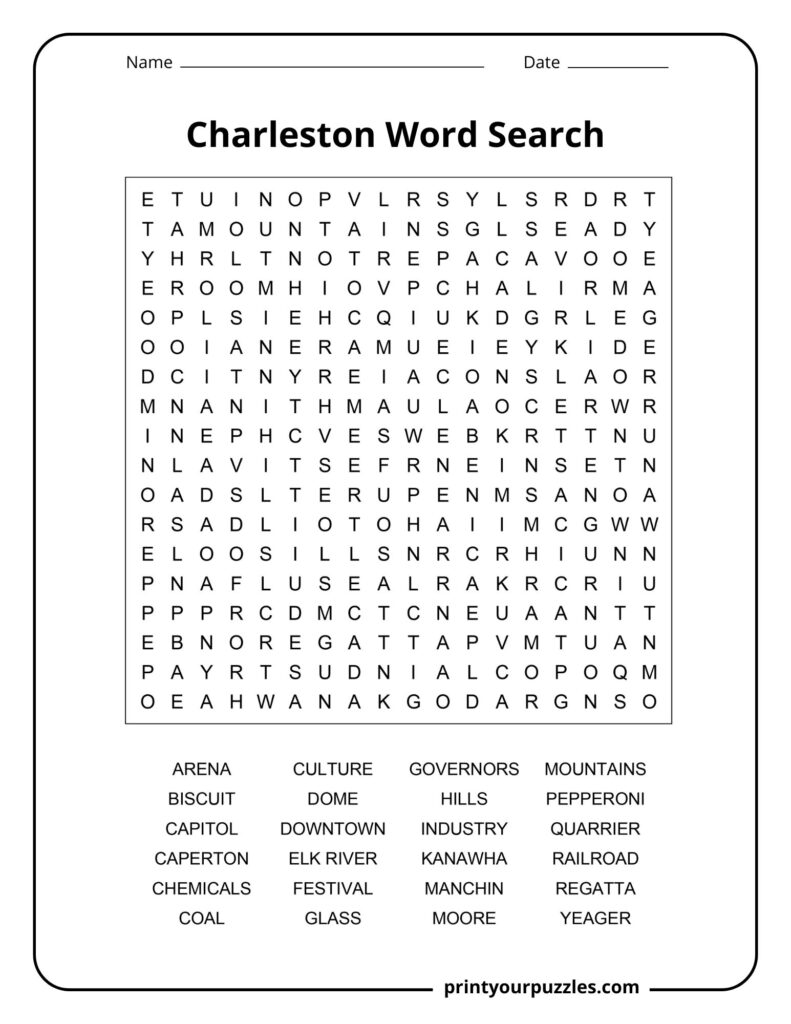
ARENA, BISCUIT, CAPITOL, CAPERTON, CHEMICALS, COAL, CULTURE, DOME, DOWNTOWN, ELK RIVER, FESTIVAL, GLASS, GOVERNORS, HILLS, INDUSTRY, KANAWHA, MANCHIN, MOORE, MOUNTAINS, PEPPERONI, QUARRIER, RAILROAD, REGATTA, YEAGER
ARENA – The Charleston Coliseum & Convention Center, a multi-purpose venue hosting sports events, concerts, and conventions, serving as a major entertainment hub for the capital city.
BISCUIT – Reference to Tudor’s Biscuit World, a beloved West Virginia fast-food chain founded in Charleston, famous for made-from-scratch biscuits and becoming a state culinary institution.
CAPITOL – The West Virginia State Capitol building, completed in 1932, serves as the seat of state government and features one of America’s most magnificent gold-domed structures.
CAPERTON – Gaston Caperton served as West Virginia’s governor from 1989-1997, implementing education reforms and later becoming president of the College Board, bringing national recognition to Charleston.
CHEMICALS – Charleston’s economy historically relied heavily on chemical manufacturing along the Kanawha River valley, with major plants producing plastics, polymers, and industrial chemicals for decades.
COAL – Coal mining shaped Charleston’s development and economy, making the city a central hub for the coal industry’s business operations, transportation, and political influence throughout Appalachia.
CULTURE – Charleston offers diverse cultural attractions including theaters, museums, the West Virginia Symphony Orchestra, and annual festivals celebrating Appalachian heritage, arts, and community traditions.
DOME – The State Capitol’s distinctive gold-leafed dome rises 293 feet, making it taller than the U.S. Capitol dome and serving as Charleston’s most iconic architectural landmark.
DOWNTOWN – Charleston’s downtown district features historic buildings, state government offices, shops, restaurants, and the bustling Capitol Street, serving as the city’s commercial and governmental heart.
ELK RIVER – The Elk River flows through Charleston, joining the Kanawha River downtown, and has historically provided water resources for industry while offering recreational opportunities for residents.
FESTIVAL – Charleston hosts numerous annual festivals including the Sternwheel Regatta, FestivALL, and various cultural celebrations that bring the community together with music, food, and entertainment.
GLASS – Glass manufacturing represents an important part of Charleston’s industrial heritage, with companies producing containers, specialty glass, and artistic pieces contributing to the region’s economy.
GOVERNORS – Charleston, as West Virginia’s capital, has been home to numerous governors who shaped state policy, including notable leaders like Caperton, Manchin, and Arch Moore.
HILLS – Charleston sits nestled among rolling Appalachian hills
that define the city’s topography, creating scenic views, challenging terrain, and a distinctive geographic character throughout neighborhoods.
INDUSTRY – Charleston’s industrial base includes chemical manufacturing, glass production, coal operations, and government services, making it West Virginia’s primary economic and commercial center for generations.
KANAWHA – The Kanawha River flows through Charleston’s center, historically enabling transportation and industry while giving its name to the county, creating the city’s geographic foundation.
MANCHIN – Joe Manchin served as Charleston’s mayor, West Virginia’s governor, and currently represents the state as U.S. Senator, becoming one of its most prominent political figures.
MOORE – Arch Moore served multiple terms as West Virginia’s governor, significantly influencing Charleston’s development and state politics during the latter twentieth century despite later legal troubles.
MOUNTAINS – The Appalachian Mountains surround Charleston, defining the region’s beauty, culture, and identity while influencing everything from climate to transportation and outdoor recreation opportunities available.
PEPPERONI – Pepperoni rolls, a West Virginia invention, are
beloved snacks featuring pepperoni baked inside soft bread, created for coal miners and now a staple food identity.
QUARRIER – Quarrier Street runs through downtown Charleston as a major thoroughfare, named after early settler families and hosting businesses, offices, and institutions central to city life.
RAILROAD – Railroads transformed Charleston into a transportation hub, moving coal and chemicals while connecting the city to national markets, fundamentally shaping its industrial growth and prosperity.
REGATTA – The Sternwheel Regatta is Charleston’s premier annual festival celebrating the city’s river heritage with races, entertainment, fireworks, and family activities along the Kanawha riverfront.
YEAGER – Yeager Airport, named for test pilot Chuck Yeager who grew up nearby, serves as Charleston’s commercial airport, connecting West Virginia’s capital to destinations nationwide.
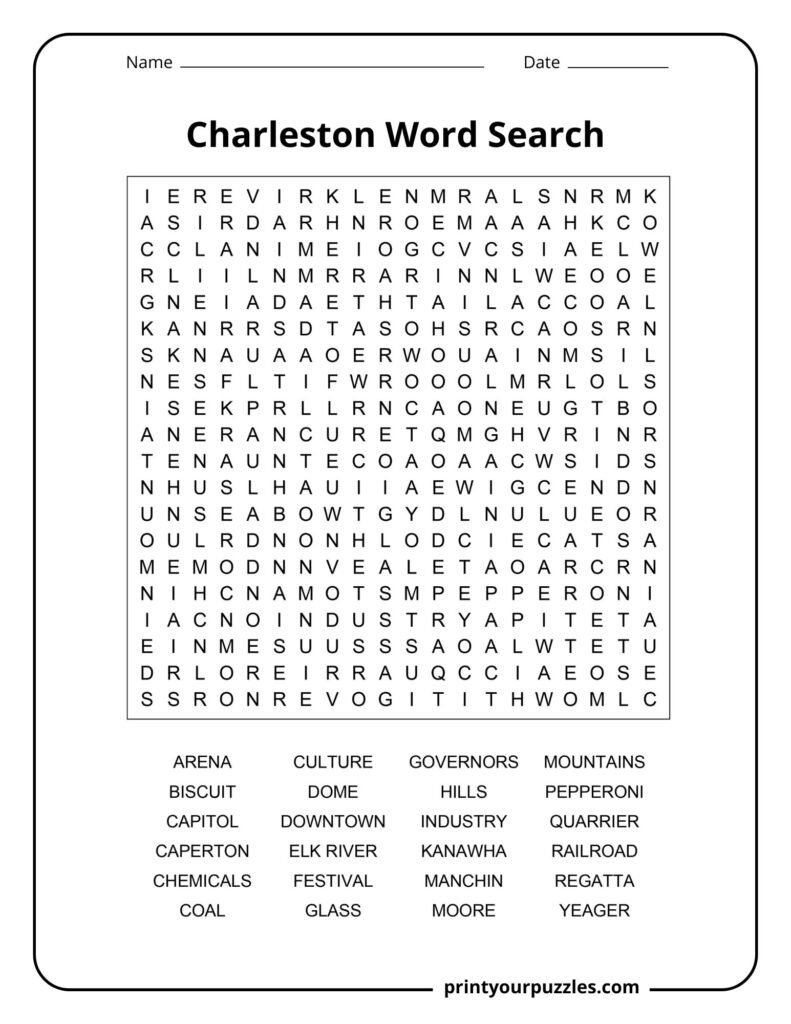
ARENA, BISCUIT, CAPITOL, CAPERTON, CHEMICALS, COAL, CULTURE, DOME, DOWNTOWN, ELK RIVER, FESTIVAL, GLASS, GOVERNORS, HILLS, INDUSTRY, KANAWHA, MANCHIN, MOORE, MOUNTAINS, PEPPERONI, QUARRIER, RAILROAD, REGATTA, YEAGER
Charleston is known for being West Virginia’s capital city, featuring the iconic gold-domed State Capitol, a rich coal and chemical industry heritage, and serving as the state’s political and economic center.
Charleston has approximately 48,000 residents within city limits, making it West Virginia’s largest city, while the greater metropolitan area includes roughly 210,000 people across the Kanawha Valley region.
Top attractions include the State Capitol building with its gold dome, the Clay Center for Arts and Sciences, Capitol Market, the West Virginia State Museum, and the scenic Kanawha River waterfront area.
Charleston experiences a humid subtropical climate with four distinct seasons: warm, humid summers averaging 85°F, cold winters with occasional snow, and beautiful spring and fall seasons ideal for outdoor activities.
Charleston’s economy centers on state government, healthcare systems, chemical manufacturing, natural gas, education, and professional services, transitioning from its historical dependence on coal and heavy industrial production.
For official city information, government updates, and public services, visit the City of Charleston website. If you are planning a trip, check out the official tourism portal, Visit Charleston.
The gold-leafed dome rises 293 feet high, standing five feet taller than the nation’s Capitol. Designed by architect Cass Gilbert, it’s one of America’s most impressive state buildings.
Created in the 1920s for coal miners needing portable lunches, pepperoni rolls became West Virginia’s unofficial state food, now enjoyed throughout Charleston’s bakeries and convenience stores statewide.
The Hollywood star frequently speaks fondly of her Charleston childhood, maintaining strong ties to West Virginia and supporting various charitable causes throughout her home state’s communities.
Originally designated capital in 1870, it lost the title to Wheeling in 1875, regained it in 1885, and has remained the permanent capital ever since then.
At its peak, the valley housed numerous major chemical manufacturers, producing everything from plastics to synthetic rubber, making Charleston a significant contributor to America’s industrial chemical production.