
The Chemical Elements word search offers an engaging and educational activity for students, science enthusiasts, and puzzle lovers of all ages. This interactive challenge combines the fun of word puzzles with the fascinating world of chemistry, helping players familiarize themselves with essential terminology from the periodic table.
This Chemical Elements word search printable features 24 carefully selected words, each related to elements, atomic particles, and chemical concepts. The puzzle includes a diverse range of terms, from common elements like gold, iron, and carbon to more exotic ones such as berkelium, neptunium, and americium. All words are presented in capital letters and arranged in various directions within the grid, providing an appropriate level of challenge.
What makes this word search printable particularly valuable is that each term comes with a comprehensive 20-30 word definition, ensuring that players not only find the words but also understand their meanings and significance in chemistry. This educational approach transforms a simple puzzle into a powerful learning tool, reinforcing knowledge about chemical elements while developing pattern recognition and vocabulary skills. Perfect for classroom activities, homework assignments, or leisure learning.
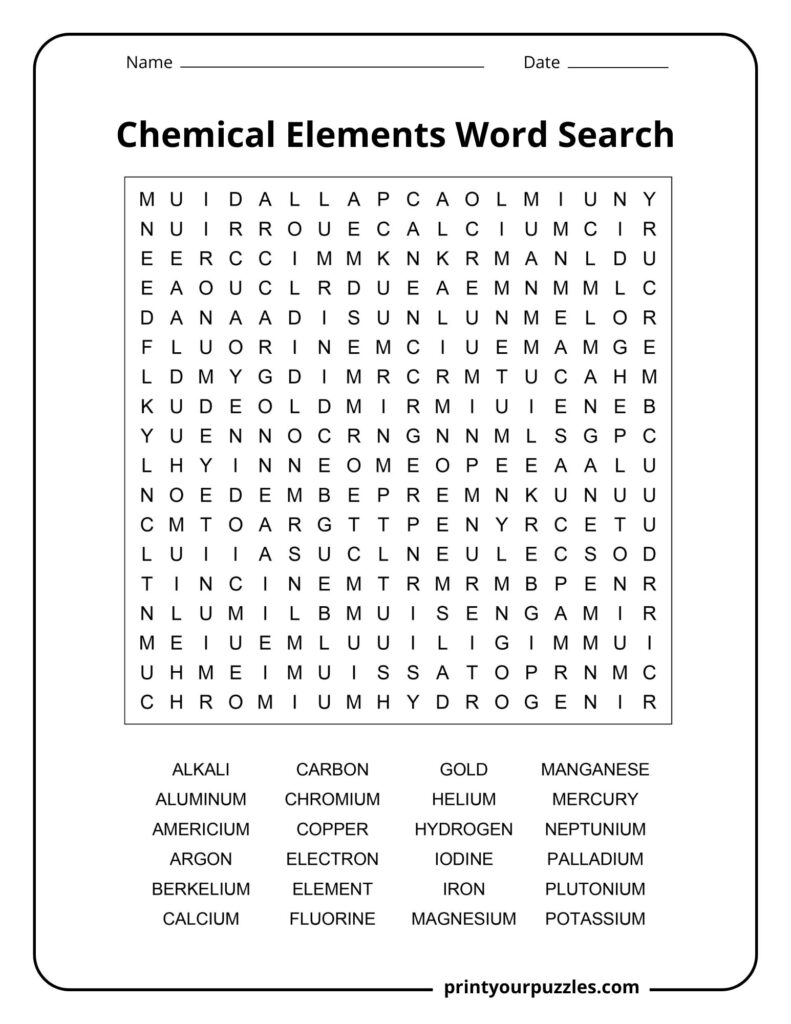
ALKALI, ALUMINUM, AMERICIUM, ARGON, BERKELIUM, CALCIUM, CARBON, CHROMIUM, COPPER, ELECTRON, ELEMENT, FLUORINE, GOLD, HELIUM, HYDROGEN, IODINE, IRON, MAGNESIUM, MANGANESE, MERCURY, NEPTUNIUM, PALLADIUM, PLUTONIUM, POTASSIUM
ALKALI – A group of highly reactive metallic elements including lithium, sodium, and potassium that form strongly basic hydroxides when combined with water and are found in Group 1.
ALUMINUM – A lightweight, silvery-white metallic element with symbol Al and atomic number 13, widely used in construction, packaging, and transportation due to its corrosion resistance and malleability.
AMERICIUM – A synthetic radioactive element with symbol Am and atomic number 95, produced in nuclear reactors, commonly used in smoke detectors and as a portable source of gamma rays.
ARGON – A colorless, odorless noble gas with symbol Ar and atomic number 18, making up about one percent of Earth’s atmosphere, used in welding and light bulbs.
BERKELIUM – A synthetic radioactive element with symbol Bk and atomic number 97, named after Berkeley, California, where it was first synthesized in 1949 by Glenn Seaborg’s team.
CALCIUM – A soft, silvery-white metallic element with symbol Ca and atomic number 20, essential for strong bones and teeth, and vital for muscle function and nerve transmission.
CARBON – A versatile nonmetallic element with symbol C and atomic number 6, forming the basis of all organic life, existing as diamond, graphite, and fullerenes naturally.
CHROMIUM – A hard, lustrous metallic element with symbol Cr and atomic number 24, used primarily in stainless steel production and chrome plating for its resistance to corrosion and tarnishing.
COPPER – A reddish-brown metallic element with symbol Cu and atomic number 29, excellent electrical conductor used extensively in wiring, plumbing, and coinage throughout human history.
ELECTRON – A subatomic particle with negative electric charge that orbits the nucleus of an atom, fundamental to electricity, chemical bonding, and responsible for an element’s chemical properties.
ELEMENT – A pure chemical substance consisting of one type of atom, distinguished by its atomic number, that cannot be broken down into simpler substances by ordinary chemical means.
FLUORINE – A highly reactive, pale yellow gaseous element with symbol F and atomic number 9, the most electronegative element, used in toothpaste and Teflon production.
GOLD – A precious, dense, yellow metallic element with symbol Au and atomic number 79, highly valued for jewelry, resistant to corrosion, and used in electronics and dentistry.
HELIUM – A colorless, odorless noble gas with symbol He and atomic number 2, second lightest element, used in balloons, diving equipment, and cryogenics for cooling.
HYDROGEN – The lightest and most abundant element in the universe with symbol H and atomic number 1, a colorless gas forming water when combined with oxygen.
IODINE – A purple-black solid nonmetallic element with symbol I and atomic number 53, essential for thyroid function, used as disinfectant and in medical imaging procedures.
IRON – A strong, magnetic metallic element with symbol Fe and atomic number 26, most commonly used metal, essential for hemoglobin production and widely used in construction.
MAGNESIUM – A lightweight, silvery-white metallic element with symbol Mg and atomic number 12, burns with brilliant white light, essential for chlorophyll and hundreds of enzymatic reactions.
MANGANESE – A hard, brittle, grayish metallic element with symbol Mn and atomic number 25, essential for steel production, important nutrient for metabolism and bone development.
MERCURY – The only metallic element that is liquid at room temperature, with symbol Hg and atomic number 80, silver colored, used in thermometers, though toxic.
NEPTUNIUM – A silvery radioactive metallic element with symbol Np and atomic number 93, the first transuranium element discovered, produced in nuclear reactors as uranium byproduct.
PALLADIUM – A rare, lustrous silvery-white metallic element with symbol Pd and atomic number 46, used in catalytic converters, electronics, dentistry, and as a catalyst in chemistry.
PLUTONIUM – A dense, silvery radioactive metallic element with symbol Pu and atomic number 94, used in nuclear weapons and reactors, extremely toxic and long-lived radioactive material.
POTASSIUM – A soft, silvery-white alkali metal with symbol K and atomic number 19, highly reactive with water, essential for nerve function, muscle contraction, and heart health.
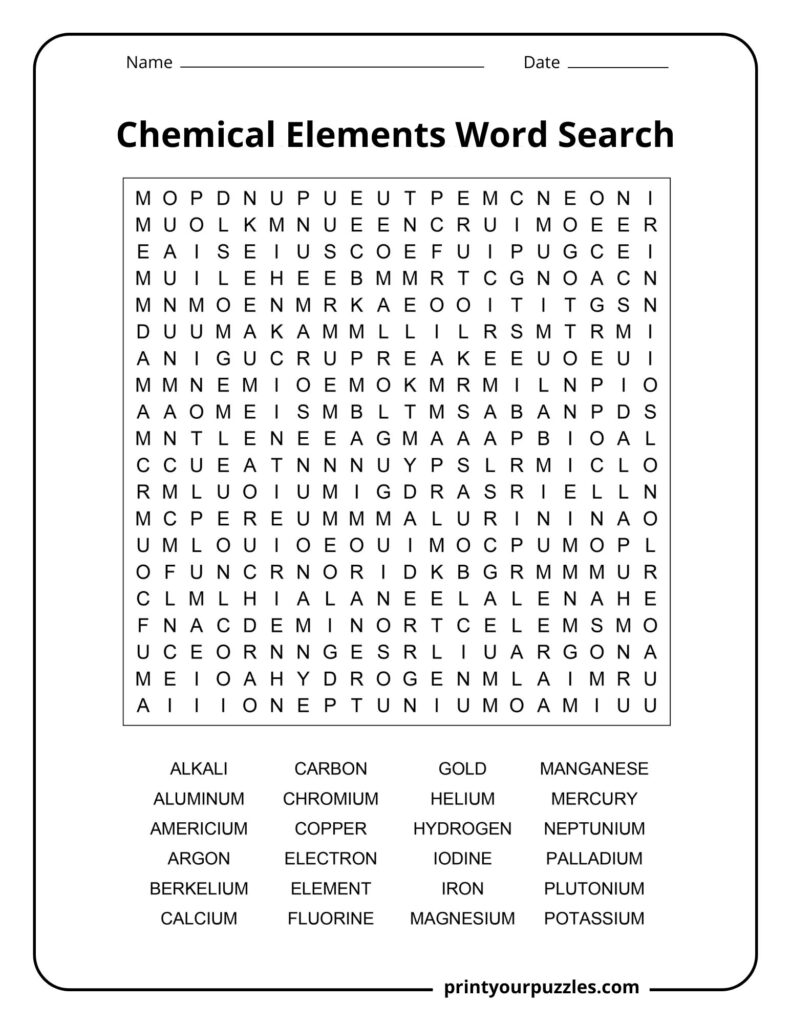
ALKALI, ALUMINUM, AMERICIUM, ARGON, BERKELIUM, CALCIUM, CARBON, CHROMIUM, COPPER, ELECTRON, ELEMENT, FLUORINE, GOLD, HELIUM, HYDROGEN, IODINE, IRON, MAGNESIUM, MANGANESE, MERCURY, NEPTUNIUM, PALLADIUM, PLUTONIUM, POTASSIUM
A chemical element is a pure substance consisting of only one type of atom, identified by its atomic number, that cannot be broken down into simpler substances through chemical reactions.
There are currently 118 confirmed chemical elements on the periodic table, including 94 naturally occurring elements and 24 synthetic elements created in laboratories through nuclear reactions.
Natural elements exist in nature and can be found on Earth or in space, while synthetic elements are artificially created in laboratories through nuclear reactions and are typically radioactive.
The periodic table is an organized chart arranging all chemical elements by increasing atomic number, grouped by similar chemical properties and electron configurations into rows called periods and columns called groups.
Hydrogen is the most abundant element, comprising about 75% of the universe’s mass, followed by helium at approximately 23%, with all other elements making up the remaining 2%.
Gallium is a metallic element with a melting point of only 29.76°C (85.57°F), meaning it liquefies from body heat when held, though it’s non-toxic and safe to touch briefly.
Gold is chemically inert and non-toxic, making it safe to consume. Edible gold leaf is used to decorate luxury desserts, chocolates, and drinks, passing harmlessly through the digestive system.
Ytterby, a small village in Sweden, inspired the names of four elements: yttrium, ytterbium, terbium, and erbium, discovered in minerals from its nearby quarry during the 18th and 19th centuries.
Osmium has a density of 22.59 grams per cubic centimeter, making it twice as dense as lead. A basketball-sized sphere of osmium would weigh approximately 1,000 pounds.
Mercury and bromine are the only elements that exist as liquids under standard conditions, with mercury being a silvery metal and bromine a reddish-brown, corrosive non-metal halogen.
Purus ut praesent facilisi dictumst sollicitudin cubilia ridiculus.