
This Cinco de Mayo word search offers an engaging and educational way to explore the rich history and vibrant culture surrounding this important Mexican celebration. Perfect for classrooms, family gatherings, or festive parties, this puzzle combines entertainment with learning, making it ideal for all ages.
Our Cinco de Mayo word search printable features 24 carefully selected words that capture the essence of May 5th celebrations, from historic elements like Battle, Puebla, and Army to cultural traditions including Mariachi, Fiesta, and Folkloric dances. Each word represents meaningful aspects of Mexican heritage, cuisine, and the historic victory that inspired this holiday.
What makes this word search printable truly special is that every single word included in the puzzle comes with a detailed definition of 20-30 words. These comprehensive explanations help participants understand not just what they’re searching for, but why each term matters to Cinco de Mayo celebrations. Students and puzzle enthusiasts can learn about Mexican culture, history, and traditions while enjoying the challenge of finding hidden words.
Whether you’re teaching about cultural diversity, planning a themed party, or simply enjoying a meaningful activity, this word search delivers both fun and educational value in one convenient package.
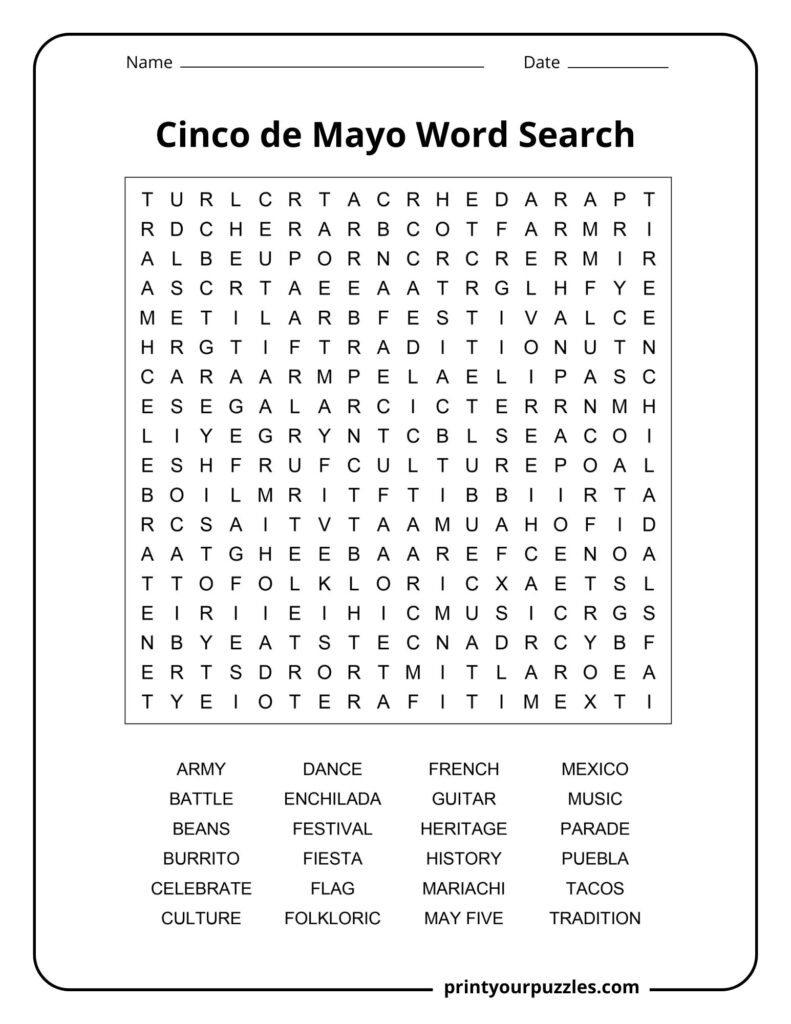
ARMY, BATTLE, BEANS, BURRITO, CELEBRATE, CULTURE, DANCE, ENCHILADA, FESTIVAL, FIESTA, FLAG, FOLKLORIC, FRENCH, GUITAR, HERITAGE, HISTORY, MARIACHI, MAY FIVE, MEXICO, MUSIC, PARADE, PUEBLA, TACOS, TRADITION
ARMY – Military forces organized for combat. On Cinco de Mayo, refers to the Mexican army that defended against French invasion at the Battle of Puebla in 1862.
BATTLE – A military engagement between opposing forces. The Battle of Puebla on May 5, 1862, was the decisive confrontation where Mexican forces defeated the French army unexpectedly.
BEANS – Legumes that are a staple in Mexican cuisine, often served refried or whole. Black beans and pinto beans are commonly featured in traditional celebrations and meals.
BURRITO – A Mexican dish consisting of a flour tortilla wrapped around various fillings like beans, rice, meat, and cheese. Popular food enjoyed during Cinco de Mayo festivities.
CELEBRATE – To observe a significant occasion with festivities and joy. Cinco de Mayo celebrates Mexican heritage, culture, and the victory over French forces at the Battle of Puebla.
CULTURE – The customs, arts, social institutions, and achievements of a particular nation or people. Cinco de Mayo honors Mexican culture through music, dance, food, and traditional celebrations.
DANCE – Rhythmic movement to music, often expressing cultural traditions. Mexican folk dances like Jarabe Tapatío and Ballet Folklórico are performed during Cinco de Mayo celebrations nationwide.
ENCHILADA – A Mexican dish featuring corn tortillas rolled around filling and covered with chili sauce. Traditional food often served at Cinco de Mayo parties and restaurant celebrations.
FESTIVAL – A celebration featuring entertainment, cultural activities, and community gathering. Cinco de Mayo festivals include parades, music performances, traditional dancing, and authentic Mexican food offerings.
FIESTA – Spanish word meaning party or celebration. Represents the festive spirit of Cinco de Mayo with colorful decorations, lively music, dancing, and communal gathering for enjoyment.
FLAG – National banner of Mexico featuring green, white, and red vertical stripes with an eagle emblem. Proudly displayed during Cinco de Mayo to represent Mexican national pride.
FOLKLORIC – Relating to traditional customs, stories, music, and dances of a culture. Ballet Folklórico performances showcase regional Mexican dances during Cinco de Mayo celebrations with colorful costumes.
FRENCH – Pertaining to France or its people. The French army invaded Mexico in 1862, leading to the Battle of Puebla commemorated on Cinco de Mayo annually.
GUITAR – String instrument central to Mexican music traditions. Acoustic and classical guitars feature prominently in mariachi bands and conjunto music played during Cinco de Mayo celebrations.
HERITAGE – Cultural traditions, history, and legacy passed down through generations. Cinco de Mayo celebrates Mexican heritage, encouraging pride in ancestry, history, and cultural contributions to society.
HISTORY – Record of past events and their significance. Cinco de Mayo commemorates the historical Battle of Puebla victory, reminding people of Mexican resilience and courage against invasion.
MARIACHI – Traditional Mexican musical ensemble featuring violins, trumpets, guitars, and vocalists wearing charro outfits. Mariachi bands are iconic features of Cinco de Mayo celebrations and Mexican culture.
MAY FIVE – The fifth day of May, the date when Mexican forces defeated the French army at Puebla in 1862, creating the holiday celebrated as Cinco de Mayo.
MEXICO – North American country with rich cultural heritage and history. Cinco de Mayo honors Mexico’s victory over French forces and celebrates Mexican culture, traditions, and national pride.
MUSIC – Organized sound expressing culture and emotion. Traditional Mexican music including mariachi, ranchera, and regional folk songs are performed during Cinco de Mayo celebrations to honor heritage.
PARADE – Public procession celebrating an event with marching bands, floats, and performers. Cinco de Mayo parades feature colorful displays, traditional dancers, music, and community participation nationwide.
PUEBLA – Mexican city where the historic Battle of Puebla occurred on May 5, 1862. General Ignacio Zaragoza led Mexican forces to unexpected victory over French troops there.
TACOS – Traditional Mexican dish with folded tortillas filled with meat, vegetables, and toppings. Popular food served at Cinco de Mayo celebrations, representing authentic Mexican culinary traditions.
TRADITION – Customs and practices passed through generations within a culture. Cinco de Mayo traditions include folk dancing, authentic cuisine, mariachi music, and family gatherings celebrating Mexican heritage.
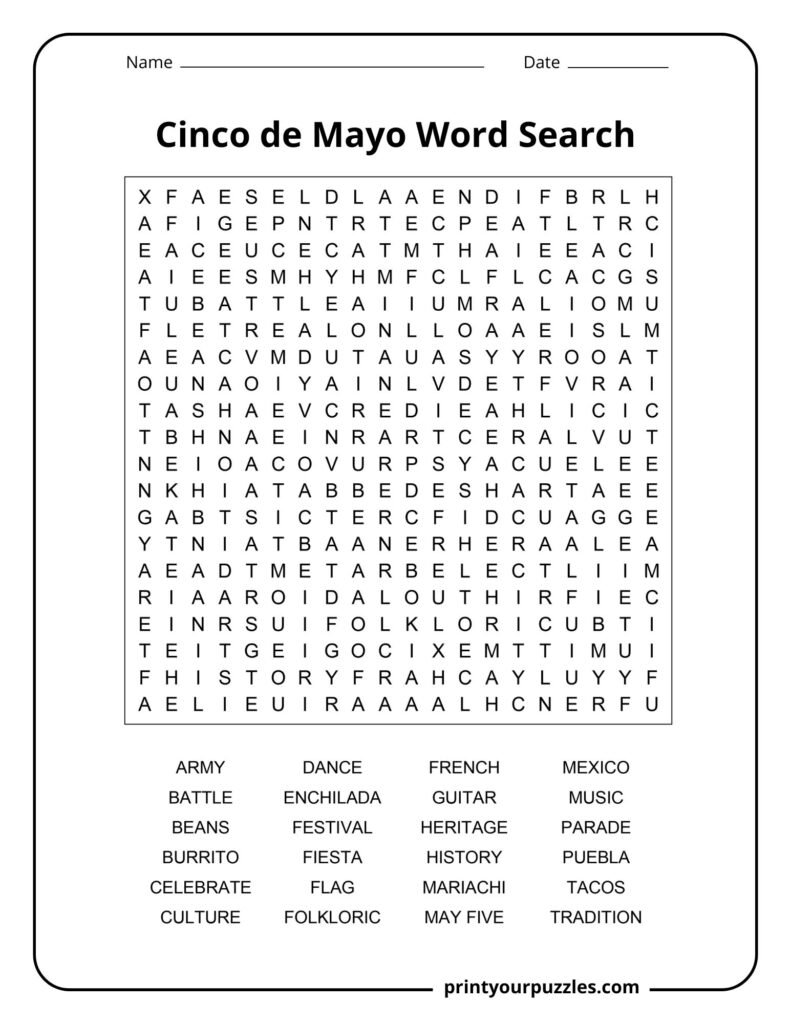
ARMY, BATTLE, BEANS, BURRITO, CELEBRATE, CULTURE, DANCE, ENCHILADA, FESTIVAL, FIESTA, FLAG, FOLKLORIC, FRENCH, GUITAR, HERITAGE, HISTORY, MARIACHI, MAY FIVE, MEXICO, MUSIC, PARADE, PUEBLA, TACOS, TRADITION
Cinco de Mayo commemorates the Mexican army’s victory over France at the Battle of Puebla on May 5, 1862. It celebrates Mexican culture, heritage, and resilience.
No, Cinco de Mayo is not Mexico’s Independence Day. Mexican Independence Day is September 16, celebrating independence from Spain in 1810, a completely different historical event.
The holiday honors the unexpected victory when outnumbered Mexican forces defeated the powerful French army at Puebla, demonstrating courage and unity against foreign invasion and oppression.
While observed in Puebla, Mexico, Cinco de Mayo is celebrated more extensively in the United States, particularly where Mexican-American communities honor their heritage through festivals and cultural events.
On May 5, 1862, approximately 4,000 Mexican soldiers led by General Ignacio Zaragoza defeated 8,000 well-equipped French troops, achieving an improbable victory that boosted national morale.
In Mexico, it’s primarily observed in Puebla. American celebrations grew significantly during the 1960s Chicano movement, becoming a widespread cultural celebration of Mexican-American heritage nationwide.
The French defeat delayed potential European support for the Confederacy. France’s weakened position prevented interference in American affairs, possibly helping preserve the Union’s ultimate victory.
France returned with reinforcements, occupying Mexico and installing Maximilian I as emperor in 1864. However, French forces withdrew in 1867, and Mexico regained independence.
This complex sauce, combining chilies with chocolate, represents Puebla’s culinary heritage. It’s traditionally served during Cinco de Mayo celebrations, honoring the battle city’s gastronomic contributions.
President Franklin Roosevelt’s 1930s-1940s initiative promoting Pan-American friendship encouraged celebrating Latin American holidays, laying groundwork for Cinco de Mayo’s widespread American adoption and commercial growth.
Purus ut praesent facilisi dictumst sollicitudin cubilia ridiculus.