
This Declaration of Independence word search offers an engaging and educational way to explore America’s founding document while reinforcing essential historical vocabulary. Perfect for students, teachers, and history enthusiasts, this interactive puzzle challenges participants to locate twenty-four carefully selected terms related to the Declaration’s creation, signers, and revolutionary principles.
Each word in the puzzle connects directly to the historic events of 1776, from key figures like Jefferson, Franklin, and Hancock to fundamental concepts like liberty, equality, and freedom. The Declaration of Independence word search printable includes words ranging from simple terms like “July” and “King” to more complex vocabulary such as “grievance” and “parchment,” providing appropriate challenges for various skill levels.
What makes this word search printable particularly valuable for learning is that every term is thoroughly defined with clear, concise explanations. These definitions help users understand not just the words themselves but their historical significance and connection to American independence. Whether used in classrooms, homeschool settings, or for personal enrichment, this puzzle combines entertainment with education, making the study of America’s founding both accessible and enjoyable while deepening comprehension of this pivotal moment in history.
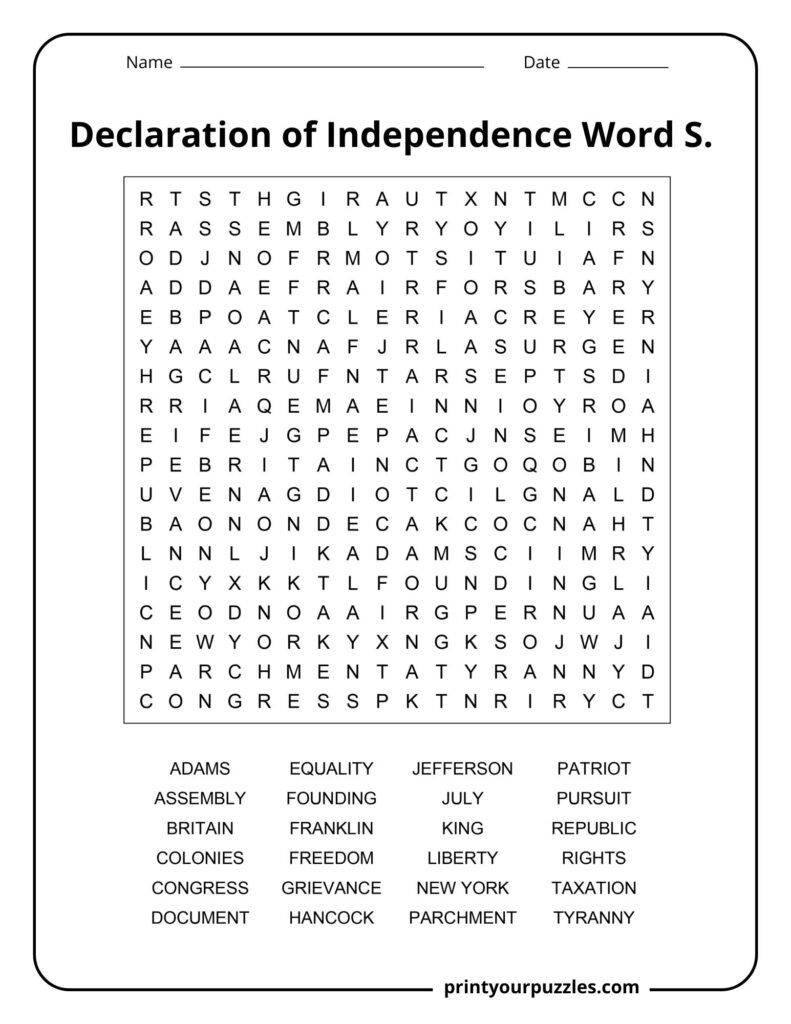
ADAMS, ASSEMBLY, BRITAIN, COLONIES, CONGRESS, DOCUMENT, EQUALITY, FOUNDING, FRANKLIN, FREEDOM, GRIEVANCE, HANCOCK, JEFFERSON, JULY, KING, LIBERTY, NEW YORK, PARCHMENT, PATRIOT, PURSUIT, REPUBLIC, RIGHTS, TAXATION, TYRANNY
ADAMS – John Adams was a Founding Father, signer of the Declaration, and second U.S. President who championed independence and helped draft the document alongside Jefferson.
ASSEMBLY – Colonial legislative bodies where elected representatives met to govern local affairs and later organized resistance against British policies, leading to calls for independence from Parliament’s control.
BRITAIN – Great Britain was the colonial power ruling the thirteen American colonies. The Declaration severed political ties with the British Crown and established American sovereignty and self-governance.
COLONIES – The thirteen British colonies along the Atlantic coast united to declare independence in 1776, transforming from separate territories into states forming a new nation together.
CONGRESS – The Continental Congress was the governing body representing the colonies that voted for independence, adopted the Declaration, and managed the Revolutionary War effort against Britain.
DOCUMENT – The Declaration of Independence is the formal document announcing America’s separation from Britain, outlining principles of natural rights, and listing grievances justifying revolution and self-determination.
EQUALITY – The principle that all people are created equal, a
foundational idea in the Declaration asserting inherent human worth and rights regardless of birth or status.
FOUNDING – The establishment of the United States as an independent nation through the Declaration, marking the birth of American democracy and constitutional government in 1776.
FRANKLIN – Benjamin Franklin was a renowned statesman, inventor, and diplomat who signed the Declaration and helped persuade France to support America’s fight for independence from Britain.
FREEDOM – Liberation from British rule and oppression, allowing colonists to govern themselves, protect natural rights, and pursue happiness without interference from a distant monarchy.
GRIEVANCE – Formal complaints listed in the Declaration against King George III’s tyrannical actions, including unfair taxation, dissolving legislatures, and maintaining standing armies without consent.
HANCOCK – John Hancock was Continental Congress president whose bold, large signature on the Declaration became iconic, symbolizing courage and commitment to American independence despite treason risks.
JEFFERSON – Thomas Jefferson was the primary author of the Declaration of Independence, crafting the eloquent statement of American principles and grievances that justified separation from Britain.
JULY – July 4, 1776, is Independence Day, when Congress officially adopted the Declaration of Independence, marking America’s birth as a sovereign nation free from British control.
KING – King George III of Britain was the monarch whose tyrannical policies and refusal to address colonial grievances prompted the colonies to declare independence and revolution.
LIBERTY – The fundamental right to live freely without oppression, a core principle of the Declaration emphasizing individual autonomy, self-governance, and protection from tyrannical government power.
NEW YORK – One of the original thirteen colonies that voted for independence. New York’s delegation initially abstained but later approved the Declaration, joining the united independence movement.
PARCHMENT – The durable animal skin material on which the Declaration was handwritten and signed, preserving this historic document for future generations in the National Archives.
PATRIOT – Colonists who supported independence from Britain, willing to fight and sacrifice for freedom, self-governance, and the revolutionary principles outlined in the Declaration of Independence.
PURSUIT – Part of the famous phrase “pursuit of happiness,” asserting that individuals have an unalienable right to seek fulfillment, prosperity, and well-being without government interference.
REPUBLIC – A form of government where citizens elect representatives to govern, established by America after independence, rejecting monarchy and embracing democratic principles of popular sovereignty.
RIGHTS – Unalienable natural rights including life, liberty, and happiness that the Declaration asserts all people possess, which governments must protect rather than violate or deny.
TAXATION – British-imposed taxes without colonial representation in Parliament sparked outrage and rebellion, becoming a major grievance listed in the Declaration justifying American independence from Britain.
TYRANNY – Oppressive, unjust rule by King George III that violated colonists’ rights, prompting the Declaration’s assertion that people may overthrow governments that become destructive to liberty.
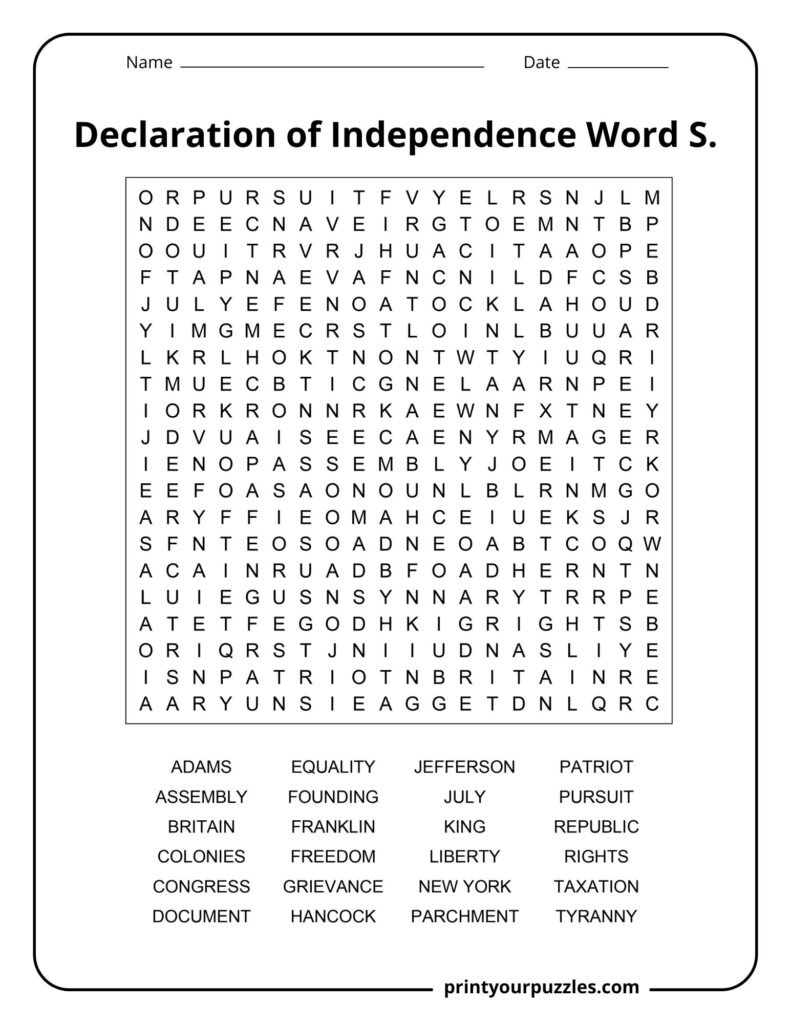
ADAMS, ASSEMBLY, BRITAIN, COLONIES, CONGRESS, DOCUMENT, EQUALITY, FOUNDING, FRANKLIN, FREEDOM, GRIEVANCE, HANCOCK, JEFFERSON, JULY, KING, LIBERTY, NEW YORK, PARCHMENT, PATRIOT, PURSUIT, REPUBLIC, RIGHTS, TAXATION, TYRANNY
The Continental Congress adopted the Declaration of Independence on July 4, 1776, in Philadelphia, establishing this date as America’s Independence Day celebrated annually throughout the nation.
Thomas Jefferson was the primary author, drafting the document at age thirty-three. Benjamin Franklin and John Adams provided edits before Congress approved the final version for adoption.
The Declaration justified American independence by outlining philosophical principles of natural rights and listing specific grievances against King George III’s tyrannical rule over the thirteen colonies.
Fifty-six delegates from the thirteen colonies signed the Declaration. John Hancock’s signature is most famous for being largest, making his name synonymous with signing documents boldly.
The original parchment Declaration is preserved in the National Archives in Washington, D.C., displayed in a protective case with controlled temperature, humidity, and lighting conditions.
Most delegates signed the Declaration on August 2, 1776, nearly a month after Congress approved it. Some signatures were added even later, extending into autumn months.
The word “inalienable” was misspelled as “unalienable” in the final parchment version. Both spellings were acceptable in the 18th century, so it wasn’t technically incorrect then.
The reverse side contains the simple handwritten phrase “Original Declaration of Independence dated 4th July 1776,” likely added as a label for identification when rolled up.
Franklin criticized the bald eagle choice, calling it a bird of “bad moral character.” He preferred the turkey, considering it more respectable and authentically American.
Richard Stockton of New Jersey was captured by British forces, and under duress, he swore allegiance to King George III, becoming the only signer to renounce independence.
Purus ut praesent facilisi dictumst sollicitudin cubilia ridiculus.