
This DNA word search offers an engaging and educational way to explore the fascinating world of genetics and molecular biology. Perfect for students, teachers, and science enthusiasts alike, this puzzle challenges you to find 24 carefully selected terms related to DNA structure, function, and processes. Each word has been chosen to represent fundamental concepts in genetics, from basic building blocks like adenine and thymine to complex processes such as replication and mutation.
What makes this DNA word search printable particularly valuable is that every term included in the puzzle comes with a clear, concise definition of 20-30 words. This feature transforms a simple word search printable into a comprehensive learning tool that reinforces understanding while making the activity enjoyable. Whether you’re reviewing for an exam, introducing genetics concepts in the classroom, or simply exploring science for fun, this resource provides both entertainment and education.
All words are presented in capital letters and contain no more than nine letters, making them accessible while maintaining scientific accuracy. The accompanying definitions ensure that learners not only find the words but also understand their significance in the world of DNA and genetics.
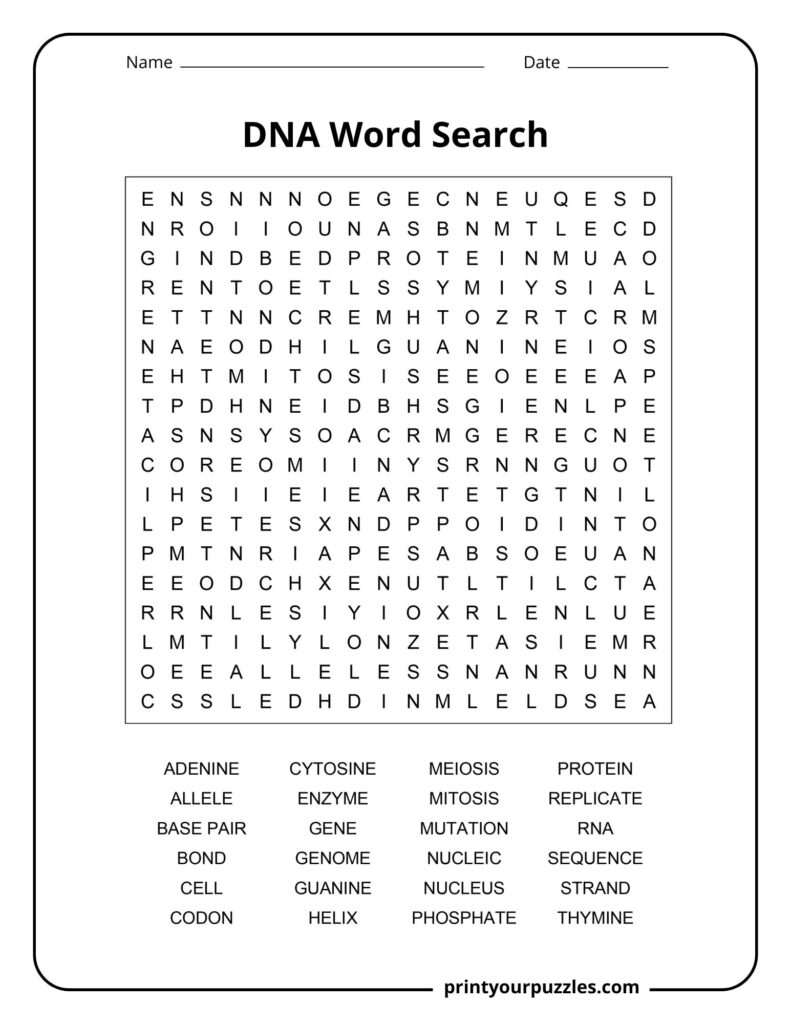
ADENINE, ALLELE, BASE PAIR, BOND, CELL, CODON, CYTOSINE, ENZYME, GENE, GENOME, GUANINE, HELIX, MEIOSIS, MITOSIS, MUTATION, NUCLEIC, NUCLEUS, PHOSPHATE, PROTEIN, REPLICATE, RNA, SEQUENCE, STRAND, THYMINE
ADENINE – A purine nitrogenous base found in DNA and RNA that pairs with thymine in DNA or uracil in RNA, essential for genetic coding.
ALLELE – An alternative form of a gene located at a specific position on a chromosome, determining variations in inherited traits among organisms.
BASE PAIR – Two complementary nitrogenous bases connected by hydrogen bonds in DNA’s double helix structure, with adenine pairing to thymine and guanine to cytosine.
BOND – A chemical connection between atoms or molecules in DNA, including hydrogen bonds between base pairs and covalent bonds in the sugar-phosphate backbone.
CELL – The smallest structural and functional unit of life, containing genetic material and organelles necessary for growth, reproduction, and maintaining living processes.
CODON – A three-nucleotide sequence on messenger RNA that codes for a specific amino acid or signals the start or stop of protein synthesis.
CYTOSINE – A pyrimidine nitrogenous base found in DNA and RNA that pairs with guanine through three hydrogen bonds, crucial for genetic information storage.
ENZYME – A biological catalyst protein that speeds up chemical reactions in cells, including DNA replication, transcription, and repair processes without being consumed.
GENE – A segment of DNA that contains instructions for making specific proteins or RNA molecules, serving as the basic unit of heredity in organisms.
GENOME – The complete set of genetic information contained in an organism’s DNA, including all genes and non-coding sequences necessary for development and function.
GUANINE – A purine nitrogenous base in DNA and RNA that pairs with cytosine through three hydrogen bonds, playing a vital role in genetic coding.
HELIX – The spiral, twisted ladder structure of DNA formed by two complementary strands wound around each other, discovered by Watson and Crick in 1953.
MEIOSIS – A specialized cell division process producing four genetically unique daughter cells with half the chromosome number, essential for sexual reproduction in organisms.
MITOSIS – A cell division process creating two identical daughter cells with the same chromosome number as the parent, important for growth and repair.
MUTATION – A permanent change in DNA sequence that can occur spontaneously or through environmental factors, potentially affecting traits and causing genetic variation.
NUCLEIC – Relating to nucleic acids like DNA and RNA, which are complex molecules responsible for storing and transmitting genetic information in all living things.
NUCLEUS – A membrane-bound organelle in eukaryotic cells containing chromosomes and genetic material, controlling cellular activities and storing hereditary information through DNA.
PHOSPHATE – A chemical group containing phosphorus and oxygen in DNA’s backbone, linking sugar molecules together to form the structural framework of genetic material.
PROTEIN – Large molecules made of amino acid chains that perform numerous cellular functions, including structure, catalysis, signaling, and regulation, encoded by genes.
REPLICATE – The process of copying DNA to produce two identical molecules before cell division, ensuring genetic information is accurately passed to daughter cells.
RNA – Ribonucleic acid, a nucleic acid that reads DNA instructions and helps synthesize proteins, exists in several forms including messenger, transfer, and ribosomal.
SEQUENCE – The specific order of nucleotide bases along a DNA or RNA strand, which determines genetic instructions for building and maintaining an organism.
STRAND – One of the two chains of nucleotides forming DNA’s double helix structure, running antiparallel to each other with complementary base pairing.
THYMINE – A pyrimidine nitrogenous base found only in DNA that pairs with adenine through two hydrogen bonds, replaced by uracil in RNA molecules.
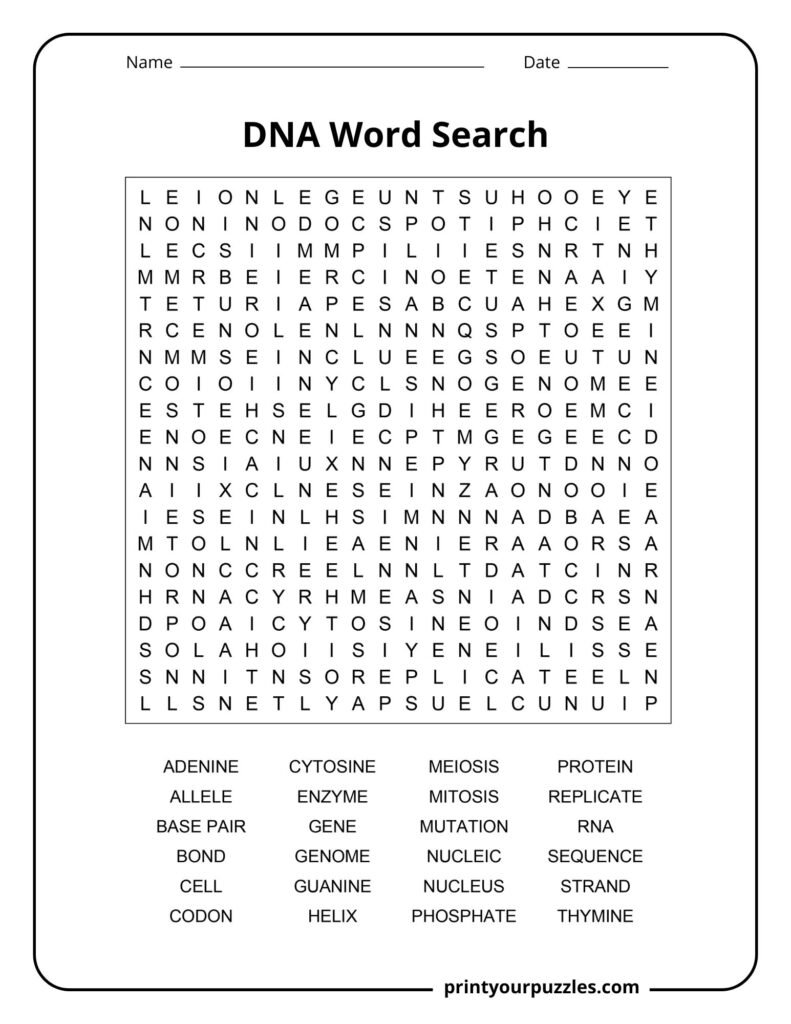
ADENINE, ALLELE, BASE PAIR, BOND, CELL, CODON, CYTOSINE, ENZYME, GENE, GENOME, GUANINE, HELIX, MEIOSIS, MITOSIS, MUTATION, NUCLEIC, NUCLEUS, PHOSPHATE, PROTEIN, REPLICATE, RNA, SEQUENCE, STRAND, THYMINE
DNA stands for deoxyribonucleic acid, a complex molecule that carries genetic instructions for development, functioning, growth, and reproduction in all known living organisms.
DNA has a double helix structure resembling a twisted ladder, with two strands connected by base pairs, discovered by Watson and Crick in 1953.
In eukaryotic cells, DNA is primarily located in the nucleus, with small amounts also found in mitochondria and chloroplasts in plant cells.
The four nitrogenous bases in DNA are adenine, thymine, guanine, and cytosine. Adenine pairs with thymine, while guanine pairs with cytosine through hydrogen bonds.
DNA replication occurs when the double helix unwinds, and each strand serves as a template for creating new complementary strands, producing two identical DNA molecules.
If you unraveled all the DNA in your body, it would stretch approximately 10 billion miles, enough to reach from Earth to Pluto and back.
Humans share about 99.9% of their DNA with each other, roughly 60% with bananas, and approximately 98% with chimpanzees, showing our biological connections.
Your DNA can be damaged up to 10,000 times per day by various factors, but fortunately, your cells have sophisticated repair mechanisms that fix it.
If you typed 60 words per minute for eight hours daily, it would take approximately 50 years to type the entire human genome sequence completely.
Identical twins don’t have exactly identical DNA due to mutations occurring after conception, and environmental factors create further differences throughout their lives.
Purus ut praesent facilisi dictumst sollicitudin cubilia ridiculus.