
Ecosystem word search puzzles offer an entertaining and educational way to explore the fascinating world of environmental science. This carefully designed activity features 24 essential ecological terms that will help you understand how living organisms interact with their surroundings and each other.
What makes this Ecosystem word search printable special is that every word included in the puzzle comes with a clear, comprehensive definition. You won’t just find terms like Predator, Symbiosis, or Decompose—you’ll also learn exactly what they mean and why they’re important to ecological systems. This combination of puzzle-solving and learning reinforces vocabulary retention while making environmental education enjoyable.
Perfect for classrooms, homeschooling, or independent study, this word search printable accommodates various learning styles and age groups. Teachers can use it to supplement biology lessons, while students can challenge themselves while building scientific literacy. The defined terms provide valuable context, transforming a simple puzzle into a complete learning tool.
Whether you’re discovering ecology for the first time or reviewing key concepts, this word search makes environmental education accessible and fun. Dive in and start exploring the incredible interconnected world of ecosystems today!
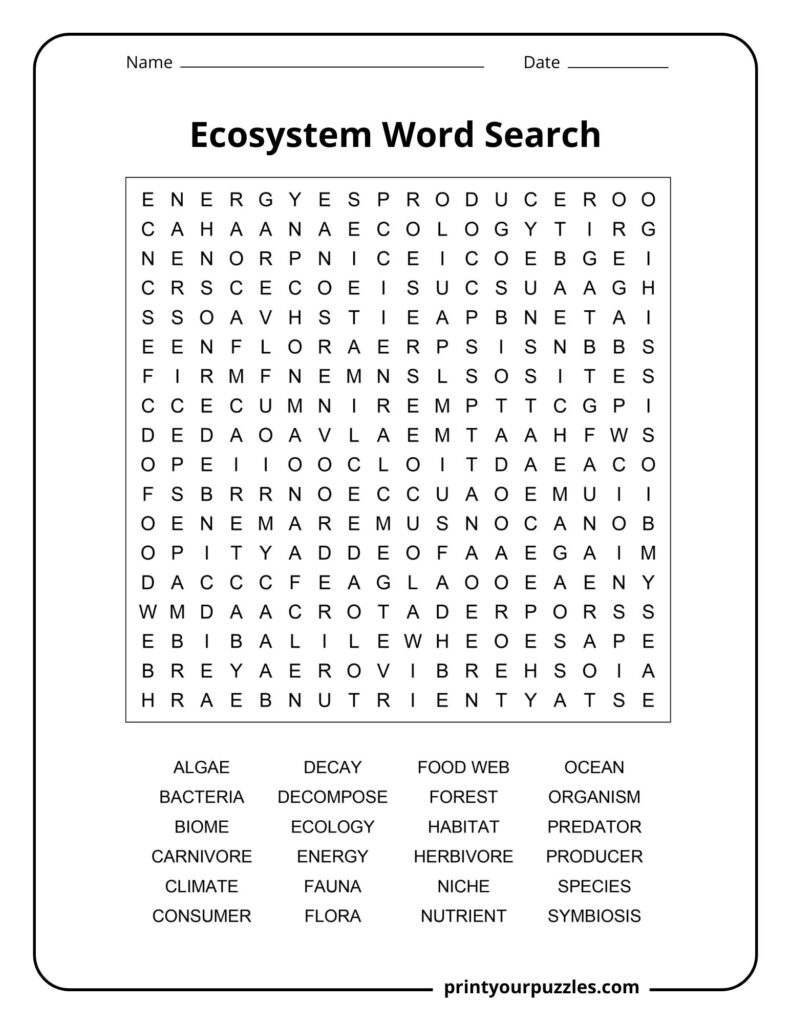
ALGAE, BACTERIA, BIOME, CARNIVORE, CLIMATE, CONSUMER, DECAY, DECOMPOSE, ECOLOGY, ENERGY, FAUNA, FLORA, FOOD WEB, FOREST, HABITAT, HERBIVORE, NICHE, NUTRIENT, OCEAN, ORGANISM, PREDATOR, PRODUCER, SPECIES, SYMBIOSIS
ALGAE – Simple aquatic organisms that perform photosynthesis, ranging from microscopic single cells to large seaweeds. They form the base of many aquatic food chains and produce oxygen.
BACTERIA – Microscopic single-celled organisms found everywhere in ecosystems. They decompose dead matter, cycle nutrients, fix nitrogen, and play essential roles in maintaining environmental balance and health.
BIOME – A large geographical area characterized by specific climate conditions, plants, and animals. Examples include deserts, rainforests, tundras, and grasslands, each with distinct ecological communities and adaptations.
CARNIVORE – An organism that primarily eats meat or other animals. Carnivores are consumers in food chains, helping control prey populations and maintaining ecosystem balance through predation and hunting.
CLIMATE – The long-term patterns of temperature, precipitation, wind, and other atmospheric conditions in a region. Climate significantly influences which organisms can survive and thrive in different ecosystems.
CONSUMER – An organism that obtains energy by eating other organisms rather than producing its own food. Consumers include herbivores, carnivores, and omnivores at various levels of food chains.
DECAY – The natural process where dead organic matter breaks down into simpler substances. Decay releases nutrients back into soil and air, enabling new growth and continuing life cycles.
DECOMPOSE – The biological breakdown of dead plants, animals, and waste materials by decomposers like bacteria and fungi. This process recycles nutrients, enriching soil and supporting new organism growth.
ECOLOGY – The scientific study of interactions between organisms and their environment. Ecology examines relationships among living things and how energy and nutrients flow through ecosystems and biological communities.
ENERGY – The capacity to do work, flowing through ecosystems from the sun to producers, then consumers. Energy transfer powers all life processes, though some is lost as heat.
FAUNA – All animal life present in a particular region, time period, or ecosystem. Fauna includes everything from microscopic invertebrates to large mammals, birds, reptiles, and amphibians in an area.
FLORA – All plant life in a particular region, time period, or ecosystem. Flora encompasses trees, shrubs, grasses, flowers, and other vegetation that form the foundation of terrestrial ecosystems.
FOOD WEB – A complex network showing how different food chains interconnect within an ecosystem. Food webs illustrate multiple feeding relationships, showing that most organisms eat and are eaten by several species.
FOREST – A large area dominated by trees and undergrowth, supporting diverse plant and animal communities. Forests produce oxygen, store carbon, regulate water cycles, and provide habitat for countless species.
HABITAT – The natural home or environment where an organism lives, providing necessary food, water, shelter, and space. Each species has specific habitat requirements essential for survival and reproduction.
HERBIVORE – An animal that feeds exclusively or primarily on plants, including leaves, fruits, seeds, and roots. Herbivores are primary consumers, transferring energy from producers to higher food chain levels.
NICHE – The specific role and position an organism occupies in its ecosystem, including its habitat, food sources, and interactions. Each species has a unique niche preventing direct competition.
NUTRIENT – Chemical substances organisms need for growth, energy, and vital functions. Essential nutrients like nitrogen, phosphorus, and carbon cycle through ecosystems, moving from soil to organisms and back again.
OCEAN – Vast saltwater bodies covering most of Earth’s surface, containing diverse ecosystems from coral reefs to deep trenches. Oceans regulate climate, produce oxygen, and support countless marine organisms.
ORGANISM – Any individual living thing, from microscopic bacteria to giant trees and whales. Organisms interact with their environment and other living things, requiring energy and nutrients to survive.
PREDATOR – An organism that hunts, kills, and consumes other animals for food. Predators help control prey populations, maintaining ecosystem balance and eliminating weak or sick individuals naturally.
PRODUCER – An organism, typically plants or algae, that creates its own food through photosynthesis using sunlight, water, and carbon dioxide. Producers form the foundation of food chains.
SPECIES – A group of similar organisms capable of interbreeding and producing fertile offspring. Species share common characteristics, genetic makeup, and occupy specific ecological niches within their ecosystems and environments.
SYMBIOSIS – A close, long-term biological interaction between two different species living together. Symbiotic relationships can be mutually beneficial, harmful to one partner, or beneficial to one without affecting another.
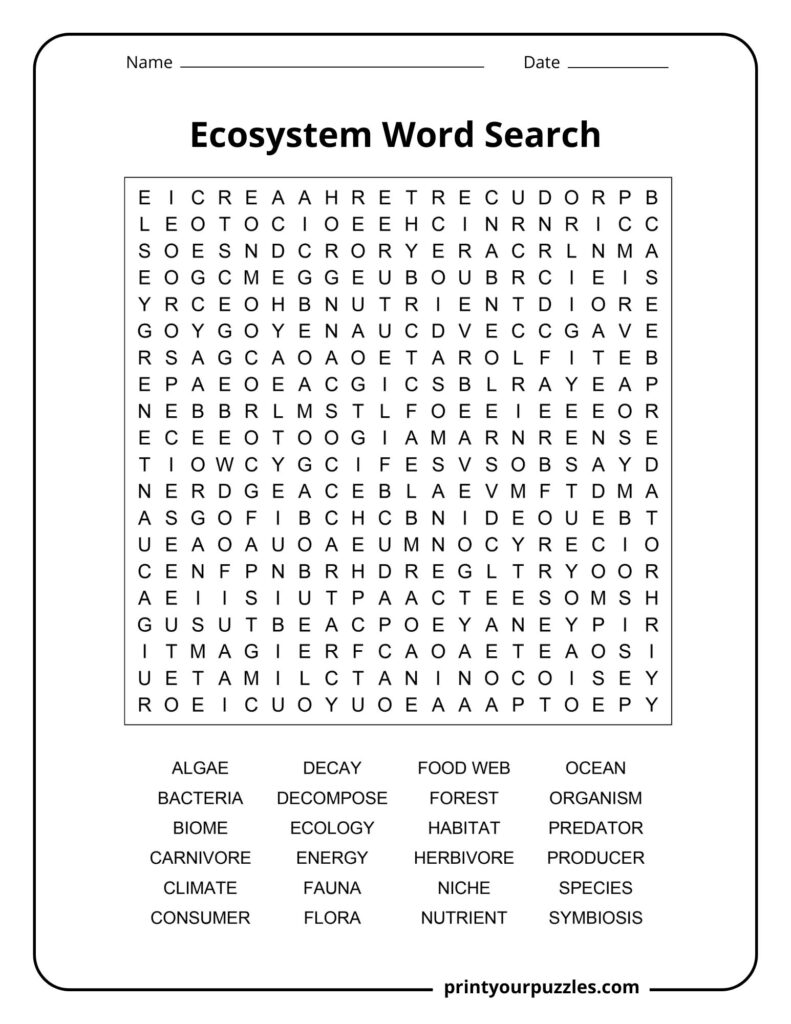
ALGAE, BACTERIA, BIOME, CARNIVORE, CLIMATE, CONSUMER, DECAY, DECOMPOSE, ECOLOGY, ENERGY, FAUNA, FLORA, FOOD WEB, FOREST, HABITAT, HERBIVORE, NICHE, NUTRIENT, OCEAN, ORGANISM, PREDATOR, PRODUCER, SPECIES, SYMBIOSIS
An ecosystem is a community of living organisms interacting with each other and their physical environment, including air, water, soil, and sunlight, forming a complex, interconnected system of energy and nutrient exchange.
Ecosystems consist of biotic components (living organisms like plants, animals, and microorganisms) and abiotic components (non-living elements such as water, sunlight, temperature, soil, and minerals) working together interdependently.
Energy flows from the sun to producers (plants) through photosynthesis, then to consumers (herbivores and carnivores) through feeding relationships. Energy decreases at each level, with some lost as heat.
Decomposers like bacteria and fungi break down dead organisms and waste, recycling essential nutrients back into soil and air. Without them, nutrients would remain locked in dead matter forever.
Ecosystem imbalance occurs when species populations change dramatically, often causing chain reactions. This can lead to species extinction, invasive species domination, habitat destruction, and reduced biodiversity threatening ecosystem survival.
Soil ecosystems host billions of bacteria, fungi, protozoa, and nematodes working together to decompose matter, cycle nutrients, and support plant growth in this hidden underground world.
These “wood wide webs” allow trees to share nutrients, send warning signals about insect attacks, and even support younger or struggling trees by transferring resources through connected roots.
These vibrant underwater ecosystems provide habitat, breeding grounds, and food sources for thousands of fish, invertebrates, and marine organisms, making them incredibly biodiverse and valuable environments.
This massive ecosystem absorbs carbon dioxide, releases moisture creating rain clouds, and regulates temperatures far beyond its borders, earning its title as “the lungs of Earth.”
After fires, floods, or abandonment, pioneer species gradually colonize areas, creating conditions for more complex communities to develop over decades or centuries, demonstrating nature’s remarkable resilience.

Purus ut praesent facilisi dictumst sollicitudin cubilia ridiculus.