
Electricity word search puzzles offer an engaging and educational way to explore fundamental concepts of electrical science while having fun. This carefully designed activity challenges participants to locate 24 essential terms related to electricity, ranging from basic units like ampere, volt, and ohm to important components such as battery, capacitor, and resistor. Each word has been selected to represent key concepts that form the foundation of understanding how electricity works in our daily lives.
What makes this Electricity word search printable particularly valuable is its educational component. Every single word hidden within the puzzle grid is thoroughly defined with clear, concise explanations of 20-30 words each. This ensures that learners don’t just find words—they understand what each term means and how it relates to electrical principles.
Whether you’re a student studying physics, a teacher creating classroom materials, or simply someone curious about electricity, this word search printable serves as both an entertaining puzzle and a comprehensive learning tool. The combination of active searching and accessible definitions creates an effective method for reinforcing electrical vocabulary and concepts in an enjoyable, interactive format.
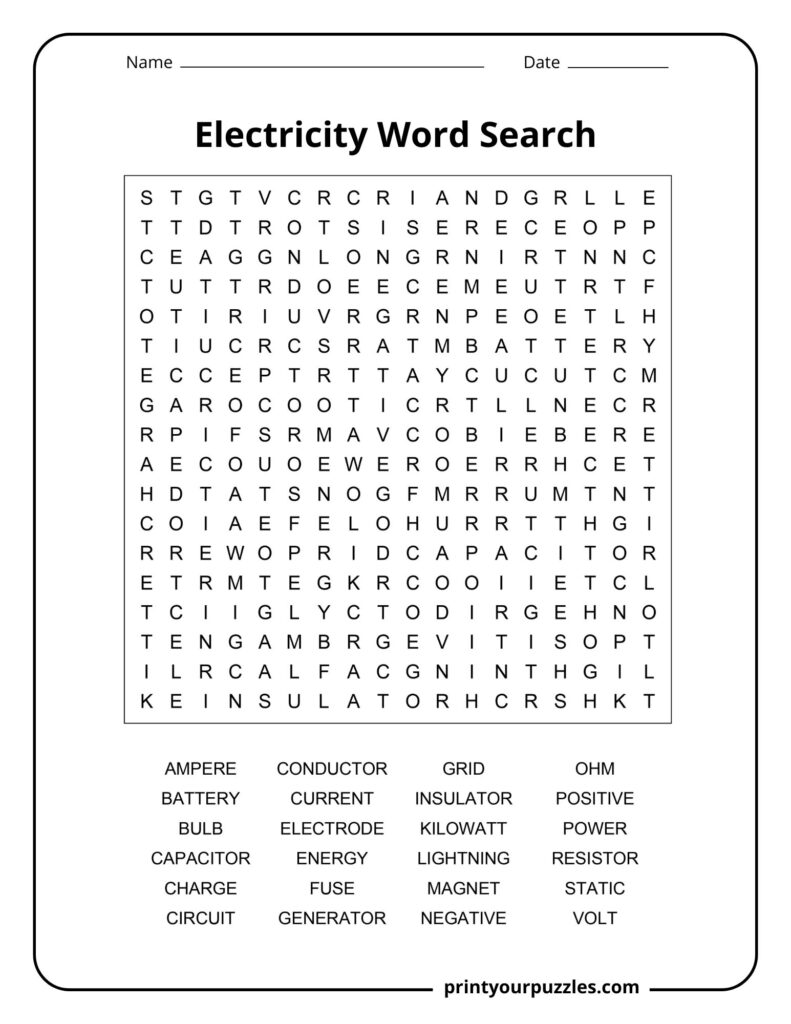
AMPERE, BATTERY, BULB, CAPACITOR, CHARGE, CIRCUIT, CONDUCTOR, CURRENT, ELECTRODE, ENERGY, FUSE, GENERATOR, GRID, INSULATOR, KILOWATT, LIGHTNING, MAGNET, NEGATIVE, OHM, POSITIVE, POWER, RESISTOR, STATIC, VOLT
AMPERE – The standard unit of electric current measurement, representing the flow of one coulomb of electrical charge per second through a conductor. Named after André-Marie Ampère.
BATTERY – A device containing electrochemical cells that converts stored chemical energy into electrical energy, providing portable power for various devices through connected positive and negative terminals.
BULB – A glass enclosure containing a filament or gas that produces light when electrical current passes through it, commonly used for illumination in homes and buildings.
CAPACITOR – An electronic component that stores electrical energy in an electric field between two conductive plates, releasing it when needed. Used in circuits for filtering and timing.
CHARGE – The fundamental property of matter that causes it to experience electromagnetic force, existing as positive or negative. Measured in coulombs and carried by protons and electrons.
CIRCUIT – A closed loop pathway that allows electrical current to flow from a power source through conductors and components, then back to the source, enabling devices to operate.
CONDUCTOR – A material, typically metal like copper or aluminum, that allows electrical current to flow easily through it due to freely moving electrons within its atomic structure.
CURRENT – The flow of electric charge through a conductor, measured in amperes. Can be direct current flowing one direction or alternating current periodically reversing direction.
ELECTRODE – A conductor through which electric current enters or leaves a medium, such as an electrolyte, gas, or vacuum. Essential component in batteries, welding, and electrochemical processes.
ENERGY – The capacity to perform work or produce change, existing in various forms including electrical, which powers devices by moving charged particles through conductive pathways and circuits.
FUSE – A safety device containing a thin wire that melts and breaks the circuit when excessive current flows, protecting electrical systems and equipment from damage or fire.
GENERATOR – A machine that converts mechanical energy into electrical energy through electromagnetic induction, rotating coils within magnetic fields to produce current for power distribution and use.
GRID – An interconnected network of power lines, substations, and transformers that distributes electricity from generating stations to consumers across cities, regions, or entire countries efficiently.
INSULATOR – A material, such as rubber, plastic, or glass, that resists electrical current flow, preventing unwanted electricity transfer and protecting people from shocks and electrical hazards.
KILOWATT – A unit of electrical power equal to one thousand watts, commonly used to measure energy consumption in homes and the output capacity of electrical appliances and systems.
LIGHTNING – A massive natural electrostatic discharge during storms, occurring when electrical charges build up in clouds and release suddenly, creating brilliant flashes and thunder through atmospheric ionization.
MAGNET – An object producing a magnetic field that attracts ferromagnetic materials and interacts with electric currents. Essential for generators, motors, and many electromagnetic devices and applications.
NEGATIVE – The terminal or charge with an excess of electrons, attracting positive charges. In circuits, current conventionally flows from positive to negative, though electrons move oppositely.
OHM – The standard unit measuring electrical resistance, indicating how much a material opposes current flow. One ohm allows one ampere when one volt is applied, following Ohm’s law.
POSITIVE – The terminal or charge with a deficit of electrons, attracting negative charges. Represents the conventional direction of current flow in electrical circuits from higher to lower potential.
POWER – The rate at which electrical energy is transferred or converted, measured in watts. Calculated by multiplying voltage and current, indicating how quickly work is performed electrically.
RESISTOR – An electronic component designed to limit current flow in circuits by providing specific resistance. Controls voltage levels, divides currents, and protects sensitive components from excessive electricity.
STATIC – Stationary electrical charge accumulated on surfaces through friction or contact, remaining until discharged. Can cause shocks, attract small objects, and damage sensitive electronic equipment unexpectedly.
VOLT – The unit measuring electrical potential difference or electromotive force between two points. One volt drives one ampere through one ohm of resistance, named after Alessandro Volta.
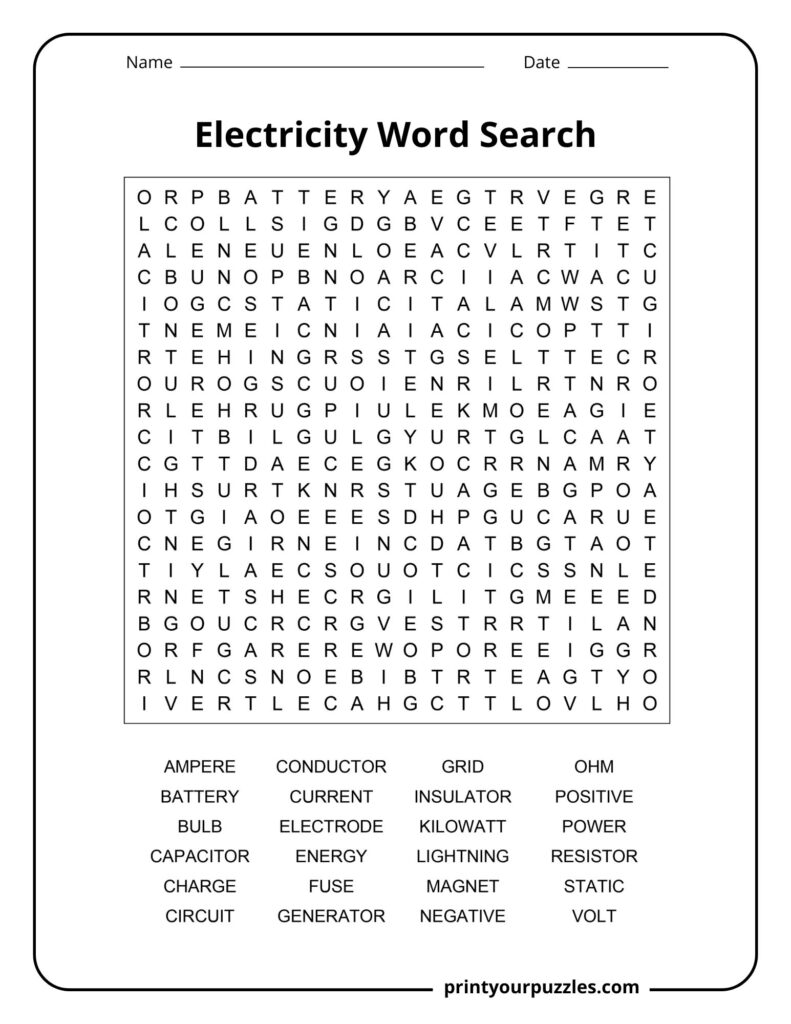
AMPERE, BATTERY, BULB, CAPACITOR, CHARGE, CIRCUIT, CONDUCTOR, CURRENT, ELECTRODE, ENERGY, FUSE, GENERATOR, GRID, INSULATOR, KILOWATT, LIGHTNING, MAGNET, NEGATIVE, OHM, POSITIVE, POWER, RESISTOR, STATIC, VOLT
Electricity is the flow of electrical charge through conductors, caused by the movement of electrons. It’s a fundamental form of energy that powers devices, lights homes, and enables modern technology.
Electricity is generated by converting mechanical energy into electrical energy through generators. Power plants use turbines driven by water, steam, wind, or combustion to rotate magnets within coils.
Alternating current periodically reverses direction, commonly used in household power. Direct current flows continuously in one direction, found in batteries and electronic devices. Both serve different purposes effectively.
Electric shocks occur when current passes through the body, typically from touching live wires or faulty equipment. The severity depends on voltage, current strength, and pathway through the body.
Use grounded outlets, avoid overloading circuits, keep electrical devices away from water, inspect cords regularly, and install circuit breakers. Never attempt electrical repairs without proper training and precautions.
A single lightning bolt can reach temperatures of approximately 30,000 degrees Celsius—five times hotter than the sun’s surface. This extreme heat causes the explosive thunder we hear during storms.
The human body is an electrical conductor because it’s approximately 60% water containing dissolved salts and minerals. Your nervous system uses electrical signals to transmit messages between your brain and body.
Electric eels can produce electrical discharges up to 600 volts, enough to stun prey or deter predators. They use specialized organs containing thousands of cells that work like biological batteries.
Electrical signals travel through wires at nearly the speed of light—approximately 300,000 kilometers per second. This allows instantaneous power delivery and communication across vast distances worldwide.
Iceland generates nearly 100% of its electricity from renewable sources, primarily geothermal and hydroelectric power. The country’s unique geology provides abundant natural energy resources for sustainable power generation.

Purus ut praesent facilisi dictumst sollicitudin cubilia ridiculus.