
Genetics word search puzzles provide an engaging gateway into one of biology’s most fundamental sciences. Genetics is the study of heredity and variation in living organisms, exploring how traits pass from parents to offspring through DNA. This branch of biology emerged in the 1860s when Gregor Mendel conducted his pioneering pea plant experiments, establishing the foundation for modern genetic science.
What makes genetics fascinating is its universal relevance—it explains why children resemble their parents, how diseases are inherited, and how evolution shapes species over time. Scientists, researchers, medical professionals, and students worldwide study genetics in laboratories, universities, hospitals, and research institutions. From understanding simple inheritance patterns to decoding complex genetic disorders, genetics impacts medicine, agriculture, forensics, and biotechnology.
Why study genetics? This science helps diagnose diseases, develop treatments, improve crop yields, and solve criminal cases through DNA analysis. Students encounter genetics throughout their education, from middle school biology to advanced university courses, making vocabulary mastery essential for academic success.
This comprehensive Genetics word search printable goes beyond simple puzzle entertainment. It includes detailed definitions for all 24 words, ensuring you understand each term’s meaning. The resource also features a helpful FAQ section answering common genetics questions and a fascinating Did You Know? section revealing surprising facts—like humans sharing 60% of their DNA with bananas!
This word search printable transforms learning into an interactive experience, making complex scientific concepts accessible and memorable for students, educators, and anyone curious about the genetic blueprint of life.
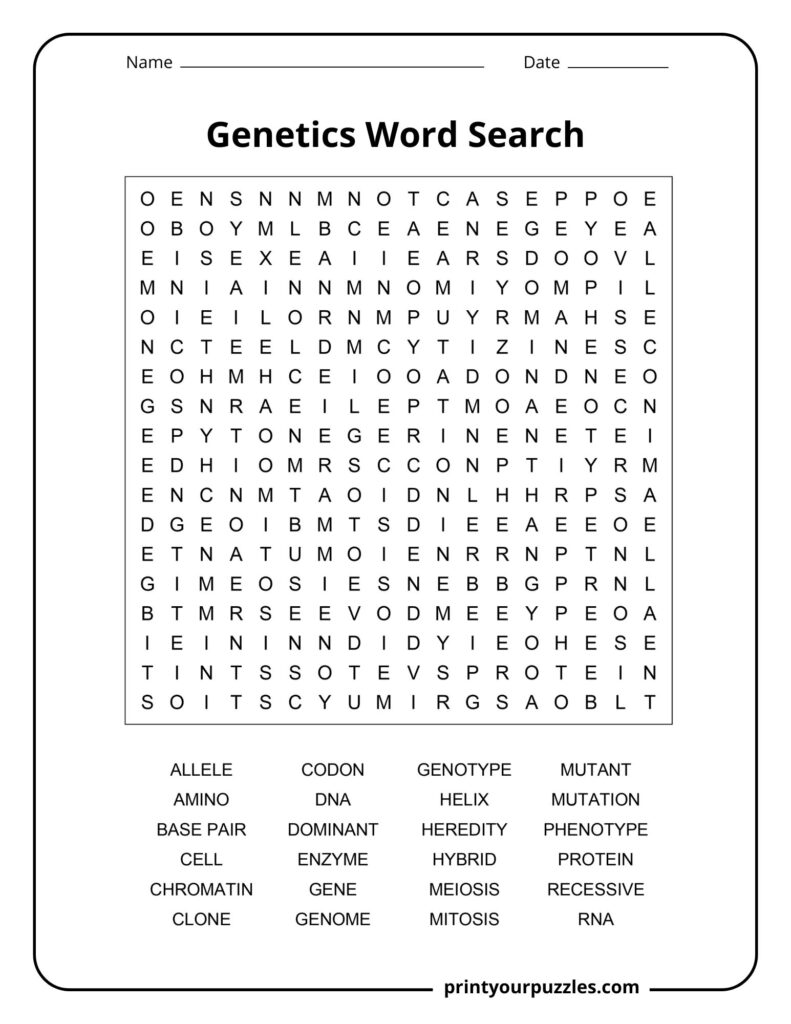
ALLELE, AMINO, BASE PAIR, CELL, CHROMATIN, CLONE, CODON, DNA, DOMINANT, ENZYME, GENE, GENOME, GENOTYPE, HELIX, HEREDITY, HYBRID, MEIOSIS, MITOSIS, MUTANT, MUTATION, PHENOTYPE, PROTEIN, RECESSIVE, RNA
ALLELE – Different versions of the same gene that occupy the same position on chromosomes, determining variations in inherited characteristics like eye color or blood type in organisms.
AMINO – Refers to amino acids, the building blocks of proteins, containing an amino group and essential for constructing proteins that perform vital functions throughout living organisms.
BASE PAIR – Two complementary nucleotide bases joined by hydrogen bonds in DNA structure: adenine pairs with thymine, and cytosine pairs with guanine, forming the ladder rungs.
CELL – The smallest basic unit of life, containing genetic material and performing all functions necessary for survival, growth, reproduction, and response to environmental stimuli in organisms.
CHROMATIN – Complex of DNA and proteins found in cell nuclei that condenses to form chromosomes during cell division, allowing efficient packaging and regulation of genetic material.
CLONE – Genetically identical organism or cell produced asexually from a single ancestor, possessing identical DNA sequences and characteristics as the original parent organism or cell.
CODON – Three-nucleotide sequence in messenger RNA that specifies which amino acid will be added during protein synthesis or signals the start or stop of translation.
DNA – Deoxyribonucleic acid, the hereditary material carrying genetic instructions for development, functioning, growth, and reproduction of all known living organisms and many viruses in existence.
DOMINANT – Genetic trait expressed in an organism’s phenotype when at least one dominant allele is present, masking the effect of any recessive allele at that gene location.
ENZYME – Biological catalyst protein that speeds up chemical reactions in living organisms without being consumed, essential for metabolism, DNA replication, and countless other cellular processes.
GENE – Basic unit of heredity made of DNA sequences that codes for specific proteins or functional RNA molecules, determining inherited traits passed from parents to offspring.
GENOME – Complete set of genetic material contained in an organism, including all genes and non-coding sequences, representing the entire hereditary information necessary for life functions.
GENOTYPE – Genetic makeup of an organism, representing the complete set of alleles inherited from parents, which interacts with environmental factors to produce observable physical characteristics.
HELIX – Spiral or coiled three-dimensional structure, most famously describing DNA’s double helix configuration where two strands twist around each other in complementary base pairing arrangement.
HEREDITY – Transmission of genetic characteristics from parent organisms to their offspring through DNA, explaining why children resemble parents and how traits pass through multiple generations naturally.
HYBRID – Offspring resulting from breeding two genetically different parents or varieties, combining traits from both parents and often exhibiting increased vigor or unique characteristic combinations.
MEIOSIS – Specialized cell division producing four genetically unique reproductive cells with half the chromosome number, essential for sexual reproduction and creating genetic diversity in offspring.
MITOSIS – Cell division process creating two identical daughter cells with the same chromosome number as the parent, essential for growth, tissue repair, and asexual reproduction.
MUTANT – Organism displaying characteristics that differ from normal or wild-type due to genetic mutation, resulting in altered DNA sequences that produce new or modified traits.
MUTATION – Permanent change in DNA sequence occurring spontaneously or through environmental factors, creating genetic variation and serving as the raw material for evolution and diversity.
PHENOTYPE – Observable physical and biochemical characteristics of an organism determined by genetic makeup interacting with environmental influences, including appearance, behavior, and biochemical properties expressed outwardly.
PROTEIN – Large complex molecule made of amino acid chains performing crucial functions including catalyzing reactions, providing structure, transporting molecules, and defending against disease in living organisms.
RECESSIVE – Genetic trait expressed only when two copies of the recessive allele are present, remaining hidden when a dominant allele exists at the same gene location.
RNA – Ribonucleic acid, single-stranded molecule essential for protein synthesis, gene regulation, and other cellular processes, serving as messenger between DNA and protein-making cellular machinery.
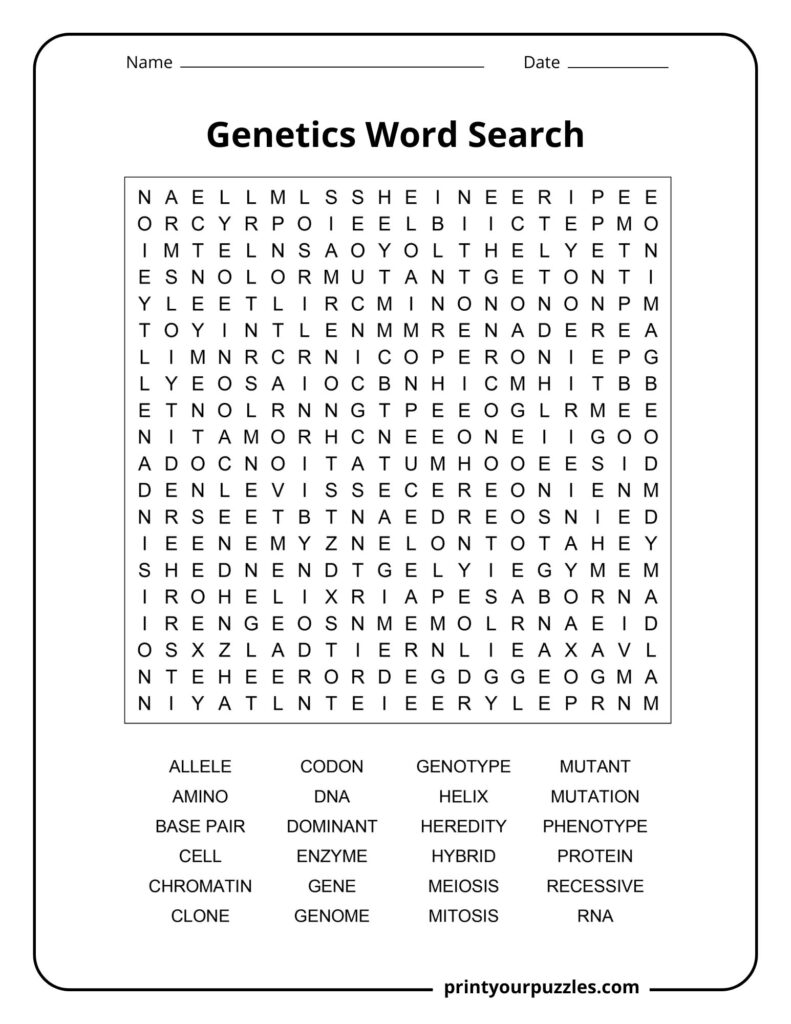
ALLELE, AMINO, BASE PAIR, CELL, CHROMATIN, CLONE, CODON, DNA, DOMINANT, ENZYME, GENE, GENOME, GENOTYPE, HELIX, HEREDITY, HYBRID, MEIOSIS, MITOSIS, MUTANT, MUTATION, PHENOTYPE, PROTEIN, RECESSIVE, RNA
Genetics is the scientific study of genes, heredity, and genetic variation in living organisms, explaining how traits and characteristics are inherited from parents to offspring through generations.
DNA is the molecule containing genetic instructions, while genes are specific segments of DNA that code for particular traits or proteins, functioning as heredity’s basic units.
Dominant genes express their traits with just one copy present, while recessive genes require two copies to be expressed, remaining hidden when paired with dominant alleles.
Yes, recessive traits can skip generations when carriers possess one recessive allele without expressing the trait, then pass it to offspring who inherit two copies.
Mutations occur from DNA replication errors, exposure to radiation, chemicals, or environmental factors, creating permanent changes in genetic sequences that may affect organism characteristics or functions.
Despite vast differences in appearance and complexity, humans and bananas share basic cellular processes and genetic sequences controlling fundamental life functions like cell division and metabolism.
While starting with the same genetic code, identical twins accumulate different mutations throughout life due to environmental exposures, lifestyle choices, and random copying errors during cell division.
Humans possess about 20,000-25,000 genes, while the tiny water flea Daphnia has over 31,000 genes, proving that organism complexity doesn’t directly correlate with gene count.
If you uncoiled all DNA from your body’s cells and connected the strands end-to-end, they would extend approximately 67 billion miles through space.
This remarkably high genetic similarity demonstrates our close evolutionary relationship with primates, with just 1.2% genetic difference creating all distinguishing human characteristics and abilities.