
Gravity word search puzzles offer an engaging way to explore one of the universe’s most fundamental forces while sharpening your vocabulary and problem-solving skills. This Gravity word search printable features 24 carefully selected terms related to gravitational concepts, from basic principles to advanced theories. Each word search printable is designed to challenge learners of all ages while reinforcing important scientific terminology.
The puzzle includes words ranging from simple concepts like Fall and Mass to more complex terms such as Space Time and Curvature. You’ll encounter famous scientists like Newton, Einstein, and Galileo who revolutionized our understanding of gravity, along with celestial objects like Black Hole and Satellite that demonstrate gravitational effects. Two-word phrases such as Free Fall are combined into single words for easier searching.
To enhance your learning experience, all the words to search are defined with clear, concise explanations of 20-30 words each. These definitions provide context and deepen your understanding of gravitational concepts, making this more than just a puzzle—it’s an educational journey through the force that holds our universe together.
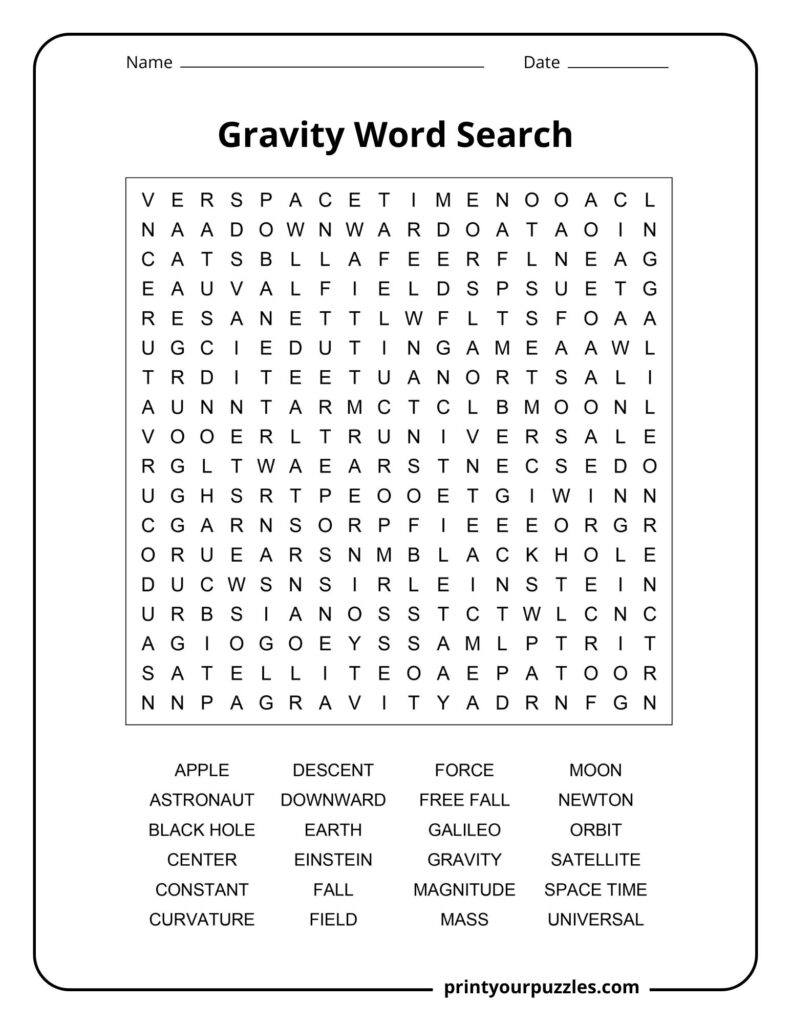
APPLE, ASTRONAUT, BLACK HOLE, CENTER, CONSTANT CURVATURE, DESCENT, DOWNWARD, EARTH, EINSTEIN, FALL, FIELD, FORCE, FREE FALL, GALILEO, GRAVITY, MAGNITUDE, MASS, MOON, NEWTON, ORBIT, SATELLITE, SPACE TIME, UNIVERSAL
APPLE – The fruit famously associated with Isaac Newton’s discovery of gravity when observing one falling from a tree, inspiring his groundbreaking theories about gravitational force.
ASTRONAUT – A trained space traveler who experiences microgravity conditions in orbit, where they appear weightless while still being affected by Earth’s gravitational pull during their missions.
BLACK HOLE – An extremely dense celestial object with gravitational force so intense that nothing, not even light, can escape once crossing its event horizon boundary.
CENTER – The point toward which gravitational force pulls objects; in planetary bodies, it’s the core where mass concentrates and gravitational attraction is strongest and most balanced.
CONSTANT – The gravitational constant, represented by G, is a fundamental value in physics that quantifies the strength of gravitational attraction between masses in Newton’s law.
CURVATURE – Einstein’s general relativity describes gravity as the bending or warping of spacetime caused by mass and energy, creating the curved paths objects follow naturally.
DESCENT – The downward movement of an object under gravitational influence, pulling it toward a larger mass like Earth, moon, or other celestial body with acceleration.
DOWNWARD – The direction toward which gravity pulls objects, typically toward Earth’s center or any massive body’s core, defining our perception of up and down orientation.
EARTH – Our home planet, whose gravitational force keeps us grounded, holds the atmosphere in place, and maintains the moon in orbit around it at constant distance.
EINSTEIN – Albert Einstein revolutionized gravitational theory with general relativity, describing gravity not as a force but as curved spacetime geometry created by mass and energy.
FALL – The motion of an object under gravity’s influence, accelerating downward at approximately 9.8 meters per second squared near Earth’s surface in the absence of resistance.
FIELD – The region surrounding a massive object where gravitational force can be detected and measured, extending infinitely but weakening with increasing distance from the source.
FORCE – In Newton’s framework, gravity is an attractive force between any two masses, proportional to their masses and inversely proportional to the square of distance between.
FREE FALL – The condition where an object moves under gravity’s influence alone, without resistance or support, experiencing apparent weightlessness like astronauts in orbiting spacecraft experience continuously.
GALILEO – Italian scientist who pioneered gravity research by demonstrating that objects of different masses fall at the same rate when air resistance is eliminated from consideration.
GRAVITY – The natural phenomenon by which objects with mass attract each other, keeping planets in orbit, holding galaxies together, and giving weight to everything around.
MAGNITUDE – The measurable strength or intensity of gravitational force between objects, determined by their masses and the distance separating them according to physical laws established.
MASS – The amount of matter in an object, which determines both its gravitational attraction to other masses and its resistance to acceleration when force applies.
MOON – Earth’s natural satellite, held in orbit by gravitational attraction while also creating tidal forces on Earth’s oceans through its own gravitational influence on water.
NEWTON – Isaac Newton formulated the universal law of gravitation, mathematically describing how every mass attracts every other mass with force proportional to their masses and distance.
ORBIT – The curved path an object follows around a more massive body when its forward motion balances gravitational pull, preventing it from falling or escaping entirely.
SATELLITE – Any object orbiting a larger celestial body due to gravitational attraction, including natural satellites like moons and artificial ones launched by humans for communication.
SPACE-TIME – Einstein’s unified concept combining three spatial dimensions with time, which massive objects curve to create what we experience and measure as gravitational attraction effects.
UNIVERSAL – Describing gravity’s nature as applying everywhere in the universe, affecting all objects with mass equally regardless of composition, location, or any other distinguishing characteristics.
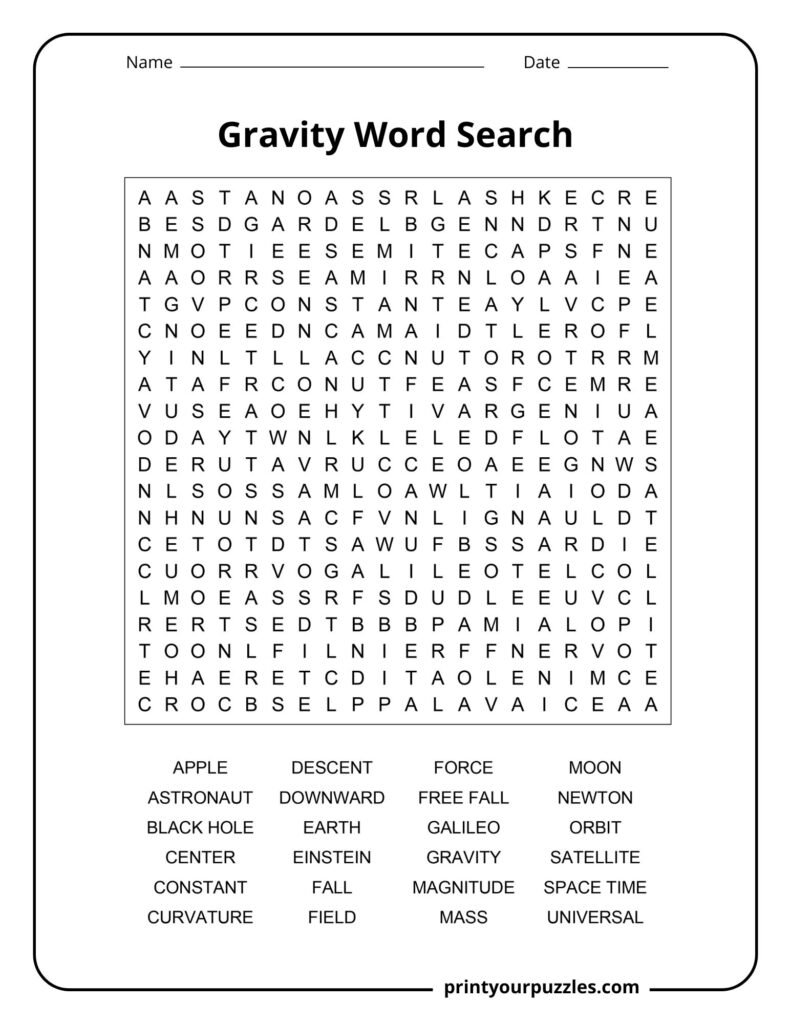
APPLE, ASTRONAUT, BLACK HOLE, CENTER, CONSTANT CURVATURE, DESCENT, DOWNWARD, EARTH, EINSTEIN, FALL, FIELD, FORCE, FREE FALL, GALILEO, GRAVITY, MAGNITUDE, MASS, MOON, NEWTON, ORBIT, SATELLITE, SPACE TIME, UNIVERSAL
Gravity is the natural force of attraction between objects with mass. It keeps planets orbiting stars, holds atmospheres in place, and gives weight to everything on Earth.
Isaac Newton famously described gravity’s laws in the 1600s after observing falling apples. Albert Einstein later revolutionized the concept with his general relativity theory in 1915.
Galileo proved that gravity accelerates all objects equally regardless of mass. Air resistance creates differences, but in a vacuum, a feather and hammer fall identically.
Yes, gravity exists everywhere in space. Astronauts appear weightless because they’re in constant freefall while orbiting Earth, not because gravity disappears. Gravity holds galaxies together.
Einstein showed that mass and energy curve spacetime itself. Objects follow these curves, which we experience as gravitational attraction. Larger masses create stronger curvature and gravitational effects.
Einstein’s theory proves that stronger gravitational fields slow down time. Clocks on GPS satellites run faster than Earth clocks, requiring constant adjustments for accurate positioning and navigation.
Earth’s rotation creates centrifugal force at the equator, slightly counteracting gravity. Additionally, Earth’s equatorial bulge means you’re farther from the planet’s center, reducing gravitational pull.
Near black holes, gravitational differences between your head and feet become so extreme that objects stretch like spaghetti. Scientists call this tidal force effect “spaghettification” in extreme conditions.
Gravitational waves, ripples in spacetime caused by massive accelerating objects, propagate at exactly the speed of light. Scientists first detected these waves in 2015 from colliding black holes.
Gravity prevents mountains from growing infinitely tall. When peaks exceed approximately 15 kilometers, their own weight causes the rock to flow like putty, collapsing under gravitational pressure.
Purus ut praesent facilisi dictumst sollicitudin cubilia ridiculus.