
This Groundhog Day word search offers an engaging and educational activity perfect for celebrating one of America’s most charming winter traditions. Whether you’re a teacher planning classroom activities, a parent seeking entertainment for children, or simply a puzzle enthusiast, this word search printable provides hours of enjoyment while teaching about groundhogs, weather folklore, and seasonal predictions.
The puzzle features 24 carefully selected words related to Groundhog Day, ranging from Phil and Shadow to Hibernate and Burrow. Each term has been chosen to capture the essence of this beloved February celebration. To enhance your learning experience, all the words to search are defined with detailed explanations of 20-30 words each, helping you understand the significance of every term you discover in the grid.
This Groundhog Day word search printable is designed with accessibility in mind, featuring words with a maximum of nine letters and including relevant two-word phrases. The alphabetically organized word list makes it easy to track your progress as you hunt for each hidden term. Perfect for all ages, this activity combines entertainment with education, making Groundhog Day more meaningful and memorable for everyone involved.
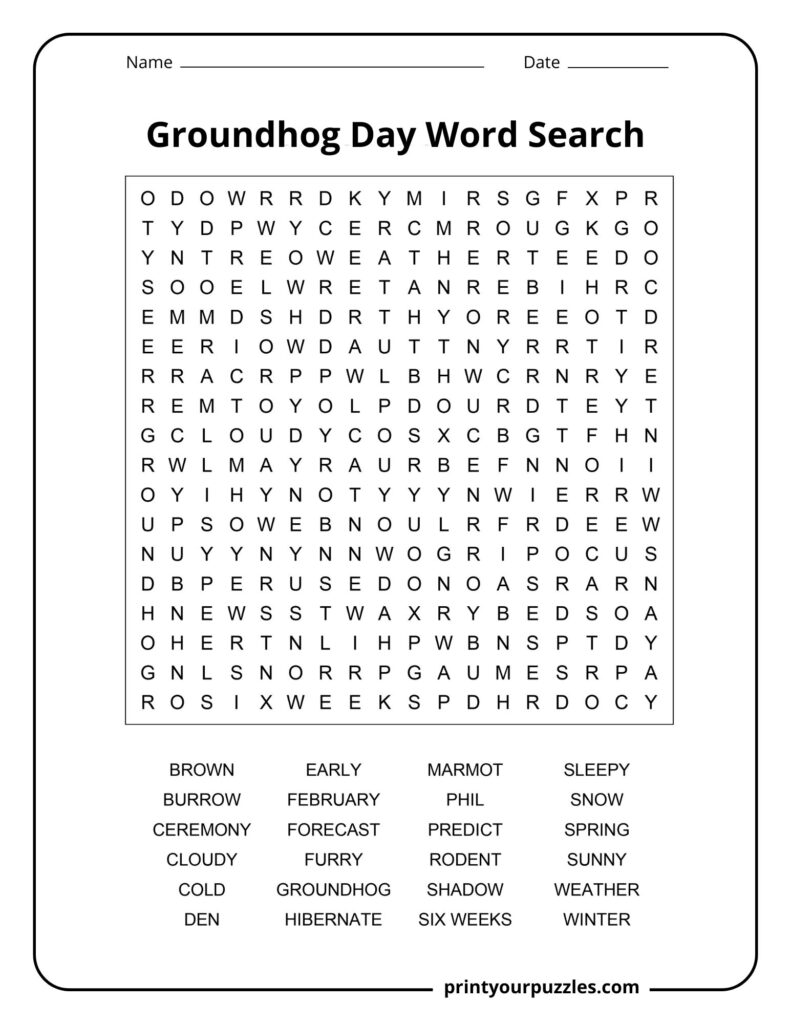
BROWN, BURROW, CEREMONY, CLOUDY, COLD, DEN, EARLY, FEBRUARY, FORECAST, FURRY, GROUNDHOG, HIBERNATE, MARMOT, PHIL, PREDICT, RODENT, SHADOW, SIX WEEKS, SLEEPY, SNOW, SPRING, SUNNY, WEATHER, WINTER
BROWN – The natural color of a groundhog’s fur, ranging from light tan to dark brown shades, providing excellent camouflage in their woodland and meadow habitats throughout North America.
BURROW – An underground tunnel system dug by groundhogs for shelter, hibernation, and raising young, typically featuring multiple entrances and chambers extending several feet below the earth’s surface.
CEREMONY – The annual Groundhog Day event held on February second, featuring crowds gathering to watch a groundhog emerge and predict weather, most famously in Punxsutawney, Pennsylvania.
CLOUDY – Weather condition with overcast skies that prevents the groundhog from seeing its shadow, traditionally predicting an early spring according to folklore and the Groundhog Day legend.
COLD – The frigid winter temperatures present during early February when Groundhog Day occurs, making the prediction of spring’s arrival particularly significant and eagerly anticipated by communities.
DEN – The main chamber within a groundhog’s burrow where the animal sleeps, hibernates through winter months, and shelters from predators and harsh weather conditions above ground.
EARLY – Describes the anticipated arrival of spring before the typical seasonal schedule, predicted when the groundhog doesn’t see its shadow on the morning of February second.
FEBRUARY – The second month of the year when Groundhog Day is celebrated annually on the second day, marking a midpoint between winter solstice and spring equinox.
FORECAST – The weather prediction made by the groundhog’s behavior on February second, supposedly indicating whether winter will continue for six more weeks or spring arrives early.
FURRY – Describes the thick, dense coat of hair covering a groundhog’s body, providing essential insulation during cold weather and protection from elements throughout the changing seasons.
GROUNDHOG – A large rodent native to North America, also called a woodchuck, known for hibernating in winter and emerging in early February to supposedly predict spring’s arrival.
HIBERNATE – The deep sleep state groundhogs enter during winter months, significantly lowering their body temperature and heart rate while surviving on stored fat until warmer spring weather arrives.
MARMOT – The scientific family name for groundhogs, which are large ground squirrels found across North America, known for their burrowing habits and hibernation patterns during winter.
PHIL – Short for Punxsutawney Phil, the most famous groundhog in America who emerges annually in Pennsylvania to make his traditional weather prediction before enthusiastic crowds.
PREDICT – To forecast future weather patterns based on whether the groundhog sees its shadow, a folklore tradition connecting animal behavior with upcoming seasonal changes and spring’s arrival.
RODENT – The mammal classification for groundhogs, characterized by continuously growing front teeth used for gnawing, including squirrels, beavers, and other similar small to medium-sized animals.
SHADOW – The dark silhouette cast by the groundhog on sunny February mornings which, according to tradition, frightens the animal back underground, predicting six more weeks of winter.
SIX WEEKS – The additional duration of winter weather predicted when the groundhog sees its shadow and retreats to its burrow, extending cold conditions until spring finally arrives in late March.
SLEEPY – The drowsy, lethargic state of groundhogs emerging from months of hibernation in early February, still groggy from their long winter sleep underground in their dens.
SNOW – Frozen precipitation typical of winter weather in early February, often present during Groundhog Day celebrations and associated with the continuation of cold seasonal conditions ahead.
SPRING – The season of renewal and warming temperatures that groundhogs supposedly predict will arrive early if they don’t see their shadow on the morning of February second.
SUNNY – Clear, bright weather conditions that create shadows on Groundhog Day, traditionally indicating six more weeks of winter when the groundhog sees its silhouette and retreats underground.
WEATHER – Atmospheric conditions including temperature, precipitation, and cloud cover that groundhogs supposedly predict on February second, influencing expectations for winter’s end and spring’s beginning.
WINTER – The coldest season of the year when groundhogs hibernate underground, with Groundhog Day occurring during its midpoint to predict whether cold weather will continue longer.
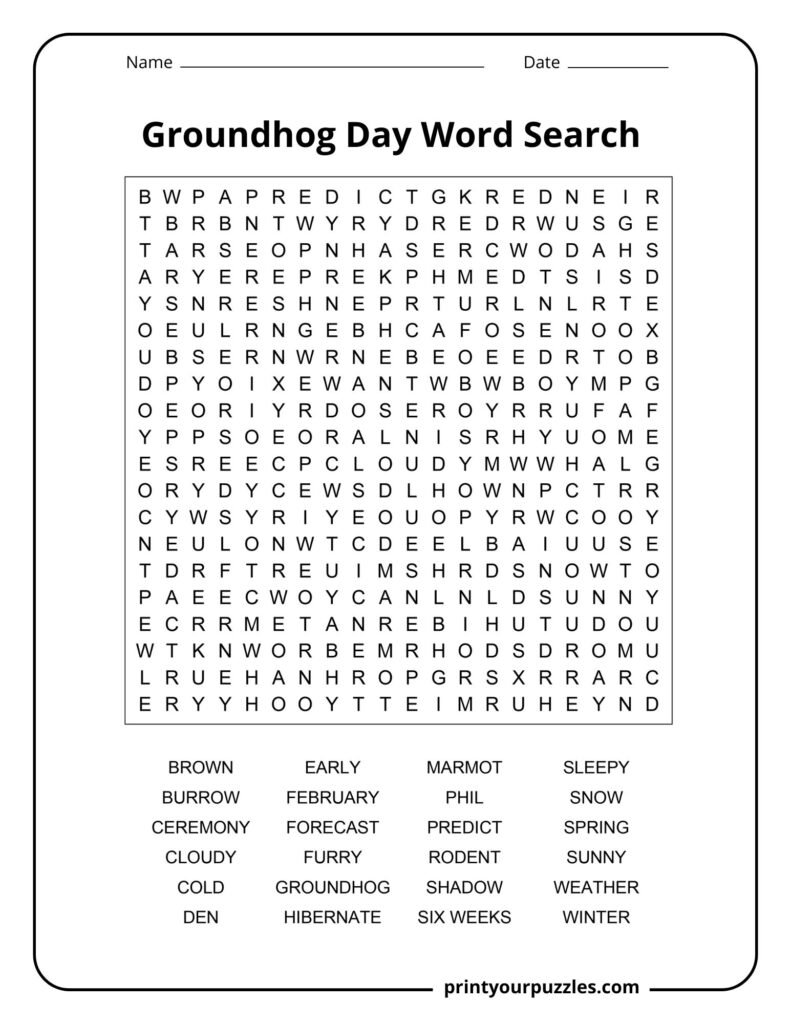
BROWN, BURROW, CEREMONY, CLOUDY, COLD, DEN, EARLY, FEBRUARY, FORECAST, FURRY, GROUNDHOG, HIBERNATE, MARMOT, PHIL, PREDICT, RODENT, SHADOW, SIX WEEKS, SLEEPY, SNOW, SPRING, SUNNY, WEATHER, WINTER
Groundhog Day is celebrated annually on February 2nd, marking the midpoint between the winter solstice and spring equinox, with festivities occurring early in the morning across North America.
Groundhog Day is a North American tradition where a groundhog emerges from hibernation to predict weather patterns. Its shadow supposedly indicates whether winter will last six more weeks.
Punxsutawney Phil is the most famous groundhog in America, residing in Punxsutawney, Pennsylvania. He has been making weather predictions since 1887, becoming an iconic symbol of this tradition.
If the groundhog sees its shadow on a sunny February morning, folklore says it will retreat underground, predicting six more weeks of winter weather ahead for everyone.
Groundhog Day originated from German immigrants who brought Candlemas traditions to Pennsylvania. They adapted the custom using groundhogs instead of European badgers or hedgehogs for weather predictions.
Despite his fame and centuries of predictions, meteorological studies show Phil’s forecasts are less reliable than simply flipping a coin, yet the beloved tradition continues attracting thousands annually.
His handlers claim this special potion grants him longevity, though wild groundhogs typically live only six years, while captive ones survive approximately fourteen years maximum.
The film’s cultural impact transformed a regional Pennsylvania celebration into an internationally recognized event, increasing attendance at Punxsutawney from thousands to tens of thousands of visitors.
Wiarton Willie has been making predictions since 1956 from the town of Wiarton. The celebration attracts thousands of visitors annually, featuring festivals, parades, and live music throughout the weekend.
German immigrants adapted this holiday, replacing European hedgehogs and badgers with Pennsylvania’s abundant groundhogs, creating America’s unique folklore tradition that continues thriving today.

Purus ut praesent facilisi dictumst sollicitudin cubilia ridiculus.