
This Jimmy Carter word search celebrates the life and legacy of James Earl Carter Jr., the 39th President of the United States who served from 1977 to 1981. Born in Plains, Georgia, in 1924, Carter rose from humble beginnings as a peanut farmer to become a Naval Academy graduate, submarine officer, state senator, governor, and ultimately president. His journey represents the American ideal of public service rooted in faith, integrity, and compassion.
Carter’s presidency was marked by significant achievements including the historic Camp David Accords that brought peace between Egypt and Israel, the Panama Canal Treaties, and a strong emphasis on human rights in foreign policy. Though he faced challenges such as the Iran hostage crisis and economic difficulties, his post-presidential life has been even more remarkable. Carter devoted decades to humanitarian work through Habitat for Humanity and the Carter Center, earning the Nobel Peace Prize in 2002 for his efforts in advancing peace, democracy, and human rights worldwide.
This Jimmy Carter word search printable goes beyond a simple puzzle. It includes comprehensive definitions for all 24 words, helping learners understand the significance of each term. You’ll also find a detailed FAQ section answering key questions about Carter’s life and a fascinating “Did You Know?” section featuring surprising facts—such as Carter helping prevent a nuclear meltdown in Canada while serving in the Navy.
This word search printable transforms entertainment into education, making it perfect for classrooms, homeschooling, or anyone interested in presidential history. Each element works together to provide a complete learning experience about one of America’s most dedicated public servants.
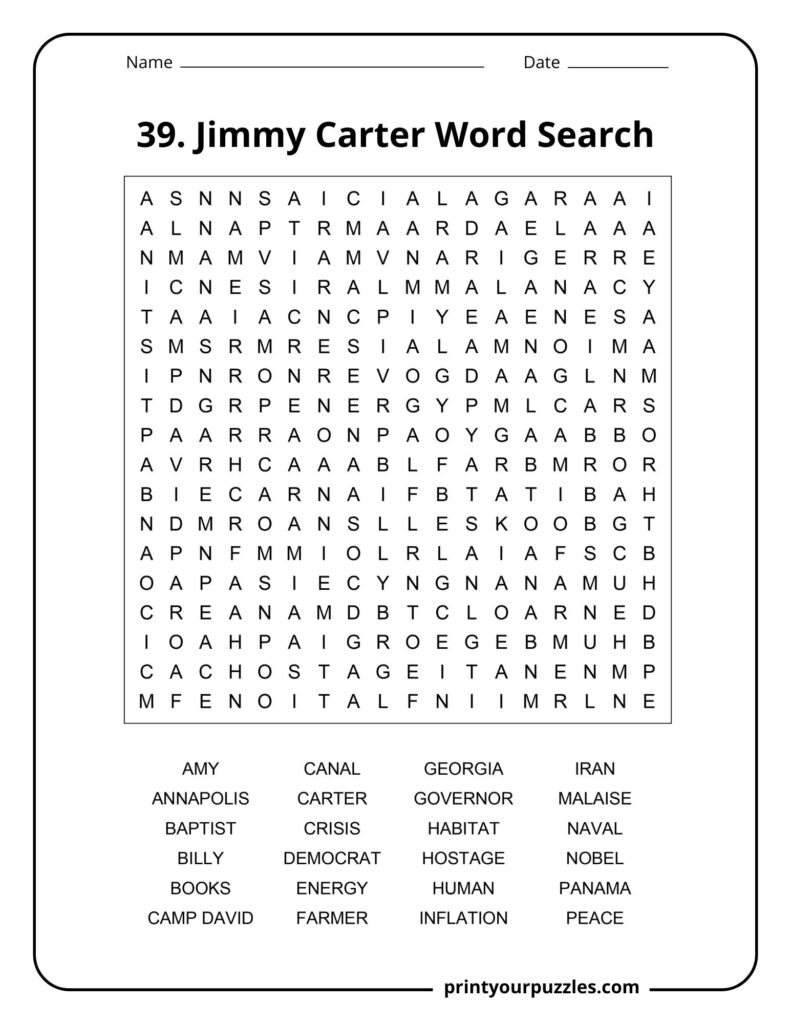
AMY, ANNAPOLIS, BAPTIST, BILLY, BOOKS, CAMP DAVID, CANAL, CARTER, CRISIS, DEMOCRAT, ENERGY, FARMER, GEORGIA, GOVERNOR, HABITAT, HOSTAGE, HUMAN, INFLATION, IRAN, MALAISE, NAVAL, NOBEL, PANAMA, PEACE
AMY – Carter’s daughter Amy Lynn, born in 1967, lived in the White House as a child and became known for her treehouse and public school attendance.
ANNAPOLIS – United States Naval Academy in Maryland where Carter graduated in 1946, launching his career as a naval officer and submarine specialist under Admiral Rickover.
BAPTIST – Carter’s devout Southern Baptist faith deeply influenced his moral approach to politics, human rights advocacy, and his Sunday school teaching that continues today.
BILLY – Carter’s younger brother Billy gained national attention for his colorful personality, beer brand, and controversial dealings with Libya during Carter’s presidency years.
BOOKS – Carter authored over 30 books post-presidency, including memoirs, poetry, fiction, and works on faith, Middle East peace, aging, and American values.
CAMP DAVID – Historic 1978 peace accords Carter brokered between Egypt’s Sadat and Israel’s Begin at the presidential retreat, achieving a landmark Middle East treaty.
CANAL – Panama Canal Treaties signed in 1977 transferred canal control to Panama by 1999, a controversial but diplomatically significant achievement of Carter’s presidency.
CARTER – James Earl Carter Jr., 39th U.S. President (1977-1981), Georgia peanut farmer who emphasized human rights, diplomacy, and later became renowned humanitarian.
CRISIS – Carter faced multiple crises including the Iran hostage situation, energy shortages, Soviet invasion of Afghanistan, and Three Mile Island nuclear accident during presidency.
DEMOCRAT – Carter served as Democratic Party president, governor, and senator, representing moderate Southern Democratic values emphasizing fiscal responsibility and social justice throughout career.
ENERGY – Carter created the Department of Energy, promoted conservation, installed White House solar panels, and championed energy independence during 1970s oil crisis era.
FARMER – Carter managed his family’s peanut farming business in Plains, Georgia, bringing agricultural perspective and small-town values to his political career and presidency.
GEORGIA – Carter’s home state where he served as state senator and governor before presidency, and where he returned to continue humanitarian work.
GOVERNOR – Carter served as Georgia’s 76th governor from 1971-1975, implementing government reorganization, environmental protection, and civil rights advances before presidential campaign.
HABITAT – Habitat for Humanity became Carter’s signature post-presidential cause, personally building homes for decades through Carter Work Projects promoting affordable housing worldwide.
HOSTAGE – Fifty-two Americans held hostage in Iran for 444 days dominated Carter’s final presidency year, with failed rescue attempt undermining his reelection campaign.
HUMAN – Carter championed human rights as central foreign policy principle, criticizing abuses worldwide and tying American aid to countries’ human rights records internationally.
INFLATION – Double-digit inflation plagued Carter’s presidency, reaching over 13%, contributing to economic “stagflation” combining high inflation with unemployment and slow growth challenges.
IRAN – Iranian Revolution and hostage crisis defined Carter’s final presidency years, with diplomatic efforts failing and military rescue attempt ending disastrously in desert.
MALAISE – Carter’s 1979 “Crisis of Confidence” speech addressed national pessimism about energy and economic problems, though “malaise” word became wrongly associated with address.
NAVAL – Carter served seven years as U.S. Navy officer on submarines, including nuclear submarine program under Admiral Rickover, shaping his technical and disciplined approach.
NOBEL – Carter received 2002 Nobel Peace Prize for decades of humanitarian work, conflict resolution, disease eradication, and election monitoring through his Atlanta-based Carter Center.
PANAMA – Panama Canal Treaties returned canal sovereignty to Panama, representing Carter’s diplomatic approach but facing significant domestic political opposition and Senate ratification battle.
PEACE – Carter devoted post-presidency to global peace efforts, mediating conflicts, monitoring elections, and promoting democracy through Carter Center’s international humanitarian mission work.
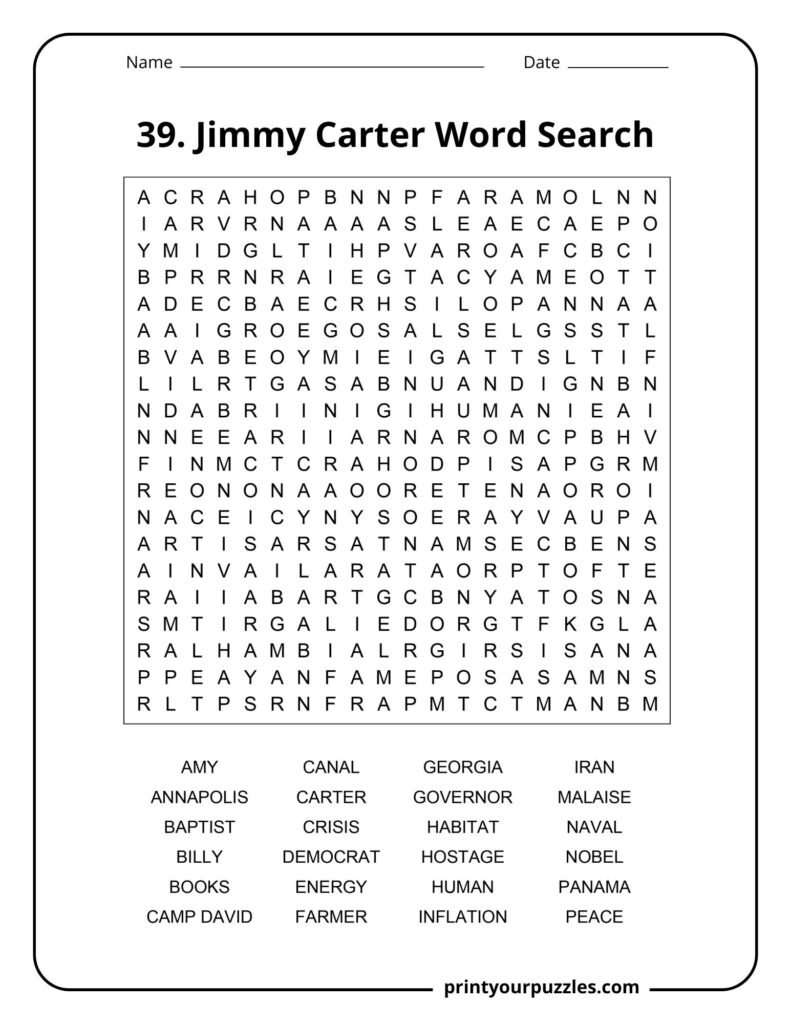
AMY, ANNAPOLIS, BAPTIST, BILLY, BOOKS, CAMP DAVID, CANAL, CARTER, CRISIS, DEMOCRAT, ENERGY, FARMER, GEORGIA, GOVERNOR, HABITAT, HOSTAGE, HUMAN, INFLATION, IRAN, MALAISE, NAVAL, NOBEL, PANAMA, PEACE
Jimmy Carter served as the 39th President from January 20, 1977, to January 20, 1981. He lost his reelection bid to Ronald Reagan in 1980.
Carter is most famous for brokering the Camp David Accords between Egypt and Israel in 1978, creating lasting Middle East peace and demonstrating successful diplomatic negotiation.
Carter won for his decades of humanitarian work through the Carter Center, advancing peace, democracy, human rights, disease eradication, and election monitoring across the globe.
Carter graduated from the Naval Academy, served as a submarine officer, managed his family’s peanut farm, and served as Georgia state senator and governor.
Carter and his wife Rosalynn became Habitat’s most famous volunteers in 1984, personally building homes for decades through annual Carter Work Projects promoting affordable housing worldwide.
For official administration records and historical biography, visit the James Carter page in the White House Archives. If you are planning a trip, visit the official Jimmy Carter Presidential Library.
The Outlier: The Unfinished Presidency of Jimmy Carter by Kai Bird. A balanced, sympathetic portrait of an idealist whose political limitations collided with turbulent times, yet whose post-presidency became legendary.
Carter filed an official UFO report describing a bright, color-changing object he witnessed in Georgia. He promised presidential UFO investigation but never declassified documents as pledged
Carter continued teaching Baptist Sunday school classes in Plains, Georgia, well into his 90s, drawing visitors worldwide to hear the former president’s biblical lessons and reflections.
As a Navy lieutenant, Carter led a team into a damaged Canadian nuclear reactor, exposing himself to radiation to help dismantle the core and prevent catastrophic disaster.
Billy Beer launched in 1977, capitalizing on his brother’s presidency. Despite initial popularity and millions of cans produced, the brand failed and ceased production within years.
Beyond political memoirs, Carter wrote poetry collections, a novel titled “The Hornet’s Nest” about the Revolutionary War, and children’s books, showcasing his diverse literary talents.