
Discover American history through this engaging Louisiana Purchase word search that brings one of the nation’s most transformative events to life. In 1803, the United States acquired approximately 828,000 square miles from France for fifteen million dollars, doubling the country’s size and opening vast territories for exploration and settlement.
This educational puzzle features 24 carefully selected terms related to the historic transaction, including key figures like Jefferson, Napoleon, Lewis, and Clark, alongside important concepts such as Expansion, Treaty, Territory, and Frontier. Each word captures an essential element of this pivotal moment that shaped America’s destiny.
What makes this Louisiana Purchase word search printable especially valuable is that every term is thoroughly defined with detailed 20-30 word explanations, helping students and history enthusiasts understand the significance behind each word they find. This word search printable serves as both an entertaining puzzle and a comprehensive learning tool, perfect for classrooms, homeschool environments, or independent study. Whether you’re a teacher seeking engaging activities or a history buff exploring America’s past, this word search offers an enjoyable way to master Louisiana Purchase vocabulary and concepts.
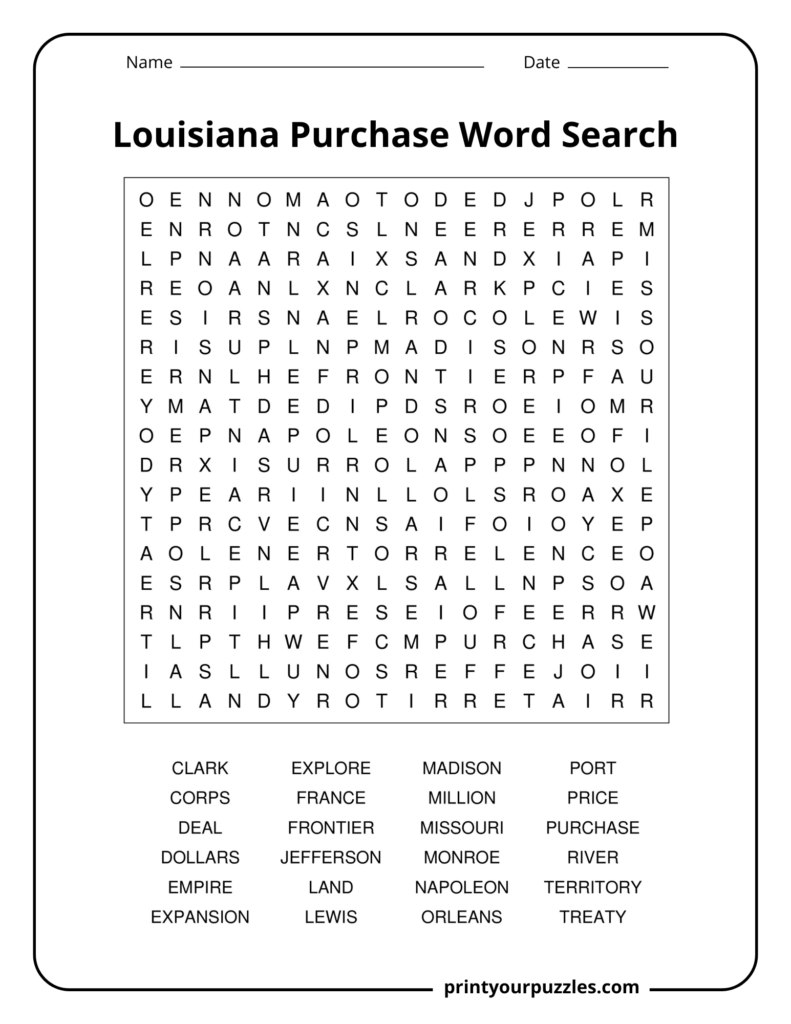
CLARK, CORPS, DEAL, DOLLARS, EMPIRE, EXPANSION, EXPLORE, FRANCE, FRONTIER, JEFFERSON, LAND, LEWIS, MADISON, MILLION, MISSOURI, MONROE, NAPOLEON, ORLEANS, PORT, PRICE, PURCHASE, RIVER, TERRITORY, TREATY
CLARK – William Clark co-led the Corps of Discovery expedition with Meriwether Lewis, mapping and exploring the newly acquired Louisiana Territory from 1804 to 1806.
CORPS – The Corps of Discovery was the exploration team led by Lewis and Clark that surveyed the Louisiana Territory, documenting geography, wildlife, and native peoples.
DEAL – The Louisiana Purchase deal was a land transaction negotiated between the United States and France, doubling America’s size for approximately fifteen million dollars in 1803.
DOLLARS – Fifteen million dollars was paid for the Louisiana Territory, equating to roughly three cents per acre, making it one of history’s greatest real estate bargains.
EMPIRE – Napoleon’s French Empire controlled Louisiana briefly before selling it to fund European wars, ending France’s colonial ambitions in mainland North America forever.
EXPANSION – The Louisiana Purchase enabled westward expansion of the United States, doubling the nation’s territory and providing vast lands for settlement, agriculture, and future statehood.
EXPLORE – President Jefferson commissioned Lewis and Clark to explore the Louisiana Territory, seeking routes to the Pacific and documenting the region’s resources and inhabitants.
FRANCE – France sold Louisiana to the United States in 1803 under Napoleon Bonaparte, who needed funds for European military campaigns and couldn’t defend distant territories.
FRONTIER – The Louisiana Purchase pushed America’s frontier dramatically westward, opening vast new lands beyond the Mississippi River for exploration, settlement, and economic development opportunities.
JEFFERSON – President Thomas Jefferson orchestrated the Louisiana Purchase in 1803, despite constitutional concerns, believing the acquisition essential for America’s agricultural future and security.
LAND – The Louisiana Purchase encompassed approximately 828,000 square miles of land, stretching from the Mississippi River to the Rocky Mountains, doubling United States territory overnight.
LEWIS – Meriwether Lewis, Jefferson’s personal secretary, led the Corps of Discovery expedition alongside William Clark, exploring and mapping the vast Louisiana Territory comprehensively.
MADISON – James Madison served as Secretary of State under Jefferson, helping negotiate the Louisiana Purchase and later becoming the fourth President of the United States.
MILLION – The United States paid fifteen million dollars total for the Louisiana Territory, with eleven million going to France and four million settling American claims.
MISSOURI – The Missouri River was a major waterway explored by Lewis and Clark, serving as a crucial route through the Louisiana Territory toward the Pacific.
MONROE – James Monroe, as minister to France, helped negotiate the Louisiana Purchase alongside Robert Livingston, securing the transformative 1803 agreement with Napoleon’s government.
NAPOLEON – Napoleon Bonaparte sold Louisiana to fund his European wars and prevent British seizure of the territory, dramatically altering North American history forever.
ORLEANS – New Orleans was a strategic port city controlling Mississippi River access, making its acquisition vital for American commerce and westward expansion efforts.
PORT – Control of port access along the Mississippi River, especially New Orleans, was crucial for American farmers shipping goods, motivating the Louisiana Purchase negotiations.
PRICE – The purchase price of fifteen million dollars seemed enormous in 1803 but proved extraordinarily economical, costing approximately three cents per acre of land.
PURCHASE – The Louisiana Purchase was the 1803 acquisition of French territory by the United States, doubling the nation’s size and reshaping America’s continental destiny.
RIVER – The Mississippi River formed the eastern boundary of the Louisiana Territory, serving as a vital commercial waterway connecting interior settlements to ocean ports.
TERRITORY – The Louisiana Territory comprised land from the Mississippi River to the Rocky Mountains, eventually forming multiple states including Louisiana, Arkansas, Missouri, and others.
TREATY – The treaty finalizing the Louisiana Purchase was signed in 1803, officially transferring French territorial claims to the United States for fifteen million dollars.
CLARK, CORPS, DEAL, DOLLARS, EMPIRE, EXPANSION, EXPLORE, FRANCE, FRONTIER, JEFFERSON, LAND, LEWIS, MADISON, MILLION, MISSOURI, MONROE, NAPOLEON, ORLEANS, PORT, PRICE, PURCHASE, RIVER, TERRITORY, TREATY
The Louisiana Purchase was the 1803 acquisition of French-controlled territory by the United States for fifteen million dollars, doubling the nation’s size and adding approximately 828,000 square miles.
Napoleon Bonaparte needed funds for European wars and couldn’t defend the distant territory from British seizure. Selling Louisiana provided immediate cash and prevented enemy acquisition of the land.
President Jefferson questioned whether the Constitution allowed territorial purchases. Despite concerns, he proceeded, arguing the treaty-making power and national interest justified the acquisition, setting important presidential precedent.
The Louisiana Purchase eventually formed fifteen states entirely or partially, including Louisiana, Arkansas, Missouri, Iowa, Nebraska, Kansas, Oklahoma, Colorado, Montana, Wyoming, Minnesota, North Dakota, and South Dakota.
Meriwander Lewis and William Clark led the Corps of Discovery expedition from 1804 to 1806, mapping the territory, documenting wildlife and geography, and establishing relationships with Native American tribes.
At fifteen million dollars for 828,000 square miles, the United States paid approximately 2.8 cents per acre, making it history’s greatest real estate bargain and most economical land acquisition.
Napoleon feared losing Louisiana to Britain during European conflicts. By selling it to America, he gained immediate funds while denying his British enemies strategic North American territory.
American diplomats James Monroe and Robert Livingston expected to negotiate only for New Orleans. When Napoleon surprisingly offered the entire territory, they quickly finalized the unprecedented deal.
Spain returned Louisiana to France in the secret 1800 Treaty of San Ildefonso. Most Americans didn’t know France controlled it until Napoleon sold the territory three years later.
Many Federalists argued the price was excessive, the territory too large to govern, and the acquisition unconstitutional, fearing it would weaken eastern states’ political influence dramatically.
Purus ut praesent facilisi dictumst sollicitudin cubilia ridiculus.