
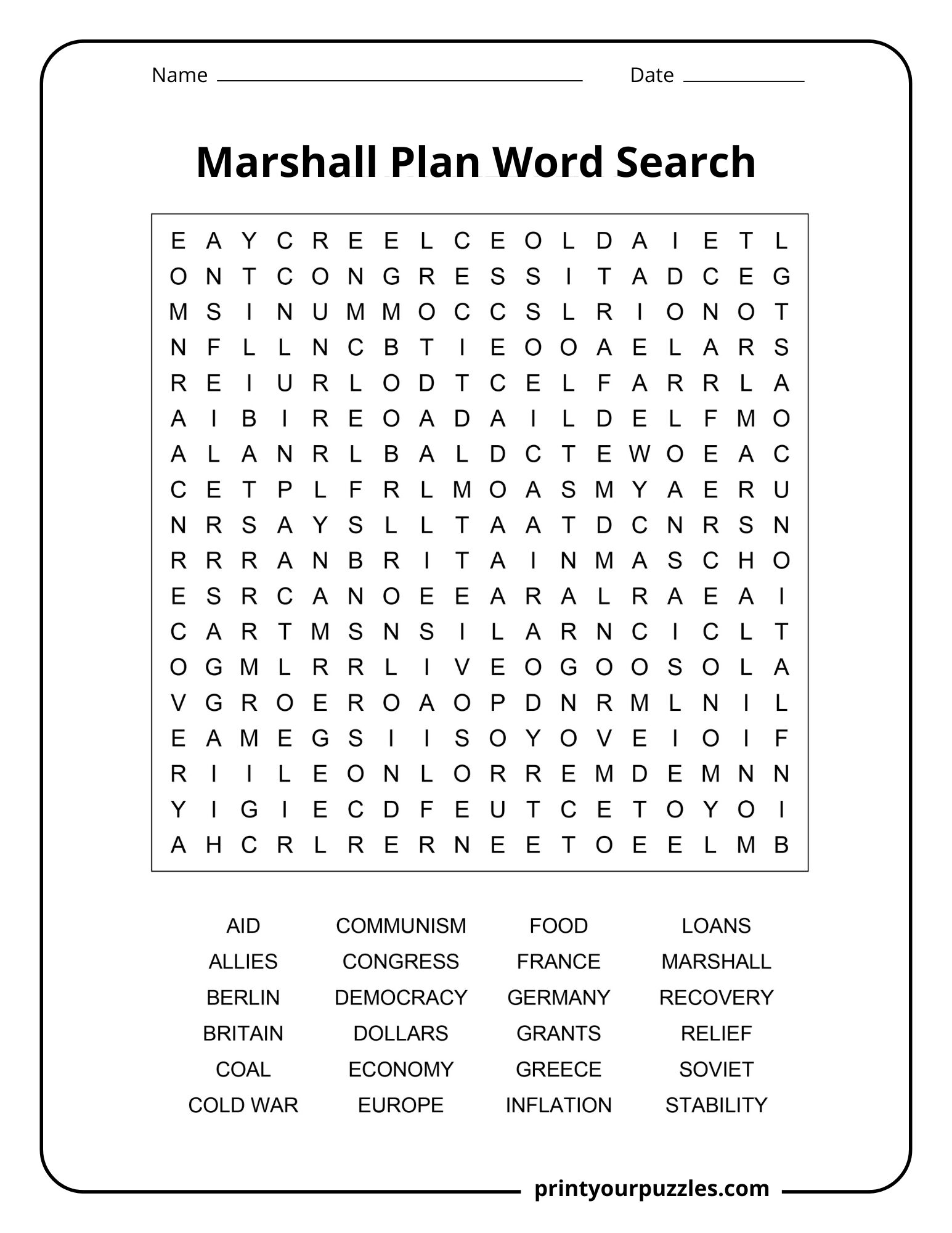
This Marshall Plan word search offers an engaging way to explore one of the most significant American foreign policy initiatives in history. The Marshall Plan, officially known as the European Recovery Program, provided crucial economic assistance to war-torn European nations after World War II, helping rebuild economies and prevent the spread of communism during the early Cold War era.
This Marshall Plan word search printable features 24 carefully selected terms that capture the essential elements of this historic program. From key countries like Britain, France, and Germany to fundamental concepts such as democracy, recovery, and stability, each word represents an important aspect of the Marshall Plan’s impact on postwar Europe. The puzzle includes single words and two-word phrases, all containing nine letters or fewer for optimal puzzle design.
What makes this word search printable particularly educational is that all words are comprehensively defined with detailed 20-30 word explanations. This ensures that students and history enthusiasts not only find the terms but also understand their historical significance and connection to the Marshall Plan. Whether used in classrooms or for independent learning, this activity combines puzzle-solving fun with meaningful historical education.
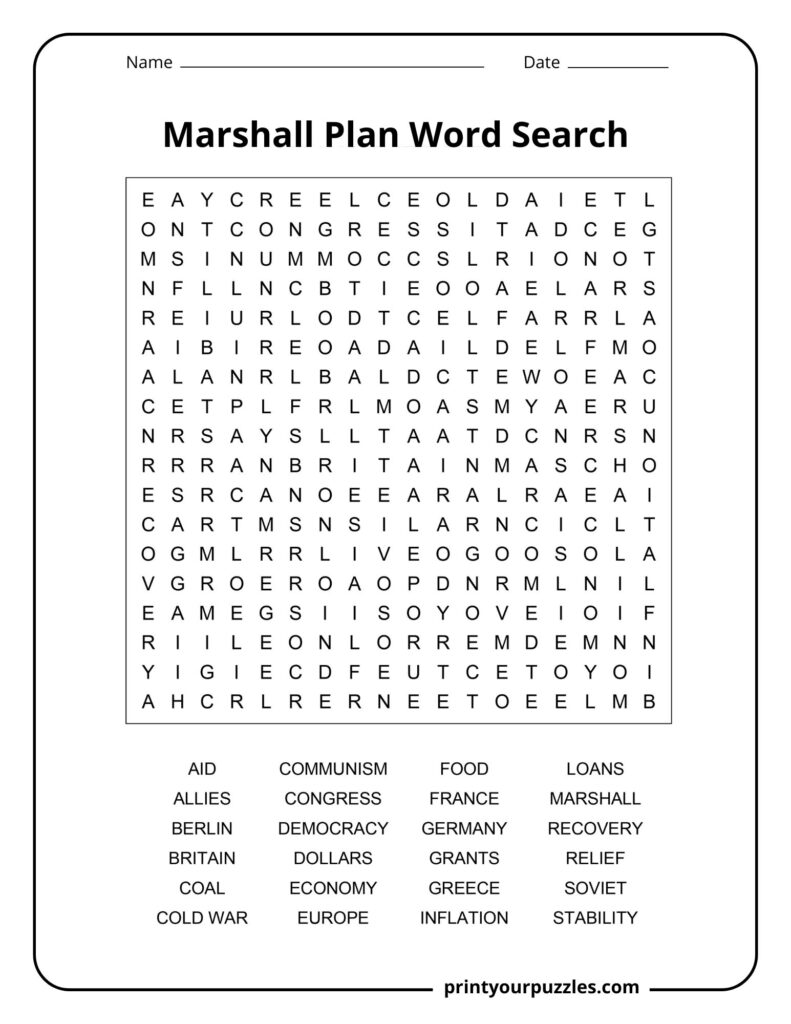
AID, ALLIES, BERLIN, BRITAIN, COAL, COLD WAR, COMMUNISM, CONGRESS, DEMOCRACY, DOLLARS, ECONOMY, EUROPE, FOOD, FRANCE, GERMANY, GRANTS, GREECE, INFLATION, LOANS, MARSHALL, RECOVERY, RELIEF, SOVIET, STABILITY
AID – Financial and material assistance provided by the United States to European nations after World War II to help rebuild their economies and infrastructure.
ALLIES – Western European nations that partnered with the United States during World War II and received Marshall Plan assistance to rebuild and resist Soviet influence.
BERLIN – German city that became a focal point of Cold War tensions, where the Marshall Plan helped support West Berlin’s economic recovery and stability.
BRITAIN – Major European recipient of Marshall Plan funds, receiving significant financial aid to rebuild its war-damaged economy and maintain its role in European recovery.
COAL – Essential natural resource needed for industrial production and heating, whose shortage in postwar Europe the Marshall Plan helped address through strategic distribution.
COLD WAR – Geopolitical tension between the United States and Soviet Union that influenced the Marshall Plan’s creation as a strategy to contain communism in Europe.
COMMUNISM – Political and economic ideology that the Marshall Plan aimed to prevent from spreading in Western Europe by strengthening democratic capitalist economies there.
CONGRESS – United States legislative body that debated and ultimately approved funding for the Marshall Plan, officially called the European Recovery Program in 1948.
DEMOCRACY – Form of government that the Marshall Plan sought to strengthen in Western Europe by providing economic stability and prosperity to democratic nations.
DOLLARS – American currency totaling approximately thirteen billion dollars that was distributed to European countries through the Marshall Plan between 1948 and 1952.
ECONOMY – System of production and trade that the Marshall Plan targeted for reconstruction, helping European nations restore industrial capacity and commercial activity after war.
EUROPE – Continent devastated by World War II that received American economic assistance through the Marshall Plan to rebuild infrastructure, industry, and agriculture comprehensively.
FOOD – Critical resource in short supply after World War II that the Marshall Plan provided to prevent starvation and malnutrition across war-torn European nations.
FRANCE – Key Marshall Plan recipient that used American aid to modernize its economy, rebuild infrastructure, and become a cornerstone of European economic integration.
GERMANY – Divided nation whose western zones received Marshall Plan assistance to rebuild industry and create economic stability, preventing communist expansion from the
east.
GRANTS – Direct financial transfers given to European countries without repayment obligations, comprising a significant portion of the Marshall Plan’s total economic assistance package.
GREECE – Strategic Mediterranean nation that received Marshall Plan aid to rebuild after civil war and resist communist insurgency, maintaining Western alignment during reconstruction.
INFLATION – Economic problem of rapidly rising prices that threatened European stability, which the Marshall Plan helped control by increasing supply of goods and currency.
LOANS – Financial assistance provided to European countries with favorable repayment terms, complementing outright grants as part of the Marshall Plan’s comprehensive economic aid.
MARSHALL – George C. Marshall, United States Secretary of State who proposed the European Recovery Program in 1947, earning the Nobel Peace Prize for it.
RECOVERY – Process of rebuilding European economies, industries, and societies after World War II devastation, which the Marshall Plan successfully accelerated through coordinated international cooperation.
RELIEF – Immediate humanitarian assistance including food, fuel, and medical supplies that the Marshall Plan provided to address urgent needs in postwar European nations.
SOVIET – Referring to the USSR, which rejected Marshall Plan participation and prevented Eastern European satellite states from accepting American economic assistance offers.
STABILITY – Political and economic steadiness that the Marshall Plan aimed to achieve in Europe, preventing chaos that could lead to communist takeovers or renewed conflict.
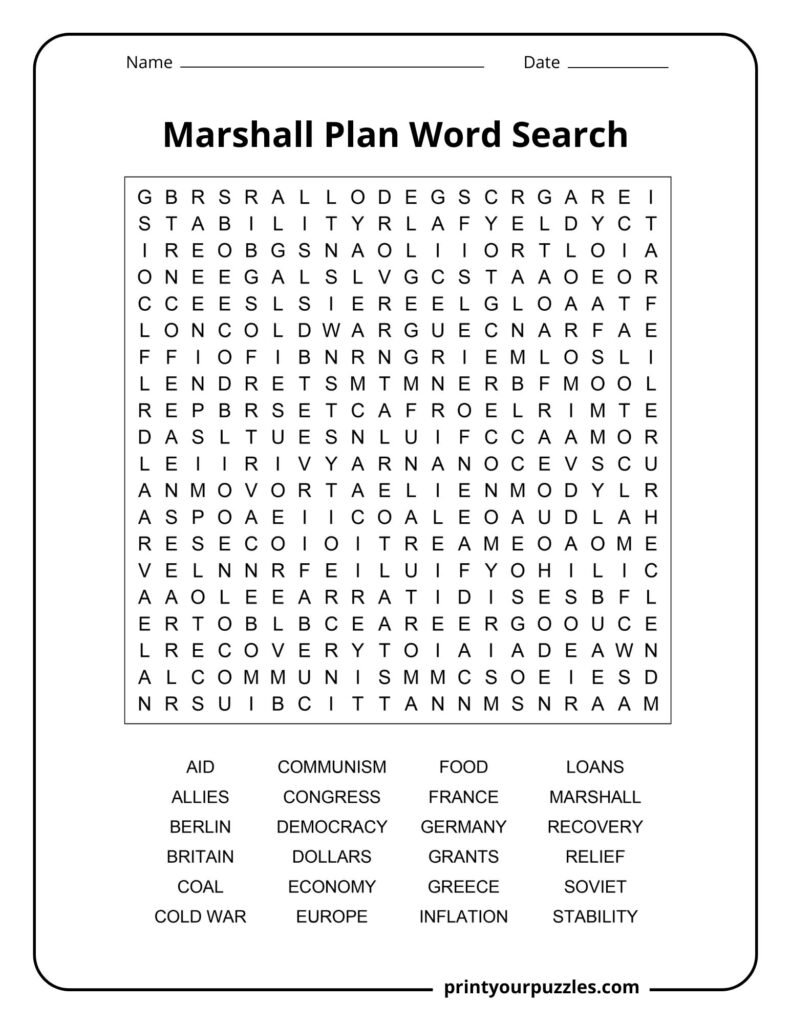
AID, ALLIES, BERLIN, BRITAIN, COAL, COLD WAR, COMMUNISM, CONGRESS, DEMOCRACY, DOLLARS, ECONOMY, EUROPE, FOOD, FRANCE, GERMANY, GRANTS, GREECE, INFLATION, LOANS, MARSHALL, RECOVERY, RELIEF, SOVIET, STABILITY
The Marshall Plan was an American initiative launched in 1948 that provided over $13 billion in economic assistance to help rebuild Western European economies after World War II.
The plan aimed to rebuild war-torn Europe, prevent economic collapse, stop the spread of communism, create stable democracies, and establish markets for American goods.
Sixteen Western European nations participated, including Britain, France, West Germany, Italy, the Netherlands, Belgium, Austria, Greece, Turkey, and the Scandinavian countries. Eastern European nations declined.
The Marshall Plan operated for four years, from April 1948 to December 1951, distributing approximately $13 billion in economic and technical assistance across participating European nations.
Yes, the plan succeeded remarkably. European industrial production increased significantly, living standards improved, economic stability returned, and Western Europe remained aligned with democratic capitalism, resisting communist expansion.
In 1953, George C. Marshall became the only career military officer to receive the Nobel Peace Prize, honored for creating the Marshall Plan that rebuilt Europe peacefully.
The $13 billion spent between 1948-1951 equals approximately $150-175 billion in today’s currency, representing one of history’s largest peaceful international aid programs ever undertaken.
Stalin and Eastern European nations were offered Marshall Plan assistance but rejected it, viewing the program as American economic imperialism designed to undermine Soviet influence.
Former Nazi Germany received substantial Marshall Plan aid, approximately $1.4 billion, helping transform it into Europe’s strongest economy and a democratic ally against communism.
George Marshall first proposed the European Recovery Program during a Harvard University graduation ceremony on June 5, 1947, in a brief, understated ten-minute address.
Purus ut praesent facilisi dictumst sollicitudin cubilia ridiculus.