
This Martin Luther King Jr. Day word search offers an enriching educational experience that combines entertainment with meaningful learning about one of America’s most celebrated civil rights leaders. Observed annually on the third Monday of January, this federal holiday honors Dr. King’s extraordinary contributions to equality and justice. Featuring 24 carefully curated words related to Dr. King’s life, values, and the civil rights movement, this puzzle provides an engaging way to commemorate this important day.
What makes this Martin Luther King word search especially valuable is that every single word included in the puzzle comes with a comprehensive definition of 20-30 words. This means participants don’t just search for terms like Freedom, Equality, and Justice—they also learn exactly what these concepts meant to Dr. King and the movement he led. Each definition provides historical context and educational depth, transforming a simple puzzle into a powerful teaching tool.
Perfect for classrooms, homeschool settings, or family activities, this word search printable and MLK Day word search resource encourages thoughtful discussion about courage, activism, and social justice. As you locate each word in the grid, take time to read its definition and reflect on how King’s legacy continues inspiring positive change today. This combination of puzzle-solving and learning creates a memorable way to honor his dream.
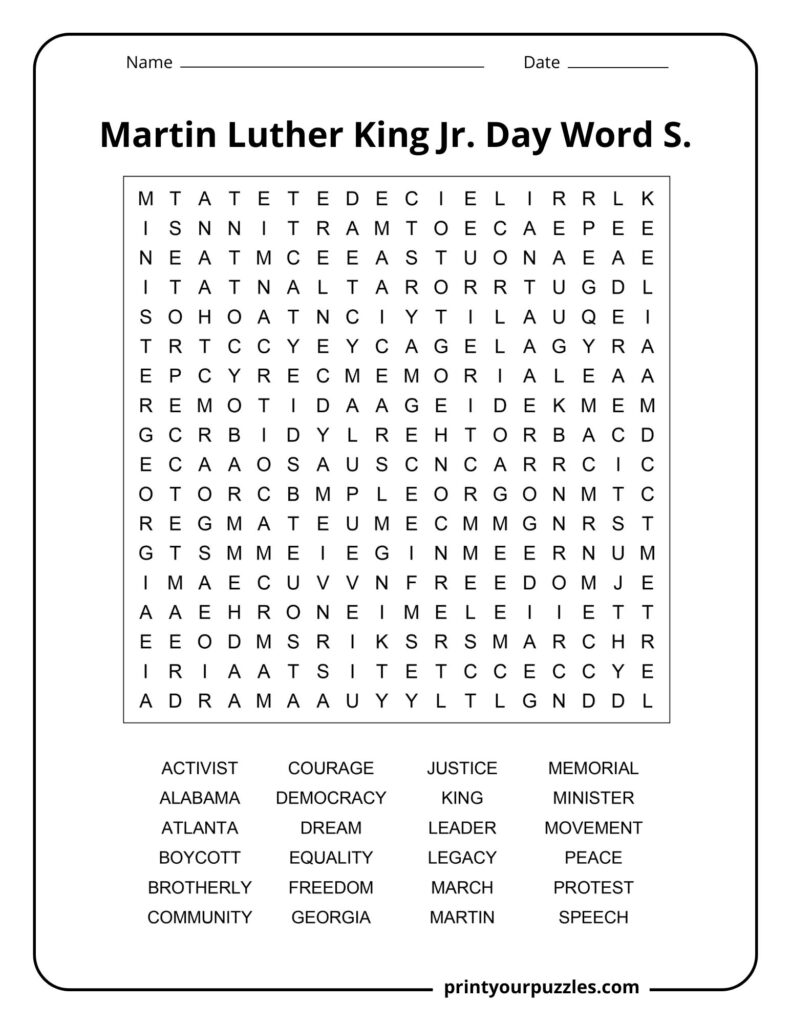
ACTIVIST, ALABAMA, ATLANTA, BOYCOTT, BROTHERLY, COMMUNITY, COURAGE, DEMOCRACY, DREAM, EQUALITY, FREEDOM, GEORGIA, JUSTICE, KING, LEADER, LEGACY, MARCH, MARTIN, MEMORIAL, MINISTER, MOVEMENT, PEACE, PROTEST, SPEECH
ACTIVIST – A person who campaigns vigorously for political or social change, often through protests, organizing, and advocacy to challenge injustice and promote equality in society.
ALABAMA – A southern state where pivotal civil rights events occurred, including the Montgomery Bus Boycott and the Selma to Montgomery marches that helped transform American history.
ATLANTA – The capital city of Georgia where Martin Luther King Jr. was born in 1929 and where he served as co-pastor at Ebenezer Baptist Church.
BOYCOTT – A form of protest where people refuse to buy products or use services from a company or organization to pressure them into changing unjust policies.
BROTHERLY – Showing affection, loyalty, and kindness toward others as if they were family members, reflecting the ideal of universal human connection and compassion that King advocated.
COMMUNITY – A group of people living in the same area or sharing common interests, values, and goals, working together for mutual support and collective betterment.
COURAGE – The mental and moral strength to face danger, fear, or difficulty with bravery, essential for those who stood against injustice during the civil rights movement.
DEMOCRACY – A system of government where citizens exercise power through voting and participation, ensuring that all people have equal voice and representation in their nation’s decisions.
DREAM – King’s famous vision of a future America where people are judged by their character rather than skin color, articulated in his iconic speech in 1963.
EQUALITY – The state where all people have the same rights, opportunities, and treatment regardless of race, gender, religion, or other characteristics that shouldn’t determine human worth.
FREEDOM – The power and right to act, speak, and think without oppressive restrictions, including liberation from discrimination, segregation, and all forms of social injustice.
GEORGIA – The southeastern state where Martin Luther King Jr. was born and raised, and where he began his ministry and civil rights activism in Atlanta.
JUSTICE – Fair and impartial treatment according to law and moral principles, ensuring that all individuals receive what they rightfully deserve without discrimination or prejudice.
KING – Dr. Martin Luther King Jr., the Baptist minister and civil rights leader who championed nonviolent resistance and became America’s most prominent advocate for racial equality.
LEADER – A person who guides, directs, and inspires others toward a common goal, using vision, courage, and moral authority to create positive change in society.
LEGACY – The lasting impact and influence someone leaves behind after death, including King’s teachings on nonviolence, equality, and justice that continue inspiring generations worldwide today.
MARCH – An organized public procession of people walking together to demonstrate support for a cause or protest against injustice, like the March on Washington.
MARTIN – The first name of Dr. Martin Luther King Jr., the civil rights icon who dedicated his life to fighting racial inequality through peaceful protest.
MEMORIAL – A structure, day, or ceremony established to honor and preserve the memory of a person or event, celebrating their contributions and ensuring remembrance.
MINISTER – A religious leader who serves a congregation, preaches sermons, and provides spiritual guidance, like King who led Ebenezer Baptist Church while advocating for justice.
MOVEMENT – An organized effort by a group of people working together to achieve social or political change, like the civil rights movement that transformed American society.
PEACE – A state of harmony, tranquility, and freedom from violence or conflict that King pursued through nonviolent resistance rather than aggression or retaliation against oppression.
PROTEST – A public demonstration expressing disapproval or objection to policies, actions, or conditions, used effectively during the civil rights era to demand equal treatment.
SPEECH – A formal address delivered to an audience, most famously King’s “I Have a Dream” speech that articulated his vision for racial equality and justice.
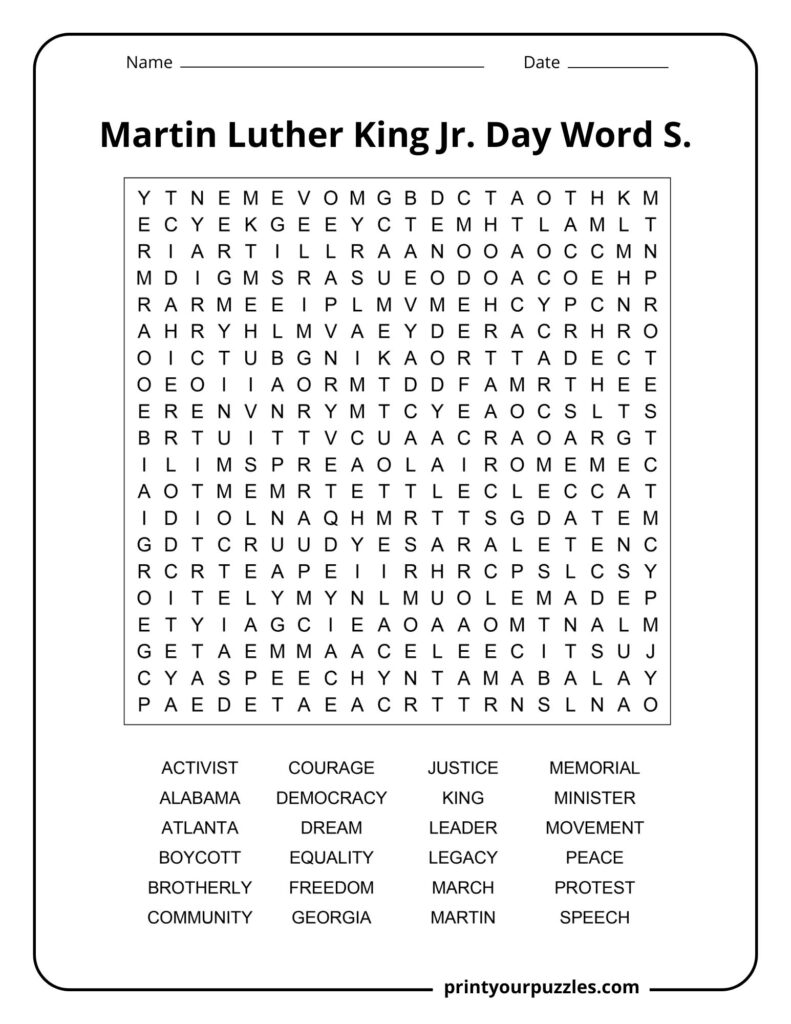
ACTIVIST, ALABAMA, ATLANTA, BOYCOTT, BROTHERLY, COMMUNITY, COURAGE, DEMOCRACY, DREAM, EQUALITY, FREEDOM, GEORGIA, JUSTICE, KING, LEADER, LEGACY, MARCH, MARTIN, MEMORIAL, MINISTER, MOVEMENT, PEACE, PROTEST, SPEECH
Martin Luther King Jr. Day is observed annually on the third Monday of January, close to King’s birthday on January 15th, making it a federal holiday.
We celebrate this day to honor Dr. King’s legacy as a civil rights leader who fought for racial equality, justice, and peace through nonviolent resistance and activism.
President Ronald Reagan signed the holiday into law in 1983, and it was first observed nationwide in 1986, though some states resisted until 2000 when all finally recognized it.
People participate in community service projects, attend commemorative events, watch documentaries about the civil rights movement, and engage in educational activities reflecting King’s values and teachings.
The motto “A Day On, Not a Day Off” encourages Americans to dedicate the holiday to volunteer service and community improvement rather than simply leisure or rest.
It took 15 years of campaigning and millions of petition signatures before President Reagan signed the legislation creating this groundbreaking federal holiday in 1983.
The legendary musician released “Happy Birthday” in 1980 and led a massive campaign collecting six million signatures to pressure Congress into creating Martin Luther King Jr. Day.
Arizona voters rejected the holiday twice before finally approving it in 1992. The NFL moved Super Bowl XXVII from Arizona to protest this decision, creating economic pressure.
The city of Hiroshima has celebrated MLK Day since the 1990s due to shared values of peace and nonviolence between King’s philosophy and Hiroshima’s anti-nuclear message.
Dr. King was born on January 15, 1929. The holiday uses the third Monday format to create a three-day weekend, falling between January 15 and 21.
Purus ut praesent facilisi dictumst sollicitudin cubilia ridiculus.