
Molecule word search puzzles offer an engaging way to explore the fascinating world of chemistry while having fun. This educational word search printable challenges you to discover 24 essential terms related to molecules, atoms, and chemical concepts hidden within the grid. Each word has been carefully selected to represent fundamental principles of molecular science, from basic building blocks like atoms and elements to more complex concepts such as compounds and reactions.
This Molecule word search printable is perfect for students, teachers, and chemistry enthusiasts of all ages who want to reinforce their understanding of molecular terminology in an interactive format. All words are presented in capital letters and arranged alphabetically for easy reference. What makes this puzzle particularly valuable is that every term included in the search is accompanied by a clear, concise definition of 20-30 words, helping you not only find the words but also understand their scientific meanings.
Whether you’re studying for a chemistry exam, teaching a class, or simply enjoy scientific puzzles, this molecule-themed activity provides both entertainment and educational value, making learning chemistry concepts enjoyable and memorable.
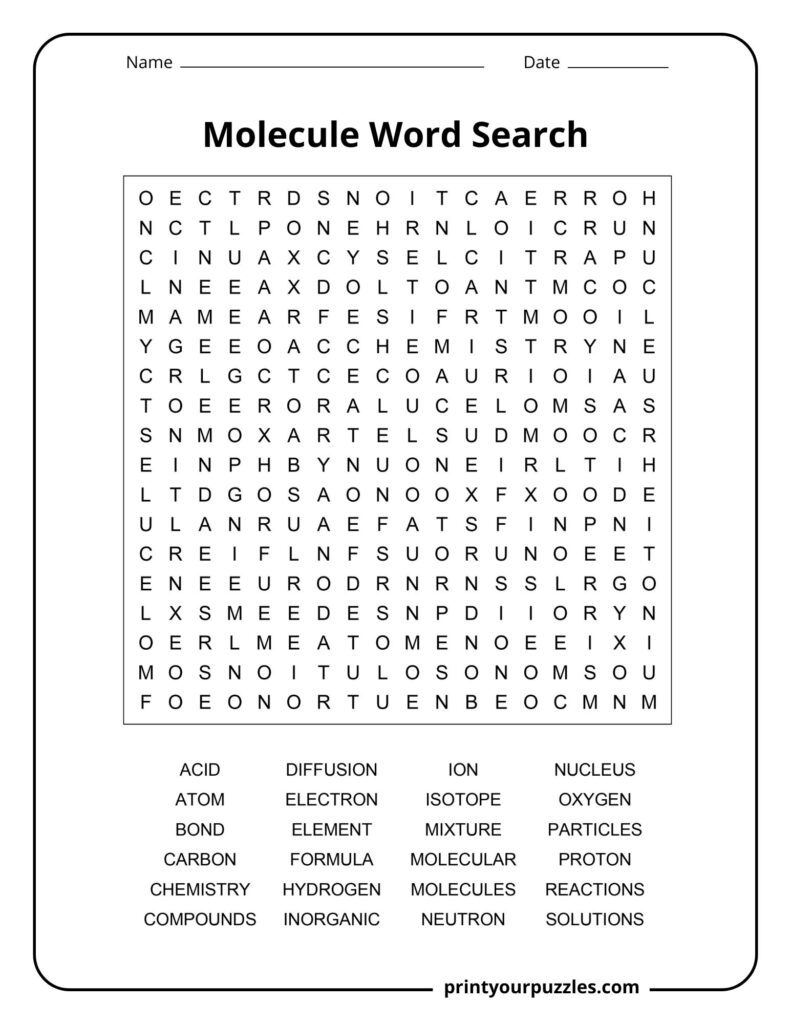
ACID, ATOM, BOND, CARBON, CHEMISTRY, COMPOUNDS, DIFFUSION, ELECTRON, ELEMENT, FORMULA, HYDROGEN, INORGANIC, ION, ISOTOPE, MIXTURE, MOLECULAR, MOLECULES, NEUTRON, NUCLEUS, OXYGEN, PARTICLES, PROTON, REACTIONS, SOLUTIONS
ACID – A chemical substance that releases hydrogen ions in water, tastes sour, turns blue litmus paper red, and has a pH value below seven on the scale.
ATOM – The smallest unit of matter that retains the properties of an element, consisting of a nucleus containing protons and neutrons, surrounded by orbiting electrons in shells.
BOND – A chemical connection between two atoms formed by sharing or transferring electrons, holding atoms together in molecules and compounds through attractive forces creating stable structures.
CARBON – A nonmetallic element with atomic number six that forms the basis of organic chemistry, capable of bonding with many elements to create millions of different compounds.
CHEMISTRY – The scientific study of matter, its properties, composition, structure, and the changes it undergoes during chemical reactions and interactions with energy and other substances.
COMPOUNDS – Substances formed when two or more different elements chemically combine in fixed proportions, creating new materials with properties distinct from their constituent elements.
DIFFUSION – The spontaneous movement of particles from areas of higher concentration to lower concentration, continuing until equilibrium is reached throughout the medium without external energy.
ELECTRON – A negatively charged subatomic particle that orbits the nucleus of an atom, participating in chemical bonding and electrical conductivity with negligible mass compared to protons.
ELEMENT – A pure substance consisting of only one type of atom that cannot be broken down into simpler substances by chemical means, represented on the periodic table.
FORMULA – A symbolic representation using chemical symbols and numbers showing the types and quantities of atoms present in a molecule or compound, indicating its composition.
HYDROGEN – The lightest and most abundant element in the universe with atomic number one, consisting of one proton and one electron, essential for water formation.
INORGANIC – Describing chemical compounds that do not contain carbon-hydrogen bonds, typically including minerals, metals, salts, and other substances not derived from living organisms.
ION – An atom or molecule that has gained or lost one or more electrons, resulting in a positive or negative electrical charge affecting its chemical behavior.
ISOTOPE – Variants of a chemical element having the same number of protons but different numbers of neutrons, resulting in different atomic masses while maintaining similar chemical properties.
MIXTURE – A combination of two or more substances that are physically blended but not chemically bonded, retaining their individual properties and capable of being separated physically.
MOLECULAR – Relating to or consisting of molecules, describing the level of organization where atoms are bonded together to form discrete units with specific properties and structures.
MOLECULES – Groups of two or more atoms held together by chemical bonds, forming the smallest units of compounds that retain the chemical properties of that substance.
NEUTRON – An electrically neutral subatomic particle found in atomic nuclei with mass nearly equal to a proton, contributing to atomic mass and stability without affecting chemical properties.
NUCLEUS – The dense central core of an atom containing protons and neutrons, comprising most of the atom’s mass while occupying only a tiny fraction of its volume.
OXYGEN – A highly reactive nonmetallic element with atomic number eight, essential for respiration and combustion, comprising about twenty-one percent of Earth’s atmosphere by volume.
PARTICLES – Tiny units of matter including atoms, molecules, ions, and subatomic components that make up all substances, exhibiting both wave-like and particle-like properties.
PROTON – A positively charged subatomic particle found in the nucleus of every atom, determining the element’s identity through its atomic number and having mass approximately equal to neutrons.
REACTIONS – Chemical processes where substances interact to form new products by breaking existing bonds and creating new ones, involving energy changes and rearrangement of atoms.
SOLUTIONS – Homogeneous mixtures where one substance (solute) is uniformly dissolved in another (solvent), forming a single phase with consistent composition and properties throughout.
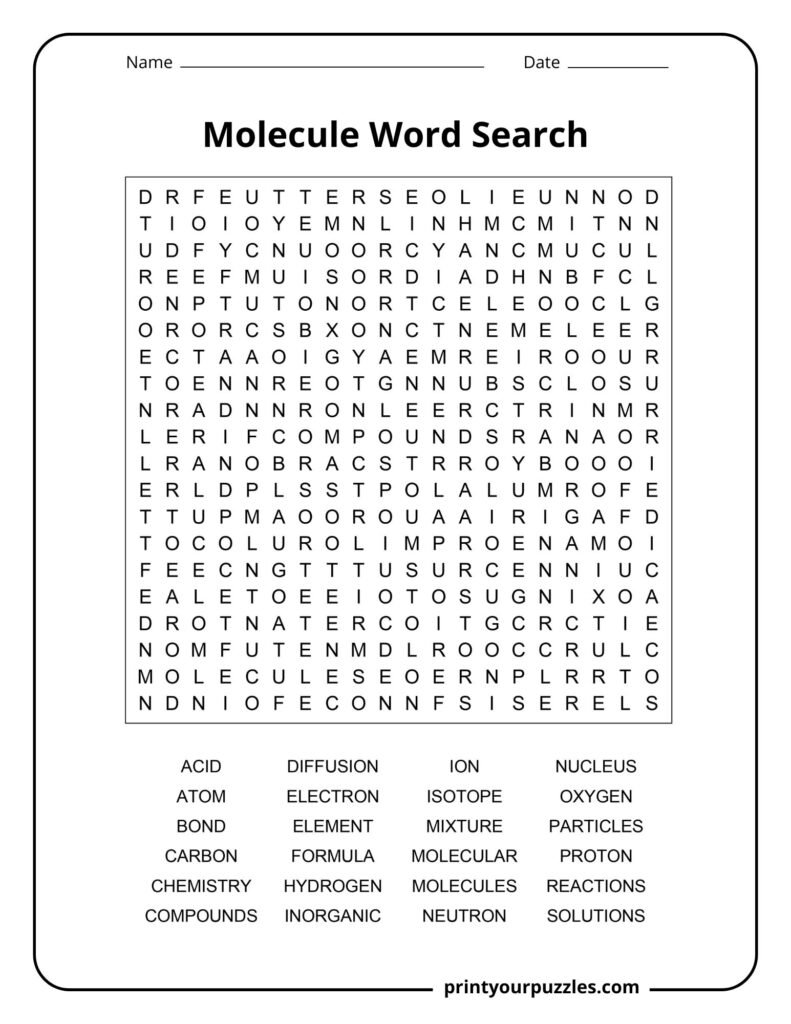
ACID, ATOM, BOND, CARBON, CHEMISTRY, COMPOUNDS, DIFFUSION, ELECTRON, ELEMENT, FORMULA, HYDROGEN, INORGANIC, ION, ISOTOPE, MIXTURE, MOLECULAR, MOLECULES, NEUTRON, NUCLEUS, OXYGEN, PARTICLES, PROTON, REACTIONS, SOLUTIONS
A molecule is the smallest unit of a chemical compound, consisting of two or more atoms bonded together chemically, that retains all the chemical properties of that substance.
Atoms are individual elements that cannot be chemically divided, while molecules are groups of two or more atoms bonded together, which can be identical or different elements forming compounds.
Common molecules include water (H₂O), oxygen gas (O₂), carbon dioxide (CO₂), table salt (NaCl), glucose (C₆H₁₂O₆), and methane (CH₄), each with distinct chemical properties and uses.
Molecules form when atoms share or transfer electrons, creating chemical bonds that hold them together. This bonding occurs to achieve stable electron configurations, releasing or absorbing energy during formation.
Molecules are essential building blocks of all living things, forming proteins, DNA, carbohydrates, and fats. They enable biological processes, store energy, carry genetic information, and facilitate cellular functions.
That’s 1,670,000,000,000,000,000,000 water molecules in just one tiny drop, demonstrating the incredibly small size of molecules and their vast numbers in everyday substances.
These molecular twins have identical chemical formulas but different three-dimensional arrangements, like left and right hands, often producing completely different effects in biological systems and medications.
This carbon molecule contains sixty carbon atoms arranged in pentagons and hexagons, discovered in 1985 and named after architect Buckminster Fuller who designed geodesic domes.
Despite being packed tightly inside microscopic cell nuclei, human DNA molecules stretch approximately two meters in length, containing billions of atoms encoding genetic information.
Odor molecules float through the air and attach to specialized smell receptors, triggering signals to your brain that interpret specific scents, from flowers to food.
Purus ut praesent facilisi dictumst sollicitudin cubilia ridiculus.