
This Monroe Doctrine word search offers an engaging educational activity for students and history enthusiasts exploring one of America’s most significant foreign policy statements. The Monroe Doctrine, proclaimed by President James Monroe in 1823, established critical principles that shaped United States relations with Europe and Latin America for generations.
This Monroe Doctrine word search printable contains 24 carefully selected terms, each directly related to the doctrine’s historical context, key figures, and lasting impact. From “Monroe” and “Adams” to “expansion” and “corollary,” every word represents an important concept in understanding this pivotal moment in American diplomatic history.
What makes this word search printable particularly valuable is that all words are thoroughly defined with concise 20-30 word explanations. This ensures learners not only find the terms within the puzzle but also comprehend their historical significance. The definitions cover essential topics including European colonization concerns, hemispheric defense, territorial integrity, and the evolving interpretation of Monroe’s original principles.
Whether used in classrooms, homeschool settings, or personal study, this activity combines puzzle-solving fun with meaningful historical education about America’s assertion of influence in the Western Hemisphere.
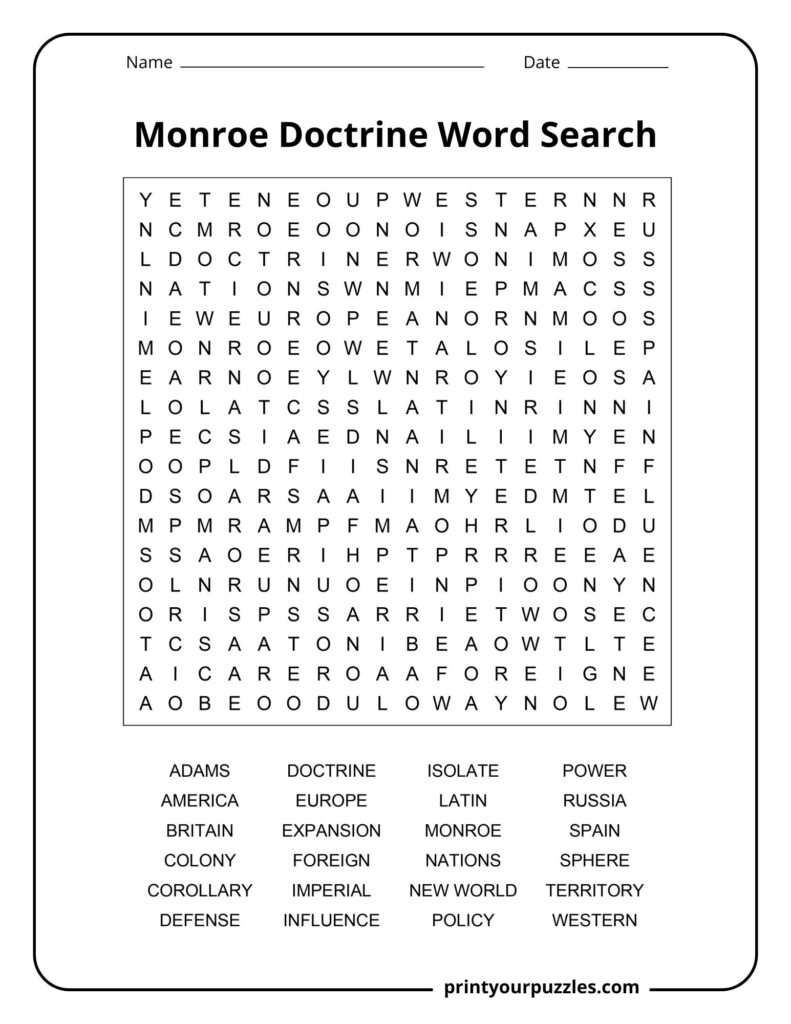
ADAMS, AMERICA, BRITAIN, COLONY, COROLLARY, DEFENSE, DOCTRINE, EUROPE, EXPANSION, FOREIGN, IMPERIAL, INFLUENCE, ISOLATE, LATIN, MONROE, NATIONS, NEW WORLD, POLICY, POWER, RUSSIA, SPAIN, SPHERE, TERRITORY, WESTERN
ADAMS – John Quincy Adams, Secretary of State under President Monroe, who played a crucial role in drafting and shaping the Monroe Doctrine’s key principles and language.
AMERICA – The United States of America, the nation that proclaimed the Monroe Doctrine in 1823 to establish its position on European interference in the Western Hemisphere.
BRITAIN – Great Britain, the powerful European nation whose naval supremacy and shared interests partially enabled the United States to enforce the Monroe Doctrine’s bold proclamations.
COLONY – Territories controlled by European powers that the Monroe Doctrine warned against establishing or expanding in the Americas, protecting newly independent Latin American nations.
COROLLARY – An extension or addition to President Theodore Roosevelt’s 1904 expansion of the Monroe Doctrine, asserting United States authority to intervene in Latin American affairs to maintain stability and order.
DEFENSE – The protection of American sovereignty, security, and interests in the Western Hemisphere, which was a primary justification for establishing the Monroe Doctrine.
DOCTRINE – A formal statement of policy or principle, specifically referring to President Monroe’s 1823 declaration outlining United States opposition to European intervention in the Americas.
EUROPE – The Old World continent whose powerful nations were warned against further colonization, intervention, or interference in the political affairs of the Western Hemisphere.
EXPANSION – The extension of European colonial territories or political influence in the Americas that the Monroe Doctrine explicitly opposed and warned against after 1823.
FOREIGN – Relating to other nations and international relations, particularly European powers’ policies toward the Americas that concerned United States leaders in the early nineteenth century.
IMPERIAL – Related to empire-building and colonial control that European powers practiced, which the Monroe Doctrine sought to prevent from spreading further in the Americas.
INFLUENCE – Political, economic, or military control that European nations might exert over American nations, which the Monroe Doctrine aimed to limit in the Western Hemisphere.
ISOLATE – To remain separate from European political conflicts and entanglements, a key principle underlying the Monroe Doctrine’s call for mutual non-interference between hemispheres.
LATIN – Referring to Latin America, the region of Spanish and Portuguese-speaking nations gaining independence that the Monroe Doctrine aimed to protect from European reconquest.
MONROE – James Monroe, the fifth President of the United States who announced the doctrine in his December 1823 annual message to Congress, establishing American hemispheric policy.
NATIONS – Independent countries of the Americas, particularly newly liberated Latin American republics, whose sovereignty the Monroe Doctrine pledged to support against European threats.
NEW WORLD – Term for the Americas, distinguished from Europe’s Old World, representing a hemisphere where the United States declared European colonization would no longer be tolerated.
POLICY – Official governmental position or diplomatic strategy, specifically the United States’ formal stance on European involvement in Western Hemisphere affairs after 1823.
POWER – Strong nations capable of exerting military, political, or economic influence, particularly European empires that the Monroe Doctrine warned against interfering in American affairs.
RUSSIA – The European empire whose territorial expansion along the Pacific Northwest coast of North America particularly concerned American leaders and influenced the doctrine’s creation.
SPAIN – The former colonial power that controlled much of Latin America until independence movements succeeded, whose potential reconquest attempts the Monroe Doctrine opposed.
SPHERE – A zone of political or economic influence or control, as in “sphere of influence,” which the Monroe Doctrine established for the Americas.
TERRITORY – Land or geographic region under governmental control or territorial claim, which European powers were warned not to expand in the Americas after 1823.
WESTERN – Relating to the Western Hemisphere, the geographic region including the Americas where the Monroe Doctrine declared United States opposition to European colonial expansion.
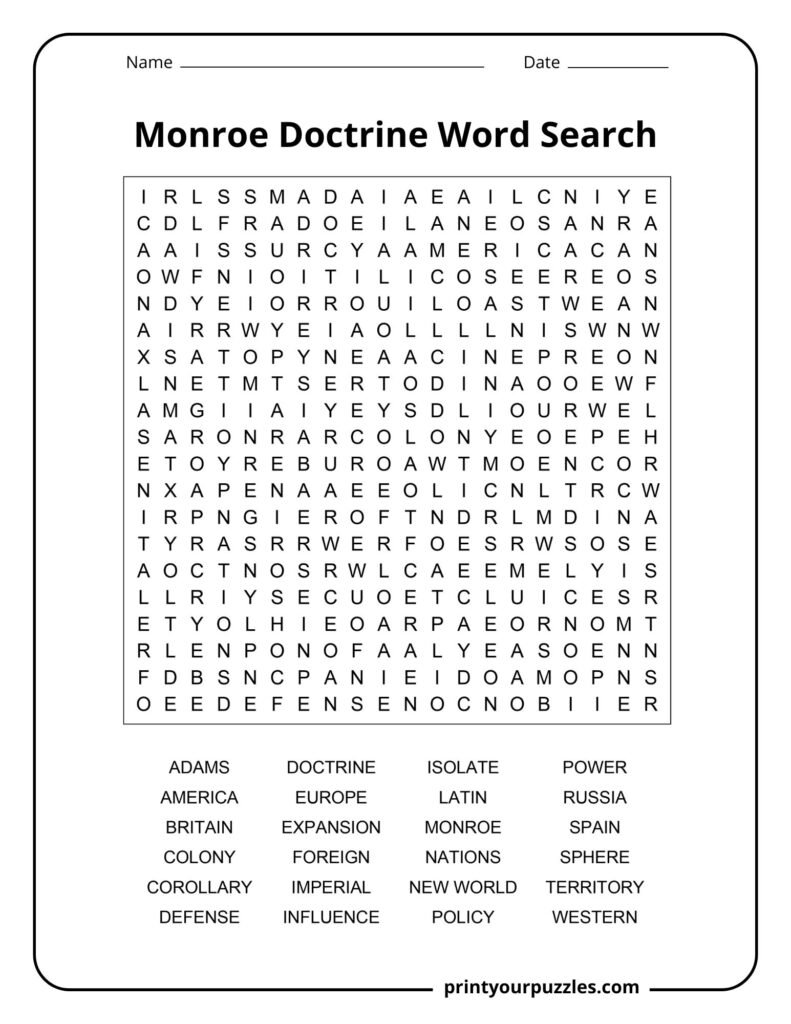
ADAMS, AMERICA, BRITAIN, COLONY, COROLLARY, DEFENSE, DOCTRINE, EUROPE, EXPANSION, FOREIGN, IMPERIAL, INFLUENCE, ISOLATE, LATIN, MONROE, NATIONS, NEW WORLD, POLICY, POWER, RUSSIA, SPAIN, SPHERE, TERRITORY, WESTERN
A United States foreign policy statement from 1823 declaring that European powers should not colonize or interfere with independent nations in the Western Hemisphere or face American opposition.
President James Monroe announced the doctrine on December 2, 1823, during his seventh annual message to Congress, establishing a cornerstone of American foreign policy for decades.
To protect newly independent Latin American nations from European reconquest, prevent further colonization in the Americas, and assert United States influence in the Western Hemisphere.
No new European colonization in the Americas, no European interference in independent American nations’ affairs, and United States non-involvement in European political conflicts or wars.
It discouraged European intervention but also justified later United States interference in Latin American affairs, especially after Theodore Roosevelt’s 1904 Corollary expanded American interventionist authority.
America lacked the naval power to back up its bold proclamation in 1823. British naval supremacy actually prevented European intervention, not American military strength.
Secretary of State Adams wrote most of the doctrine’s principles and convinced President Monroe to issue it, though Monroe received all the credit and naming rights.
European powers and Latin American nations paid little attention to the doctrine until the United States gained enough power to actually enforce its provisions later.
The 1823 declaration had no official name initially. The phrase “Monroe Doctrine” didn’t become popular until the 1850s when politicians began regularly referencing Monroe’s policy statement.
His 1904 Roosevelt Corollary transformed the doctrine from preventing European interference into justifying United States intervention throughout Latin America, becoming the “international police power” policy.
Purus ut praesent facilisi dictumst sollicitudin cubilia ridiculus.