
This Moon Phases word search offers an exciting educational adventure into the celestial mechanics governing Earth’s only natural satellite. Designed for students, educators, astronomy enthusiasts, and curious minds of all ages, this puzzle transforms learning about lunar cycles into an engaging activity that builds vocabulary while deepening understanding of our cosmic neighbor.
Moon phases occur as the moon orbits Earth approximately every 29.5 days, creating a predictable cycle of changing appearances. What we observe from our planet depends on how much sunlight reflects off the moon’s surface toward us, determined by the constantly shifting positions of the sun, moon, and Earth. The eight main phases—new, waxing crescent, first quarter, waxing gibbous, full, waning gibbous, last quarter, and waning crescent—repeat in sequence throughout each month.
Humans have observed these lunar transformations from everywhere on Earth for millennia, using moon phases to track time, plan agricultural activities, and navigate across oceans. The moon’s gravitational influence creates ocean tides, while its reliable cycle has shaped calendars and cultural traditions worldwide.
This comprehensive Moon Phases word search printable goes beyond typical puzzles by including educational enhancements that maximize learning potential. Every word features a detailed 20-30 word definition explaining its astronomical significance. Additionally, five frequently asked questions address common curiosities—such as whether you knew the moon is visible during daytime hours approximately half the time—while five “Did You Know?” facts reveal fascinating lunar trivia.
This word search printable transforms puzzle-solving into a complete educational experience, making complex astronomical concepts accessible and memorable for learners at every level.
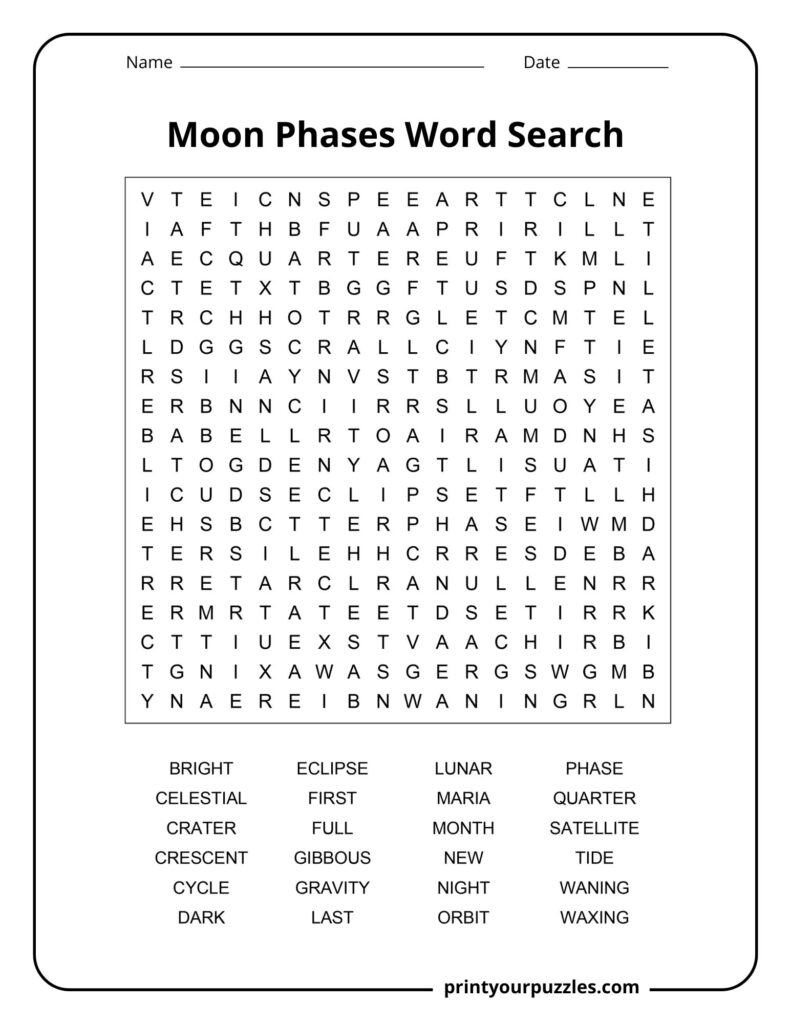
BRIGHT, CELESTIAL, CRATER, CRESCENT, CYCLE, DARK, ECLIPSE, FIRST, FULL, GIBBOUS, GRAVITY, LAST, LUNAR, MARIA, MONTH, NEW, NIGHT, ORBIT, PHASE, QUARTER, SATELLITE, TIDE, WANING, WAXING
BRIGHT – The illuminated portion of the moon visible from Earth, reflecting sunlight and appearing luminous against the dark night sky during various lunar phases.
CELESTIAL – Relating to the sky, heavens, or outer space where astronomical objects like the moon, stars, and planets exist and move in their orbital patterns.
CRATER – Bowl-shaped depressions on the moon’s surface created by meteorite impacts over billions of years, visible as dark spots through telescopes and creating lunar topography.
CRESCENT – A curved, sickle-shaped moon phase appearing when less than half of the moon’s visible surface is illuminated, occurring after new or before full moon.
CYCLE – The complete sequence of moon phases from new moon through full moon and back to new moon, repeating approximately every twenty-nine and a half days.
DARK – The unilluminated portion of the moon not receiving direct sunlight, appearing as shadow and varying in size throughout the lunar phase cycle each month.
ECLIPSE – A celestial event when the moon passes through Earth’s shadow creating a lunar eclipse, or blocks the sun’s light creating a solar eclipse phenomenon.
FIRST – The first quarter moon phase occurring approximately one week after the new moon, when exactly half of the moon’s visible surface appears illuminated from Earth.
FULL – The lunar phase when the entire visible surface of the moon is illuminated by sunlight, appearing as a complete bright circle in the night sky.
GIBBOUS – A moon phase appearing when more than half but less than the entire visible surface is illuminated, occurring between quarter and full moon stages.
GRAVITY – The fundamental force that keeps the moon in orbit around Earth and causes ocean tides through gravitational pull on Earth’s water bodies and surfaces.
LAST – The last quarter moon phase occurring approximately three weeks into the lunar cycle, when half of the moon’s visible surface appears illuminated before new moon.
LUNAR – Pertaining to or relating to the moon, its phases, cycles, orbit, surface features, or any phenomena associated with Earth’s natural celestial satellite companion.
MARIA – Large, dark, basaltic plains on the moon’s surface formed by ancient volcanic eruptions, visible from Earth and resembling seas to early astronomers who named them.
MONTH – A measurement of time based approximately on one complete lunar cycle, originally derived from the moon’s journey through all its phases from new to new.
NEW – The lunar phase when the moon is positioned between Earth and sun, making its illuminated side face away from Earth, appearing invisible in sky.
NIGHT – The period of darkness when the moon is most commonly observed, though it can also be visible during daytime depending on its current orbital phase.
ORBIT – The elliptical path the moon follows around Earth, completing one revolution approximately every twenty-seven days while rotating on its own axis synchronously with rotation.
PHASE – The particular appearance of the moon’s illuminated portion as seen from Earth, changing gradually throughout the monthly lunar cycle in predictable sequential patterns and
stages.
QUARTER – A moon phase when exactly half of the visible lunar surface appears illuminated, occurring twice monthly as first quarter and last or third quarter.
SATELLITE – A natural celestial body that orbits a larger planet; the moon is Earth’s only natural satellite, held in orbit by mutual gravitational attraction forces.
TIDE – The rise and fall of ocean water levels caused primarily by the moon’s gravitational pull on Earth, creating high and low tides twice daily.
WANING – The period when the moon’s illuminated visible portion gradually decreases in size, occurring after full moon and continuing until the new moon phase arrives again.
WAXING – The period when the moon’s illuminated visible portion gradually increases in size, occurring after new moon and continuing until reaching the full moon phase.
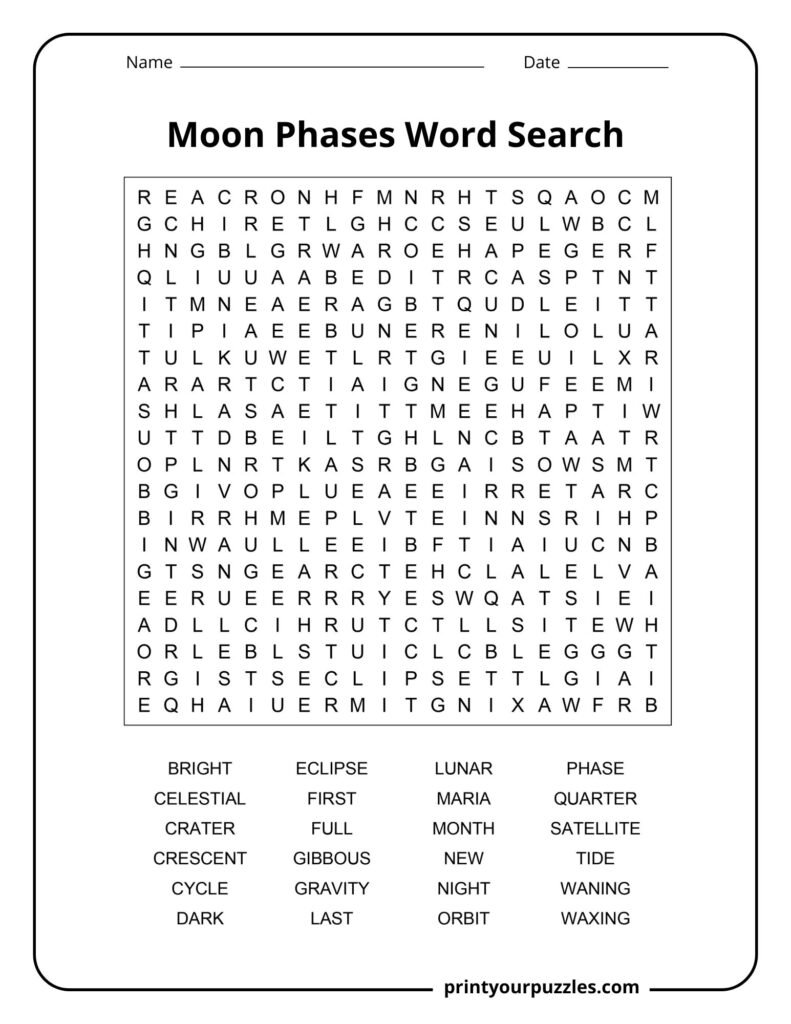
BRIGHT, CELESTIAL, CRATER, CRESCENT, CYCLE, DARK, ECLIPSE, FIRST, FULL, GIBBOUS, GRAVITY, LAST, LUNAR, MARIA, MONTH, NEW, NIGHT, ORBIT, PHASE, QUARTER, SATELLITE, TIDE, WANING, WAXING
A complete lunar cycle from new moon through all phases and back to new moon takes approximately 29.5 days, known as a synodic month or lunation period.
Moon phases result from the changing angles between the sun, moon, and Earth as the moon orbits our planet, altering how much sunlight reflects toward us.
Waxing means the illuminated portion is growing larger after new moon, while waning means it’s decreasing after full moon, creating the cycle’s two distinct halves.
The moon rotates on its axis at the same rate it orbits Earth, called synchronous rotation or tidal locking, keeping one hemisphere perpetually facing our planet.
There are eight primary moon phases: new, waxing crescent, first quarter, waxing gibbous, full, waning gibbous, last quarter, and waning crescent, repeating monthly in sequence.
This optical illusion, called the moon illusion, makes the full moon seem bigger when rising or setting, though its actual size remains constant throughout the night.
A blue moon refers to the second full moon occurring within a single calendar month, happening approximately every two to three years due to lunar cycle timing.
Many marine species, including corals and sea turtles, time their spawning to specific moon phases, while some predators hunt more successfully during darker new moon nights.
Native Americans named full moons seasonally: Harvest Moon, Wolf Moon, Strawberry Moon, and others, reflecting natural events and agricultural activities occurring during each month.
The moon is visible during daylight approximately half the time, particularly during first and last quarter phases when it rises or sets during morning or afternoon.