

This Nervous System word search offers an engaging and educational approach to learning about one of the body’s most vital systems. Perfect for students, educators, and science enthusiasts, this puzzle features 24 carefully selected terms that cover essential nervous system components and functions. From basic structures like “brain” and “nerve” to more complex concepts such as “synapse,” “myelin,” and “ganglion,” each word has been chosen to provide comprehensive coverage of neurological terminology.
What makes this Nervous System word search printable especially valuable is that every term included in the puzzle comes with a detailed definition. Each word is explained using 20-30 words, ensuring learners not only find the hidden terms but also understand their meanings and significance within the nervous system. This combination of puzzle-solving and vocabulary building creates a powerful learning tool that reinforces retention and comprehension.
The word search printable format makes it convenient for classroom use, homeschool lessons, or independent study sessions. Whether you’re reviewing for an exam, introducing new scientific vocabulary, or simply exploring how the nervous system works, this activity transforms learning into an enjoyable experience. All definitions are provided separately, allowing users to reference them while solving the puzzle or afterward to verify their knowledge.
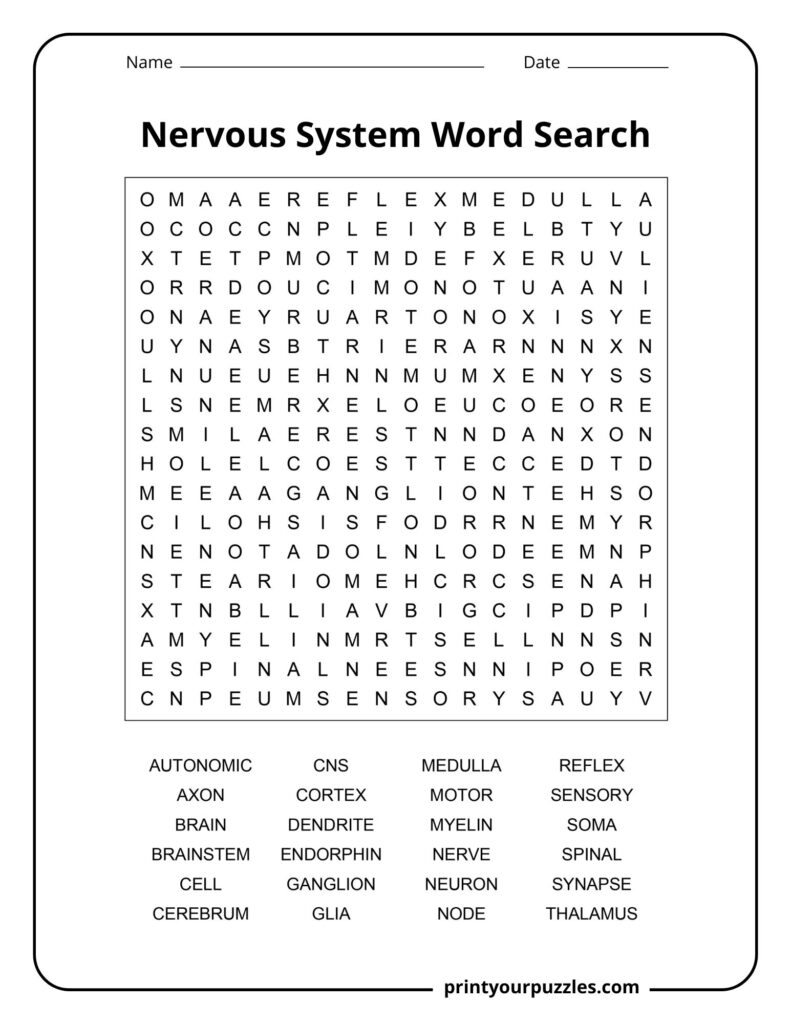
AUTONOMIC, AXON, BRAIN, BRAINSTEM, CELL, CEREBRUM, CNS, CORTEX, DENDRITE, ENDORPHIN, GANGLION, GLIA, MEDULLA, MOTOR, MYELIN, NERVE, NEURON, NODE, REFLEX, SENSORY, SOMA, SPINAL, SYNAPSE, THALAMUS
AUTONOMIC – The division of the nervous system that controls involuntary bodily functions like heart rate, digestion, breathing, and gland secretion without conscious effort or awareness.
AXON – A long, slender projection of a nerve cell that conducts electrical impulses away from the neuron’s cell body toward other neurons, muscles, or glands.
BRAIN – The central command organ of the nervous system, responsible for processing sensory information, controlling bodily functions, enabling thought, memory, emotion, and coordinating all voluntary movements.
BRAINSTEM – The lower portion of the brain connecting to the spinal cord, controlling vital automatic functions including breathing, heart rate, blood pressure, and consciousness level regulation.
CELL – The basic structural and functional unit of all living organisms, including specialized nerve cells called neurons that transmit electrical and chemical signals throughout the body.
CEREBRUM – The largest part of the brain, divided into two hemispheres, responsible for higher cognitive functions including thinking, learning, memory, language, voluntary movement, and sensory processing.
CNS – Central Nervous System; comprises the brain and spinal cord, serving as the main processing center that integrates sensory information and coordinates responses throughout the body.
CORTEX – The outermost layer of the cerebrum, consisting of folded gray matter responsible for consciousness, thought, memory, language, attention, perception, and voluntary muscle movement coordination.
DENDRITE – Branched extensions of a neuron that receive electrical signals from other neurons and transmit these impulses toward the cell body for processing and integration purposes.
ENDORPHIN – Natural pain-relieving chemicals produced by the nervous system that act like morphine, reducing pain perception and creating feelings of pleasure or euphoria during stress or exercise.
GANGLION – A cluster or group of nerve cell bodies located outside the central nervous system that serves as a relay station for transmitting signals between nerves.
GLIA – Supporting cells in the nervous system that provide structural support, insulation, nutrients, and protection for neurons while also maintaining the brain’s chemical environment properly.
MEDULLA – The medulla oblongata is the lowest part of the brainstem that regulates vital automatic functions including breathing, heart rate, blood pressure, and reflex actions.
MOTOR – Relating to nerves or neurons that carry signals from the central nervous system to muscles and glands, enabling voluntary and involuntary movements throughout the body.
MYELIN – A fatty insulating substance that forms a protective sheath around nerve fibers, significantly increasing the speed of electrical signal transmission and preventing signal loss along axons.
NERVE – A bundle of axons enclosed in connective tissue that transmits electrical impulses between the brain, spinal cord, and other body parts, enabling communication throughout organisms.
NEURON – A specialized nerve cell that transmits information through electrical and chemical signals, serving as the fundamental functional unit of the nervous system for processing and communication.
NODE – Nodes of Ranvier are small gaps in the myelin sheath along axons where electrical signals jump between sections, dramatically accelerating nerve impulse transmission speed.
REFLEX – An involuntary, rapid, automatic response to a stimulus that occurs without conscious thought, involving a simple neural pathway typically through the spinal cord only.
SENSORY – Relating to nerves or neurons that carry information from sensory receptors throughout the body to the central nervous system, enabling perception of external and internal stimuli.
SOMA – The cell body of a neuron containing the nucleus and organelles, responsible for maintaining the cell’s metabolic functions and integrating incoming signals from dendrites properly.
SPINAL – Relating to the spinal cord, the long cylindrical bundle of nerve tissue extending from the brainstem down the vertebral column, transmitting signals between brain and body.
SYNAPSE – The junction between two neurons or between a neuron and target cell where chemical or electrical signals are transmitted, enabling communication within the nervous system.
THALAMUS – A dual-lobed structure deep within the brain that acts as a relay station, processing and directing sensory information to appropriate areas of the cerebral cortex.
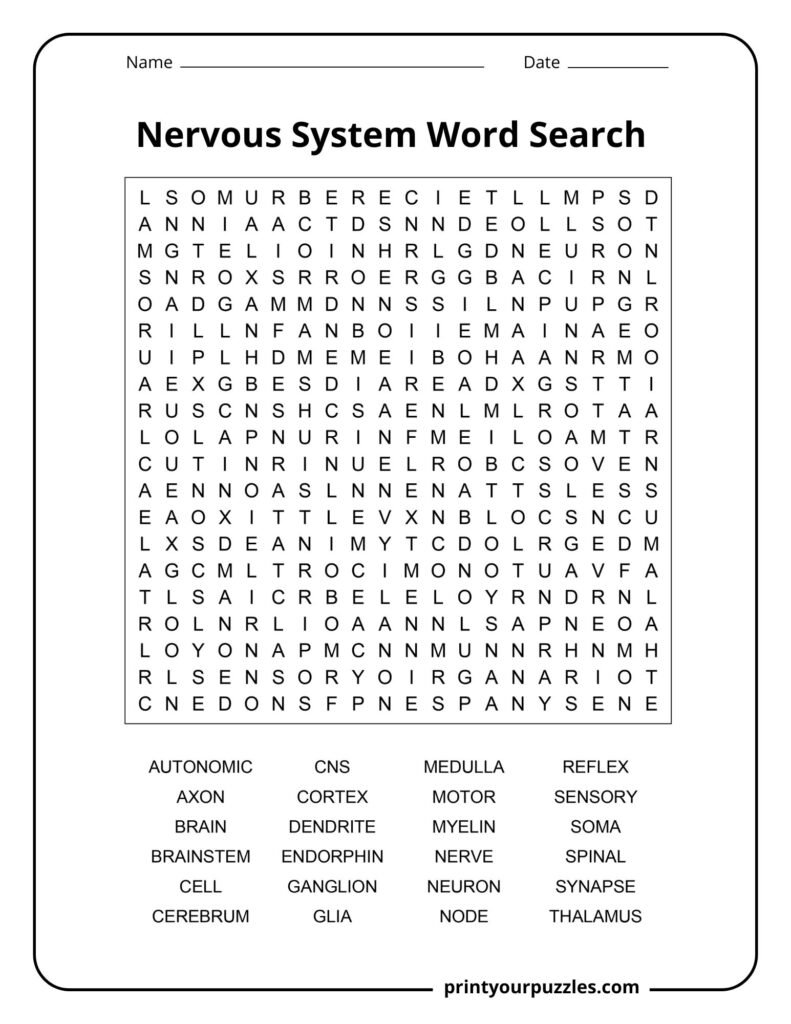
AUTONOMIC, AXON, BRAIN, BRAINSTEM, CELL, CEREBRUM, CNS, CORTEX, DENDRITE, ENDORPHIN, GANGLION, GLIA, MEDULLA, MOTOR, MYELIN, NERVE, NEURON, NODE, REFLEX, SENSORY, SOMA, SPINAL, SYNAPSE, THALAMUS
The nervous system is the body’s electrical communication network, consisting of the brain, spinal cord, and nerves that coordinate all bodily functions, movements, sensations, and thoughts.
The central nervous system (CNS) includes the brain and spinal cord, while the peripheral nervous system (PNS) comprises all nerves extending throughout the body’s tissues and organs.
Neurons communicate through electrical impulses traveling along axons and chemical signals called neurotransmitters that cross synapses, the tiny gaps between nerve cells, enabling rapid information transmission throughout.
Sensory neurons carry information from receptors to the brain and spinal cord, while motor neurons transmit commands from the central nervous system to muscles and glands.
The autonomic nervous system regulates involuntary functions including heart rate, breathing, digestion, blood pressure, body temperature, and gland secretion without requiring conscious thought or effort.
The fastest nerve impulses in your body zoom along myelinated axons at incredible speeds, allowing you to react almost instantly to stimuli like touching something hot.
Each neuron can form thousands of connections with other neurons, creating trillions of synapses that enable complex thoughts, memories, emotions, and the ability to learn new information.
Despite weighing only about three pounds, the brain constantly demands substantial glucose and oxygen to power its billions of neurons and maintain all cognitive functions throughout the day.
While the brain processes pain signals from throughout your body, it lacks pain receptors itself, which is why surgeons can perform certain brain surgeries on conscious patients.
Spinal reflexes like pulling your hand from a hot surface occur through the spinal cord alone, allowing faster protective responses before your brain even registers what happened.
Purus ut praesent facilisi dictumst sollicitudin cubilia ridiculus.