
This Pierre word search celebrates the capital city of South Dakota, a charming community of approximately 14,000 residents nestled along the Missouri River in the geographic center of the state. Pierre (pronounced “PEER”) is America’s second smallest state capital, yet it holds tremendous historical and cultural significance for the Mount Rushmore State.
Pierre became South Dakota’s temporary capital when the state achieved statehood in 1889, chosen specifically for its central location. In 1904, it was designated the permanent capital, and locals invested their own money to construct the magnificent neoclassical Capitol building completed in 1910. This financial commitment ensured Pierre would retain its status against rival cities vying for the honor.
This Pierre word search printable features 24 words representing the city’s most defining characteristics—from natural wonders like Oahe Dam and Lake Oahe to legendary residents including rodeo champion Casey Tibbs and journalist Tom Brokaw. The puzzle goes beyond simple entertainment by providing comprehensive definitions for each term, along with helpful FAQ answers and fascinating Did You Know facts that make learning about Pierre engaging and memorable.
Did you know that Capitol Lake never freezes, even during harsh South Dakota winters? An artesian well feeds warm water year-round, creating a haven for migratory waterfowl. This is just one of many intriguing facts you’ll discover.
Whether you’re a student studying state capitals, a traveler planning a South Dakota visit, or simply a puzzle enthusiast, this word search printable combines educational value with entertaining challenge, offering insights into Pierre’s rich heritage, outdoor recreation, and small-town charm.
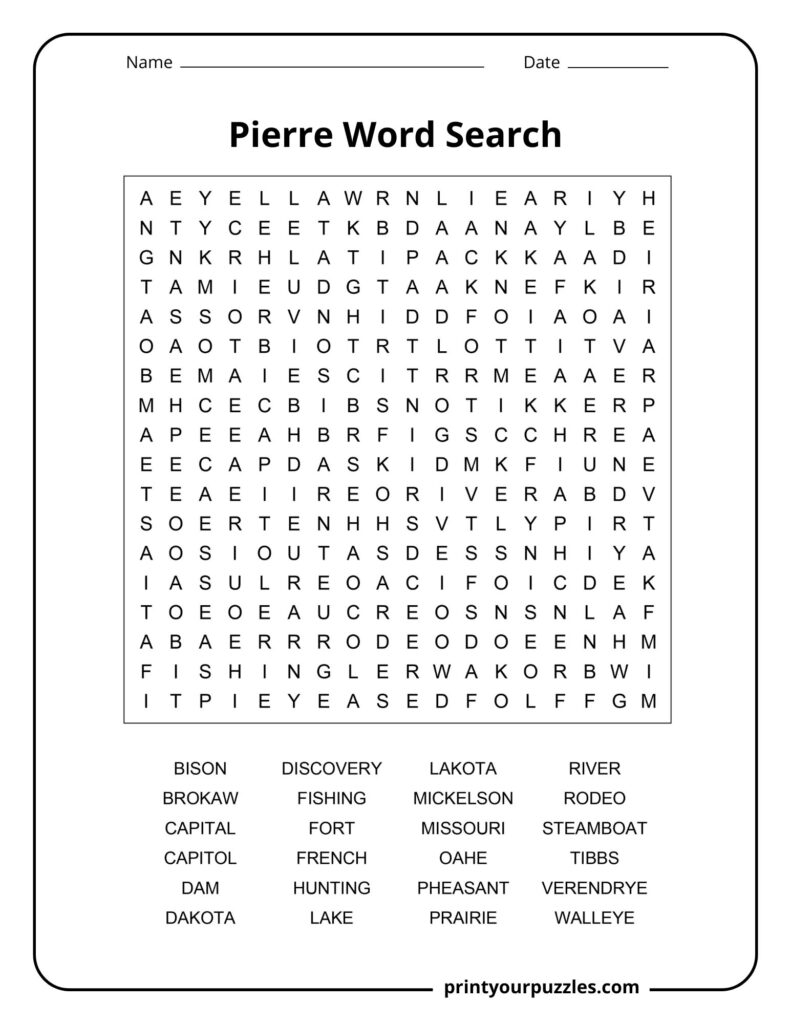
BISON, BROKAW, CAPITAL, CAPITOL, DAM, DAKOTA, DISCOVERY, FISHING, FORT, FRENCH, HUNTING, LAKE, LAKOTA, MICKELSON, MISSOURI, OAHE, PHEASANT, PRAIRIE, RIVER, RODEO, STEAMBOAT, TIBBS, VERENDRYE, WALLEYE
BISON – Large North American mammal nearly extinct until Scotty Philip saved the species near Pierre. Symbol of South Dakota’s wildlife heritage and Great Plains history.
BROKAW – Tom Brokaw, renowned NBC news anchor and journalist born in Webster, South Dakota, grew up near Pierre and became one of America’s most trusted broadcasters.
CAPITAL – Pierre serves as South Dakota’s seat of government since 1889, chosen for its central geographic location. It’s the second smallest state capital in America.
CAPITOL – The neoclassical government building completed in 1910, featuring Italian marble floors and beautiful architecture. Built by locals to secure Pierre’s status as permanent capital.
DAM – Oahe Dam, completed in 1962, sits five miles north of Pierre. This massive structure provides power, flood control, irrigation, and created Lake Oahe recreation area.
DAKOTA – Name derived from Native American Sioux word meaning “friend” or “ally.” Represents the state and indigenous peoples who first inhabited the Pierre region for centuries.
DISCOVERY – The South Dakota Discovery Center offers over sixty hands-on science exhibits in Pierre. This interactive museum teaches physics, electricity, and life sciences to all ages.
FISHING – Popular Pierre activity on Lake Oahe and Missouri River. Anglers catch walleye, northern pike, and trout year-round from numerous accessible spots and shorelines.
FORT – Fort Pierre across the river is South Dakota’s oldest continuous settlement, established as a fur trading post in the 1800s and military fort location.
FRENCH – French explorers Verendrye brothers claimed the Pierre region for France in 1743, burying a lead plate later discovered in 1913 at Fort Pierre site.
HUNTING – Major recreational activity near Pierre with abundant pheasant, waterfowl, and deer populations. South Dakota’s hunting traditions draw sportsmen from across the United States annually.
LAKE – Capitol Lake is an artesian-fed water body on capitol grounds, staying warm year-round. Lake Oahe offers 2,200 miles of shoreline for recreation and tourism.
LAKOTA – Indigenous Sioux people who inhabited the Pierre region for generations before European settlement. Their rich cultural heritage is preserved in Pierre’s Cultural Heritage Center.
MICKELSON – Governor George Mickelson died in a 1993 plane crash. The Fighting Stallions Memorial on capitol grounds honors him and seven other South Dakotans who perished.
MISSOURI – Major river flowing through Pierre, historically vital for steamboat trade and fur trading. Today it provides recreation, fishing, and created Lake Oahe when dammed.
OAHE – Massive dam and reservoir north of Pierre creating the fourth largest artificial lake in America. Name comes from Lakota word meaning “a place to stand on.”
PHEASANT – South Dakota’s state bird, abundant in Pierre area grasslands. Ring-necked pheasants attract hunters statewide and represent the region’s agricultural landscape and hunting culture.
PRAIRIE – Vast grassland ecosystem surrounding Pierre characterized by rolling hills and native grasses. Defines South Dakota’s landscape and supports agriculture, wildlife, and natural beauty.
RIVER – The Missouri River borders Pierre, historically serving as transportation route for explorers, fur traders, and steamboats. LaFramboise Island sits within the river near downtown.
RODEO – Casey Tibbs from Fort Pierre dominated 1950s rodeo, becoming World All-Around Cowboy Champion. The South Dakota Rodeo Center honors him and other rodeo legends.
STEAMBOAT – Historic vessels that made Fort Pierre a major
trade center and transportation hub in the 1800s, carrying goods and passengers along the Missouri River.
TIBBS – Casey Tibbs, legendary rodeo champion from Fort Pierre who won multiple world championships in the 1950s and became a Hollywood stuntman in western films.
VERENDRYE – Louis and François Vérendrye, French explorer brothers who claimed the Pierre region for France in 1743, burying a commemorative lead plate later discovered.
WALLEYE – Popular game fish in Missouri River and Lake Oahe near Pierre. These freshwater fish are prized by anglers for their sporting challenge and excellent taste.
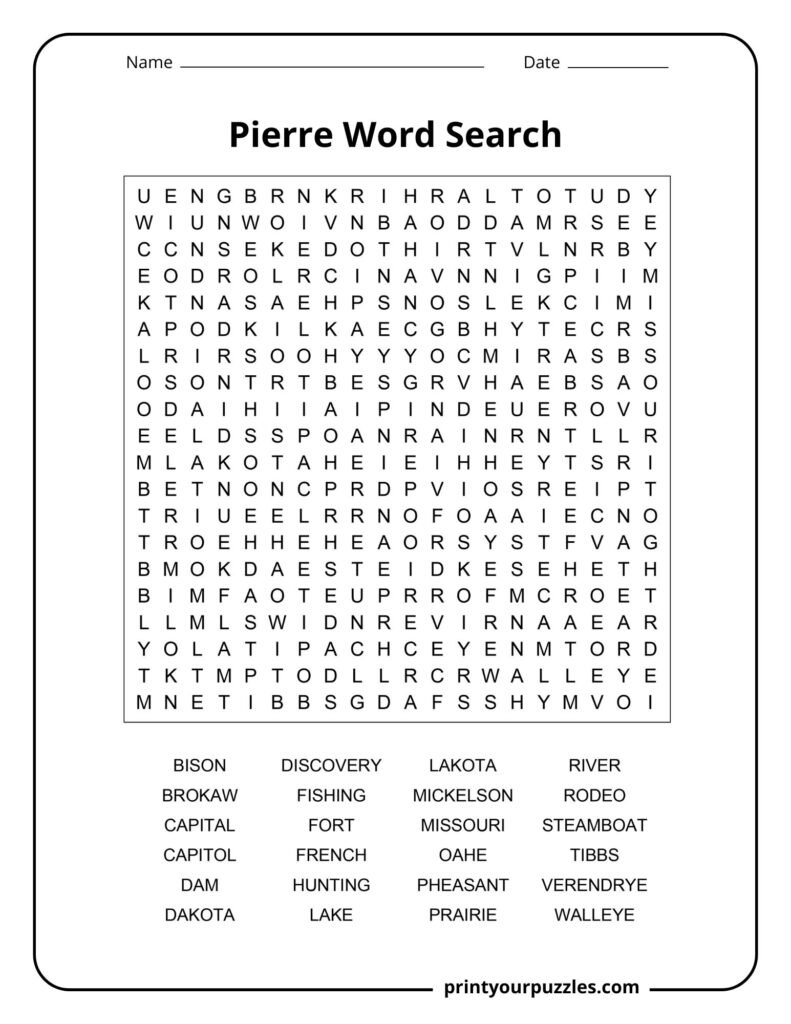
BISON, BROKAW, CAPITAL, CAPITOL, DAM, DAKOTA, DISCOVERY, FISHING, FORT, FRENCH, HUNTING, LAKE, LAKOTA, MICKELSON, MISSOURI, OAHE, PHEASANT, PRAIRIE, RIVER, RODEO, STEAMBOAT, TIBBS, VERENDRYE, WALLEYE
Despite French explorer origins, locals pronounce it “PEER” following American English patterns. The city was named after Fort Pierre, which honored French fur trader Pierre Chouteau Jr.
Pierre has approximately 14,000 residents, making it America’s second smallest state capital after Montpelier, Vermont. Its central location, not size, determined its selection as capital.
Must-see attractions include the South Dakota Capitol building, Cultural Heritage Center, Oahe Dam and Lake, LaFramboise Island Nature Area, Discovery Center, and the Trail of Governors statues.
Pierre offers excellent fishing and hunting, boating on Lake Oahe, hiking on LaFramboise Island, ice fishing in winter, wildlife watching, and exploring the Missouri River recreational areas year-round.
Pierre became the temporary capital when South Dakota achieved statehood in 1889. In 1904, it was designated the permanent capital, with the current Capitol building completed in 1910.
For official city information, government updates, and public services, visit the City of Pierre website. If you are planning a trip, check out the official tourism portal, Visit Pierre.
An artesian well feeds warm water into Capitol Lake, maintaining temperatures around 93 degrees Fahrenheit year-round. This creates a welcoming habitat for thousands of migratory waterfowl seeking winter refuge.
The Vérendrye brothers claimed the region for France by burying a commemorative lead plate. Fort Pierre schoolchildren found it 170 years later, proving France’s early exploration claims.
Pierre residents invested their own money to build the magnificent neoclassical Capitol completed in 1910. Their financial commitment successfully secured Pierre’s position as South Dakota’s permanent capital.
When buffalo faced extinction in the early 1900s, rancher Scotty Philip purchased and protected a herd near Pierre. His conservation efforts helped preserve this iconic American species for future generations.
The Trail of Governors features life-sized bronze statues honoring every person who served as South Dakota’s governor. Visitors can walk among these historical figures throughout downtown Pierre.