
This Respiratory System word search provides an engaging educational activity for students, teachers, and anyone interested in learning about how we breathe. The puzzle features 24 carefully selected terms related to the organs, structures, and processes involved in respiration, from the nose where air enters to the tiny alveoli where oxygen enters the bloodstream.
What makes this Respiratory System word search printable particularly valuable is that every term included in the puzzle is thoroughly defined with clear, concise explanations. Each word is described in 20-30 words, helping learners understand not just the terminology but also the function and importance of each component within the respiratory system. This combination of puzzle-solving and learning definitions reinforces vocabulary retention more effectively than studying alone.
The word search printable format makes it easy to distribute in classrooms, incorporate into homeschool lessons, or use for independent study. Whether you’re a student preparing for an exam, a teacher creating engaging lesson materials, or simply someone curious about human anatomy, this word search transforms learning respiratory system vocabulary into an entertaining challenge. All words are presented in capital letters and alphabetical order for easy reference, ensuring a comprehensive and organized learning experience.
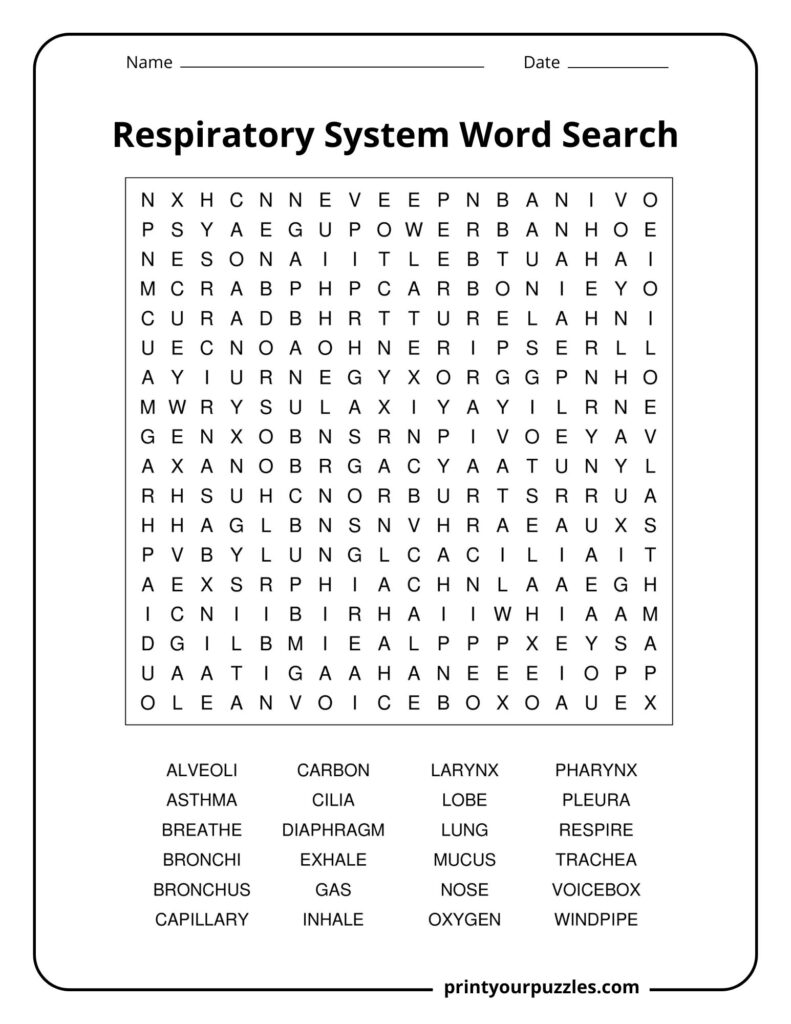
ALVEOLI, ASTHMA, BREATHE, BRONCHI, BRONCHUS, CAPILLARY, CARBON, CILIA, DIAPHRAGM, EXHALE, GAS, INHALE, LARYNX, LOBE, LUNG, MUCUS, NOSE, OXYGEN, PHARYNX, PLEURA, RESPIRE, TRACHEA, VOICE BOX, WINDPIPE
ALVEOLI – Tiny air sacs in the lungs where gas exchange occurs. Oxygen passes into the bloodstream and carbon dioxide is removed from blood to be exhaled out.
ASTHMA – A chronic respiratory condition causing airways to narrow and swell, producing extra mucus. This makes breathing difficult and triggers coughing, wheezing, and shortness of breath episodes.
BREATHE – The process of inhaling oxygen-rich air into the lungs and exhaling carbon dioxide-filled air out. This essential action occurs automatically, regulated by the brain’s respiratory center continuously.
BRONCHI – The two main branches of the trachea that divide and carry air into the left and right lungs. They further subdivide into smaller bronchioles throughout each lung.
BRONCHUS – A singular large airway tube branching from the trachea. Each bronchus leads into one lung and continues dividing into progressively smaller tubes that distribute air throughout lung tissue.
CAPILLARY – Microscopic blood vessels surrounding alveoli where gas exchange happens. Oxygen diffuses from air into blood while carbon dioxide moves from blood into air to be exhaled away.
CARBON – Refers to carbon dioxide, a waste gas produced by cellular metabolism. It travels through blood to lungs where it’s expelled during exhalation, maintaining proper blood pH balance.
CILIA – Tiny hair-like structures lining the respiratory tract that move in coordinated waves. They sweep mucus, dust, and trapped particles upward toward the throat for removal or swallowing.
DIAPHRAGM – A dome-shaped muscle below the lungs that contracts and flattens during inhalation, creating negative pressure. This draws air into lungs; relaxing it helps push air out completely.
EXHALE – The act of breathing out, expelling air from the lungs. The diaphragm relaxes, lungs recoil, and carbon dioxide-rich air is pushed out through airways to the atmosphere.
GAS – Refers to gases exchanged during respiration: oxygen and carbon dioxide. Oxygen enters blood from air; carbon dioxide leaves blood and is breathed out, sustaining cellular function properly.
INHALE – The act of breathing in air through the nose or mouth. The diaphragm contracts, chest expands, and oxygen-rich air flows into the lungs for gas exchange.
LARYNX – The voice box located in the neck between the pharynx and trachea. It contains vocal cords that vibrate to produce sound and protects airways during swallowing with the epiglottis.
LOBE – A distinct section of the lung separated by fissures. The right lung has three lobes while the left lung has two lobes, accommodating space for the heart structure.
LUNG – The primary respiratory organs that facilitate gas exchange. These spongy, elastic organs expand with air during inhalation and contract during exhalation, supplying oxygen to blood continuously and efficiently.
MUCUS – A sticky, protective fluid lining respiratory passages. It traps dust, bacteria, and harmful particles, preventing them from reaching lungs. Cilia move it upward for elimination regularly and continuously.
NOSE – The facial structure forming the entrance to the respiratory system. It filters, warms, and humidifies incoming air while also housing olfactory receptors responsible for smell sensation detection.
OXYGEN – An essential gas absorbed by lungs from air during breathing. It enters the bloodstream through alveoli and is transported to body cells where it fuels cellular respiration and energy production.
PHARYNX – The throat, a muscular tube connecting the nasal cavity and mouth to the larynx and esophagus. It serves as a passageway for both air and food during breathing and eating.
PLEURA – A double-layered membrane surrounding each lung and lining the chest cavity. It produces lubricating fluid that reduces friction during breathing movements, allowing smooth lung expansion and contraction.
RESPIRE – To breathe; the process of inhaling oxygen and exhaling carbon dioxide. This term also refers to cellular respiration where cells use oxygen to produce energy from nutrients efficiently.
TRACHEA – The windpipe, a tube reinforced with cartilage rings connecting the larynx to the bronchi. It conducts air to and from lungs while its cilia and mucus trap debris.
VOICE BOX – Another name for the larynx, containing vocal cords that vibrate when air passes through them. This vibration produces sound, which is shaped into speech by mouth and tongue.
WINDPIPE – Common name for the trachea, the main airway tube extending from the larynx down to where it splits into bronchi. Cartilage rings maintain its structure and keep it open.
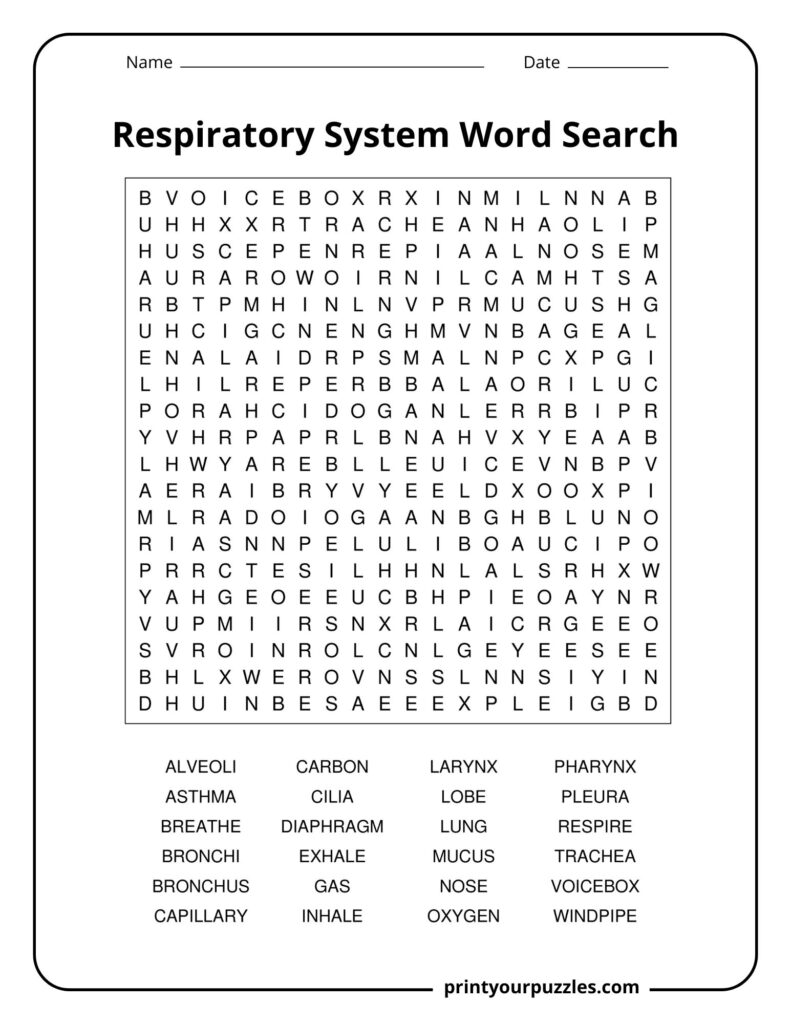
ALVEOLI, ASTHMA, BREATHE, BRONCHI, BRONCHUS, CAPILLARY, CARBON, CILIA, DIAPHRAGM, EXHALE, GAS, INHALE, LARYNX, LOBE, LUNG, MUCUS, NOSE, OXYGEN, PHARYNX, PLEURA, RESPIRE, TRACHEA, VOICE BOX, WINDPIPE
The respiratory system’s primary function is to facilitate gas exchange, bringing oxygen into the body for cellular energy production and removing carbon dioxide waste through breathing processes continuously.
Major organs include the nose, pharynx, larynx, trachea, bronchi, and lungs. The diaphragm muscle also plays a crucial role by controlling breathing movements and enabling air intake and expulsion.
Gas exchange happens in tiny alveoli where oxygen from inhaled air diffuses into surrounding capillaries while carbon dioxide from blood crosses into alveoli to be exhaled out completely.
The brain’s respiratory center monitors carbon dioxide levels in blood and automatically signals the diaphragm and intercostal muscles to contract, triggering inhalation without conscious thought or effort required.
Common conditions include asthma, bronchitis, pneumonia, emphysema, and allergies. These can cause symptoms like wheezing, coughing, shortness of breath, and chest tightness requiring medical attention and treatment options.
The average person takes between 17,000 to 23,000 breaths daily, moving roughly 11,000 liters of air through their lungs. This happens automatically without conscious effort throughout your entire life.
The left lung has only two lobes instead of three to accommodate space for your heart. This size difference allows the heart to sit comfortably in the chest cavity.
If you laid out all the airways and air sacs in your lungs end-to-end, they would extend approximately 1,500 miles. The surface area equals roughly a tennis court size.
Every time you exhale, moisture evaporates from your lungs and airways. This adds up to approximately 200-400 milliliters of water lost through breathing each day naturally.
Your nostrils alternate dominance every few hours in a process called the nasal cycle. One nostril handles most airflow while the other rests, switching throughout the day automatically.
Purus ut praesent facilisi dictumst sollicitudin cubilia ridiculus.