
This Saint Patrick’s Day word search offers an entertaining and educational way to celebrate Irish culture and heritage on March 17th. Perfect for classrooms, family gatherings, or personal enjoyment, this puzzle features 24 carefully selected words and phrases that capture the essence of this beloved holiday.
Our St Patrick’s Day word search is designed for convenience and accessibility, making it easy to share with students, friends, and family members of all ages. Whether you’re a teacher planning festive classroom activities or a parent looking for engaging holiday entertainment, this word search printable provides hours of fun while teaching about Irish traditions.
What makes this puzzle special is that every word included comes with a comprehensive definition of 20-30 words, helping participants understand the meaning and significance behind each term. From shamrocks and Celtic traditions to leprechauns and Irish folklore, you’ll discover fascinating facts about the symbols, customs, and history that make Saint Patrick’s Day a worldwide celebration. These definitions transform a simple word search into an enriching learning experience that deepens appreciation for Ireland’s patron saint and the enduring legacy of Irish culture.
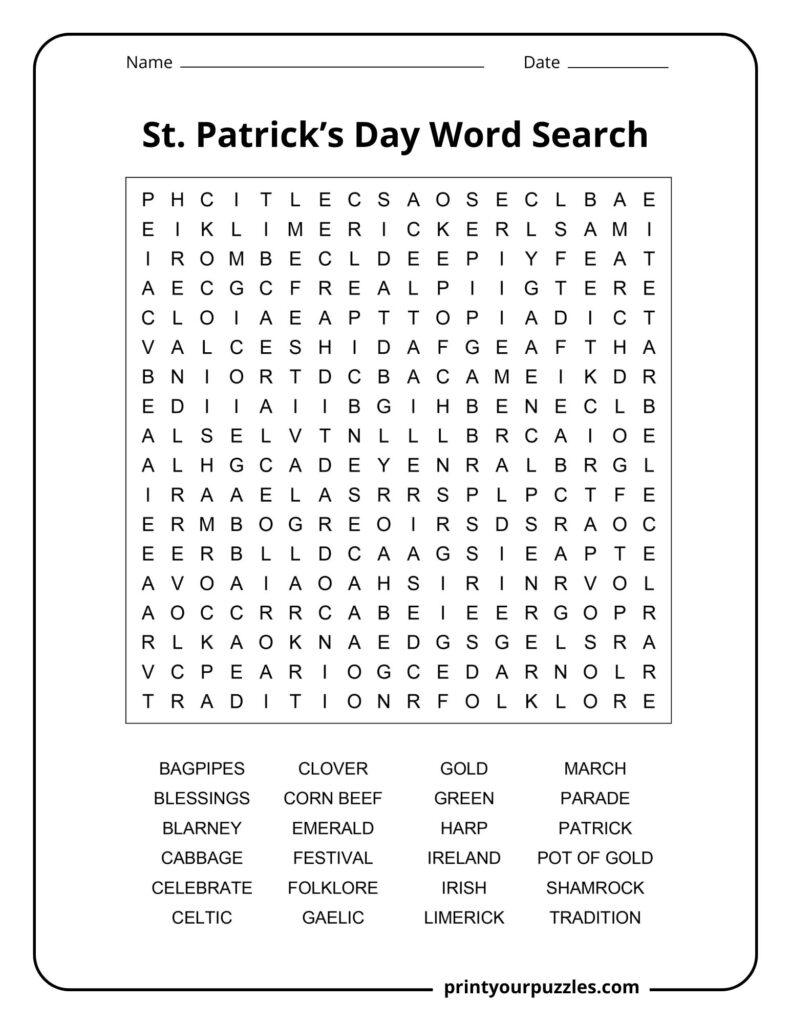
BAGPIPES, BLESSINGS, BLARNEY, CABBAGE, CELEBRATE, CELTIC, CLOVER, CORN BEEF, EMERALD, FESTIVAL, FOLKLORE, GAELIC, GOLD, GREEN, HARP, IRELAND, IRISH, LIMERICK, MARCH, PARADE, PATRICK, POT OF GOLD, SHAMROCK, TRADITION
BAGPIPES – Traditional Scottish and Irish musical instrument consisting of reed pipes and a bag that produces distinctive droning sounds, commonly played at Celtic celebrations and parades.
BLESSINGS – Prayers, good wishes, or divine favor invoked for protection and prosperity, often associated with Irish traditions and the religious aspects of St. Patrick’s Day celebrations.
BLARNEY – Skillful flattery or smooth, clever talk originating from Ireland’s Blarney Castle, where kissing the famous stone supposedly grants the gift of eloquent speech.
CABBAGE – Leafy green vegetable traditionally served with corned beef on St. Patrick’s Day, representing Irish-American culinary traditions, though not authentically Irish in this pairing.
CELEBRATE – To honor and observe St. Patrick’s Day through festivities, parades, wearing green, and participating in Irish cultural traditions worldwide on March seventeenth annually.
CELTIC – Relating to the ancient Celts and their descendants, including Irish, Scottish, and Welsh people, encompassing their languages, art, music, and rich cultural heritage.
CLOVER – Small plant with characteristic three-leafed formation, symbolizing the Holy Trinity in Irish tradition; the rare four-leaf variety represents extraordinary good luck.
CORN BEEF – Salt-cured beef brisket, often served with cabbage on St. Patrick’s Day in America, representing Irish-American immigrant cuisine rather than traditional Irish fare.
EMERALD – Precious green gemstone that gives Ireland its nickname “The Emerald Isle” due to the country’s lush, verdant landscape and rolling green countryside.
FESTIVAL – Large-scale celebration featuring parades, music, dancing, food, and cultural activities held annually to commemorate St. Patrick and honor Irish heritage and traditions.
FOLKLORE – Traditional Irish stories, legends, myths, and superstitions passed down through generations, featuring leprechauns, fairies, and tales of ancient Celtic heroes and magical lands.
GAELIC – Ancient Celtic language spoken in Ireland and Scotland, representing Irish cultural identity and heritage, still taught and used in certain regions today.
GOLD – Precious metal associated with leprechaun legends and the mythical treasure found at rainbow’s end, symbolizing luck and wealth in Irish folklore traditions.
GREEN – The symbolic color of Ireland and St. Patrick’s Day, representing the island’s lush landscapes, Irish pride, and worn worldwide to celebrate Irish heritage.
HARP – Ireland’s national symbol and traditional musical instrument, featured on Irish coins and official emblems, producing beautiful melodic sounds in Celtic music performances.
IRELAND – Island nation in the North Atlantic, known for its rich culture, history, stunning landscapes, and as the birthplace of St. Patrick’s Day celebrations worldwide.
IRISH – Relating to Ireland, its people, language, and culture, celebrated globally on St. Patrick’s Day through traditions, music, dance, and displays of national pride.
LIMERICK – Five-line humorous poem with distinctive AABBA rhyme scheme, originating from Ireland’s Limerick city, known for its witty, often nonsensical or playful verses.
MARCH – The third month of the year when St. Patrick’s Day is celebrated on the seventeenth, marking spring’s arrival with Irish festivities worldwide.
PARADE – Public procession featuring marching bands, dancers, floats, and costumed participants celebrating St. Patrick’s Day, with major events held in Dublin, New York, and globally.
PATRICK – Patron saint of Ireland who lived in the fifth century, credited with bringing Christianity to Ireland and celebrated annually on March seventeenth.
POT OF GOLD – Legendary treasure hidden at rainbow’s end, guarded by leprechauns in Irish folklore, symbolizing elusive riches, dreams, and the magic of Irish mythology.
SHAMROCK – Three-leafed clover plant, Ireland’s national symbol, reportedly used by St. Patrick to explain the Holy Trinity, worn proudly on St. Patrick’s Day celebrations.
TRADITION – Customs, beliefs, and practices passed down through Irish generations, including storytelling, music, dance, and festive celebrations maintaining cultural identity and heritage.
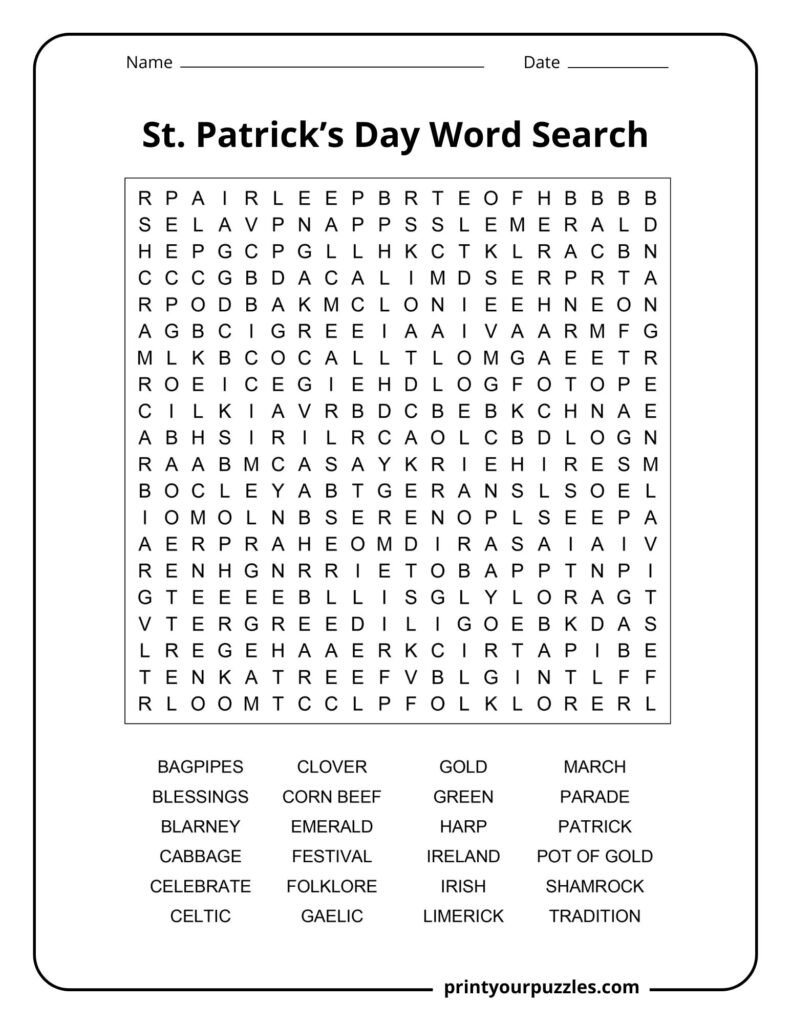
BAGPIPES, BLESSINGS, BLARNEY, CABBAGE, CELEBRATE, CELTIC, CLOVER, CORN BEEF, EMERALD, FESTIVAL, FOLKLORE, GAELIC, GOLD, GREEN, HARP, IRELAND, IRISH, LIMERICK, MARCH, PARADE, PATRICK, POT OF GOLD, SHAMROCK, TRADITION
St. Patrick’s Day is celebrated annually on March 17th, marking the traditional death date of Saint Patrick, Ireland’s patron saint who died circa 461 AD.
Saint Patrick was a fifth-century Christian missionary who brought Christianity to Ireland. He’s credited with using the shamrock to explain the Holy Trinity to Irish pagans.
Green represents Ireland’s lush landscapes and national identity. Wearing green shows Irish pride and solidarity. Legend says it also makes you invisible to mischievous leprechauns pinching people.
The shamrock, a three-leafed clover, is Ireland’s national symbol. Saint Patrick reportedly used it as a visual metaphor to teach the concept of the Holy Trinity to Irish people.
No, St. Patrick’s Day is celebrated worldwide, especially in countries with Irish diaspora populations. Major parades and festivities occur in the United States, Canada, Australia, and numerous other nations.
Saint Patrick was born in Roman Britain, possibly Scotland or Wales. He was kidnapped by Irish raiders at age sixteen and enslaved in Ireland before escaping and later returning as a missionary.
St. Patrick’s traditional color was “St. Patrick’s Blue,” seen in ancient Irish flags and illustrations. Green became prominent later through Ireland’s nickname and nationalist movements during the eighteenth century.
This popular St. Patrick’s Day meal is actually Irish-American. In Ireland, people traditionally ate bacon and cabbage. Irish immigrants in America substituted cheaper corned beef from Jewish delis.
Since 1962, Chicago has used eco-friendly vegetable dye to turn the Chicago River emerald green each March. The tradition started accidentally when plumbers used dye to trace pollution sources.
Ireland never had snakes due to its island geography and Ice Age climate. The “snakes” St. Patrick supposedly banished likely symbolize pagan beliefs he converted to Christianity throughout Ireland.
Purus ut praesent facilisi dictumst sollicitudin cubilia ridiculus.