
This Solar System word search invites learners on an exciting journey through our cosmic neighborhood, exploring the fascinating realm that has captivated humanity for millennia. Our Solar System formed approximately 4.6 billion years ago from a collapsing cloud of gas and dust, creating the Sun and eight planets that orbit within this vast celestial system located in the Milky Way galaxy’s Orion Arm.
What makes our Solar System remarkable is its incredible diversity—from scorching Mercury, closest to the Sun, to frigid Neptune at the outer edge. The system includes rocky inner planets, massive gas giants, numerous moons, asteroids, comets, and dwarf planets like Pluto. Scientists and astronomers study this cosmic family to understand planetary formation, search for life beyond Earth, and prepare for future space exploration.
This Solar System word search printable goes far beyond traditional puzzles by incorporating comprehensive educational resources. Each of the 24 hidden words comes with detailed definitions explaining astronomical concepts in accessible language. Additionally, the puzzle includes an engaging FAQ section answering common questions about planetary classifications and Solar System structure, plus a fascinating “Did You Know?” section revealing surprising facts—like Saturn being light enough to float in water!
This word search printable transforms entertainment into education, making it perfect for classroom activities, homeschool lessons, or independent learning. Whether you’re a student discovering space for the first time or an enthusiast deepening your knowledge, this puzzle offers an engaging way to explore our magnificent Solar System.
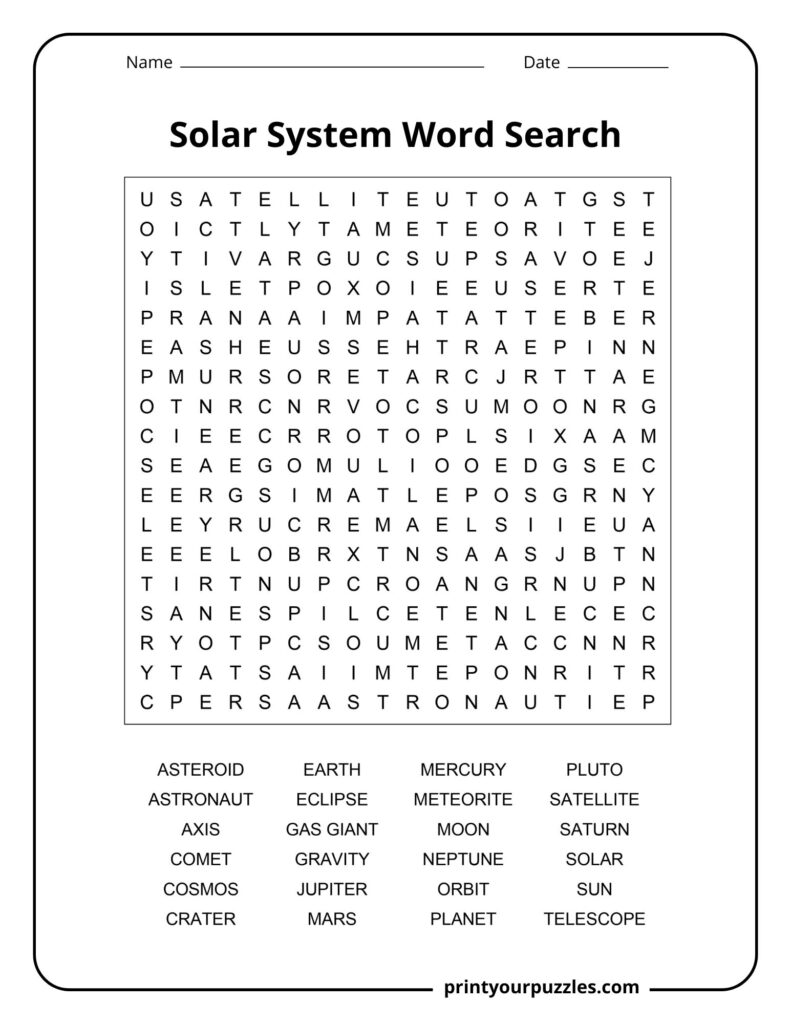
ASTEROID, ASTRONAUT, AXIS, COMET, COSMOS, CRATER, EARTH, ECLIPSE, GAS GIANT, GRAVITY, JUPITER, MARS, MERCURY, METEORITE, MOON, NEPTUNE, ORBIT, PLANET, PLUTO, SATELLITE, SATURN, SOLAR, SUN, TELESCOPE
ASTEROID – A small rocky or metallic object orbiting the Sun, typically found in the asteroid belt between Mars and Jupiter, ranging from meters to hundreds of kilometers wide.
ASTRONAUT – A person trained and equipped to travel in spacecraft beyond Earth’s atmosphere, conducting scientific research, performing maintenance tasks, and exploring space for human knowledge and advancement.
AXIS – An imaginary straight line passing through the center of a planet or celestial body around which it rotates, determining its day-night cycle and seasonal patterns.
COMET – An icy celestial body that develops a glowing tail of gas and dust when its orbit brings it close to the Sun, causing its frozen materials to vaporize.
COSMOS – The universe regarded as an orderly, harmonious system encompassing all matter, energy, space, and time, including galaxies, stars, planets, and all forms of existence throughout infinity.
CRATER – A bowl-shaped depression on a planet or moon’s surface formed by the high-speed impact of meteorites, asteroids, or comets, or created by volcanic activity explosions.
EARTH – The third planet from the Sun and our home world, featuring liquid water, diverse life forms, protective atmosphere, and unique conditions supporting complex ecosystems throughout continents.
ECLIPSE – A celestial event occurring when one astronomical body moves into the shadow of another, temporarily blocking light, such as when the Moon obscures the Sun or Earth.
GAS GIANT – A massive planet composed primarily of hydrogen and helium gases rather than solid rock, like Jupiter or Saturn, featuring thick atmospheres and often numerous moons orbiting.
GRAVITY – The natural attractive force between objects with mass, pulling them toward each other, keeping planets in orbit around stars and moons around planets throughout the universe.
JUPITER – The largest planet in our Solar System, a massive gas giant with distinctive bands of clouds, the famous Great Red Spot storm, and over seventy known moons.
MARS – The fourth planet from the Sun, known as the Red Planet due to iron oxide on its surface, featuring polar ice caps, volcanoes, and potential for past water.
MERCURY – The smallest planet and closest to the Sun, featuring extreme temperature variations, no atmosphere, a heavily cratered surface, and the fastest orbital speed in our system.
METEORITE – A solid piece of debris from space that survives its fiery passage through Earth’s atmosphere and lands on the surface, providing valuable samples of extraterrestrial material for study.
MOON – Earth’s natural satellite orbiting our planet, influencing ocean tides, stabilizing Earth’s axial tilt, and providing reflected sunlight that illuminates our nights with its changing phases.
NEPTUNE – The eighth and most distant planet from the Sun in our Solar System, an ice giant with powerful winds, a deep blue color, and several moons including Triton.
ORBIT – The curved path followed by a celestial object moving around another due to gravitational attraction, such as planets circling the Sun or satellites revolving around Earth continuously.
PLANET – A large celestial body orbiting a star, having sufficient mass for gravity to form it into a spherical shape, and having cleared its orbital path of other debris.
PLUTO – A dwarf planet in the outer Solar System beyond Neptune’s orbit, once considered the ninth planet, featuring a heart-shaped region and five known moons including Charon.
SATELLITE – Any object orbiting a planet or star, either natural like moons formed from cosmic debris, or artificial spacecraft launched by humans for communication, observation, or scientific purposes.
SATURN – The sixth planet from the Sun, famous for its spectacular system of icy rings, numerous moons including Titan, and its distinctive golden appearance from hydrogen clouds.
SOLAR – Relating to or originating from the Sun, our central star that provides light, heat, and energy to Earth and all planets within our system through nuclear fusion.
SUN – The star at the center of our Solar System, a massive sphere of hot plasma producing energy through nuclear fusion, providing essential light and warmth for life on Earth.
TELESCOPE – An optical instrument using lenses or mirrors to magnify distant objects, allowing astronomers to observe planets, stars, galaxies, and other celestial phenomena across vast cosmic distances.
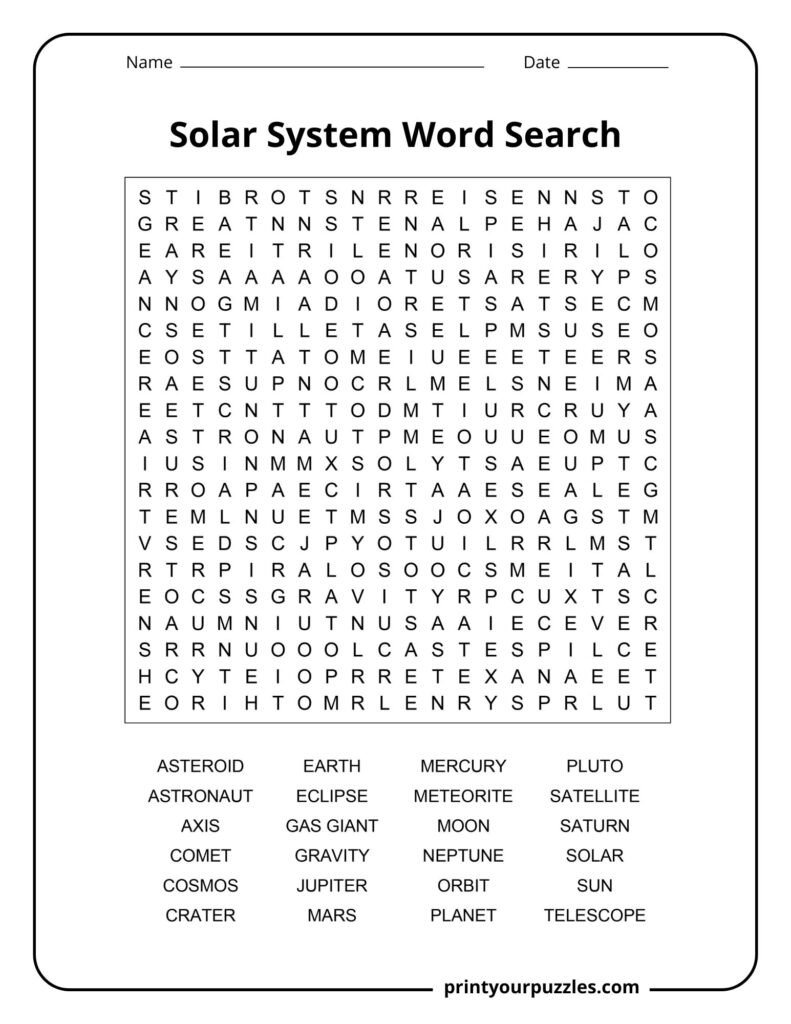
ASTEROID, ASTRONAUT, AXIS, COMET, COSMOS, CRATER, EARTH, ECLIPSE, GAS GIANT, GRAVITY, JUPITER, MARS, MERCURY, METEORITE, MOON, NEPTUNE, ORBIT, PLANET, PLUTO, SATELLITE, SATURN, SOLAR, SUN, TELESCOPE
There are eight planets in our Solar System: Mercury, Venus, Earth, Mars, Jupiter, Saturn, Uranus, and Neptune. Pluto was reclassified as a dwarf planet in 2006.
Jupiter is the largest planet, with a diameter of approximately 143,000 kilometers. This gas giant is more than eleven times wider than Earth and contains more mass than all other planets combined.
The Solar System formed approximately 4.6 billion years ago from a collapsing cloud of gas and dust. The Sun ignited first, followed by planets forming from remaining material orbiting around it.
The asteroid belt, located between Mars and Jupiter, separates the rocky inner planets from the gaseous outer planets. It contains millions of rocky remnants from the Solar System’s formation period.
Pluto was reclassified as a dwarf planet because it hasn’t cleared its orbital path of other debris, which is a requirement for full planetary status established by astronomers in 2006.
Venus spins clockwise on its axis, opposite to Earth and most other planets. Additionally, one day on Venus lasts longer than its entire year around the Sun!
Saturn is the least dense planet in our Solar System. If you could find an ocean large enough, Saturn would actually float because its density is lower than water’s!
A Martian day, called a “sol,” lasts 24 hours and 37 minutes, just slightly longer than Earth’s day. This similarity makes Mars particularly interesting for potential human colonization efforts.
Despite having eight planets, numerous moons, asteroids, and comets, the Sun’s enormous mass accounts for nearly all matter in our entire Solar System, demonstrating its dominant gravitational influence.
Neptune’s atmosphere produces supersonic winds reaching speeds up to 2,100 kilometers per hour, faster than any other planet, creating massive storms in its frigid blue atmosphere.