
This South Carolina word search offers an exciting educational journey through the Palmetto State’s rich history, culture, and traditions. Perfect for students, teachers, families, and puzzle enthusiasts, this engaging activity challenges you to discover 24 carefully curated words that represent what makes South Carolina unique.
The puzzle features a diverse collection of terms spanning geography, history, cuisine, and culture. From coastal treasures like Atlantic beaches and marshes to mountainous Blue Ridge landscapes, you’ll explore the state’s varied terrain. Historical references include Secession, Patriots, and influential figures like Calhoun, while culinary favorites such as shrimp, grits, sweet tea, and okra celebrate lowcountry food traditions. Sports fans will recognize Clemson Tigers and Gamecocks, representing the state’s passionate college rivalry.
What sets this South Carolina word search printable apart is that every word comes with a comprehensive 20-30 word definition, helping you learn while you search. This word search printable serves as both entertainment and education, making it ideal for classroom activities, homeschooling lessons, or simply expanding your knowledge of South Carolina’s fascinating heritage. Challenge yourself to find all 24 words and discover the stories behind them!
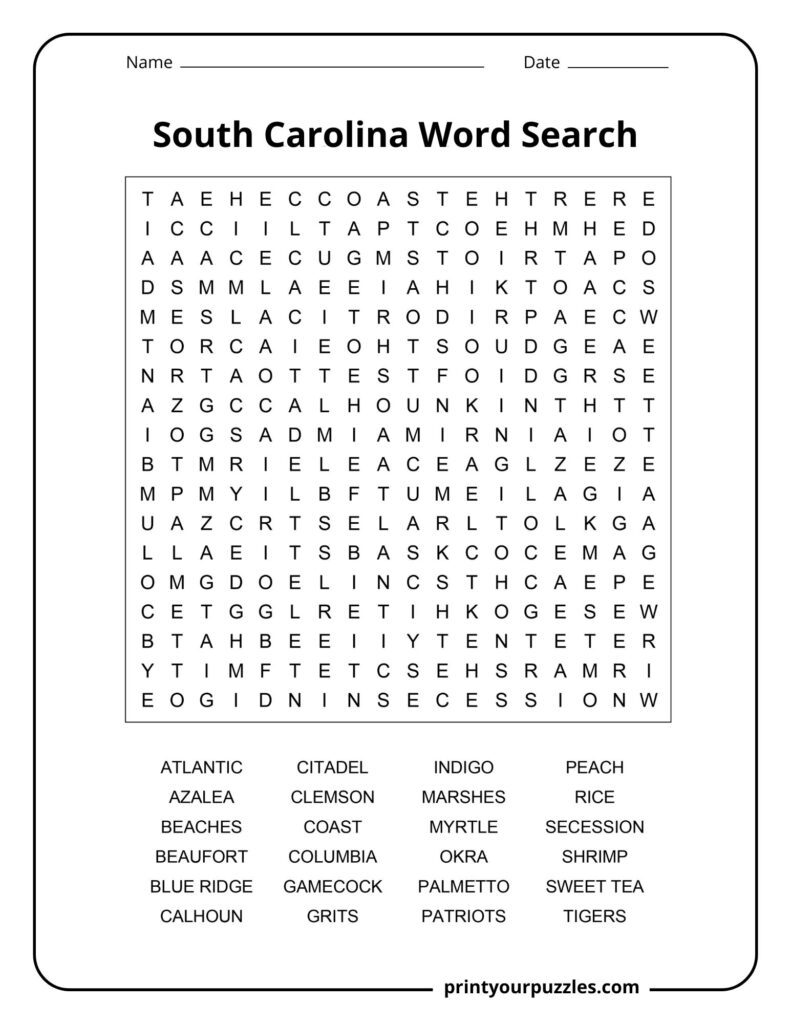
ATLANTIC, AZALEA, BEACHES, BEAUFORT, BLUE RIDGE, CALHOUN, CITADEL, CLEMSON, COAST, COLUMBIA, GAMECOCK, GRITS, INDIGO, MARSHES, MYRTLE, OKRA, PALMETTO, PATRIOTS, PEACH, RICE, SECESSION, SHRIMP, SWEET TEA, TIGERS
ATLANTIC – The ocean bordering South Carolina’s eastern coastline, providing beaches, maritime economy, and hurricane vulnerability that shapes the state’s culture and climate throughout history.
AZALEA – Flowering shrub blooming spectacularly across South Carolina each spring, especially in Charleston gardens, symbolizing Southern horticulture and the state’s mild climate beauty.
BEACHES – Coastal attractions like Myrtle Beach, Hilton Head, and Folly Beach draw millions of tourists annually, making tourism a vital economic driver for South Carolina’s economy.
BEAUFORT – Historic coastal city known for antebellum architecture, Gullah culture, Marine Corps base, and serving as a filming location for numerous movies including Forrest Gump.
BLUE RIDGE – Northwestern mountain region offering waterfalls, hiking trails, and cooler climate, contrasting sharply with the state’s coastal lowcountry landscape and attracting outdoor enthusiasts year-round.
CALHOUN – John C. Calhoun, influential South Carolina politician who served as vice president, senator, and fierce advocate for states’ rights during the antebellum period.
CITADEL – Military college in Charleston founded in 1842, known for rigorous discipline, historic campus, and producing military leaders while maintaining Southern military tradition.
CLEMSON – Major public university in upstate South Carolina, known for engineering programs, football dominance, and intense rivalry with University of South Carolina’s Gamecocks.
COAST – South Carolina’s 187-mile coastline features barrier islands, salt marshes, historic ports, and diverse ecosystems supporting fishing, shipping, and beach tourism industries.
COLUMBIA – State capital and largest city, home to University of South Carolina, government offices, and historic sites including Sherman’s Civil War burning path.
GAMECOCK – University of South Carolina’s mascot, representing the state bird and reflecting colonial-era cockfighting tradition, symbolizing fierce fighting spirit in athletic competitions.
GRITS – Traditional Southern ground corn dish, breakfast staple in South Carolina cuisine, often served with shrimp, butter, or cheese in lowcountry cooking traditions.
INDIGO – Colonial cash crop that made South Carolina wealthy before cotton, producing blue dye exported to Europe, cultivated extensively by enslaved laborers.
MARSHES – Coastal salt marshes provide crucial ecosystems for wildlife, fishing nurseries, storm protection, and scenic beauty characteristic of South Carolina’s lowcountry landscape.
MYRTLE – Myrtle Beach, the state’s most popular tourist destination, famous for golf courses, entertainment, boardwalk attractions, and drawing millions of visitors annually.
OKRA – Vegetable brought from Africa, integral to lowcountry cuisine, used in gumbo, fried dishes, and representing African culinary influence on South Carolina’s food culture.
PALMETTO – South Carolina’s state tree, appearing on the state flag, symbolizing Revolutionary War Fort Moultrie defense where palmetto logs absorbed British cannonballs effectively.
PATRIOTS – Revolutionary War fighters who defended South Carolina against British forces, participating in crucial battles like Kings Mountain and Cowpens that changed war’s momentum.
PEACH – Important fruit crop in South Carolina, particularly in the Ridge region, making the state a significant southeastern peach producer after Georgia.
RICE – Historical cash crop that dominated lowcountry plantations, requiring extensive enslaved labor, creating immense wealth and shaping South Carolina’s agricultural and cultural legacy.
SECESSION – South Carolina became the first state to secede from the Union in December 1860, triggering the Civil War and fundamentally altering American history.
SHRIMP – Seafood staple in lowcountry cuisine, caught along coast, featured in dishes like shrimp and grits, representing South Carolina’s maritime culinary traditions.
SWEET TEA – Iconic Southern beverage, heavily sweetened iced tea served throughout South Carolina, considered the unofficial state drink and hospitality symbol in regional culture.
TIGERS – Clemson University’s athletic mascot and team name, representing one of college football’s most successful programs and passionate fan base in South Carolina.
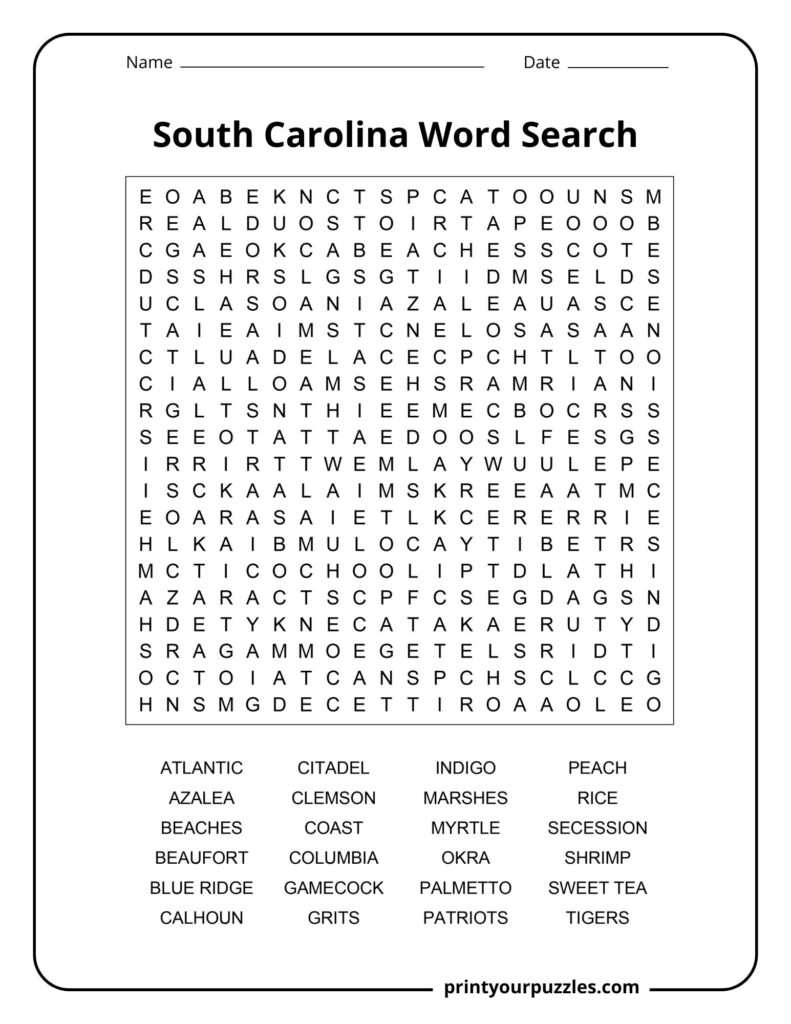
ATLANTIC, AZALEA, BEACHES, BEAUFORT, BLUE RIDGE, CALHOUN, CITADEL, CLEMSON, COAST, COLUMBIA, GAMECOCK, GRITS, INDIGO, MARSHES, MYRTLE, OKRA, PALMETTO, PATRIOTS, PEACH, RICE, SECESSION, SHRIMP, SWEET TEA, TIGERS
South Carolina is known for historic Charleston, beautiful beaches, Myrtle Beach tourism, lowcountry cuisine, Civil War history, plantation heritage, golf courses, and the first state to secede from the Union.
Columbia is South Carolina’s capital and largest city, located in the center of the state. It serves as the governmental hub and home to the University of South Carolina.
South Carolina earned the nickname “Palmetto State” because palmetto trees helped defend Fort Moultrie during the Revolutionary War. The spongy wood absorbed British cannonballs, leading to victory.
Major attractions include Myrtle Beach’s entertainment district, historic Charleston, Hilton Head Island resorts, Fort Sumter, Congaree National Park, Brookgreen Gardens, and numerous Revolutionary and Civil War sites.
South Carolina cuisine features shrimp and grits, she-crab soup, lowcountry boil, mustard-based barbecue sauce, sweet tea, boiled peanuts, frogmore stew, okra dishes, and fresh Atlantic seafood specialties.
For official state records and government services, visit the South Carolina State Portal. If you are planning a trip, check out Discover South Carolina.
The state’s full legal name is “State of Rhode Island and Providence Plantations,” making it the longest official name of any U.S. state until 2020.
The White Horse Tavern in Newport opened in 1673 and still operates today, serving guests for over 350 years, making it America’s oldest continuously operating tavern.
The first diner, a horse-drawn lunch wagon selling food to night workers, was created in Providence in 1872 by Walter Scott, revolutionizing American casual dining culture forever.
Rhode Island officially renounced allegiance to King George III on May 4, 1776—two months before the Declaration of Independence was signed by the other colonies.
Despite having five counties for geographic purposes, Rhode Island abolished county governance in 1842, making it the only U.S. state without functioning county-level administration today.
Purus ut praesent facilisi dictumst sollicitudin cubilia ridiculus.