
This South Dakota word search offers an engaging and educational journey through the Mount Rushmore State’s most defining features. Perfect for students, teachers, families, and puzzle enthusiasts, this activity combines entertainment with learning about one of America’s most historically rich and naturally beautiful states.
The puzzle features 24 carefully selected words representing South Dakota’s diverse character—from iconic landmarks like Badlands and Rushmore to cultural treasures like chislic and kuchen. You’ll discover terms honoring Native American heritage including Lakota and Sioux, wildlife such as bison and pheasant, and historic figures like Custer and Ingalls. Each word captures an essential aspect of what makes South Dakota unique.
What sets this South Dakota word search printable apart is that every single word included in the puzzle comes with a detailed 20-30 word definition, helping solvers understand the significance of each term they find. This word search printable serves as both an entertaining challenge and an informative resource, making it ideal for classroom activities, homeschooling, road trip entertainment, or anyone wanting to deepen their knowledge of South Dakota while enjoying a classic puzzle format.
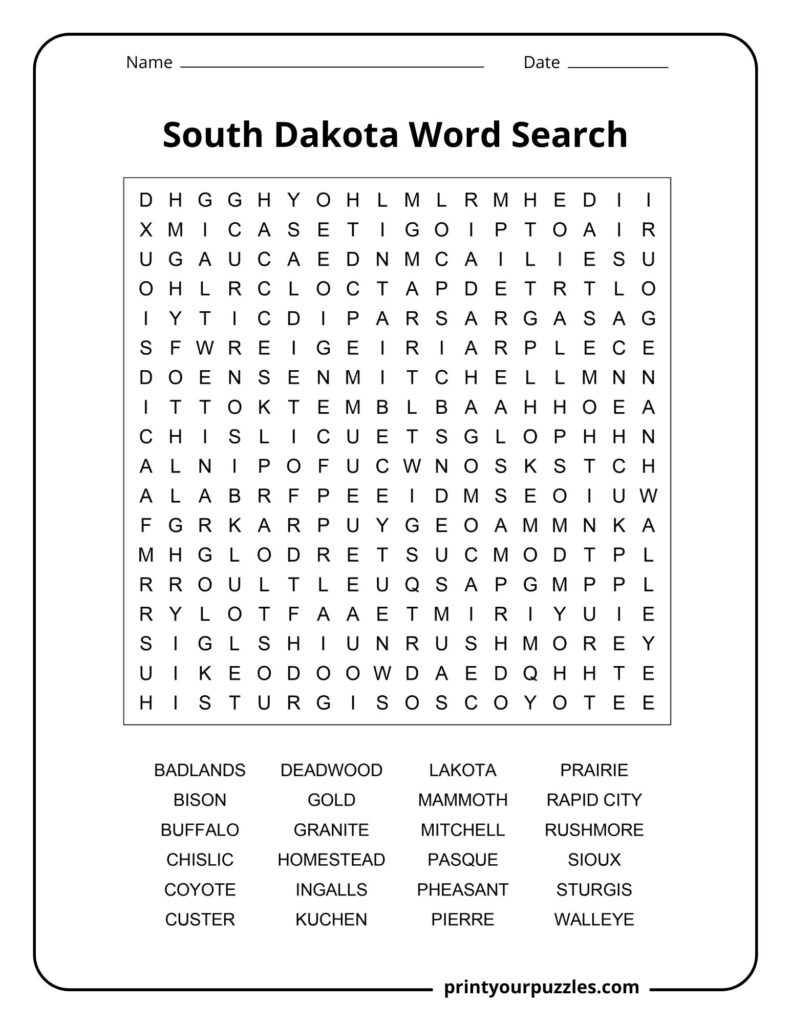
BADLANDS, BISON, BUFFALO, CHISLIC, COYOTE, CUSTER, DEADWOOD, GOLD, GRANITE, HOMESTEAD, INGALLS, KUCHEN, LAKOTA, MAMMOTH, MITCHELL, PASQUE, PHEASANT, PIERRE, PRAIRIE, RAPID CITY, RUSHMORE, SIOUX, STURGIS, WALLEYE
BADLANDS – Stunning eroded rock formations in southwestern South Dakota featuring dramatic buttes, pinnacles, and canyons. A national park showcasing millions of years of geological history and fossil beds.
BISON – Large, shaggy-haired North American mammal that roams South Dakota’s prairies and parks. Often called buffalo, these iconic animals symbolize the state’s wildlife heritage and western history.
BUFFALO – Common name for American bison. These massive animals once roamed the Great Plains in millions and remain central to South Dakota’s cultural identity and Native American traditions.
CHISLIC – South Dakota’s signature dish consisting of cubed red meat, traditionally lamb or mutton, deep-fried or grilled and served on toothpicks. Often enjoyed with garlic salt and crackers.
COYOTE – South Dakota’s official state animal. This adaptable wild canine is known for its distinctive howl and thrives throughout the prairies, hills, and badlands of the region.
CUSTER – General George Armstrong Custer explored the Black Hills in 1874, discovering gold. The town and state park bearing his name commemorate this controversial historical figure and expedition.
DEADWOOD – Historic Wild West town in the Black Hills, famous for gold rush history, gambling, and legendary figures like Wild Bill Hickok and Calamity Jane who are buried there.
GOLD – Precious metal discovered in the Black Hills in 1874, sparking a major gold rush that transformed South Dakota’s economy and led to significant population growth and development.
GRANITE – Durable igneous rock abundant in South Dakota’s Black Hills. Mount Rushmore and Crazy Horse Memorial are both carved from this hard stone, showcasing exceptional geological features.
HOMESTEAD – The Homestead Act of 1862 encouraged settlement in South Dakota by offering free land to pioneers willing to farm it, dramatically shaping the state’s agricultural character and population.
INGALLS – Laura Ingalls Wilder, beloved author of “Little House” books, spent childhood years in De Smet, South Dakota. The town celebrates her legacy with museums and annual pageants.
KUCHEN – South Dakota’s official state dessert, a German fruit-filled sweet cake with custard topping. This traditional pastry reflects the strong German-Russian immigrant influence in the region.
LAKOTA – Major Native American tribe and part of the Great Sioux Nation. The Lakota people have deep historical and ongoing cultural connections to South Dakota’s lands and heritage.
MAMMOTH – The Mammoth Site in Hot Springs preserves one of the world’s largest concentrations of Columbian and woolly mammoth fossils, offering insights into Ice Age history and paleontology.
MITCHELL – South Dakota city famous for the Corn Palace, a unique building decorated annually with murals made from corn and grains, attracting thousands of visitors and celebrating agricultural abundance.
PASQUE – The American pasqueflower, South Dakota’s state flower, blooms early on prairies with purple petals. This hardy wildflower symbolizes resilience and signals spring’s arrival across the plains.
PHEASANT – South Dakota’s state bird, the ring-necked pheasant is prized by hunters. These colorful game birds thrive in agricultural areas and contribute significantly to the state’s hunting tourism industry.
PIERRE – South Dakota’s state capital located on the Missouri River. Though one of America’s smallest state capitals by population, it serves as the governmental center for state affairs.
PRAIRIE – Vast grassland ecosystem dominating South Dakota’s landscape. These rolling plains support agriculture, wildlife, and represent the state’s heartland character with endless horizons and natural beauty.
RAPID CITY – South Dakota’s second-largest city, serving as the gateway to Mount Rushmore, Black Hills, and Badlands. A regional hub for tourism, commerce, and outdoor recreation activities.
RUSHMORE – Mount Rushmore National Memorial features carved granite faces of Presidents Washington, Jefferson, Theodore Roosevelt, and Lincoln. This iconic sculpture symbolizes American democracy and attracts millions annually.
SIOUX – Collective name for the Great Sioux Nation, including Dakota, Lakota, and Nakota tribes. These indigenous peoples have profound historical connections to South Dakota’s land and culture.
STURGIS – Small Black Hills city hosting the world-famous Sturgis Motorcycle Rally each August. This legendary event draws hundreds of thousands of bikers annually, celebrating motorcycle culture and community.
WALLEYE – Prized freshwater game fish abundant in South Dakota’s lakes and Missouri River. Known for excellent taste, walleye fishing is a popular recreational activity and culinary tradition.
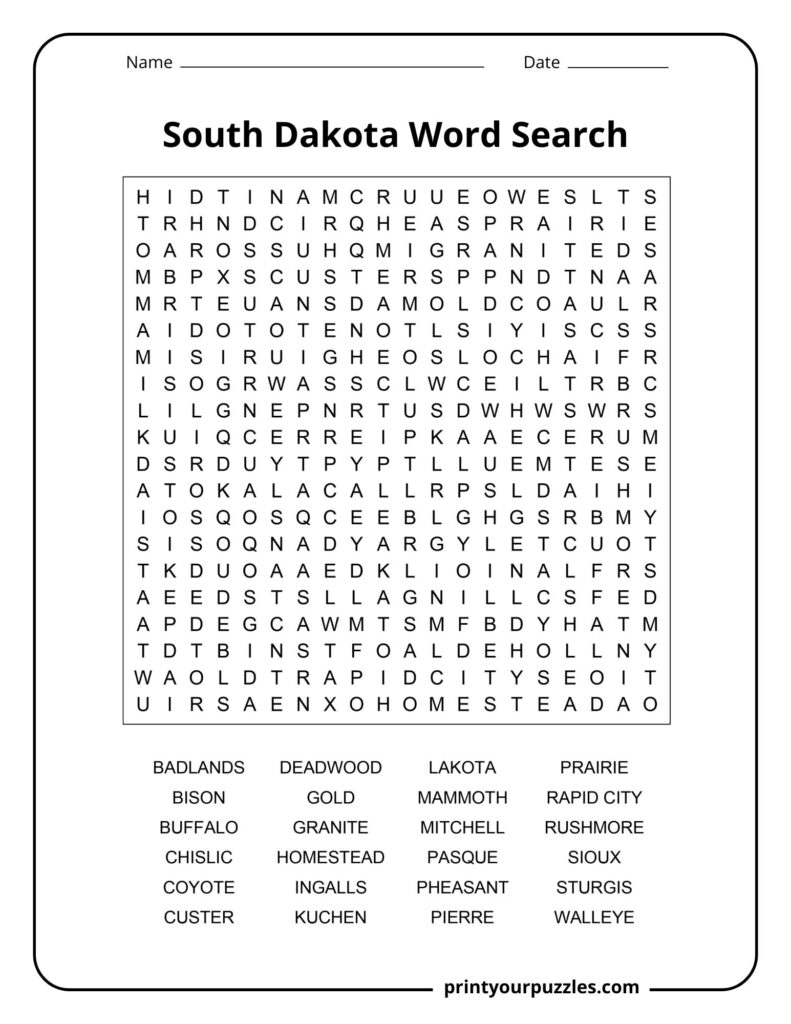
BADLANDS, BISON, BUFFALO, CHISLIC, COYOTE, CUSTER, DEADWOOD, GOLD, GRANITE, HOMESTEAD, INGALLS, KUCHEN, LAKOTA, MAMMOTH, MITCHELL, PASQUE, PHEASANT, PIERRE, PRAIRIE, RAPID CITY, RUSHMORE, SIOUX, STURGIS, WALLEYE
South Dakota is most famous for Mount Rushmore National Memorial, featuring carved presidential faces, along with Badlands National Park, Crazy Horse Memorial, and its rich Native American heritage and history.
Pierre is South Dakota’s capital city, located on the Missouri River in the central part of the state. Despite being the capital, it remains one of America’s smallest state capitals.
Agriculture dominates South Dakota’s economy, particularly cattle ranching, corn, and soybeans. Tourism, manufacturing, healthcare, and financial services also contribute significantly to the state’s economic foundation and employment opportunities.
The Lakota, Dakota, and Nakota tribes, collectively known as the Great Sioux Nation, have deep historical connections to South Dakota. Nine federally recognized tribal reservations exist within the state today.
Summer months from June through August offer ideal weather for visiting Mount Rushmore, national parks, and attending the famous Sturgis Motorcycle Rally. Fall provides beautiful colors and fewer crowds throughout attractions.
For official state records and government services, visit the South Dakota State Portal. If you are planning a trip, check out Travel South Dakota.
The world-famous Corn Palace features new murals annually, created using thousands of bushels of corn, grains, and grasses. This unique tradition has continued since 1892, celebrating agricultural abundance.
Sculptor Gutzon Borglum initially planned to carve the presidents from head to waist. However, funding limitations and difficult rock conditions meant only the 60-foot-tall faces were completed.
Paleontologist Sue Hendrickson found this remarkable 67-million-year-old Tyrannosaurus rex specimen near Faith in 1990. Sue now resides at Chicago’s Field Museum after considerable legal controversy.
What started as a small racing event has grown into the world’s largest motorcycle rally, now attracting over 500,000 bikers annually to this tiny Black Hills town.
South Dakota is one of only nine U.S. states without personal income tax, making it attractive for retirees and businesses while relying on sales and property taxes instead.



Purus ut praesent facilisi dictumst sollicitudin cubilia ridiculus.