

This States of Matter word search offers an exciting way to explore essential scientific concepts while reinforcing key vocabulary related to physical science. Perfect for students, teachers, and science enthusiasts, this puzzle provides an engaging learning experience that combines education with entertainment.
The puzzle features 24 carefully selected terms covering solids, liquids, gases, and plasma, along with important processes like evaporation, condensation, melting, and freezing. What makes this resource particularly valuable is that all the words to search are defined with clear, concise explanations ranging from 20 to 30 words each. These definitions help learners understand not just the vocabulary, but the actual scientific concepts behind each term.
This States of Matter word search printable is ideal for classroom activities, homework assignments, test preparation, or independent study. Teachers can use it as a review tool, while parents will appreciate it as a supplemental learning resource. The word search printable format makes it convenient to use in any educational setting, whether at home or school. By combining puzzle-solving with comprehensive definitions, this activity transforms vocabulary practice into a meaningful learning experience that helps students master fundamental science concepts.
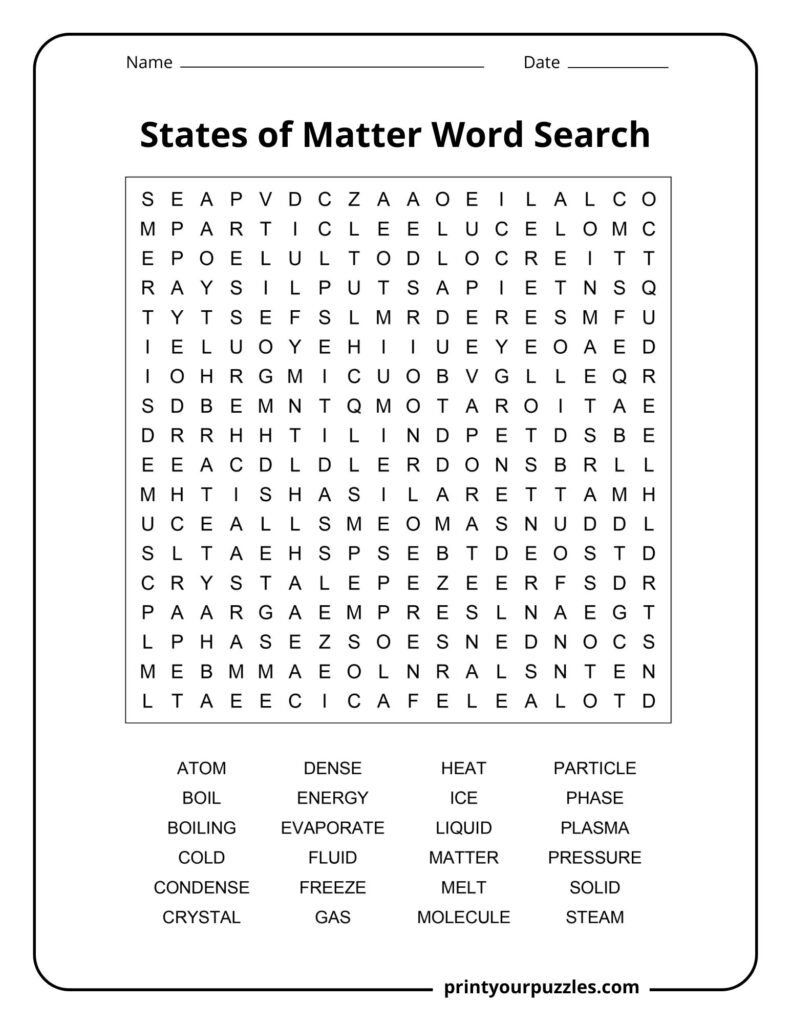
ATOM, BOIL, BOILING, COLD, CONDENSE, CRYSTAL, DENSE, ENERGY, EVAPORATE, FLUID, FREEZE, GAS, HEAT, ICE, LIQUID, MATTER, MELT, MOLECULE, PARTICLE, PHASE, PLASMA, PRESSURE, SOLID, STEAM
ATOM – The smallest unit of matter that retains the properties of an element, consisting of a nucleus surrounded by electrons in constant motion.
BOIL – The rapid transformation of a liquid into gas when heated to its boiling point, characterized by bubbles forming throughout the liquid.
BOILING – The process where a liquid rapidly converts to vapor at a specific temperature, creating bubbles that rise to the surface and release gas.
COLD – A condition of low temperature where thermal energy is reduced, causing particles to slow down and move less vigorously than in warmer conditions.
CONDENSE – The process where gas transforms into liquid when cooled, as water vapor becomes droplets when it contacts a cold surface or temperature drops.
CRYSTAL – A solid material whose atoms are arranged in a highly ordered, repeating three-dimensional pattern, forming distinctive geometric shapes with flat surfaces and angles.
DENSE – Having particles packed closely together, resulting in greater mass per unit volume, making the substance heavier than less compact materials of equal size.
ENERGY – The capacity to do work or cause change, existing in forms like heat, light, or motion, driving phase transitions between matter states.
EVAPORATE – The gradual process where liquid molecules gain enough energy to escape into the air as gas, occurring at temperatures below the boiling point.
FLUID – Any substance that flows and takes the shape of its container, including both liquids and gases, which lack a fixed rigid structure.
FREEZE – The transformation of liquid into solid when temperature drops below the freezing point, causing molecules to slow down and form rigid structures.
GAS – A state of matter where particles move freely and rapidly, spreading out to fill any available space with no fixed shape or volume.
HEAT – Thermal energy that transfers from warmer objects to cooler ones, increasing molecular motion and potentially causing changes in matter’s physical state.
ICE – The solid form of water created when liquid water freezes at zero degrees Celsius, with molecules arranged in a crystalline hexagonal structure.
LIQUID – A state of matter with definite volume but no fixed shape, flowing freely while maintaining constant density and taking its container’s form.
MATTER – Anything that has mass and occupies space, existing in various states including solid, liquid, gas, and plasma, composed of atoms and molecules.
MELT – The phase transition where solid transforms into liquid when heated above its melting point, as molecular bonds weaken and particles move more freely.
MOLECULE – Two or more atoms chemically bonded together, forming the smallest unit of a compound that retains its chemical properties and characteristic behavior.
PARTICLE – An extremely small piece of matter, such as an atom or molecule, that makes up all substances and determines their properties and behavior.
PHASE – A distinct state or form of matter with uniform physical properties, such as solid, liquid, or gas, separated by phase transitions or boundaries.
PLASMA – The fourth state of matter where gas becomes ionized with freely moving charged particles, found in stars, lightning, and fluorescent lights naturally.
PRESSURE – The force exerted per unit area on a surface, affecting matter’s state by compressing particles closer together or allowing them to expand.
SOLID – A state of matter with fixed shape and volume, where particles are tightly packed in organized patterns and vibrate in fixed positions.
STEAM – Water in its gaseous state produced when liquid water boils or evaporates, consisting of invisible water vapor molecules dispersed in the air.
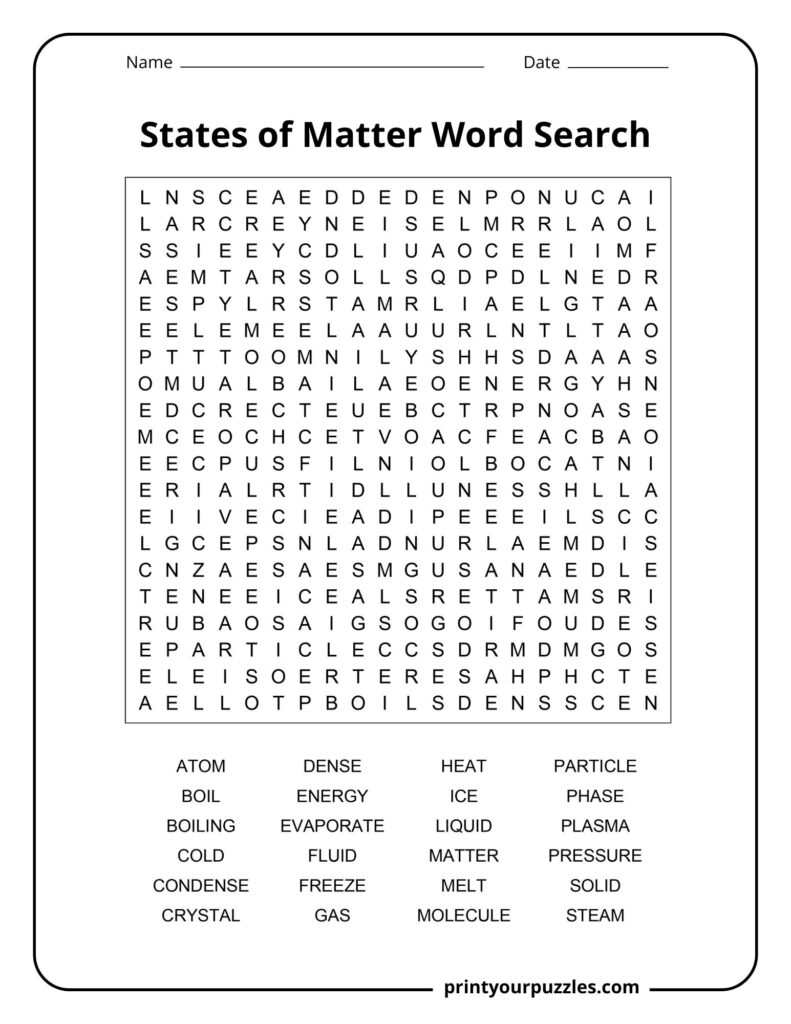
ATOM, BOIL, BOILING, COLD, CONDENSE, CRYSTAL, DENSE, ENERGY, EVAPORATE, FLUID, FREEZE, GAS, HEAT, ICE, LIQUID, MATTER, MELT, MOLECULE, PARTICLE, PHASE, PLASMA, PRESSURE, SOLID, STEAM
The four main states of matter are solid, liquid, gas, and plasma. Each state has distinct properties based on how tightly particles are packed and how freely they move.
Temperature controls particle movement and energy. Increasing temperature causes matter to change from solid to liquid to gas, while decreasing temperature reverses these phase transitions through cooling.
Evaporation occurs at any temperature when surface molecules escape into air, while boiling happens at a specific temperature when bubbles form throughout the entire liquid volume rapidly.
Yes, through sublimation and deposition. Sublimation transforms solid directly to gas, like dry ice becoming carbon dioxide. Deposition converts gas directly to solid, like frost formation.
Plasma is ionized gas containing free electrons and charged particles. It occurs naturally in stars, lightning bolts, and auroras, and artificially in neon signs and fluorescent lights.
Most materials become denser as solids, but ice floats because frozen water molecules form a crystalline structure with more space between them than liquid water.
Glass is an amorphous solid without crystalline structure. Its molecules move extremely slowly, which is why very old windows are sometimes thicker at the bottom than the top.
While rare on Earth, plasma dominates the cosmos. Stars, including our Sun, are giant balls of plasma, making it the most abundant state of matter in existence.
Even at absolute zero temperature, helium remains liquid unless extreme pressure is applied. This unique property makes helium incredibly useful in scientific research and cryogenics applications worldwide.
Scientists have discovered exotic states including Bose-Einstein condensates, superfluids, and supercritical fluids. These states exhibit unusual properties only observable under extreme conditions like near absolute zero temperatures.

Purus ut praesent facilisi dictumst sollicitudin cubilia ridiculus.