
This Vietnam War word search provides an engaging educational tool for exploring one of the most significant conflicts in modern history. Designed for students, educators, and history enthusiasts, this puzzle combines entertainment with meaningful learning about the Vietnam War era.
Our Vietnam War word search printable features 24 carefully selected terms that capture essential aspects of this complex conflict. From military equipment and tactical operations to key locations and strategic concepts, each word represents an important element of the war. The puzzle includes terms like Huey helicopters, napalm, guerrilla warfare, and iconic locations such as Saigon and Hanoi.
What makes this word search printable particularly valuable is that all words are thoroughly defined with detailed 20-30 word explanations. These definitions provide historical context and help users understand the significance of each term, transforming a simple puzzle into a comprehensive learning experience.
Whether used in classrooms, for homeschooling, or personal enrichment, this resource offers an interactive approach to understanding Vietnam War vocabulary. The combination of puzzle-solving engagement and educational definitions ensures that participants not only find words but also grasp their historical importance, making learning about this pivotal period both accessible and memorable.
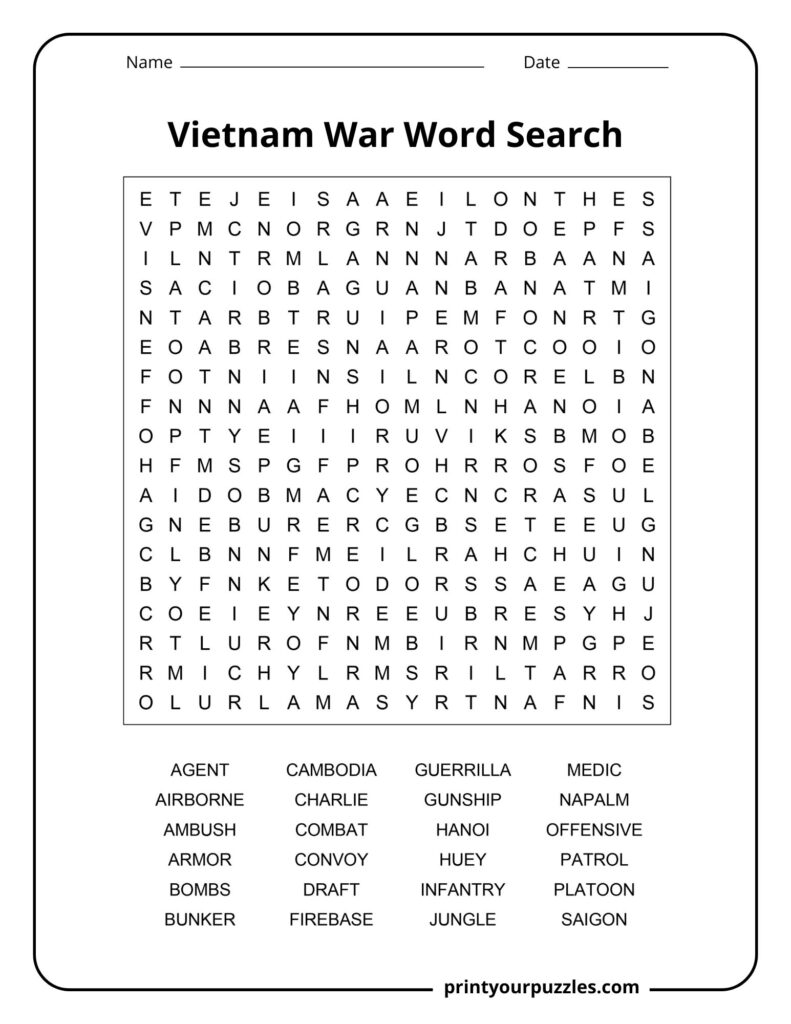
AGENT, AIRBORNE, AMBUSH, ARMOR, BOMBS, BUNKER, CAMBODIA, CHARLIE, COMBAT, CONVOY, DRAFT, FIREBASE, GUERRILLA, GUNSHIP, HANOI, HUEY, INFANTRY, JUNGLE, MEDIC, NAPALM, OFFENSIVE, PATROL, PLATOON, SAIGON
AGENT – Chemical defoliants like Agent Orange used to destroy jungle cover and crops, causing long-term health problems for exposed soldiers and Vietnamese civilians.
AIRBORNE – Elite paratroopers who jumped from aircraft into combat zones, including the 101st and 82nd Airborne Divisions that conducted rapid deployment operations throughout Vietnam.
AMBUSH – Surprise attacks by Viet Cong forces hiding in jungle terrain, targeting American patrols and convoys using knowledge of local geography and guerrilla tactics.
ARMOR – Tanks and armored personnel carriers used for ground operations, providing mobile firepower and protection despite challenges navigating Vietnam’s difficult jungle and rice paddy terrain.
BOMBS – Massive aerial bombardment campaigns dropped millions of tons of explosives on North Vietnam, Cambodia, and Laos in operations like Rolling Thunder and Linebacker.
BUNKER – Underground fortified shelters built by both sides for protection from artillery and air strikes, connected by extensive tunnel networks especially by Viet Cong.
CAMBODIA – Neutral neighboring country secretly bombed by US forces to destroy North Vietnamese supply routes and sanctuaries along the Ho Chi Minh Trail network.
CHARLIE – American military slang nickname for Viet Cong guerrilla fighters, derived from the military phonetic alphabet designation “Victor Charlie” meaning VC or Viet Cong.
COMBAT – Close-quarters fighting in dense jungle environments involving small unit actions, search and destroy missions, and intense firefights with guerrilla forces throughout South Vietnam.
CONVOY – Military vehicle columns transporting troops, supplies, and equipment along roads, frequently targeted by Viet Cong ambushes using mines, rockets, and small arms fire.
DRAFT – Mandatory military conscription system requiring young American men to serve in armed forces, causing widespread protests and social division throughout the United States.
FIREBASE – Temporary fortified artillery positions established in remote areas to provide fire support for ground operations and serve as defended outposts in hostile territory.
GUERRILLA – Unconventional warfare tactics used by Viet Cong, including hit-and-run attacks, sabotage, booby traps, and blending with civilian populations to avoid conventional battles.
GUNSHIP – Armed helicopters like Cobra attack helicopters providing close air support with rockets and machine guns, escorting troop transports and attacking enemy positions.
HANOI – Capital city of North Vietnam and headquarters of communist government led by Ho Chi Minh, primary target of American bombing campaigns throughout the war.
HUEY – Iconic UH-1 helicopter used extensively for troop transport, medical evacuation, and supply missions, becoming the symbolic aircraft of the Vietnam War era.
INFANTRY – Ground combat soldiers conducting patrols, search and destroy missions, and fighting in difficult jungle conditions against elusive Viet Cong and North Vietnamese forces.
JUNGLE – Dense tropical forest terrain of Vietnam providing cover for enemy forces, presenting extreme challenges including heat, disease, limited visibility, and difficult navigation.
MEDIC – Combat medical personnel providing emergency first aid and life-saving treatment to wounded soldiers under fire, often risking their lives to evacuate casualties.
NAPALM – Jellied gasoline incendiary weapon dropped from aircraft, creating devastating firestorms that burned jungle cover and destroyed enemy positions with extreme heat.
OFFENSIVE – Major military campaigns like the Tet Offensive in 1968, when North Vietnamese forces launched coordinated surprise attacks throughout South Vietnam during holiday ceasefire.
PATROL – Small unit reconnaissance missions through hostile territory searching for enemy forces, gathering intelligence, and securing villages while vulnerable to ambushes and booby traps.
PLATOON – Basic infantry unit of approximately forty soldiers led by a lieutenant, conducting ground operations and bearing the brunt of close combat throughout the conflict.
SAIGON – Capital of South Vietnam and headquarters of American military operations, falling to North Vietnamese forces in 1975, ending the war with dramatic evacuations.
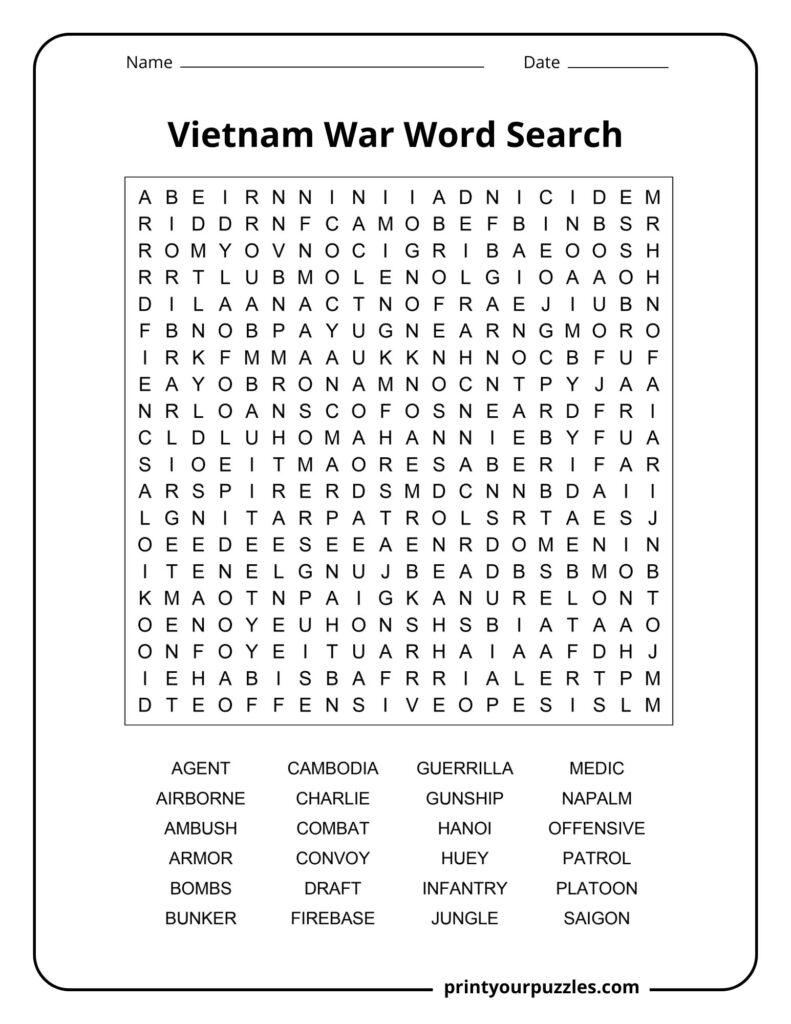
AGENT, AIRBORNE, AMBUSH, ARMOR, BOMBS, BUNKER, CAMBODIA, CHARLIE, COMBAT, CONVOY, DRAFT, FIREBASE, GUERRILLA, GUNSHIP, HANOI, HUEY, INFANTRY, JUNGLE, MEDIC, NAPALM, OFFENSIVE, PATROL, PLATOON, SAIGON
The Vietnam War occurred from 1955 to 1975, with major American combat involvement from 1965 to 1973. The conflict ended when North Vietnamese forces captured Saigon on April 30, 1975.
America intervened to prevent communist North Vietnam from taking over South Vietnam, following the Cold War policy of containment. The domino theory suggested communism would spread throughout Southeast Asia.
North Vietnam won the war, reunifying the country under communist control after South Vietnam’s capital Saigon fell in 1975. This marked America’s first major military defeat in history.
Approximately 58,000 American soldiers died, while Vietnamese casualties exceeded three million including both military and civilian deaths. Hundreds of thousands more were wounded or displaced throughout the conflict.
The Tet Offensive was a massive coordinated attack launched by North Vietnamese forces in January 1968 during the Tet holiday, targeting over 100 cities and shocking Americans despite being militarily repelled.
American families watched nightly news footage of actual combat, bringing the war’s brutal reality into living rooms and significantly influencing public opinion against continued military involvement.
The Cu Chi tunnel network included living quarters, hospitals, weapons factories, and supply routes, allowing guerrilla fighters to hide, move undetected, and launch surprise attacks against American forces.
Over 12,000 helicopters served in Vietnam, with approximately 5,000 destroyed during combat. The distinctive “whomp-whomp” sound became synonymous with the war and defined aerial mobility tactics.
This was significantly younger than World War II soldiers, whose average age was 26. Many Vietnam veterans were teenagers facing intense combat with limited life experience.
Beginning in 1969, capsules containing dates were randomly drawn to determine draft order. Men with low lottery numbers faced almost certain deployment to Vietnam’s combat zones.
Purus ut praesent facilisi dictumst sollicitudin cubilia ridiculus.