
This Watergate Scandal word search offers an engaging way to explore one of America’s most significant political crises. The scandal, which led to President Richard Nixon’s resignation in 1974, fundamentally changed how Americans view presidential accountability and government transparency. This educational Watergate Scandal word search printable features 24 carefully selected terms that capture the key figures, events, and concepts central to understanding this watershed moment in U.S. history.
From investigative reporters Bernstein and Woodward to the infamous break-in at the Democratic National Committee headquarters, each word represents a crucial element of the scandal that captivated the nation. The puzzle includes important figures like John Dean and special prosecutors Cox and Jaworski, as well as significant terms like coverup, tapes, hearings, and impeachment proceedings. This word search printable is perfect for students, history enthusiasts, or anyone seeking to reinforce their knowledge of Watergate’s complex narrative.
To enhance your learning experience, all words included in the puzzle are thoroughly defined, providing context and explanation for each term. This makes the activity both entertaining and educational, helping you connect the dots of this intricate political scandal.
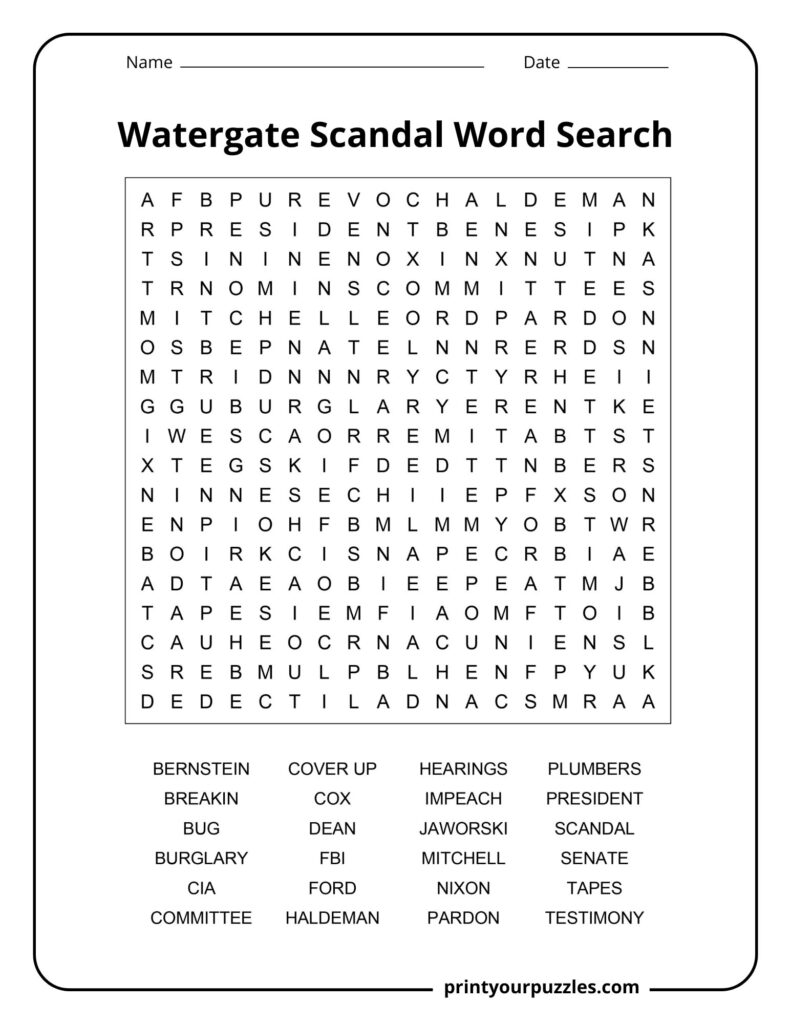
BERNSTEIN, BREAKIN, BUG, BURGLARY, CIA, COMMITTEE, COVER-UP, COX, DEAN, FBI, FORD, HALDEMAN, HEARINGS, IMPEACH, JAWORSKI, MITCHELL, NIXON, PARDON, PLUMBERS, PRESIDENT, SCANDAL, SENATE, TAPES, TESTIMONY
BERNSTEIN – Carl Bernstein, Washington Post investigative reporter who, alongside Bob Woodward, broke the Watergate story and uncovered the Nixon administration’s involvement in the scandal.
BREAKIN – The illegal entry into Democratic National Committee headquarters at the Watergate complex on June 17, 1972, which initiated the scandal that toppled Nixon’s presidency.
BUG – Electronic listening devices and wiretaps illegally installed by Nixon operatives to surveil political opponents and gather intelligence during the 1972 presidential campaign.
BURGLARY – The criminal act of breaking into the Watergate offices to photograph documents and install surveillance equipment, leading to the arrest of five men.
CIA – Central Intelligence Agency, whose former operatives participated in the break-in and whose potential involvement raised concerns about intelligence agency abuses of power.
COMMITTEE – The Senate Select Committee on Presidential Campaign Activities, chaired by Sam Ervin, which investigated Watergate through televised hearings in 1973, revealing widespread corruption.
COVER-UP – The systematic attempt by Nixon and his aides to obstruct justice by concealing White House involvement, paying hush money, and destroying evidence.
COX – Archibald Cox, the first special prosecutor appointed to investigate Watergate, fired by Nixon during the Saturday Night Massacre in October 1973.
DEAN – John Dean, White House counsel who testified against Nixon, revealing the cover-up and famously stating there was “a cancer on the presidency.”
FBI – Federal Bureau of Investigation, which conducted the initial criminal investigation into the break-in and faced pressure from the White House to limit inquiries.
FORD – Gerald Ford, Nixon’s vice president who became president after Nixon’s resignation and controversially granted Nixon a full pardon in September 1974.
HALDEMAN – H.R. “Bob” Haldeman, Nixon’s powerful chief of staff who orchestrated cover-up efforts and was convicted of conspiracy, obstruction, and perjury charges.
HEARINGS – The televised Senate Watergate hearings in 1973 that captivated the nation and exposed the extent of White House corruption and abuse of power.
IMPEACH – The constitutional process begun by the House Judiciary Committee to remove Nixon from office for obstruction, abuse of power, and contempt of Congress.
JAWORSKI – Leon Jaworski, the second special prosecutor who succeeded Cox and successfully fought to obtain Nixon’s secret White House tape recordings through Supreme Court.
MITCHELL – John Mitchell, Nixon’s former attorney general and campaign director, convicted for his role in the break-in conspiracy and cover-up, served prison time.
NIXON – Richard Nixon, 37th U.S. president who resigned on August 9, 1974, becoming the only American president to resign from office amid impeachment.
PARDON – President Ford’s controversial decision to grant Nixon a full pardon for any crimes committed while in office, preventing criminal prosecution but sparking public outrage.
PLUMBERS – The White House Special Investigations Unit, nicknamed “Plumbers,” created to stop information leaks and conduct covert operations against Nixon’s perceived enemies.
PRESIDENT – The office held by Richard Nixon, whose abuse of presidential power and obstruction of justice led to constitutional crisis and redefined executive accountability.
SCANDAL – The political crisis involving illegal activities, abuse of power, and cover-up that destroyed Nixon’s presidency and shook American faith in government institutions.
SENATE – The U.S. Senate’s role in investigating Watergate through the Ervin Committee hearings, which brought crucial evidence and testimony to public attention nationwide.
TAPES – Secret White House audio recordings that proved Nixon’s involvement in the cover-up, including the “smoking gun” tape that forced his resignation.
TESTIMONY – Sworn statements given by witnesses during Senate hearings and trials, including Dean’s revelations and Alexander Butterfield’s disclosure of the taping system.
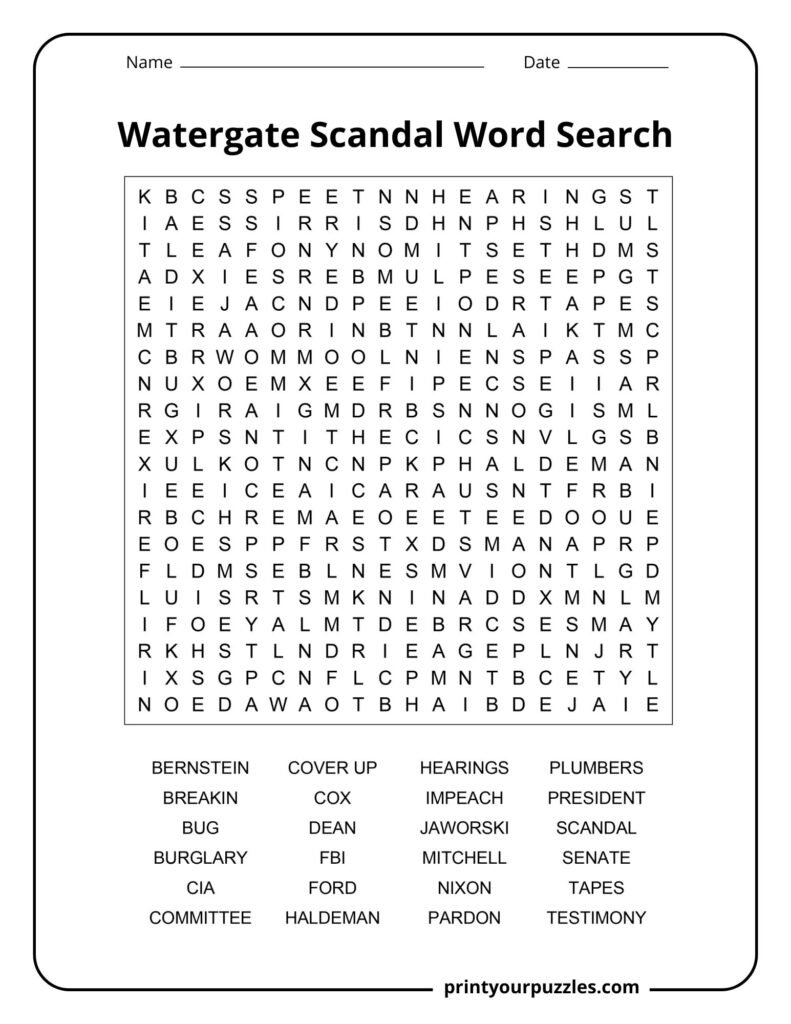
BERNSTEIN, BREAKIN, BUG, BURGLARY, CIA, COMMITTEE, COVER-UP, COX, DEAN, FBI, FORD, HALDEMAN, HEARINGS, IMPEACH, JAWORSKI, MITCHELL, NIXON, PARDON, PLUMBERS, PRESIDENT, SCANDAL, SENATE, TAPES, TESTIMONY
The Watergate Scandal was a political crisis involving the break-in at Democratic headquarters, subsequent cover-up by President Nixon’s administration, and abuse of presidential power that led to Nixon’s resignation.
Nixon resigned on August 9, 1974, facing certain impeachment after the “smoking gun” tape revealed his direct involvement in obstructing the FBI’s investigation of the Watergate break-in.
Washington Post reporters Bob Woodward and Carl Bernstein, confidential source “Deep Throat” (FBI’s Mark Felt), special prosecutors Cox and Jaworski, and White House counsel John Dean were instrumental.
Numerous officials were convicted and imprisoned, Nixon became the only president to resign, public trust in government declined, and reforms strengthened oversight of executive power and campaign finance.
The Saturday Night Massacre occurred October 20, 1973, when Nixon ordered the firing of special prosecutor Archibald Cox, leading to resignations by Attorney General Richardson and Deputy Kleindienst.
Mark Felt, the FBI’s associate director, finally revealed his identity in 2005, just three years before his death, ending one of journalism’s greatest mysteries.
The Watergate Hotel and office complex in Washington, D.C., continues operating as a luxury hotel, and tourists can visit the site where history’s most famous break-in occurred.
The voice-activated system captured all Oval Office conversations, ultimately providing the evidence that proved his guilt and forced his resignation from the presidency in disgrace.
Frank Wills discovered the tape twice during his rounds, became suspicious the second time, and called police, inadvertently triggering the scandal that toppled a presidency.
In November 1972, Nixon defeated George McGovern with 520 electoral votes, making his spectacular fall from power less than two years later even more dramatic.
Purus ut praesent facilisi dictumst sollicitudin cubilia ridiculus.