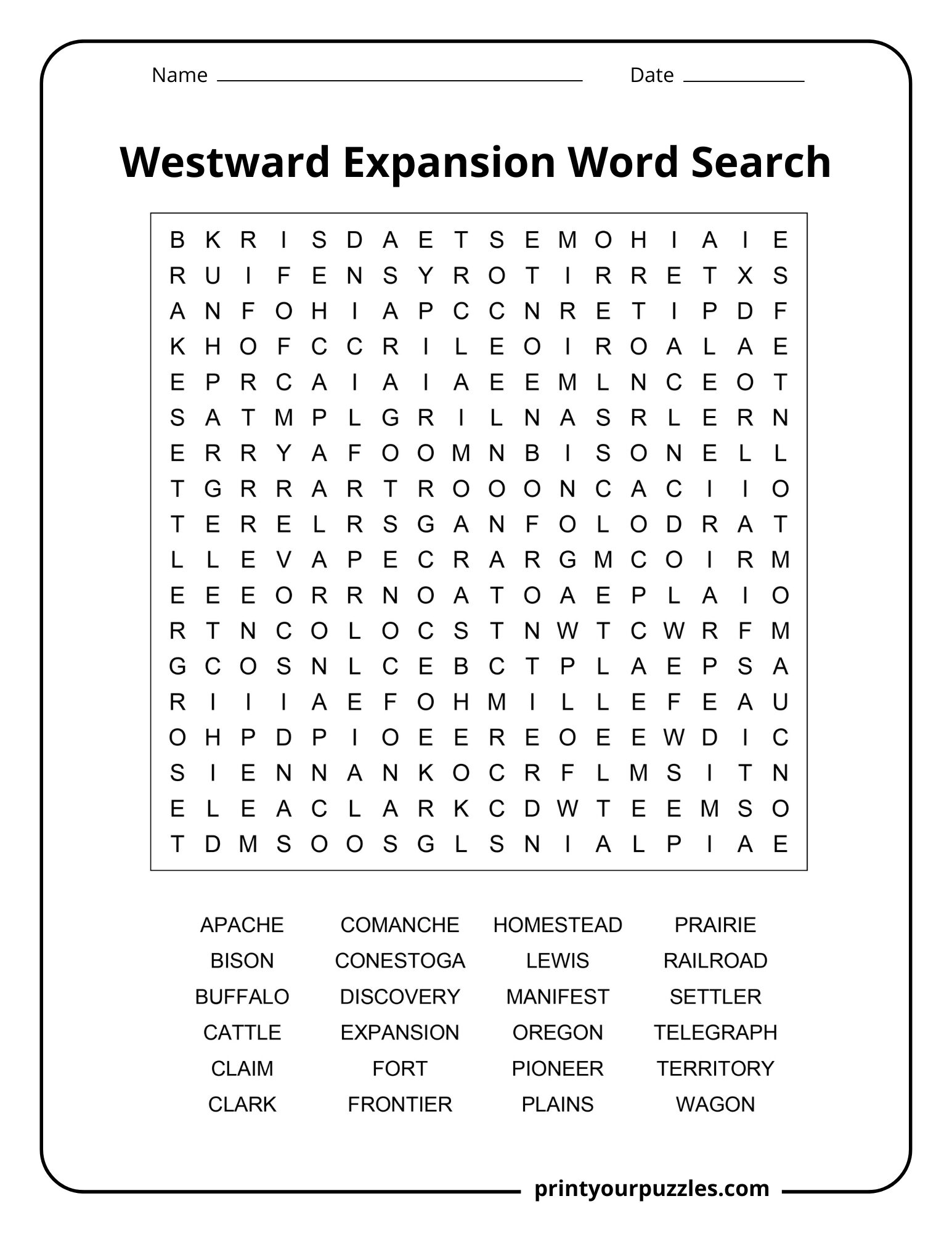

This Westward Expansion word search offers an engaging educational activity that explores one of the most transformative periods in American history. As settlers moved across the continent throughout the nineteenth century, they encountered diverse landscapes, Native American tribes, and countless challenges that shaped the nation’s development.
This Westward Expansion word search printable features twenty-four carefully selected terms that capture the essence of westward migration. From legendary explorers like Lewis and Clark to iconic symbols such as covered wagons and the Transcontinental Railroad, each word represents a crucial element of this historical movement. You’ll discover terms related to Native American tribes including Apache and Comanche, important concepts like Manifest Destiny and homesteads, and the geography of plains and prairies that pioneers traversed.
What makes this word search printable particularly valuable for learning is that every term included comes with a detailed definition of twenty to thirty words. These definitions provide historical context and deeper understanding, transforming a simple puzzle into a comprehensive learning tool that educates while entertaining students and history enthusiasts alike.
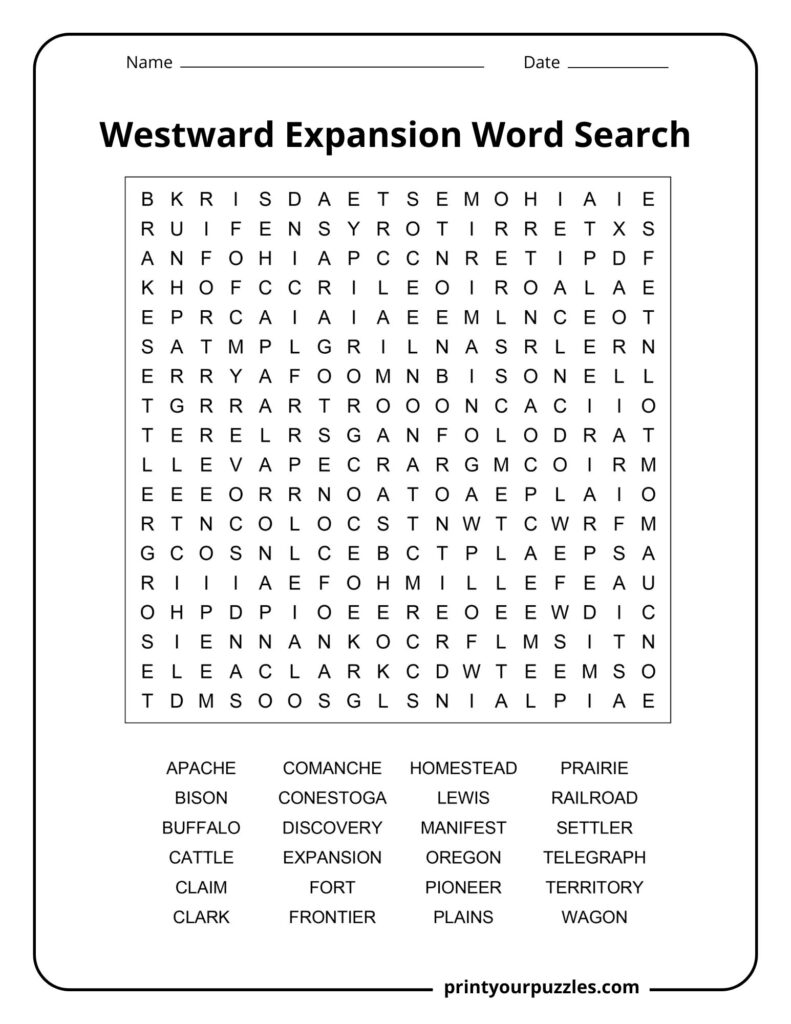
APACHE, BISON, BUFFALO, CATTLE, CLAIM, CLARK, COMANCHE, CONESTOGA, DISCOVERY, EXPANSION, FORT, FRONTIER, HOMESTEAD, LEWIS, MANIFEST, OREGON, PIONEER, PLAINS, PRAIRIE, RAILROAD, SETTLER, TELEGRAPH, TERRITORY, WAGON
APACHE – Native American tribe inhabiting the Southwest regions, known for fierce resistance against Mexican and American expansion into their ancestral lands during the nineteenth century.
BISON – Large grazing mammals that roamed the Great Plains in vast herds, providing essential resources for Native Americans and nearly hunted to extinction by settlers.
BUFFALO – Common name for bison; these massive animals were central to Plains Indian culture and economy, providing food, clothing, shelter, and tools for survival.
CATTLE – Livestock driven westward in massive herds along trails like the Chisholm Trail, establishing ranching as a major industry in the American West’s economy.
CLAIM – Parcels of land that settlers staked and registered as their own, often through government programs or simply by occupying and improving unclaimed western territory.
CLARK – William Clark, co-leader with Meriwether Lewis of the Corps of Discovery expedition that explored the Louisiana Purchase and mapped routes to the Pacific Ocean.
COMANCHE – Powerful Native American tribe dominating the Southern Plains, expert horsemen who controlled vast territories and resisted American expansion for decades with fierce
determination.
CONESTOGA – Large covered wagon with curved bed, designed in Pennsylvania, became iconic symbol of westward migration though prairie schooners were more commonly used.
DISCOVERY – The Corps of Discovery expedition led by Lewis and Clark from eighteen-oh-four to eighteen-oh-six, exploring western territories and establishing American presence beyond Mississippi.
EXPANSION – The movement of American settlement, culture, and political control westward across the continent, dramatically accelerating throughout the eighteen hundreds with various motivations driving migration.
FORT – Military outposts established throughout the West providing protection for settlers, serving as trading centers, and projecting American military power across newly acquired territories.
FRONTIER – The edge of settled territory where civilization met wilderness, constantly moving westward as pioneers established communities and transformed landscapes into farmland and towns.
HOMESTEAD – The Homestead Act of eighteen sixty-two granted one hundred sixty acres of public land to settlers who improved and lived on it for five years.
LEWIS – Meriwether Lewis, explorer who co-led the Corps of
Discovery expedition with William Clark, documenting flora, fauna, and geography of the western territories extensively.
MANIFEST – Manifest Destiny, the nineteenth-century belief that American expansion across the continent was justified, inevitable, and divinely ordained, influencing national policy and settler attitudes.
OREGON – The Oregon Trail stretched over two thousand miles from Missouri to Oregon Territory, traveled by hundreds of thousands of settlers seeking farmland and opportunities.
PIONEER – Early settlers who ventured into unsettled western territories, facing harsh conditions, establishing communities, and paving the way for subsequent waves of migration westward.
PLAINS – The Great Plains, vast grassland region stretching from Mississippi River to Rocky Mountains, home to Native American tribes and later transformed into agricultural heartland.
PRAIRIE – Expansive grassland ecosystems covering much of central North America, characterized by fertile soil that attracted farmers despite challenges of harsh weather and isolation.
RAILROAD – The Transcontinental Railroad, completed in eighteen sixty-nine, connected eastern and western United States, revolutionizing transportation, commerce, and accelerating western settlement dramatically.
SETTLER – Individuals and families who moved westward to establish permanent homes, farms, and communities, transforming wilderness into settled territory through agriculture and development.
TELEGRAPH – Communication technology that transmitted messages instantly across vast distances using electrical signals, connecting remote western territories with eastern cities and enabling rapid coordination.
TERRITORY – Regions under United States jurisdiction but not yet admitted as states, governed federally until meeting population and organizational requirements for statehood admission.
WAGON – Covered wagons, especially prairie schooners, served as transportation and temporary homes for families traveling westward along trails, carrying all possessions across thousands of miles.
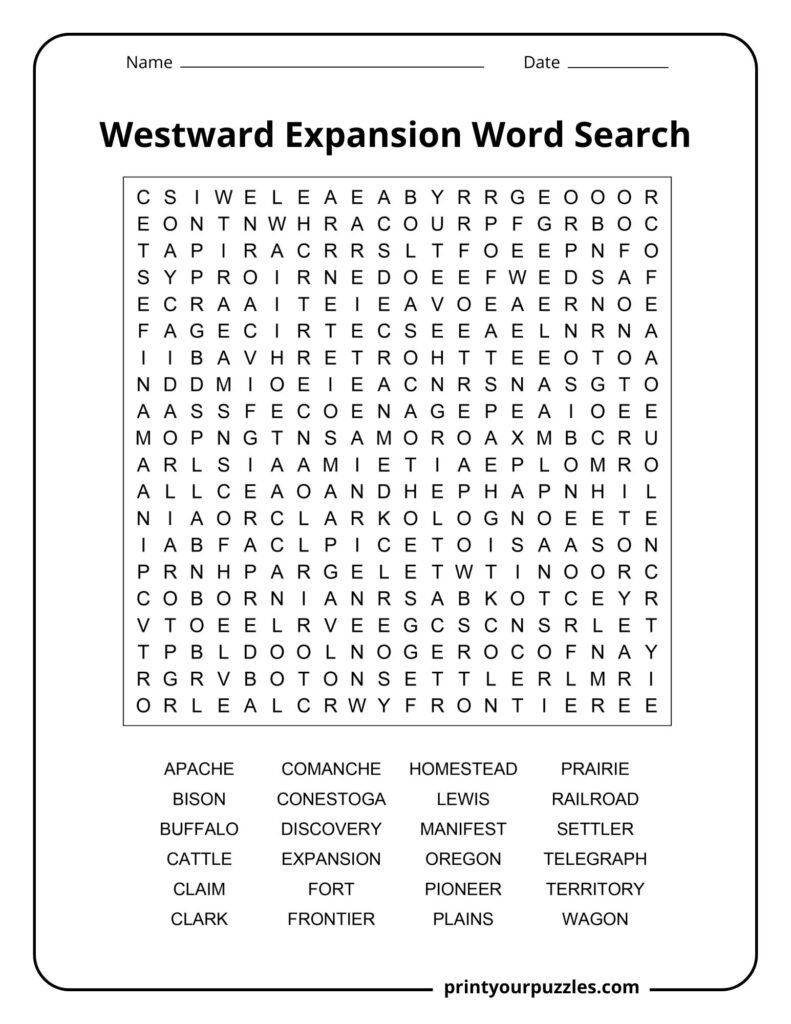
APACHE, BISON, BUFFALO, CATTLE, CLAIM, CLARK, COMANCHE, CONESTOGA, DISCOVERY, EXPANSION, FORT, FRONTIER, HOMESTEAD, LEWIS, MANIFEST, OREGON, PIONEER, PLAINS, PRAIRIE, RAILROAD, SETTLER, TELEGRAPH, TERRITORY, WAGON
Westward Expansion was the nineteenth-century movement of American settlers migrating beyond the Mississippi River toward the Pacific Coast, driven by economic opportunities, land availability, and Manifest Destiny beliefs.
Major trails included the Oregon Trail to the Pacific Northwest, California Trail to gold fields, Santa Fe Trail for trade, and Mormon Trail to Utah, each spanning thousands of miles.
The Homestead Act of eighteen sixty-two offered one hundred sixty acres of free public land to settlers who lived on and improved it for five years, attracting hundreds of thousands westward.
Native Americans faced displacement from ancestral lands, broken treaties, military conflicts, loss of buffalo herds, forced relocations to reservations, and devastating cultural disruption throughout their territories.
Completed in eighteen sixty-nine, the Transcontinental Railroad dramatically reduced travel time from months to days, facilitated commerce, accelerated settlement, and unified the nation’s economy coast to coast.
Disease, especially cholera, killed far more travelers than Native American attacks. Approximately forty thousand people perished during the westward journey, with graves marking the trail’s path.
Pioneers walked alongside their wagons most of the journey to reduce weight on oxen. The wagon primarily carried supplies, with families walking fifteen miles daily.
Operating from April eighteen sixty to October eighteen sixty-one, this famous mail service was quickly made obsolete by the transcontinental telegraph, though it became legendary in American folklore.
Unmarried women and widows could file homestead claims independently, providing rare opportunity for female land ownership and economic independence during the nineteenth century’s patriarchal society.
This phrase described facing the harsh realities of westward travel. Some discouraged travelers turned back, while others persevered despite encountering difficulties beyond their expectations.
Purus ut praesent facilisi dictumst sollicitudin cubilia ridiculus.