
This engaging Wild West word search brings the excitement and adventure of America’s frontier era right to your fingertips. Perfect for history enthusiasts, puzzle lovers, and educators alike, this activity combines entertainment with learning as you hunt for twenty-four carefully selected terms that defined the Old West.
What makes this Wild West word search printable particularly valuable is that every single word included in the puzzle comes with a detailed definition. You won’t just find words like “desperado,” “lasso,” and “frontier”—you’ll also learn exactly what each term meant during this legendary period of American history. This educational feature transforms a simple puzzle into an enriching experience that deepens your understanding of cowboy culture, frontier life, and western heritage.
The word search printable is designed for maximum accessibility and convenience. Simply download, print, and start your word-hunting adventure through the dusty trails of the Wild West. Whether you’re using it in classrooms, at home, or during themed events, this puzzle offers hours of educational entertainment while exploring the colorful vocabulary that shaped America’s most iconic era. Each discovered word connects you to the rich tapestry of frontier history.
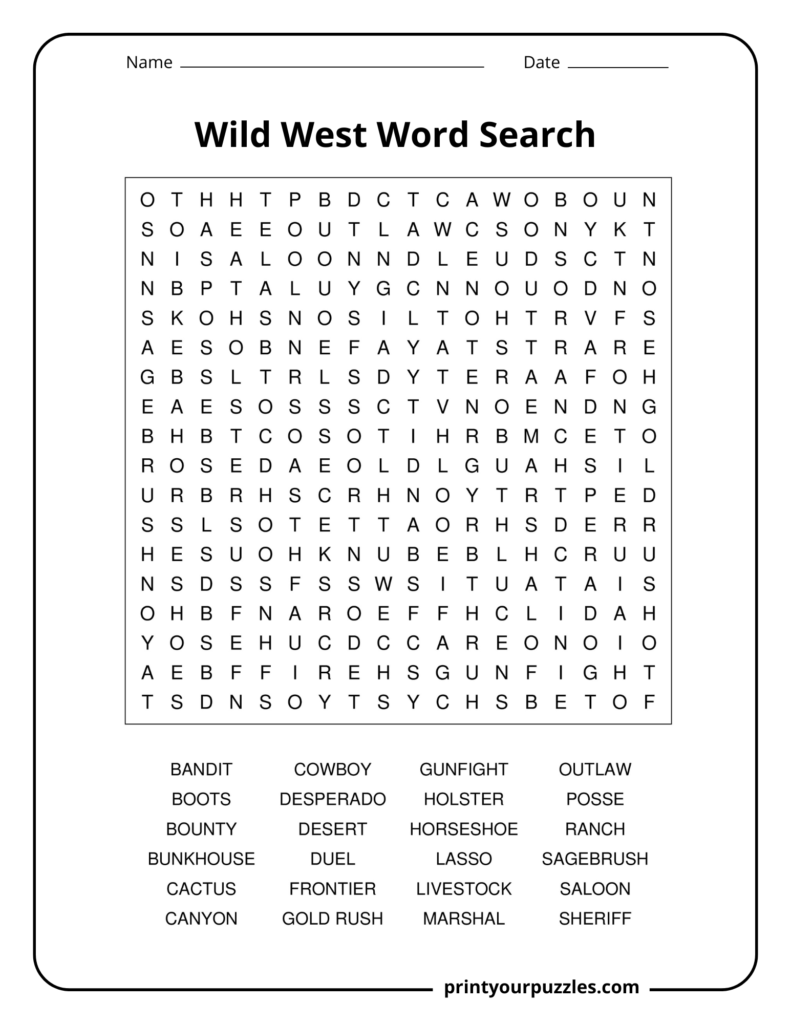
BANDIT, BOOTS, BOUNTY, BUNKHOUSE, CACTUS, CANYON, COWBOY, DESPERADO, DESERT, DUEL, FRONTIER, GOLD RUSH, GUNFIGHT, HOLSTER, HORSESHOE, LASSO, LIVESTOCK, MARSHAL, OUTLAW, POSSE, RANCH, SAGEBRUSH, SALOON, SHERIFF
BANDIT – A lawless criminal or outlaw who robs travelers, stagecoaches, or trains in the Wild West, often operating in gangs and evading capture across vast frontier territories.
BOOTS – Sturdy leather footwear worn by cowboys and frontier settlers, typically featuring high tops, pointed toes, and heels designed for riding horses and working on ranches.
BOUNTY – A monetary reward offered by law enforcement or private citizens for capturing or killing wanted criminals, outlaws, or dangerous individuals threatening frontier communities and settlements.
BUNKHOUSE – A rustic dormitory-style building on ranches where cowboys and hired ranch hands slept, ate, and lived together during their employment, sharing cramped but communal quarters.
CACTUS – A spiny desert plant common throughout the American Southwest, symbolizing the harsh, arid environment of the Wild West where water was scarce and survival challenging.
CANYON – A deep, narrow valley with steep rocky walls carved by rivers over millennia, providing natural hideouts for outlaws and dramatic landscapes throughout the western frontier.
COWBOY – A ranch worker skilled in herding cattle, riding horses, and performing various ranch duties, becoming an iconic symbol of American frontier life and western culture.
DESPERADO – A dangerous, reckless outlaw or criminal who operates with bold disregard for law and personal safety, often involved in violent crimes across the lawless frontier.
DESERT – Vast, arid regions with sparse vegetation and extreme temperatures that characterized much of the western frontier, challenging settlers, travelers, and prospectors seeking new opportunities.
DUEL – A formal face-to-face combat between two individuals using pistols to settle disputes or defend honor, often resulting in death on dusty main streets.
FRONTIER – The advancing edge of settlement in the American West where civilization met wilderness, representing opportunity, danger, and the expansion of territories into unexplored lands.
GOLD RUSH – A mass migration of prospectors and fortune-seekers to newly discovered gold deposits, particularly during California’s eighteen forty-nine boom, transforming western regions into bustling communities.
GUNFIGHT – A violent confrontation between armed individuals or groups using firearms, often occurring in saloons, streets, or remote locations, settling disputes through deadly force.
HOLSTER – A leather case worn on the hip or chest designed to securely hold a pistol or revolver, allowing quick access for self-defense or confrontation.
HORSESHOE – A U-shaped metal shoe nailed to horses’ hooves to protect them from wear and injury, essential for horses traveling across rough western terrain daily.
LASSO – A looped rope used by cowboys to catch cattle and horses by throwing it skillfully around the animal’s neck or legs during roundups and ranch work.
LIVESTOCK – Domesticated animals raised on ranches including cattle, horses, sheep, and pigs, representing the economic foundation of western ranching culture and frontier agricultural development.
MARSHAL – A federal or local law enforcement officer responsible for maintaining order, capturing outlaws, and enforcing laws in frontier towns and territories across the West.
OUTLAW – A fugitive criminal living outside legal society, often wanted for robbery, murder, or other serious crimes, evading lawmen while surviving in the rugged frontier.
POSSE – A group of citizens temporarily deputized by a law enforcement officer to pursue criminals, track outlaws, or maintain order during emergencies in frontier communities.
RANCH – A large agricultural property where cattle, horses, and other livestock are raised, serving as the center of western economic life and cowboy culture activities.
SAGEBRUSH – A hardy, aromatic shrub prevalent throughout western deserts and plains, symbolizing the rugged landscape and becoming emblematic of cowboy country and frontier life.
SALOON – A frontier drinking establishment serving alcohol, providing entertainment, gambling, and social gathering spaces where cowboys, miners, and travelers congregated after long, hard days.
SHERIFF – An elected law enforcement officer responsible for maintaining peace and order in a county or town, often facing dangerous outlaws in the lawless frontier.
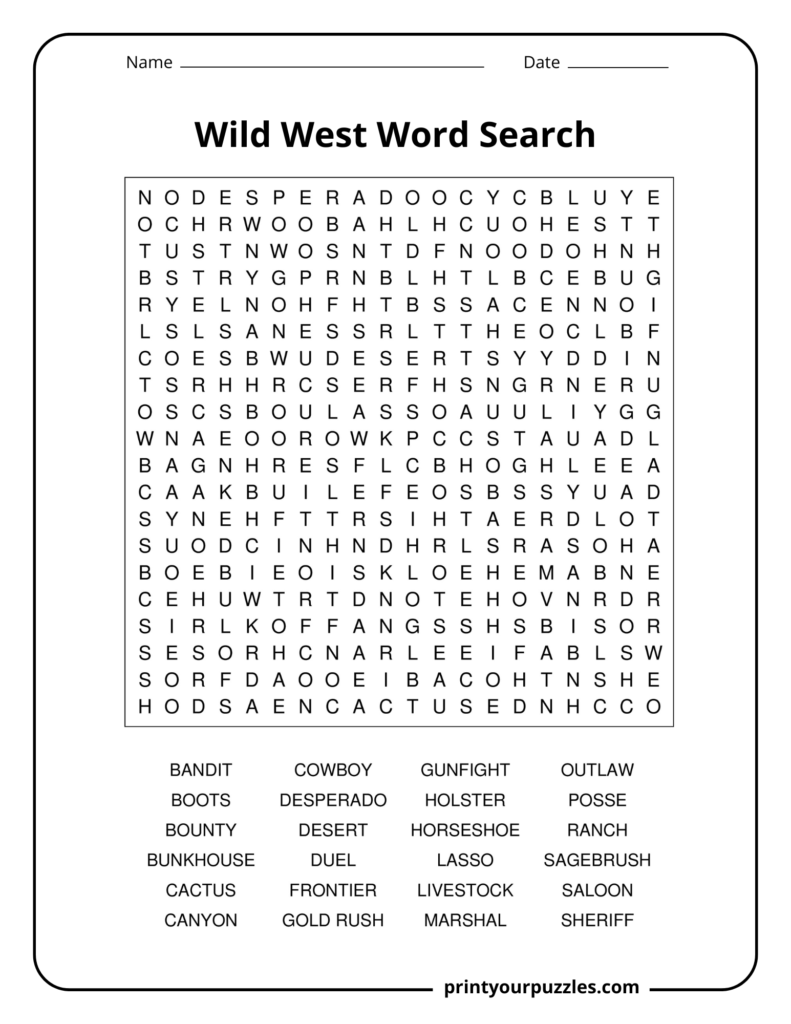
BANDIT, BOOTS, BOUNTY, BUNKHOUSE, CACTUS, CANYON, COWBOY, DESPERADO, DESERT, DUEL, FRONTIER, GOLD RUSH, GUNFIGHT, HOLSTER, HORSESHOE, LASSO, LIVESTOCK, MARSHAL, OUTLAW, POSSE, RANCH, SAGEBRUSH, SALOON, SHERIFF
The Wild West era spanned roughly from the end of the Civil War in eighteen sixty-five to approximately eighteen ninety-five, when frontier territories became more settled and civilized states.
Notable outlaws included Jesse James, Billy the Kid, Butch Cassidy, the Sundance Kid, and Belle Starr, who became legendary figures through their daring robberies and violent confrontations with lawmen.
Common occupations included cowboys herding cattle, miners seeking gold and silver, ranchers raising livestock, lawmen maintaining order, saloon keepers, blacksmiths, and merchants supplying frontier communities with essential goods.
While Hollywood exaggerated the violence, the Wild West was genuinely dangerous due to limited law enforcement, frequent gunfights, harsh living conditions, disease, conflicts with Native Americans, and unpredictable natural hazards.
The frontier era ended due to railroad expansion connecting remote areas, increased settlement and statehood, stronger law enforcement, barbed wire fencing ending open ranges, and modernization transforming rugged territories.
Before becoming legendary for the Gunfight at the O.K. Corral, Earp worked various jobs including bartending, gambling, and even operating brothels throughout multiple frontier towns.
Cowboys used bandanas as practical tools to filter dust during cattle drives, wipe sweat, protect necks from sunburn, and even serve as emergency bandages or water filters.
Real gunfights were typically quick, chaotic ambushes or close-range confrontations in saloons, not dramatic noon duels on empty streets with formal countdowns and fair play protocols.
Approximately one in four cowboys was Black, and Mexican vaqueros actually pioneered many ranching techniques, horsemanship skills, and traditions later adopted throughout the American West.
While Martha Jane Canary did live on the frontier, historians believe she embellished stories about scouting, Indian fighting, and her relationship with Wild Bill Hickok significantly.

Purus ut praesent facilisi dictumst sollicitudin cubilia ridiculus.