
Coding is the process of writing instructions that tell computers, websites, applications, and other digital devices what to do. These instructions are written in programming languages, which use specific words, symbols, and rules that computers can understand. Although coding may seem complicated at first, it is similar to giving someone a clear set of step-by-step directions. When the instructions are written correctly, the computer follows them to complete a task.
There are many programming languages, and each one has its own purposes and strengths. Python is often recommended for beginners because its commands are relatively easy to read. JavaScript is widely used to make websites interactive, while HTML and CSS help organize and style web pages. Other languages, such as Java, C++, Swift, and SQL, are used to create mobile applications, develop games, manage databases, and build complex software systems.
A computer program is usually created by breaking a larger problem into smaller, manageable steps. Programmers first decide what they want the program to accomplish. They then write the code, test it, and correct any mistakes they discover. These mistakes are known as bugs, and the process of finding and fixing them is called debugging. Testing and debugging are essential because even a small error, such as a missing symbol or an incorrect command, can prevent a program from working properly.
Coding also teaches useful skills that go beyond computers. It encourages logical thinking, creativity, patience, and problem-solving. Programmers often need to experiment with different solutions, learn from unsuccessful attempts, and improve their work gradually. Coding can be used to create websites, animations, robots, games, educational tools, business software, and many other digital products.
Learning basic coding vocabulary can make programming concepts easier to understand. Terms such as algorithm, variable, function, loop, input, output, and command appear frequently in computer science. A coding word search can provide an enjoyable way to review these terms while becoming more familiar with the language of programming.
Coding continues to play an important role in modern life. From smartphones and online shopping to transportation and healthcare systems, computer programs support many everyday activities. Understanding how coding works helps people become more informed users of technology and may inspire them to create digital projects of their own.
Related Word Searches:
Math | Algebra | Electricity | Physics | Quantum Physics | Energy
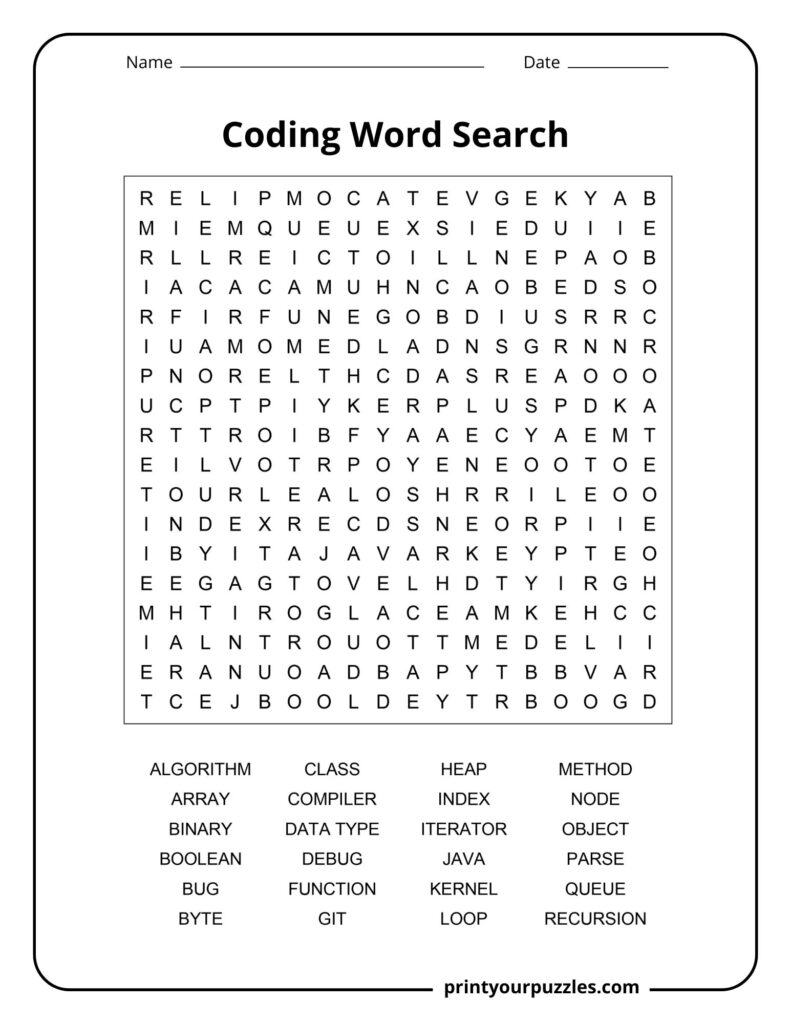
ALGORITHM, ARRAY, BINARY, BOOLEAN, BUG, BYTE, CLASS, COMPILER, DATA TYPE, DEBUG, FUNCTION, GIT, HEAP, INDEX, ITERATOR, JAVA, KERNEL, LOOP, METHOD, NODE, OBJECT, PARSE, QUEUE, RECURSION
ALGORITHM – A step-by-step set of instructions designed to solve a specific problem or perform a task. Algorithms form the logical foundation of all programs and determine how data is processed efficiently.
ARRAY – A data structure that stores a fixed-size collection of elements of the same type in contiguous memory locations. Elements are accessed using an index number starting from zero.
BINARY – A base-two number system using only digits zero and one. Computers use binary to represent all data internally, since electronic circuits operate with two states: on and off.
BOOLEAN – A data type that holds only two possible values: true or false. Booleans are essential for controlling program flow through conditional statements, comparisons, and logical operations in code.
BUG – An error or flaw in a program that causes it to behave unexpectedly or produce incorrect results. Bugs can range from simple typos to complex logical mistakes in the code.
BYTE – A unit of digital information consisting of eight bits. A byte can represent 256 different values and is the standard unit used to measure file sizes and memory capacity.
CLASS – A blueprint or template in object-oriented programming that defines properties and behaviors for creating objects. Classes encapsulate data and methods, promoting code reusability and organized structure.
COMPILER – A program that translates source code written in a high-level programming language into machine code that a computer can execute. It checks for errors before generating the final executable file.
DATA TYPE – A classification that specifies what kind of value a variable can hold, such as integers, strings, or booleans. Data types help the compiler allocate memory and validate operations correctly.
DEBUG – The process of finding, analyzing, and fixing errors or bugs in a program. Developers use debugging tools like breakpoints and log messages to trace and correct unexpected behavior in code.
FUNCTION – A reusable block of code that performs a specific task and can accept inputs and return outputs. Functions help organize programs into smaller, manageable pieces, reducing repetition and improving clarity.
GIT – A distributed version control system that tracks changes in source code during software development. Git allows multiple developers to collaborate, manage branches, and maintain a complete history of modifications.
HEAP – A region of memory used for dynamic allocation where data can be stored and accessed in any order. Also refers to a tree-based data structure used in priority queues and sorting algorithms.
INDEX – A numerical position that identifies the location of an element within a data structure like an array or list. In most programming languages, indexing starts at zero for the first element.
ITERATOR – An object that enables traversal through elements of a collection one at a time without exposing the underlying structure. Iterators provide a standard way to loop through lists, sets, and other containers.
JAVA – A widely used, object-oriented programming language designed to be platform-independent. Java programs run on the Java Virtual Machine, allowing the same code to execute on different operating systems seamlessly.
KERNEL – The core component of an operating system that manages hardware resources and system calls. The kernel handles memory allocation, process scheduling, and communication between software and physical devices.
LOOP – A control structure that repeats a block of code multiple times until a specified condition is met. Common types include for loops, while loops, and do-while loops used to automate repetitive tasks.
METHOD – A function defined inside a class that operates on the object’s data in object-oriented programming. Methods define the behaviors of objects and can access and modify the instance’s internal state.
NODE – A fundamental unit in data structures like linked lists, trees, and graphs. Each node typically contains a value and one or more references pointing to other nodes, forming connected structures.
OBJECT – An instance of a class that contains both data and methods acting on that data. Objects represent real-world entities in object-oriented programming and interact with each other to build complex systems.
PARSE – The process of analyzing a string of text or code to extract meaningful information and convert it into a structured format. Parsers are used in compilers, data processing, and reading file formats.
QUEUE – A linear data structure that follows the first-in, first-out principle, meaning elements are added at the rear and removed from the front. Queues are used in scheduling and buffering tasks.
RECURSION – A programming technique where a function calls itself to solve smaller instances of a problem until reaching a base case. Recursion is commonly used for tasks like tree traversal and factorial calculation.
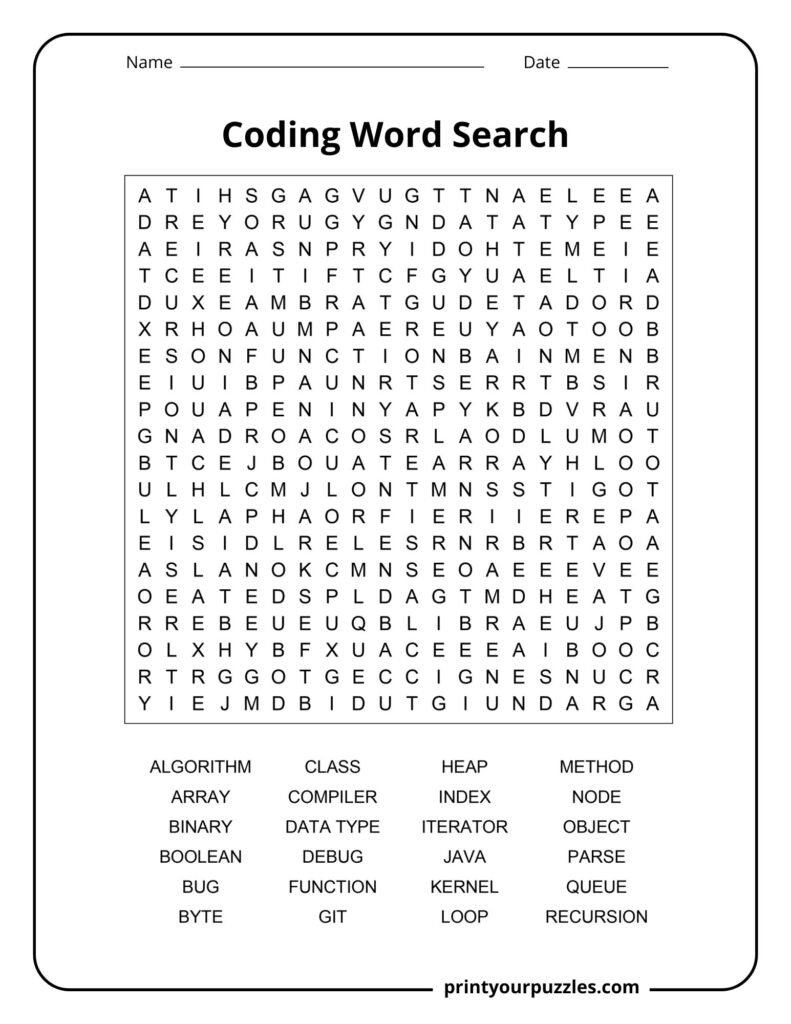
ALGORITHM, ARRAY, BINARY, BOOLEAN, BUG, BYTE, CLASS, COMPILER, DATA TYPE, DEBUG, FUNCTION, GIT, HEAP, INDEX, ITERATOR, JAVA, KERNEL, LOOP, METHOD, NODE, OBJECT, PARSE, QUEUE, RECURSION
Coding is the process of writing instructions in a programming language that a computer can understand and execute. It allows humans to create software, websites, applications, and automated systems.
Python is widely recommended for beginners due to its simple, readable syntax. It is versatile and used in web development, data science, automation, and artificial intelligence projects worldwide.
Learning basic coding concepts typically takes a few weeks to a few months. However, becoming proficient requires consistent practice over one to two years depending on dedication and goals.
No, many successful programmers are self-taught or have completed online courses and bootcamps. Employers increasingly value practical skills, project portfolios, and problem-solving abilities over formal academic degrees.
Programming languages are generally grouped into categories such as procedural, object-oriented, functional, and scripting languages. Popular examples include Python, Java, JavaScript, C++, and Ruby among many others.
Ada Lovelace wrote the first algorithm intended for a machine in 1843, long before modern computers existed. She is celebrated as a pioneer in computing history.
In 1947, engineers found a moth trapped inside a Harvard computer causing malfunctions. Grace Hopper documented it, and the term “bug” became standard for describing program errors.
While most developers use only a handful, hundreds of languages have been created for specific purposes. New languages continue to emerge as technology evolves and new needs arise.
William Higinbotham created “Tennis for Two” in 1958 using an analog computer and an oscilloscope screen. It is considered one of the earliest interactive electronic games ever made.
The Voyager probes, launched in 1977, run on programs written in assembly language and FORTRAN. Engineers carefully update this ancient code to keep the missions operating successfully today.