

Dark matter is one of the greatest mysteries in modern science. Scientists cannot see it directly because it does not produce, reflect, or absorb light. However, they believe it exists because of the powerful gravitational effects it has on stars, galaxies, and other objects throughout the universe.
Everything we can normally observe, including planets, stars, gas, dust, and living things, is made of ordinary matter. Surprisingly, ordinary matter represents only a small part of the universe. Scientists estimate that dark matter makes up about 27 percent of the universe, while ordinary matter accounts for approximately 5 percent. The remaining portion is believed to consist mainly of dark energy, another mysterious component connected to the universe’s expansion.
Evidence for dark matter comes largely from studying how galaxies move. Stars near the outer edges of galaxies travel much faster than expected. Based only on the visible material inside a galaxy, these stars should escape into space. Instead, they remain in orbit, suggesting that a large amount of invisible matter provides additional gravitational force.
Dark matter also helps explain gravitational lensing. This occurs when the gravity of a massive object bends light traveling from something farther away. By measuring how strongly the light is distorted, astronomers can estimate the total mass present. In many cases, the amount of mass detected is much greater than the amount of visible matter.
Scientists still do not know exactly what dark matter is made of. It may consist of undiscovered particles that rarely interact with ordinary matter. Researchers use underground detectors, particle accelerators, space telescopes, and advanced computer simulations to search for clues. Although no dark matter particle has yet been confirmed, experiments continue around the world.
A dark matter word search offers an entertaining way to become familiar with important terms connected to astronomy, gravity, galaxies, particles, and the structure of the universe. Learning this vocabulary can make complex scientific ideas easier to understand and remember.
Dark matter may be invisible, but its influence appears across the cosmos. Discovering its true nature could transform our understanding of physics and reveal important details about how galaxies formed, how the universe developed, and what most of the universe is actually made of.
Related Word Searches:
Astronomy | Gravity | Physics | Quantum Physics | Matter | Visible Stars
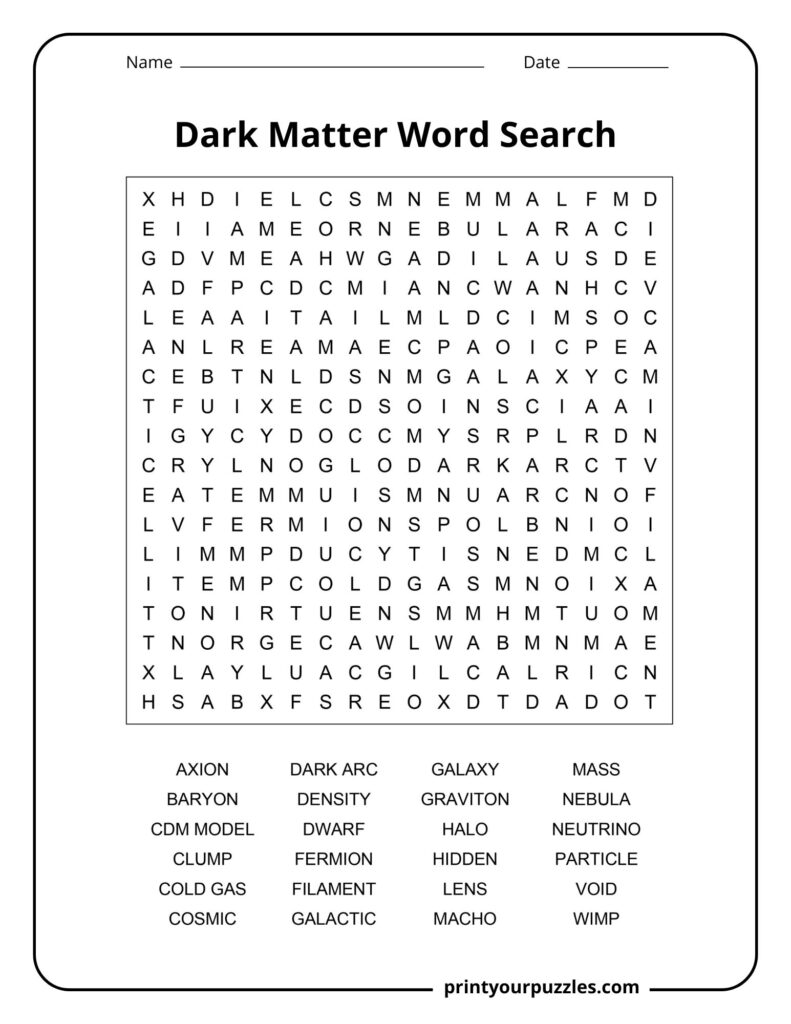
AXION, BARYON, CDM MODEL, CLUMP, COLD GAS, COSMIC, DARK ARC, DENSITY, DWARF, FERMION, FILAMENT, GALACTIC, GALAXY, GRAVITON, HALO, HIDDEN, LENS, MACHO, MASS, NEBULA, NEUTRINO, PARTICLE, VOID, WIMP
AXION – A hypothetical elementary particle proposed to solve a problem in quantum chromodynamics. Axions are extremely light and weakly interacting, making them a leading candidate for dark matter composition.
BARYON – A subatomic particle made of three quarks, such as protons and neutrons. Baryonic matter forms visible structures, but dark matter is predominantly non-baryonic, meaning it consists of something fundamentally different.
CDM MODEL – Cold Dark Matter model, the standard cosmological framework explaining how slow-moving dark matter particles clump together under gravity to form the large-scale structure of galaxies and galaxy clusters we observe.
CLUMP – Refers to concentrations of dark matter that gravitationally gather in dense regions. These clumps act as scaffolding, attracting normal matter and seeding the formation of galaxies throughout the universe.
COLD GAS – Cool gas clouds in galaxies whose motion and distribution are influenced by dark matter’s gravitational pull. Studying cold gas rotation curves provided early compelling evidence that unseen mass surrounds galaxies.
COSMIC – Relating to the universe at its largest scales. Dark matter plays a cosmic role by shaping the evolution, expansion, and overall structure of the universe since the earliest moments after the Big Bang.
DARK ARC – A curved gravitational lensing feature caused by dark matter bending light from distant galaxies. These arcs appear around massive galaxy clusters and help scientists map invisible dark matter distributions.
DENSITY – The amount of mass per unit volume. Dark matter density varies across the universe, being highest in galaxy cores and cluster centers, and it determines how structures grow and evolve over time.
DWARF – Small, faint galaxies that are dominated by dark matter, often containing hundreds of times more dark matter than visible stars. Dwarf galaxies serve as important laboratories for testing dark matter theories.
FERMION – A particle obeying Fermi-Dirac statistics, such as electrons and quarks. Some dark matter candidates are fermions, including hypothetical sterile neutrinos, which could explain the universe’s missing mass if they exist.
FILAMENT – Enormous thread-like structures of dark matter and galaxies stretching across hundreds of millions of light-years. Filaments form the cosmic web, connecting galaxy clusters and defining the universe’s large-scale architecture.
GALACTIC – Pertaining to galaxies. Dark matter has galactic significance because it forms invisible halos surrounding galaxies, providing the extra gravitational force needed to keep stars orbiting at unexpectedly high speeds.
GALAXY – A massive system of stars, gas, dust, and dark matter bound by gravity. Most of a galaxy’s total mass is dark matter, which holds everything together and influences its shape and rotation.
GRAVITON – A hypothetical quantum particle that would carry the gravitational force. If gravitons exist, they could help explain how dark matter interacts gravitationally with ordinary matter without emitting any detectable light.
HALO – An extended, roughly spherical region of dark matter surrounding a galaxy. Dark matter halos are far larger than the visible galaxy itself and contain most of the galaxy’s total mass.
HIDDEN – Describes dark matter’s elusive nature. It neither emits, absorbs, nor reflects light, remaining hidden from direct observation. Its existence is inferred only through gravitational effects on visible matter and light.
LENS – Short for gravitational lensing, where dark matter’s gravity bends light from background objects. This effect allows astronomers to detect and map dark matter even though it is completely invisible to telescopes.
MACHO – Massive Astrophysical Compact Halo Object, such as black holes or brown dwarfs. MACHOs were proposed as dark matter candidates, but surveys showed they cannot account for most of the missing mass.
MASS – A fundamental property of dark matter. Although invisible, dark matter has mass that exerts gravitational influence. It constitutes roughly twenty-seven percent of the universe’s total mass-energy content, far exceeding visible matter.
NEBULA – A cloud of gas and dust in space. While nebulae are visible matter, their formation and behavior can be influenced by surrounding dark matter, which shapes gravitational environments within galaxies.
NEUTRINO – A nearly massless, weakly interacting subatomic particle. Although neutrinos are real and abundant, they move too fast and are too light to account for dark matter, which must be cold and slow-moving.
PARTICLE – A fundamental unit of matter. Physicists believe dark matter consists of undiscovered particles that interact through gravity but not electromagnetism, explaining why they cannot be seen with conventional detection methods.
VOID – Vast, nearly empty regions of space between cosmic filaments containing very little matter or dark matter. Voids can span hundreds of millions of light-years and reveal how dark matter shapes cosmic structure.
WIMP – Weakly Interacting Massive Particle, a leading theoretical dark matter candidate. WIMPs would have significant mass but interact so rarely with normal matter that detecting them requires extremely sensitive underground experiments.

AXION, BARYON, CDM MODEL, CLUMP, COLD GAS, COSMIC, DARK ARC, DENSITY, DWARF, FERMION, FILAMENT, GALACTIC, GALAXY, GRAVITON, HALO, HIDDEN, LENS, MACHO, MASS, NEBULA, NEUTRINO, PARTICLE, VOID, WIMP
Dark matter is an invisible, mysterious substance that does not emit, absorb, or reflect light. It makes up approximately twenty-seven percent of the universe’s total mass-energy content.
Scientists detect dark matter through its gravitational effects on visible matter, such as galaxy rotation curves, gravitational lensing of light, and the large-scale structure of the cosmic web.
The exact composition remains unknown. Leading candidates include hypothetical particles like WIMPs and axions. It is non-baryonic, meaning it differs fundamentally from ordinary matter made of protons and neutrons.
So far, no direct detection has been confirmed. Scientists use extremely sensitive underground detectors and particle accelerators searching for rare interactions between dark matter particles and ordinary matter.
Dark matter provides the gravitational scaffolding that holds galaxies together and shapes the universe’s large-scale structure. Without it, galaxies would fly apart and cosmic structures could not have formed.
The Disordered Cosmos: A Journey into Dark Matter, Spacetime, and Dreams Deferred” by Chanda Prescod-Weinstein. Highly recommended for those seeking a perfect balance of scientific rigor and clarity. Dr. Prescod-Weinstein explains complex particle physics and dark matter through a deeply human, accessible narrative that makes the mysteries of the universe feel both precise and profoundly personal.
Only fifteen percent is ordinary visible matter like stars, planets, and living beings. The vast majority of the universe’s mass remains completely invisible and undetectable by telescopes.
Swiss astronomer Fritz Zwicky noticed that galaxies in the Coma Cluster moved too fast to be held together by visible matter alone, suggesting a hidden mass existed.
Billions of dark matter particles may be streaming through you constantly without any effect. They interact so weakly with ordinary matter that you would never feel or notice them.
Dark matter’s gravity pulled gas together in the early universe, forming the first galaxies. Without this invisible scaffolding, stars and planets like Earth could never have formed.
Laboratories buried kilometers beneath mountains shield experiments from cosmic rays, creating ultra-quiet environments where scientists hope to catch the extremely rare interaction of a dark matter particle.