
Astronomy is the scientific study of everything beyond Earth’s atmosphere. It explores the Sun, Moon, planets, stars, galaxies, comets, asteroids, and the enormous universe that contains them all. By observing these objects and studying how they move, form, and change, astronomers work to understand both the history of the universe and its possible future.
For thousands of years, people have looked at the night sky with curiosity. Ancient civilizations observed the movements of the Sun, Moon, and stars to create calendars, plan harvests, navigate across land and sea, and mark important events. Over time, astronomy developed from simple observations into a modern science supported by mathematics, physics, chemistry, and advanced technology.
Telescopes are among the most important tools used in astronomy. Some are located on Earth, while others travel through space. These instruments collect visible light and other forms of energy, including radio waves, infrared radiation, ultraviolet light, X-rays, and gamma rays. Each type of observation reveals different information about distant objects that cannot be reached directly.
Our solar system is one major area of astronomical study. It includes the Sun and everything held by its gravity, such as eight planets, dwarf planets, moons, asteroids, and comets. Scientists examine these objects to learn how the solar system formed approximately 4.6 billion years ago and whether places beyond Earth might support life.
Astronomy also investigates stars and galaxies. Stars are enormous spheres of hot gas that produce energy through nuclear reactions. They are born inside clouds of gas and dust, change throughout their lifetimes, and eventually die in different ways. Galaxies are huge collections of stars, planets, gas, dust, and dark matter. Earth is located in the Milky Way galaxy, which contains billions of stars.
Mathematics plays an essential role in astronomy. Astronomers use equations to calculate distances, measure speeds, predict orbits, and understand gravity. An astronomy word search can introduce important vocabulary connected with planets, space exploration, celestial objects, and the scientific tools used to study the universe.
Studying astronomy helps us understand Earth’s place in space. It also encourages curiosity, careful observation, and exploration while reminding us that the universe is far larger and more complex than our everyday surroundings.
Related Word Searches:
Solar System | Visible Stars | Moon Phases | Gravity | Dark Matter | Physics
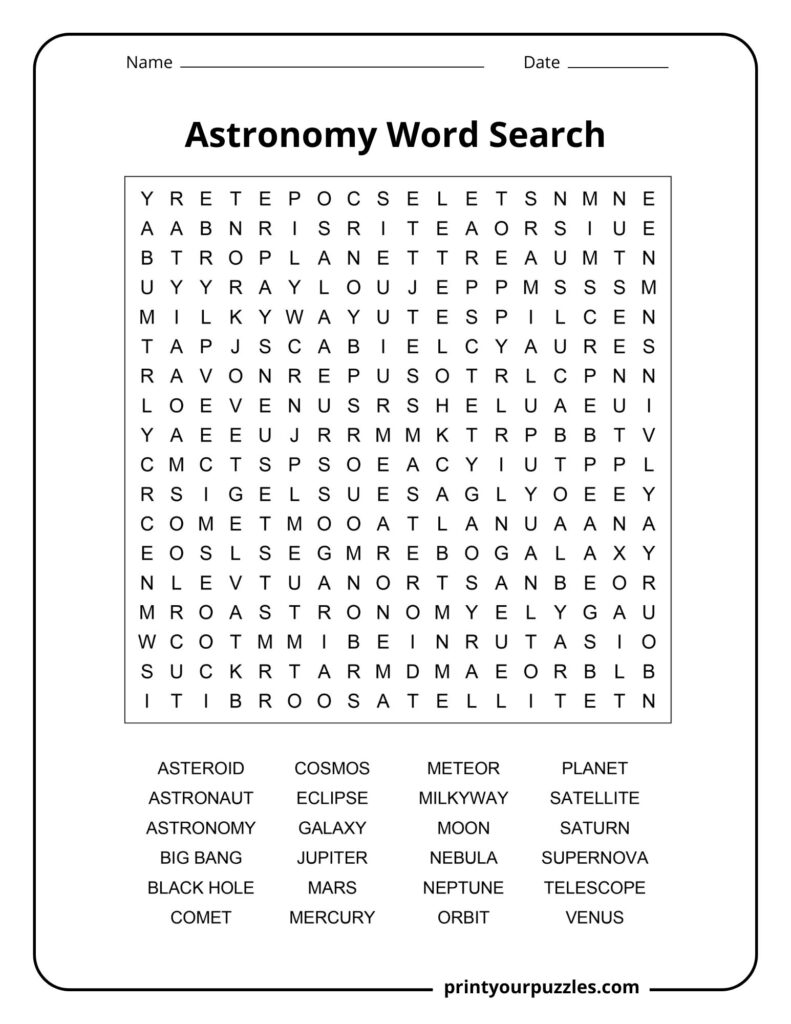
ASTEROID, ASTRONAUT, ASTRONOMY, BIG BANG, BLACK HOLE, COMET, COSMOS, ECLIPSE, GALAXY, JUPITER, MARS, MERCURY, METEOR, MILKYWAY, MOON, NEBULA, NEPTUNE, ORBIT, PLANET, SATELLITE, SATURN, SUPERNOVA, TELESCOPE, VENUS
ASTEROID – A small rocky object orbiting the Sun, typically found in the asteroid belt between Mars and Jupiter, ranging from meters to hundreds of kilometers in diameter.
ASTRONAUT – A person trained to travel and work in space, operating spacecraft and conducting scientific experiments beyond Earth’s atmosphere for space exploration missions and research purposes.
ASTRONOMY – The scientific study of celestial objects, space, and the universe, including stars, planets, galaxies, and cosmic phenomena, using observation, mathematics, and physics principles.
BIG BANG – The prevailing cosmological theory describing the universe’s origin approximately thirteen point eight billion years ago from an extremely hot, dense state that rapidly expanded outward.
BLACK HOLE – An extremely dense region in space where gravity is so strong that nothing, not even light, can escape once it crosses the event horizon boundary.
COMET – An icy celestial body that orbits the Sun, developing a glowing coma and tail when approaching the Sun due to solar radiation vaporizing its frozen materials.
COSMOS – The universe regarded as a complete, orderly, harmonious system, encompassing all matter, energy, space, time, and the physical laws governing their existence and interactions.
ECLIPSE – An astronomical event occurring when one celestial body moves into the shadow of another, such as the Moon blocking the Sun or Earth shadowing the Moon.
GALAXY – A massive system containing billions of stars, gas, dust, and dark matter bound together by gravity, with our Milky Way being one example among billions.
JUPITER – The largest planet in our solar system, a gas giant with distinctive colored bands, a Great Red Spot storm, and at least seventy-nine known moons.
MARS – The fourth planet from the Sun, known as the Red Planet due to iron oxide on its surface, featuring polar ice caps, valleys, and deserts.
MERCURY – The smallest planet and closest to the Sun in our solar system, featuring extreme temperature variations, a cratered surface, and no atmosphere to retain heat.
METEOR – A streak of light produced when a meteoroid enters Earth’s atmosphere at high speed and burns up due to friction, commonly called a shooting star.
MILKYWAY – Our home galaxy, a barred spiral galaxy containing over two hundred billion stars, including our Sun, spanning approximately one hundred thousand light-years across its disk.
MOON – Earth’s only natural satellite, orbiting our planet approximately every twenty-seven days, influencing tides and displaying phases as it reflects sunlight from different angles.
NEBULA – A giant cloud of dust and gas in space, often serving as stellar nurseries where new stars form or remnants of dying stars dispersing matter.
NEPTUNE – The eighth and farthest planet from the Sun, an ice giant with supersonic winds, a deep blue color from methane, and fourteen known moons.
ORBIT – The curved path a celestial object follows around another object due to gravitational attraction, such as planets circling the Sun or satellites orbiting Earth continuously.
PLANET – A large celestial body orbiting a star, spherical due to its own gravity, having cleared its orbital path of debris, like Earth or Jupiter.
SATELLITE – An object orbiting a planet or star, either natural like moons or artificial devices launched by humans for communication, observation, navigation, and scientific research.
SATURN – The sixth planet from the Sun, famous for its prominent ring system made of ice and rock particles, and over eighty known moons.
SUPERNOVA – A powerful stellar explosion occurring when a massive star dies, briefly outshining entire galaxies and dispersing heavy elements into space for future star formation.
TELESCOPE – An optical instrument using lenses or mirrors to magnify distant objects, allowing astronomers to observe celestial bodies, planets, stars, and galaxies in greater detail.
VENUS – The second planet from the Sun, similar in size to Earth but with extreme surface temperatures, thick carbon dioxide atmosphere, and sulfuric acid clouds.
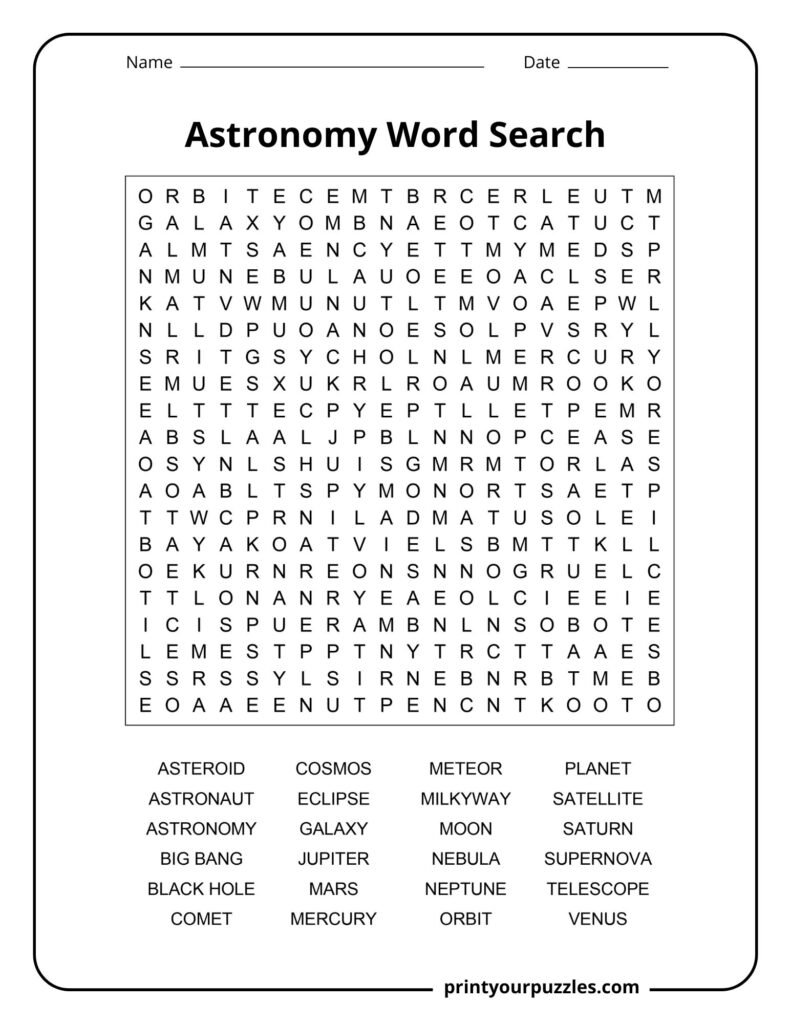
ASTEROID, ASTRONAUT, ASTRONOMY, BIG BANG, BLACK HOLE, COMET, COSMOS, ECLIPSE, GALAXY, JUPITER, MARS, MERCURY, METEOR, MILKYWAY, MOON, NEBULA, NEPTUNE, ORBIT, PLANET, SATELLITE, SATURN, SUPERNOVA, TELESCOPE, VENUS
Astronomy is the scientific study of celestial objects and the universe using observation and physics. Astrology is a pseudoscience claiming celestial positions influence human affairs and personalities without scientific evidence.
Our solar system contains eight planets: Mercury, Venus, Earth, Mars, Jupiter, Saturn, Uranus, and Neptune. Pluto was reclassified as a dwarf planet in two thousand six by astronomers.
A light-year is the distance light travels in one year, approximately nine point five trillion kilometers. Astronomers use it to measure vast distances between stars and galaxies efficiently.
Yes, we can observe other galaxies using telescopes. The Andromeda Galaxy is visible to the naked eye under dark skies, located approximately two point five million light-years away.
Moon phases occur as the Moon orbits Earth, changing the angle of sunlight reflecting off its surface. We see different illuminated portions from new moon to full moon.
Venus rotates so slowly on its axis that it takes two hundred forty-three Earth days to complete one rotation, but only two hundred twenty-five days to orbit the Sun.
Neutron stars compress approximately one point four times the Sun’s mass into a sphere only twenty kilometers wide, creating the densest matter in the universe besides black holes.
Despite having eight planets, numerous moons, asteroids, and comets, the Sun contains almost all matter in our solar system, demonstrating its gravitational dominance over everything orbiting it.
Sound waves require molecules to vibrate and transmit energy. Since space is a vacuum with virtually no air or matter, astronauts cannot hear anything outside their spacecraft.
Scientists estimate the observable universe contains approximately two hundred billion trillion stars, far exceeding the estimated seven quintillion grains of sand covering Earth’s beaches and deserts.