Introduction to the Arizona Word Search
Arizona begins with color: red rocks, golden desert light, deep blue skies, green cacti, and canyon walls shaped by millions of years of wind and water. Located in the Mountain West, with a strong Southwestern identity, Arizona has Phoenix as both its capital and largest city. Known as The Grand Canyon State, it is one of the most visually recognizable places in America.
The Grand Canyon is Arizona’s most famous landmark, carved over millions of years by the Colorado River. Yet the state is much more than one natural wonder. Sedona’s red rocks, Petrified Forest National Park, Monument Valley, the Sonoran Desert, and the pine forests near Flagstaff all show different sides of Arizona’s geography. Visitors can experience hot desert valleys, snowy mountain areas, cactus landscapes, ancient rock formations, and cool high plateaus within the same state.
This Arizona word search gives students and puzzle lovers a fun way to explore the landscapes, cultures, animals, and landmarks that make Arizona unique. Long before Arizona became the 48th state in 1912, many Native American nations shaped the region’s history and culture. Today, Arizona is home to several Indigenous communities, including the Navajo Nation, Hopi Tribe, Apache tribes, Tohono O’odham Nation, and many others. Their traditions, languages, art, and connection to the land remain central to the state’s identity.
Arizona’s economy includes tourism, mining, agriculture, technology, aerospace, healthcare, education, and solar energy. Copper has been especially important, which is why Arizona is often called The Copper State. Route 66, desert highways, national parks, and historic towns also make the state an important place for road trips and outdoor adventure.
Food adds another Southwestern layer to Arizona’s identity. Sonoran-style Mexican food, Navajo fry bread, chimichangas, prickly pear treats, citrus, dates, and mesquite flavors all reflect the state’s borderland and desert influences. Arizona is a place of contrasts: dry deserts and snowy mountains, ancient ruins and modern cities, quiet canyons and busy highways. As you complete this free printable Arizona word search, look for words connected to its deserts, foods, cultures, wildlife, history, and canyon landscapes.
Keep learning about the Mountain West States with our New Mexico word search, California word search, Nevada word search, and the full US States Word Searches collection.
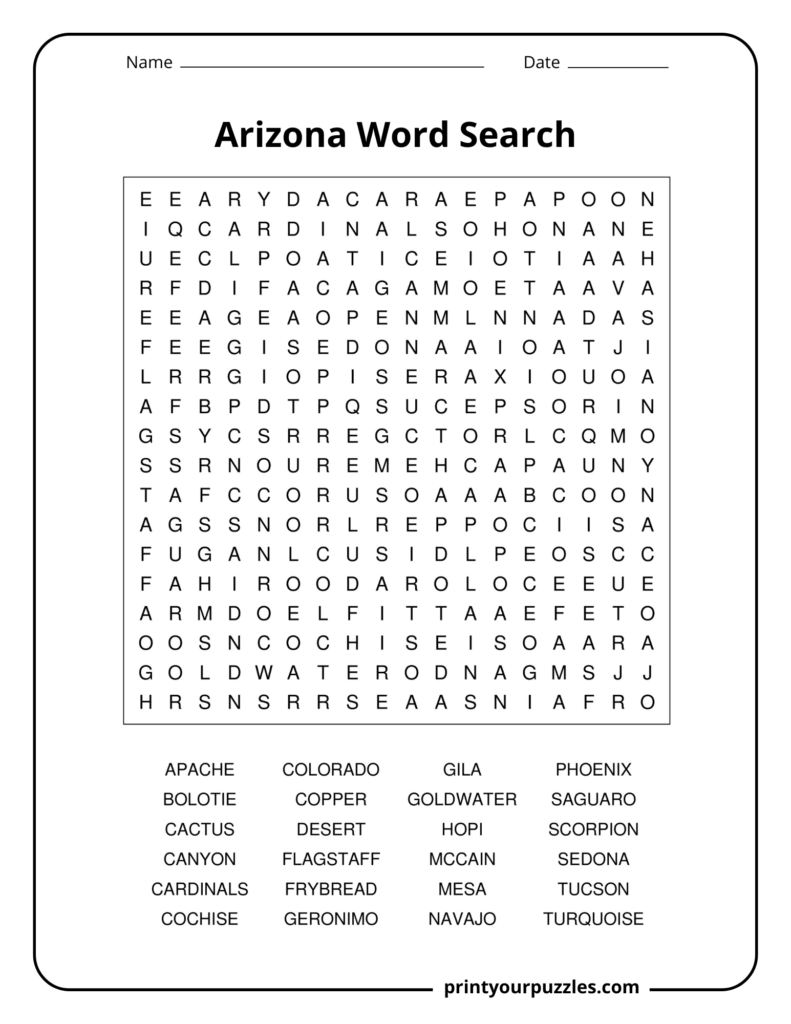
Medium Difficulty Word Search
Words to Find
APACHE, BOLOTIE, CACTUS, CANYON, CARDINALS, COCHISE, COLORADO, COPPER, DESERT, FLAGSTAFF, FRYBREAD, GERONIMO, GILA, GOLDWATER, HOPI, MCCAIN, MESA, NAVAJO, PHOENIX, SAGUARO, SCORPION, SEDONA, TUCSON, TURQUOISE
All Words Defined
APACHE – Indigenous Native American tribe that historically inhabited Arizona and the Southwest. Known for their fierce resistance against Mexican and American expansion during the 1800s.
BOLOTIE – Arizona’s official state neckwear since 1971. A braided leather cord with decorative clasp, often featuring turquoise or silver, worn as a Western-style tie alternative.
CACTUS – Spiny desert plant abundant throughout Arizona’s landscape. Adapted to store water in arid conditions, cacti are iconic symbols of the American Southwest and desert ecosystems.
CANYON – Deep gorge carved by river erosion over millions of years. Arizona is home to the Grand Canyon, one of Earth’s most spectacular natural wonders and geological marvels.
CARDINALS – Arizona’s professional NFL football team based in Glendale. Originally founded in Chicago, the franchise relocated to Arizona in 1988 and represents the state in sports.
COCHISE – Legendary Apache chief who led his people in resisting American encroachment during the 1860s. A county in southeastern Arizona bears his name honoring his legacy.
COLORADO – Major river flowing through Arizona, carving the Grand Canyon over millions of years. Provides crucial water resources for agriculture, cities, and hydroelectric power throughout the Southwest.
COPPER – Arizona’s most valuable mineral resource and official state metal. The state is America’s leading copper producer, with massive mining operations supporting the economy for generations.
DESERT – Arid landscape defining much of Arizona’s geography, including the Sonoran Desert. Characterized by extreme temperatures, sparse rainfall, and unique adapted plants and animals thriving there.
FLAGSTAFF – Northern Arizona city situated at 7,000 feet elevation near the San Francisco Peaks. Known for cooler climate, ponderosa pine forests, skiing, and being a gateway to Grand Canyon.
FRYBREAD – Traditional Native American food made from fried dough, popular throughout Arizona’s reservations. Often served as a base for Navajo tacos or topped with honey and powdered sugar.
GERONIMO – Famous Apache warrior and medicine man who resisted Mexican and American military forces until 1886. His name became synonymous with courage and defiance throughout American history.
GILA – Refers to the Gila monster, a venomous lizard native to Arizona’s deserts. Also names a river flowing through the state, important for irrigation and wildlife habitat.
GOLDWATER – Barry Goldwater, influential Arizona senator and 1964 Republican presidential candidate. Conservative icon who represented Arizona in Congress for decades, shaping American political conservatism significantly.
HOPI – Indigenous people residing primarily on mesas in northeastern Arizona for over a thousand years. Known for their pueblo villages, kachina dolls, pottery, and deeply spiritual agricultural traditions.
MCCAIN – John McCain, decorated Navy veteran and Arizona senator who served from 1987 until his death in 2018. Republican presidential nominee in 2008, known for maverick independence.
MESA – Arizona’s third-largest city in the Phoenix metropolitan area. The word also describes flat-topped elevated landforms common throughout Arizona’s desert landscape and plateau regions.
NAVAJO – Largest Native American tribe in the United States, with significant reservation lands spanning northeastern Arizona. Known for weaving, silversmithing, and their unbroken code in World War II.
PHOENIX – Arizona’s capital and largest city, rising from desert into a major metropolitan area. Named after the mythical bird, symbolizing growth from agricultural settlement to thriving modern metropolis.
SAGUARO – Iconic giant cactus native to Sonoran Desert, reaching heights over forty feet. Arizona’s state flower, these majestic plants live over 150 years and symbolize the Southwest landscape.
SCORPION – Venomous arachnid common in Arizona’s deserts, identified by curved tail and pincers. Arizona bark scorpions are the most dangerous species in North America, requiring caution outdoors.
SEDONA – Picturesque city in northern Arizona famous for stunning red rock formations and natural beauty. Popular destination for tourism, art galleries, hiking, spiritual retreats, and outdoor recreation activities.
TUCSON – Arizona’s second-largest city, located in the Sonoran Desert with rich Spanish and Mexican heritage. Home to University of Arizona, historic missions, and surrounded by dramatic mountain ranges.
TURQUOISE – Blue-green gemstone mined extensively in Arizona, prized for centuries by Native Americans. Used in traditional jewelry and artwork, the stone symbolizes protection, healing, and Southwestern artistic traditions.
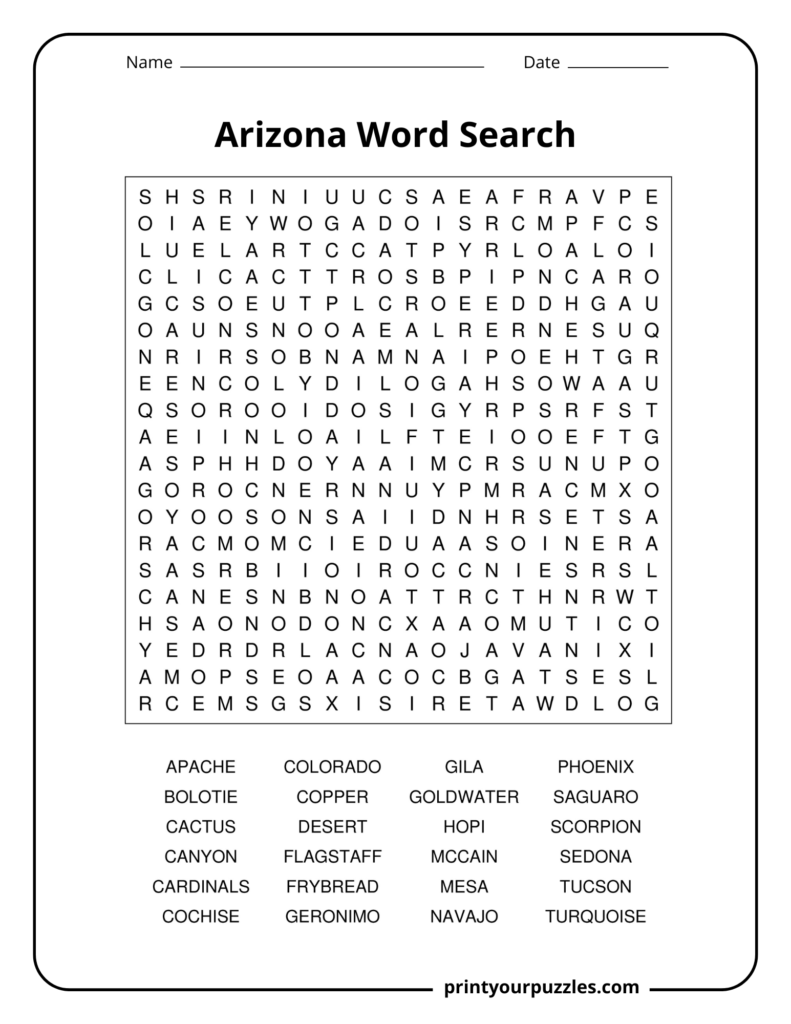
Hard Difficulty Word Search
Words to Find
APACHE, BOLOTIE, CACTUS, CANYON, CARDINALS, COCHISE, COLORADO, COPPER, DESERT, FLAGSTAFF, FRYBREAD, GERONIMO, GILA, GOLDWATER, HOPI, MCCAIN, MESA, NAVAJO, PHOENIX, SAGUARO, SCORPION, SEDONA, TUCSON, TURQUOISE
6 Key FAQs About Arizona
5 Curious "Did You Know?" Facts About Arizona