
Oregon feels like a state shaped by rain, rivers, forests, and restless landscapes. Located in the Pacific region of the United States, it stretches from the rugged Pacific Coast to the Cascade Mountains, high desert, fertile valleys, and wide-open eastern plains. Salem is the capital, while Portland is the largest city and a major center for culture, food, business, technology, and creativity.
The natural variety of Oregon is one of its greatest strengths. Along the coast, waves crash against cliffs, beaches, lighthouses, dunes, and fishing towns. Inland, the Willamette Valley is known for farms, vineyards, cities, and some of the state’s most productive land. The Cascade Range includes volcanic peaks such as Mount Hood, while Crater Lake National Park protects the deepest lake in the United States, famous for its intense blue water. Farther east, Oregon becomes drier, with deserts, canyons, ranches, and wide skies. These contrasts give an Oregon word search many vivid themes to explore.
Long before Oregon became the 33rd state in 1859, Indigenous peoples lived across the region, including the Chinook, Nez Perce, Klamath, Umatilla, Coos, Tillamook, and many others. Their histories and connections to rivers, salmon, forests, and coastal lands remain essential to understanding Oregon. In the 1800s, the Oregon Trail brought thousands of settlers westward, making the state closely connected to migration, frontier life, and the expansion of the United States.
Today, Oregon’s economy includes technology, agriculture, forestry, fishing, outdoor recreation, education, healthcare, manufacturing, and tourism. The state is known for environmental awareness, bicycle-friendly cities, independent bookstores, farmers markets, coffee culture, craft breweries, and a strong connection to local food and nature.
Oregon’s foods often reflect its land and water: salmon, hazelnuts, berries, pears, mushrooms, artisan cheeses, and fresh seafood are all part of its identity. Yet Oregon is not defined by one image. It is misty coastlines, volcanic mountains, green valleys, desert roads, and creative cities all at once. As you complete this free printable Oregon word search, look for words connected to its forests, rivers, trails, foods, volcanoes, coast, and Pacific Northwest spirit.
Keep exploring the Pacific States with our Washington word search, California word search, Idaho word search, and the full US States Word Searches collection.
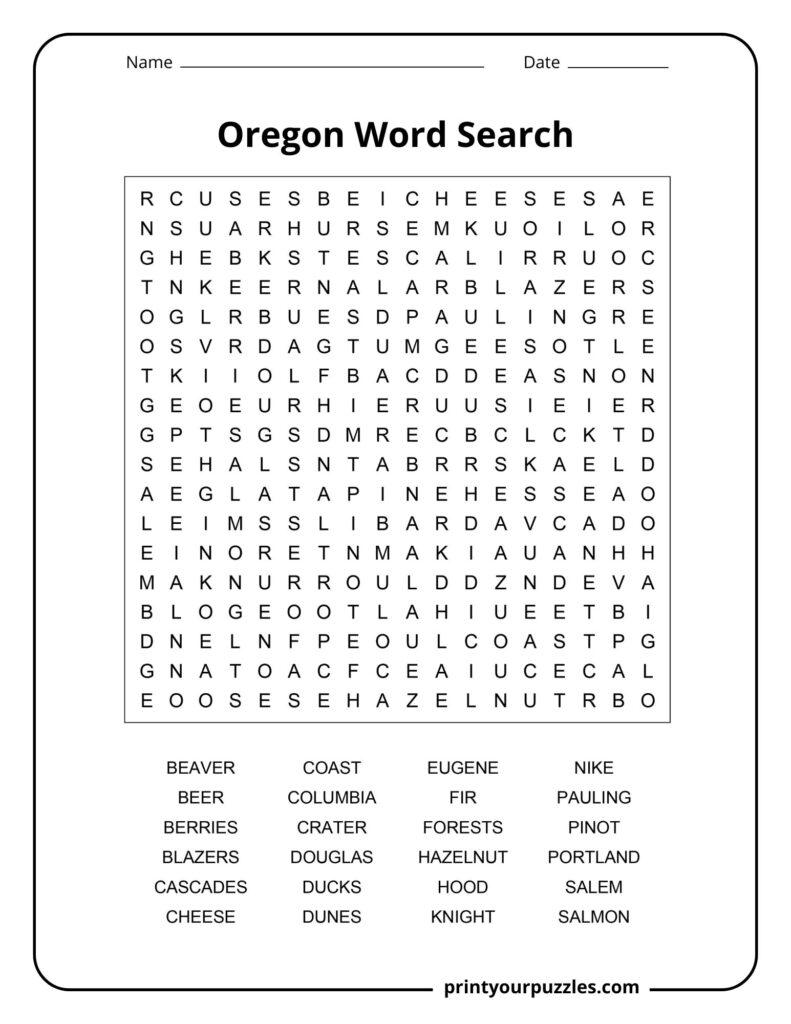
BEAVER, BEER, BERRIES, BLAZERS, CASCADES, CHEESE, COAST, COLUMBIA, CRATER, DOUGLAS, DUCKS, DUNES, EUGENE, FIR, FORESTS, HAZELNUT, HOOD, KNIGHT, NIKE, PAULING, PINOT, PORTLAND, SALEM, SALMON
BEAVER – Oregon’s official state animal since 1969. The beaver appears on the state flag’s reverse side and represents the fur trade that shaped early Oregon history.
BEER – Oregon boasts over 300 breweries, making it a craft beer capital. Portland has more breweries than any other city worldwide, earning its “Beervana” nickname.
BERRIES – Oregon leads US production of blackberries, blueberries, and the unique marionberry, a blackberry hybrid developed at Oregon State University and beloved statewide as a culinary staple.
BLAZERS – Portland Trail Blazers, Oregon’s only major professional sports team. The NBA franchise won the championship in 1977 and plays at the Moda Center downtown.
CASCADES – The Cascade Mountain Range runs north-south through Oregon, featuring volcanic peaks like Mount Hood, creating dramatic landscapes and dividing the state’s wet and dry regions.
CHEESE – Tillamook, Oregon’s iconic cheese brand, has produced quality cheddar since 1909. The coastal creamery attracts a million visitors yearly and represents Oregon’s thriving dairy industry.
COAST – Oregon’s 363-mile Pacific coastline features dramatic cliffs, sandy beaches, and coastal towns. State law ensures public access to all beaches, a unique American provision.
COLUMBIA – The Columbia River forms most of Oregon’s northern border with Washington. This mighty waterway supported Native tribes, enabled westward expansion, and provides hydroelectric power today.
CRATER – Crater Lake National Park features America’s deepest lake, formed 7,700 years ago when Mount Mazama collapsed. Its pristine blue waters reach 1,943 feet deep and attract visitors worldwide.
DOUGLAS – The Douglas fir, Oregon’s state tree, dominates forests statewide. Named for botanist David Douglas, these towering evergreens define Oregon’s landscape and timber industry heritage.
DUCKS – University of Oregon’s athletic teams in Eugene. The Ducks football program is nationally prominent, wearing Nike-designed uniforms and playing at Autzen Stadium before passionate fans.
DUNES – Oregon Dunes National Recreation Area stretches 40 miles along the central coast, featuring towering sand dunes up to 500 feet tall for hiking and off-road adventures.
EUGENE – Oregon’s second-largest city, home to University of Oregon. Known as “Track Town USA,” Eugene hosts Olympic track trials and maintains a progressive, environmentally-conscious culture.
FIR – Oregon’s official state tree is the Douglas fir. These massive conifers can exceed 300 feet tall and have sustained the state’s legendary timber industry.
FORESTS – Nearly half of Oregon’s land is forested, covering 30 million acres. These dense woodlands support timber industries, recreation, wildlife, and define the state’s green identity.
HAZELNUT – Oregon produces 99% of America’s hazelnuts (filberts), with Willamette Valley’s climate perfect for cultivation. The state grows approximately 35,000 tons annually for domestic and export markets.
HOOD – Mount Hood, Oregon’s highest peak at 11,240 feet, is a dormant volcano visible from Portland. This iconic mountain offers year-round skiing and defines the state’s skyline.
KNIGHT – Phil Knight, Nike co-founder and University of Oregon graduate, revolutionized athletic footwear. His business empire and philanthropy have profoundly shaped Oregon’s economy and educational institutions statewide.
NIKE – Global athletic brand headquartered in Beaverton, Oregon since 1972. Co-founded by Phil Knight and Bill Bowerman, Nike employs thousands and dominates the worldwide sportswear industry.
PAULING – Linus Pauling, Oregon’s only double Nobel Prize winner, grew up in Portland. The chemist and peace activist won prizes for Chemistry (1954) and Peace (1962).
PINOT – Oregon’s Willamette Valley produces world-class Pinot Noir wines. The region’s cool climate creates exceptional vintages, establishing Oregon as America’s premier Pinot Noir producer since the 1960s.
PORTLAND – Oregon’s largest city and cultural hub, known for coffee culture, food carts, bridges, and progressive values. The City of Roses sits where the Willamette meets the Columbia.
SALEM – Oregon’s state capital since 1851, located in the Willamette Valley. Home to the state legislature, Willamette University, and numerous state government offices serving Oregon’s residents.
SALMON – Chinook, Coho, and other salmon species are vital to Oregon’s ecology, economy, and Native heritage. These fish migrate through Columbia River tributaries, sustaining fisheries and cultural traditions.
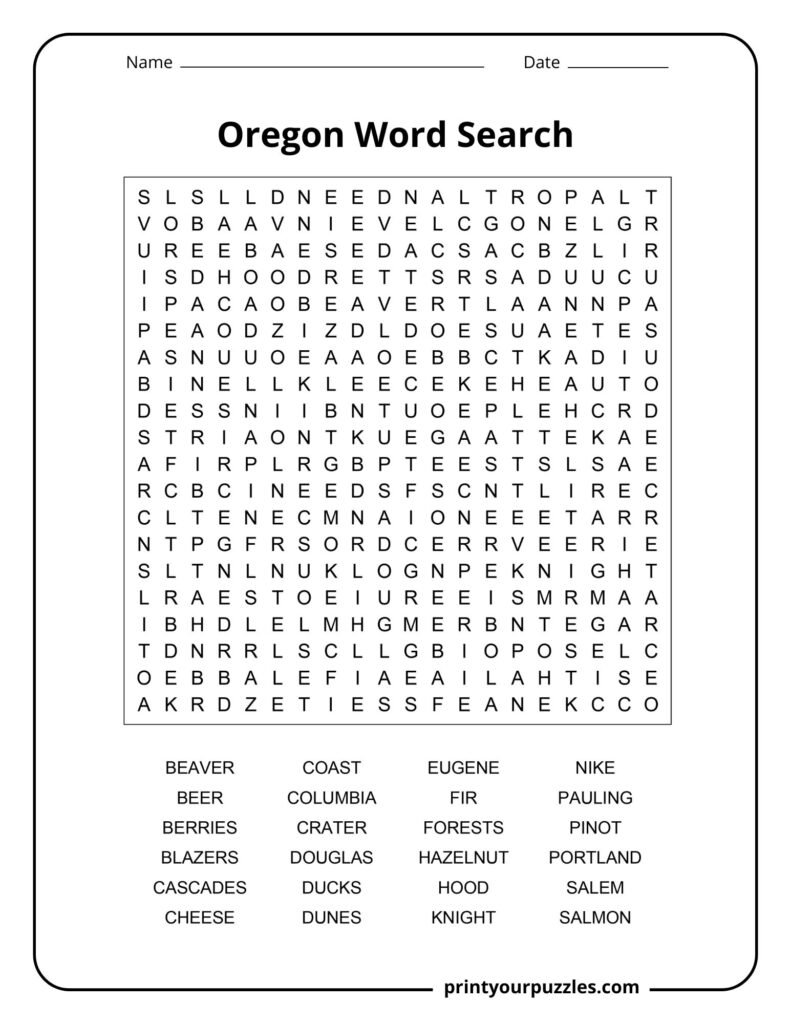
BEAVER, BEER, BERRIES, BLAZERS, CASCADES, CHEESE, COAST, COLUMBIA, CRATER, DOUGLAS, DUCKS, DUNES, EUGENE, FIR, FORESTS, HAZELNUT, HOOD, KNIGHT, NIKE, PAULING, PINOT, PORTLAND, SALEM, SALMON
Oregon is famous for Crater Lake, craft beer, wine production, Nike headquarters, natural beauty, the Pacific coastline, outdoor recreation, progressive politics, and its “Keep Portland Weird” culture.
Salem is Oregon’s capital city, located in the Willamette Valley. Founded in 1842, it houses the state legislature, government offices, and Willamette University since 1851.
Western Oregon has mild, rainy winters and dry summers. Eastern Oregon is high desert with hot summers and cold winters. The Cascades divide these two distinct climate zones.
Oregon became the 33rd U.S. state on February 14, 1859, Valentine’s Day. It was the only state admitted with a constitution prohibiting slavery while excluding Black residents.
Technology (Intel, Nike), timber and forestry, agriculture (hazelnuts, berries, wine), tourism, manufacturing, and renewable energy drive Oregon’s economy. Portland anchors the state’s tech sector and creative industries.
For official state records and government services, visit the Oregon State Portal. If you are planning a trip, check out Travel Oregon.
Oregon is one of only five U.S. states without sales tax, making shopping more affordable. However, it compensates with higher income taxes, ranking among America’s highest rates.
Oregon and New Jersey are the only states prohibiting self-service gas stations. Attendants must pump fuel for customers, a law dating to 1951 for safety and employment reasons.
Oregon is the only U.S. state with a double-sided flag. The front displays the state seal, while the reverse shows a golden beaver, the state animal.
Since 1967, Oregon law guarantees public access to the entire 363-mile coastline. No beach can be privately owned, ensuring recreational access for all residents and visitors.
In 1971, Oregon pioneered container deposit legislation requiring refundable deposits on beverage containers. This groundbreaking environmental law inspired similar programs nationwide, dramatically reducing roadside litter.