Introduction to the Electricity Word Search
Electricity is a form of energy that plays an essential role in everyday life. It powers the lights in our homes, charges phones and computers, operates appliances, and supports hospitals, schools, factories, and transportation systems. Although electricity may seem invisible, its effects are all around us, from a glowing light bulb to a flash of lightning during a storm.
Electricity is connected to tiny particles called atoms. Every atom contains negatively charged electrons and positively charged protons. When electrons move from one place to another, they create an electric current. This movement usually travels through materials called conductors, such as copper and other metals. Materials that resist the movement of electricity, including rubber, plastic, and glass, are known as insulators. Insulators help protect people from electric shocks and make electrical equipment safer to use.
An electrical circuit is a complete pathway through which current can flow. A simple circuit may include a power source, wires, a switch, and a device such as a light bulb. When the circuit is closed, electricity travels through the pathway and the bulb lights up. When the circuit is open, the pathway is broken, so the current stops flowing. Understanding circuits helps explain how many electronic devices and household systems operate.
Electricity can be produced from several energy sources. Power stations may use coal, natural gas, nuclear energy, moving water, wind, or sunlight to generate electricity. Renewable sources such as solar, wind, and hydroelectric power can produce energy with fewer greenhouse gas emissions than fossil fuels. After electricity is generated, it travels through power lines and electrical grids before reaching homes and businesses.
Important electrical concepts include voltage, current, resistance, and power. Voltage pushes electric charges through a circuit, current measures the flow of those charges, and resistance slows the flow. These ideas are closely connected and help scientists, engineers, and electricians design safe and efficient systems.
Learning about electricity also means understanding safety. People should never touch damaged wires, place objects into electrical outlets, or use electrical devices near water. An electricity word search can introduce useful vocabulary such as circuit, current, conductor, battery, voltage, and energy while making the topic more engaging. By exploring these terms, learners can better understand how electricity is created, controlled, and used throughout the modern world.
Related Word Searches:
Magnetism | Physics | Energy | Atom | Coding | Matter
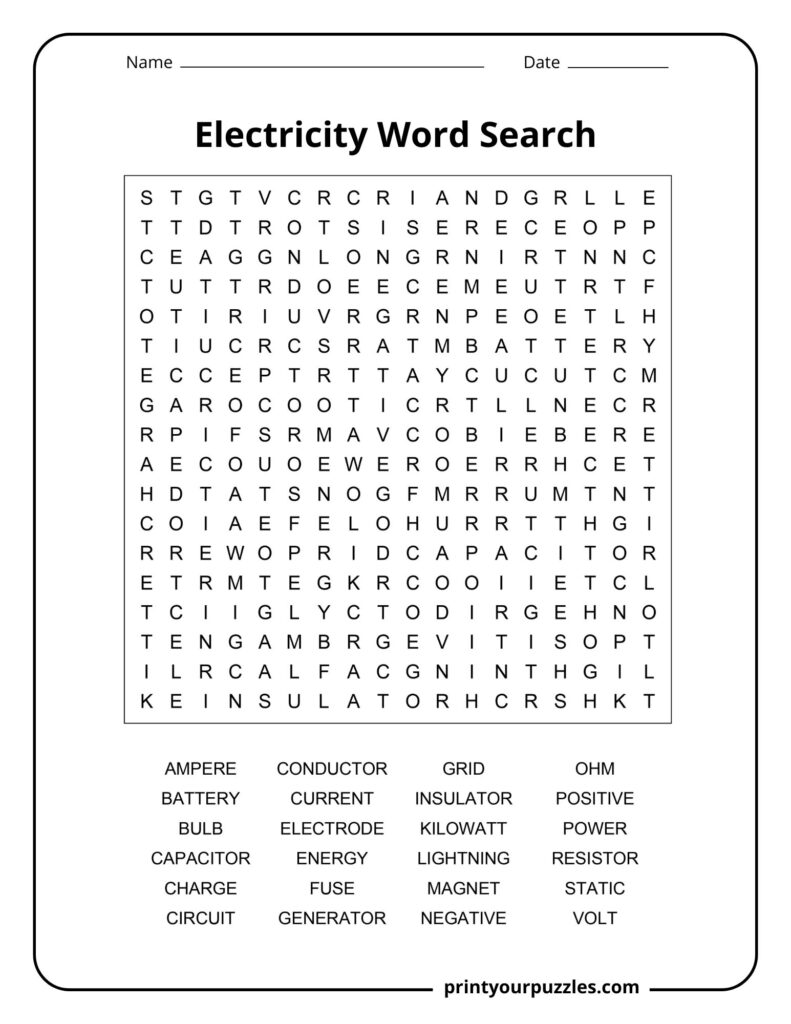
Medium Difficulty Word Search
Words to Find:
AMPERE, BATTERY, BULB, CAPACITOR, CHARGE, CIRCUIT, CONDUCTOR, CURRENT, ELECTRODE, ENERGY, FUSE, GENERATOR, GRID, INSULATOR, KILOWATT, LIGHTNING, MAGNET, NEGATIVE, OHM, POSITIVE, POWER, RESISTOR, STATIC, VOLT
All Words Defined
AMPERE – The standard unit of electric current measurement, representing the flow of one coulomb of electrical charge per second through a conductor. Named after André-Marie Ampère.
BATTERY – A device containing electrochemical cells that converts stored chemical energy into electrical energy, providing portable power for various devices through connected positive and negative terminals.
BULB – A glass enclosure containing a filament or gas that produces light when electrical current passes through it, commonly used for illumination in homes and buildings.
CAPACITOR – An electronic component that stores electrical energy in an electric field between two conductive plates, releasing it when needed. Used in circuits for filtering and timing.
CHARGE – The fundamental property of matter that causes it to experience electromagnetic force, existing as positive or negative. Measured in coulombs and carried by protons and electrons.
CIRCUIT – A closed loop pathway that allows electrical current to flow from a power source through conductors and components, then back to the source, enabling devices to operate.
CONDUCTOR – A material, typically metal like copper or aluminum, that allows electrical current to flow easily through it due to freely moving electrons within its atomic structure.
CURRENT – The flow of electric charge through a conductor, measured in amperes. Can be direct current flowing one direction or alternating current periodically reversing direction.
ELECTRODE – A conductor through which electric current enters or leaves a medium, such as an electrolyte, gas, or vacuum. Essential component in batteries, welding, and electrochemical processes.
ENERGY – The capacity to perform work or produce change, existing in various forms including electrical, which powers devices by moving charged particles through conductive pathways and circuits.
FUSE – A safety device containing a thin wire that melts and breaks the circuit when excessive current flows, protecting electrical systems and equipment from damage or fire.
GENERATOR – A machine that converts mechanical energy into electrical energy through electromagnetic induction, rotating coils within magnetic fields to produce current for power distribution and use.
GRID – An interconnected network of power lines, substations, and transformers that distributes electricity from generating stations to consumers across cities, regions, or entire countries efficiently.
INSULATOR – A material, such as rubber, plastic, or glass, that resists electrical current flow, preventing unwanted electricity transfer and protecting people from shocks and electrical hazards.
KILOWATT – A unit of electrical power equal to one thousand watts, commonly used to measure energy consumption in homes and the output capacity of electrical appliances and systems.
LIGHTNING – A massive natural electrostatic discharge during storms, occurring when electrical charges build up in clouds and release suddenly, creating brilliant flashes and thunder through atmospheric ionization.
MAGNET – An object producing a magnetic field that attracts ferromagnetic materials and interacts with electric currents. Essential for generators, motors, and many electromagnetic devices and applications.
NEGATIVE – The terminal or charge with an excess of electrons, attracting positive charges. In circuits, current conventionally flows from positive to negative, though electrons move oppositely.
OHM – The standard unit measuring electrical resistance, indicating how much a material opposes current flow. One ohm allows one ampere when one volt is applied, following Ohm’s law.
POSITIVE – The terminal or charge with a deficit of electrons, attracting negative charges. Represents the conventional direction of current flow in electrical circuits from higher to lower potential.
POWER – The rate at which electrical energy is transferred or converted, measured in watts. Calculated by multiplying voltage and current, indicating how quickly work is performed electrically.
RESISTOR – An electronic component designed to limit current flow in circuits by providing specific resistance. Controls voltage levels, divides currents, and protects sensitive components from excessive electricity.
STATIC – Stationary electrical charge accumulated on surfaces through friction or contact, remaining until discharged. Can cause shocks, attract small objects, and damage sensitive electronic equipment unexpectedly.
VOLT – The unit measuring electrical potential difference or electromotive force between two points. One volt drives one ampere through one ohm of resistance, named after Alessandro Volta.
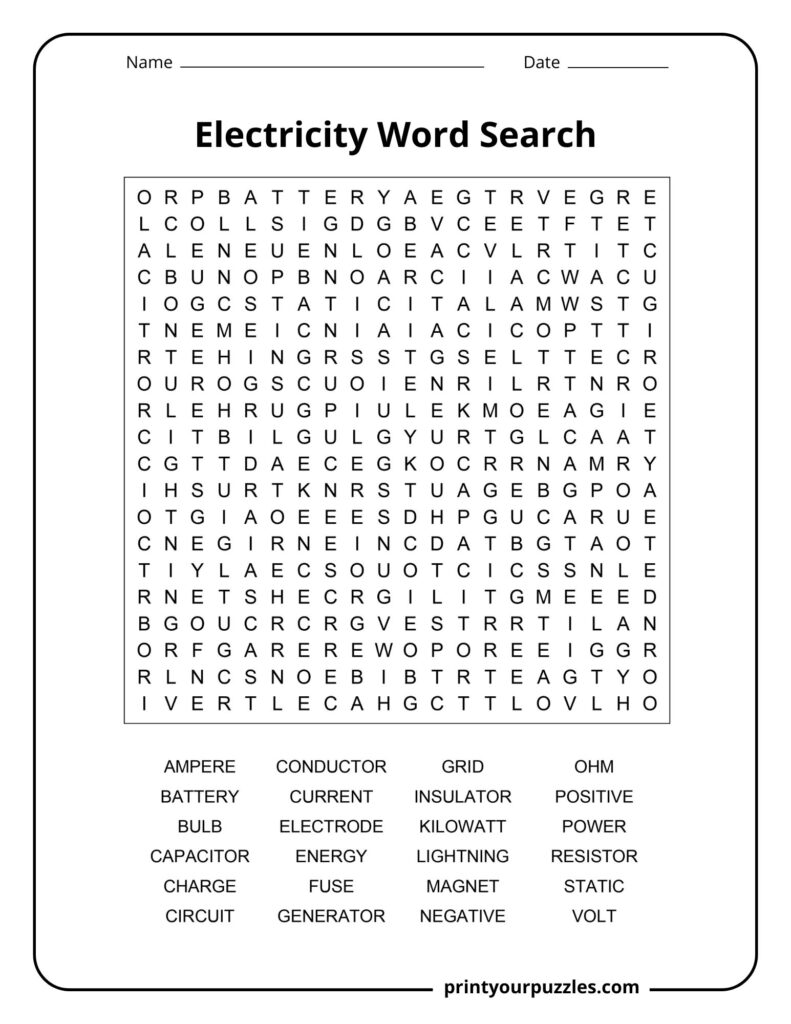
Hard Difficulty Word Search
Words to Find:
AMPERE, BATTERY, BULB, CAPACITOR, CHARGE, CIRCUIT, CONDUCTOR, CURRENT, ELECTRODE, ENERGY, FUSE, GENERATOR, GRID, INSULATOR, KILOWATT, LIGHTNING, MAGNET, NEGATIVE, OHM, POSITIVE, POWER, RESISTOR, STATIC, VOLT
5 Key FAQs About Electricity
5 Curious "Did You Know?" Facts About Electricity