
Tallahassee feels very different from the beach cities many people first associate with Florida. Set among rolling hills, oak trees, lakes, and forests in the state’s northern region, Florida’s capital has a distinctly Southern atmosphere shaped by history, education, politics, nature, and a strong sense of local community.
The area has been inhabited for thousands of years, with Indigenous peoples establishing important settlements long before European arrival. Spanish explorers reached the region in the sixteenth century, and Tallahassee later developed as a political center after Florida became a U.S. territory. Its inland location helped distinguish it from the coastal ports that dominated much of the state’s early economy.
One of the most interesting places to visit is Mission San Luis, a reconstructed seventeenth-century Spanish mission community where visitors can learn about interactions between Spanish settlers and the Apalachee people. Historic buildings, demonstrations, and interpretive exhibits make the site especially useful for understanding Florida before statehood.
Nature is equally important to the Tallahassee experience. The Alfred B. Maclay Gardens State Park offers landscaped gardens, walking trails, lakes, and peaceful outdoor spaces, while the broader region is filled with forests, springs, and wildlife areas. Tallahassee’s canopy roads, shaded by large oaks and other trees, are among the most distinctive features of the surrounding landscape.
Art and culture are strongly influenced by the city’s universities, especially Florida State University and Florida A&M University. Museums, music, theater, public art, and sporting events help give Tallahassee a youthful energy alongside its historic character.
Local food reflects both Southern and Floridian influences. Fried seafood, barbecue, grits, biscuits, pecan desserts, fresh produce, and Gulf Coast flavors appear on many menus, while modern restaurants add Caribbean, Latin American, and other international influences.
A Tallahassee word search can introduce readers to vocabulary connected with Florida history, Indigenous heritage, universities, gardens, Southern food, and outdoor life. With wooded landscapes, historic sites, cultural institutions, and a slower inland rhythm, Tallahassee offers a side of Florida that many visitors do not expect.
Related Word Searches:
Florida | Atlanta | Montgomery | Columbia | Baton Rouge
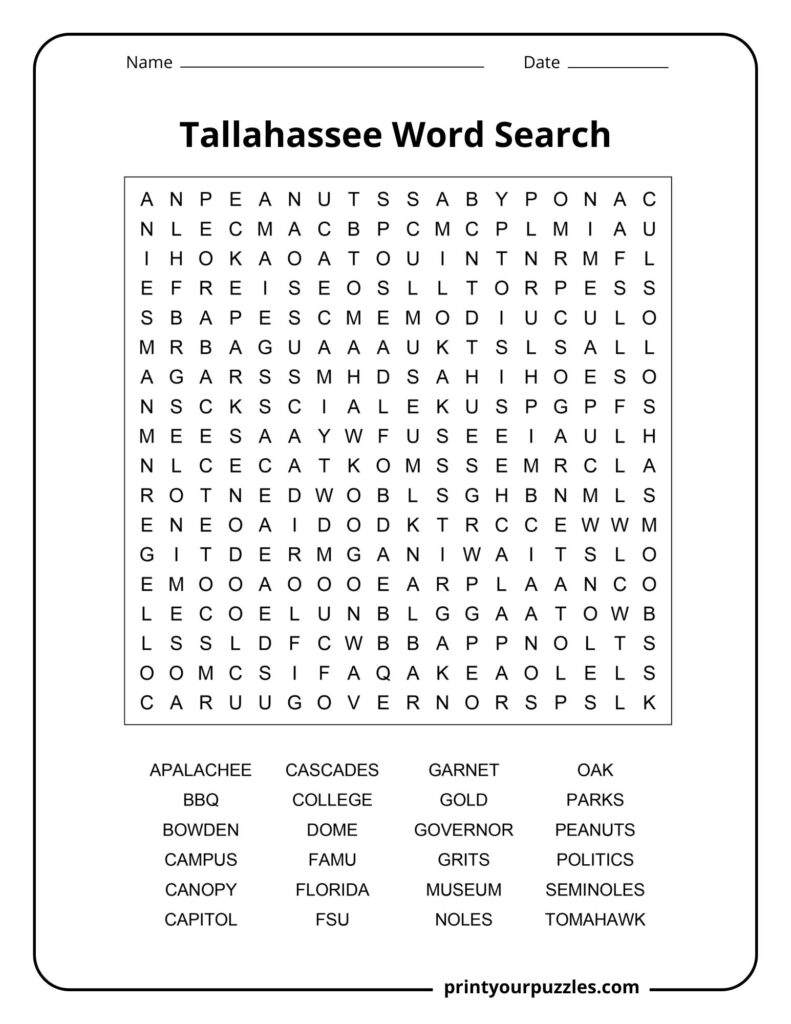
APALACHEE, BBQ, BOWDEN, CAMPUS, CANOPY, CAPITOL, CASCADES, COLLEGE, DOME, FAMU, FLORIDA, FSU, GARNET, GOLD, GOVERNOR, GRITS, MUSEUM, NOLES, OAK, PARKS, PEANUTS, POLITICS, SEMINOLES, TOMAHAWK
APALACHEE – Indigenous Native American tribe that inhabited the Tallahassee area for centuries before European contact. The city’s name derives from their language, meaning “old fields” or “old town.”
BBQ – Barbecue is a cornerstone of Tallahassee’s Southern culinary tradition, featuring slow-smoked meats with regional sauces. Local establishments serve authentic Florida-style barbecue reflecting deep-rooted cultural heritage.
BOWDEN – Bobby Bowden coached Florida State football from 1976 to 2009, becoming one of college football’s winningest coaches. He transformed FSU into a national powerhouse and Tallahassee icon.
CAMPUS – Tallahassee hosts multiple university campuses including Florida State University and Florida A&M University, making it a vibrant college town. These institutions define the
city’s youthful energy and educational focus.
CANOPY – Famous canopy roads feature sprawling live oak trees whose branches create natural tunnels over historic roadways. These protected scenic routes are cherished landmarks showcasing Tallahassee’s natural beauty.
CAPITOL – Florida’s State Capitol building houses the legislature and governor’s office, making Tallahassee the political nerve center. The historic and modern capitol buildings dominate the downtown skyline.
CASCADES – Cascades Park is a 24-acre urban park featuring amphitheater, playgrounds, and walking trails along a restored creek. This revitalized space hosts community events and concerts throughout the year.
COLLEGE – As a college town, Tallahassee’s identity centers around higher education with two major universities. Student populations significantly influence local culture, economy, and entertainment options throughout the city.
DOME – The distinctive dome tops Florida’s Historic Capitol building, serving as an iconic architectural symbol. Visitors can ascend to observation levels for panoramic views of downtown Tallahassee.
FAMU – Florida Agricultural and Mechanical University is a historically Black university renowned for its Marching 100 band and academic programs. FAMU significantly contributes to Tallahassee’s educational and cultural landscape.
FLORIDA – Tallahassee serves as Florida’s state capital since 1824, chosen for its central location between Pensacola and St. Augustine. The city represents governmental authority for the Sunshine State.
FSU – Florida State University is a major research institution with nationally ranked programs in athletics, arts, and sciences. The Seminoles’ presence profoundly shapes Tallahassee’s identity and economy.
GARNET – Deep garnet red is one of Florida State University’s official school colors, displayed prominently during football games. Fans wear garnet throughout Tallahassee on game days showing Seminole pride.
GOLD – Gold complements garnet as FSU’s second official color, representing excellence and tradition. The garnet and gold combination unites the Tallahassee community during athletic events and celebrations.
GOVERNOR – Florida’s governor resides and works in Tallahassee, residing at the Governor’s Mansion near the Capitol. The governor’s presence makes Tallahassee the center of executive state power.
GRITS – Ground corn grits are a Southern breakfast staple served throughout Tallahassee restaurants and homes. This comfort food represents regional culinary traditions deeply embedded in local food culture.
MUSEUM – Multiple museums including the Museum of Florida History and Tallahassee Museum preserve and showcase regional heritage. These institutions offer educational experiences highlighting natural history, culture, and art.
NOLES – Shortened nickname for FSU Seminoles used affectionately by students, alumni, and fans. “Go Noles” is a common rallying cry heard throughout Tallahassee during football season.
OAK – Majestic Southern live oak trees define Tallahassee’s landscape, providing shade and beauty throughout the city. These ancient trees create the famous canopy roads and grace residential neighborhoods.
PARKS – Tallahassee boasts numerous parks offering recreational opportunities including hiking, biking, and wildlife viewing. The extensive park system preserves natural areas while providing community gathering spaces.
PEANUTS – Peanuts are an important agricultural crop in surrounding Leon County and North Florida. Boiled peanuts are a popular regional snack sold at roadside stands and sporting events.
POLITICS – As Florida’s capital, Tallahassee is the epicenter of state politics where laws are made and political careers unfold. Lobbyists, legislators, and government workers create a politically charged atmosphere.
SEMINOLES – The Seminoles are FSU’s athletic teams and mascot, honoring the Seminole Tribe of Florida through university partnership. The name represents strength, courage, and unconquered spirit.
TOMAHAWK – The tomahawk chop is FSU’s iconic fan gesture accompanied by the war chant during athletic events. This symbol represents Seminole tradition and unifies thousands of fans in Doak Campbell Stadium.
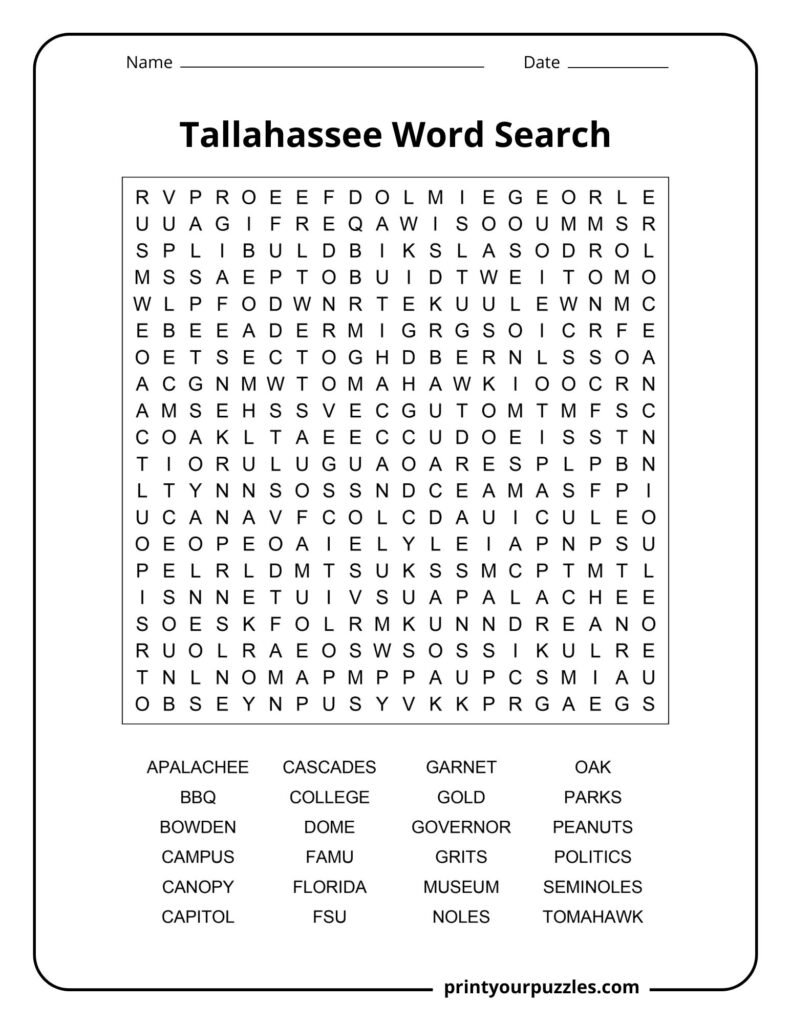
APALACHEE, BBQ, BOWDEN, CAMPUS, CANOPY, CAPITOL, CASCADES, COLLEGE, DOME, FAMU, FLORIDA, FSU, GARNET, GOLD, GOVERNOR, GRITS, MUSEUM, NOLES, OAK, PARKS, PEANUTS, POLITICS, SEMINOLES, TOMAHAWK
Tallahassee became Florida’s capital in 1824 because of its central location between St. Augustine and Pensacola, Florida’s two major cities at that time, making it accessible for government officials.
Tallahassee is renowned for being Florida’s capital, home to Florida State University and Florida A&M University, its historic canopy roads, Southern cuisine, and vibrant college football culture.
The name Tallahassee comes from the Apalachee or Muskogee language, generally meaning “old fields” or “old town,” referencing the Native American settlements that existed in the area before European colonization.
Tallahassee hosts Florida State University (FSU), a major research institution, and Florida A&M University (FAMU), a historically Black university. Tallahassee Community College also serves the area’s educational needs.
Tallahassee features a humid subtropical climate with hot summers and mild winters. Spring (March-May) and fall (September-November) offer pleasant temperatures ideal for exploring outdoor attractions and attending football games.
For official city information, government updates, and public services, visit the City of Tallahassee website. If you are planning a trip, check out the official tourism portal, Visit Tallahassee.
Unlike most of Florida, Tallahassee sits atop rolling hills rather than flat terrain. This unique topography results from the city’s location in the state’s panhandle, creating distinctive elevation changes throughout town.
Tallahassee’s iconic canopy roads are protected by local ordinances prohibiting tree removal. These living tunnels of ancient live oaks, some over 200 years old, are preserved as irreplaceable historical and natural treasures.
Tallahassee remains the only Confederate state capital east of the Mississippi River never captured by Union forces during the Civil War. The Battle of Natural Bridge in 1865 successfully protected the city from invasion.
The Tallahassee area features numerous sinkholes, underground caves, and springs due to limestone geology. Wakulla Springs, just south of the city, is one of the world’s largest and deepest freshwater springs.
Florida State University runs the Flying High Circus, one of only two collegiate circuses in America. Since 1947, student performers have amazed audiences with acrobatic acts, requiring no previous circus experience.