
The Bible is a collection of sacred writings that tells the story of God’s relationship with humanity. Rather than being a single book written by one author, it is a library of many books composed over hundreds of years. These writings include history, laws, poetry, wisdom, prophecy, letters, biographies, and accounts of faith.
The Bible is divided into two main sections: the Old Testament and the New Testament. The Old Testament focuses on creation, the history of Israel, God’s covenant with His people, and the messages of prophets. It begins with Genesis, which describes creation and the lives of figures such as Abraham, Isaac, Jacob, and Joseph.
Other Old Testament books explain the Exodus from Egypt, the giving of the Law, the rise of Israel’s kings, and the nation’s periods of success, conflict, exile, and return. Books such as Psalms and Proverbs contain prayers, songs, wisdom, and practical advice, while prophetic books communicate warnings, encouragement, and hope.
The New Testament centers on Jesus Christ and the beginning of the Christian Church. Its first four books—Matthew, Mark, Luke, and John—are known as the Gospels. They describe Jesus’ life, teachings, miracles, death, and resurrection, although each Gospel presents the story from a slightly different perspective.
The Book of Acts explains how Jesus’ followers spread the Christian message after His resurrection. It describes the work of apostles such as Peter and Paul and records the growth of the early Church. Many of the remaining New Testament books are letters written to churches or individuals, offering guidance about faith, worship, behavior, unity, and perseverance.
Different Christian traditions do not always include exactly the same number of biblical books. Protestant Bibles usually contain 66 books, while Catholic and Orthodox Bibles include additional Old Testament writings. Despite these differences, all Christian Bibles share the central story of God, humanity, faith, redemption, and hope.
A books of the Bible word search can help readers become familiar with important titles, people, themes, and sections found throughout Scripture. While completing the puzzle, readers can review how the Bible is organized and discover the variety of writings that have shaped Jewish and Christian belief for centuries.
Related Word Searches:
Old Testament | New Testament | Genesis | Jesus Christ
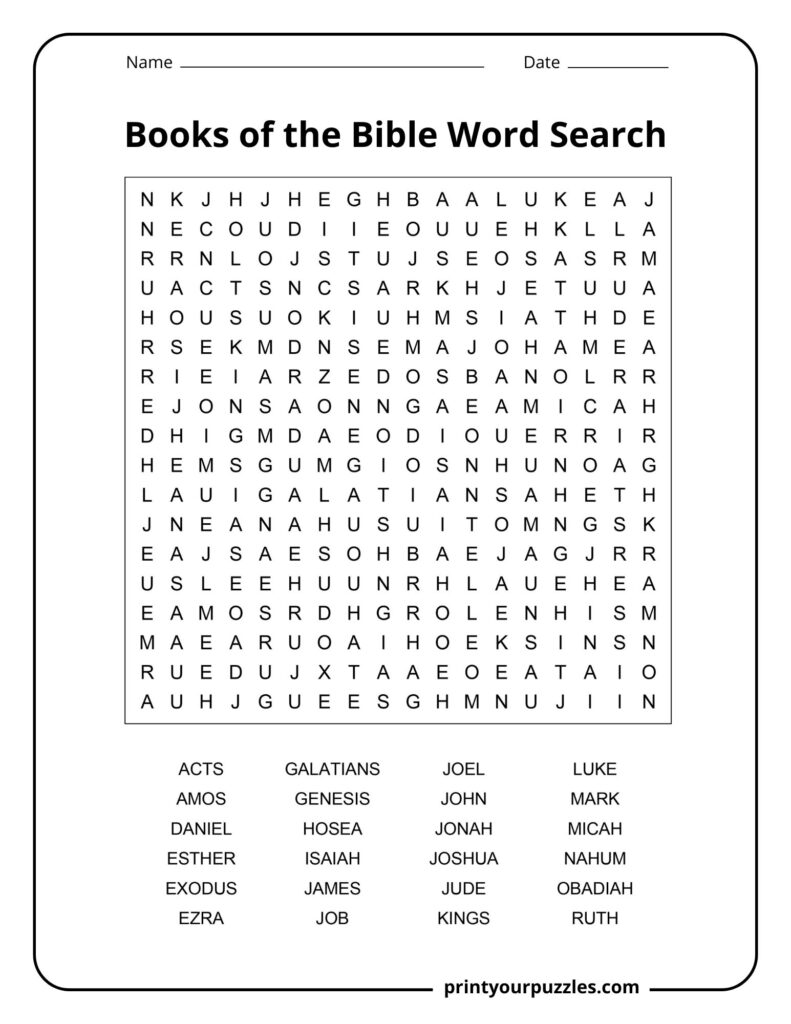
ACTS, AMOS, DANIEL, ESTHER, EXODUS, EZRA, GALATIANS, GENESIS, HOSEA, ISAIAH, JAMES, JOB, JOEL, JOHN, JONAH, JOSHUA, JUDE, KINGS, LUKE, MARK, MICAH, NAHUM, OBADIAH, RUTH
ACTS – This New Testament book records the early Christian church’s history, focusing on the apostles’ missions, the Holy Spirit’s work, and Paul’s transformative journeys spreading the gospel throughout the Roman Empire.
AMOS – An Old Testament prophetic book where a humble shepherd from Judah delivers God’s warnings of judgment against Israel and surrounding nations for their social injustice and religious corruption.
DANIEL – This Old Testament book tells of a faithful Jewish exile in Babylon who interprets dreams, survives a lions’ den, and receives powerful apocalyptic visions about future kingdoms and God’s sovereignty.
ESTHER – An Old Testament book narrating a brave Jewish queen in Persia who risks her life to save her people from a genocidal plot, celebrated annually through the Jewish festival of Purim.
EXODUS – The second book of the Bible recounting Israel’s liberation from Egyptian slavery, Moses‘ leadership, the Ten Commandments, and God’s covenant relationship established with His chosen people at Sinai.
EZRA – This Old Testament historical book describes the Jewish people’s return from Babylonian exile, the rebuilding of Jerusalem’s temple, and Ezra’s efforts to restore proper worship and faithfulness to God’s law.
GALATIANS – A New Testament letter from Paul to churches in Galatia, passionately defending salvation through faith alone in Christ, not through following the Jewish law, emphasizing Christian freedom and grace.
GENESIS – The Bible’s first book covering creation, humanity’s fall into sin, the great flood, and God’s covenant promises to patriarchs Abraham, Isaac, and Jacob, establishing Israel’s foundational story and identity.
HOSEA – An Old Testament prophetic book using Hosea’s marriage to an unfaithful wife as a powerful metaphor for God’s enduring, steadfast love toward Israel despite their persistent spiritual unfaithfulness and idolatry.
ISAIAH – A major Old Testament prophetic book containing warnings of judgment, promises of restoration, and messianic prophecies about a coming servant who would suffer and bring salvation to all nations.
JAMES – A practical New Testament letter emphasizing that genuine faith produces good works, addressing topics like wisdom, patience, controlling the tongue, caring for the poor, and enduring trials faithfully.
JOB – An Old Testament wisdom book exploring the profound mystery of human suffering through the story of a righteous man who loses everything yet ultimately encounters God’s overwhelming presence and sovereignty.
JOEL – A short Old Testament prophetic book warning of a devastating locust plague as divine judgment, calling people to repentance, and promising God’s Spirit being poured out on all people in future days.
JOHN – The fourth Gospel presents Jesus as the divine Word made flesh, emphasizing His miraculous signs, spiritual teachings, intimate relationship with the Father, and the promise of eternal life through belief.
JONAH – An Old Testament book about a reluctant prophet who flees God’s command, is swallowed by a great fish, and eventually preaches repentance to Nineveh, revealing God’s mercy toward all nations.
JOSHUA – This Old Testament historical book follows Moses‘ successor as he leads Israel across the Jordan River into the Promised Land, conquering Canaan and dividing the territory among the twelve tribes.
JUDE – A brief New Testament letter warning believers against false teachers who distort God’s grace, urging Christians to contend earnestly for the faith and remain grounded in God’s love and mercy.
KINGS – Two Old Testament historical books tracing Israel’s monarchy from Solomon’s glorious reign through the divided kingdom’s decline, foreign conquests, and the prophets who called rulers back to faithfulness.
LUKE – A detailed New Testament Gospel written by a physician, emphasizing Jesus’ compassion for outcasts, women, the poor, and sinners, presenting Him as the universal Savior of all humanity.
MARK – The shortest Gospel, presenting Jesus as a man of immediate action and authority, focusing on His powerful miracles, servant leadership, suffering, and ultimate sacrificial death and triumphant resurrection.
MICAH – An Old Testament prophetic book condemning injustice and corruption among Israel’s leaders while promising a future ruler from Bethlehem and famously calling people to act justly, love mercy, and walk humbly.
NAHUM – A short Old Testament prophetic book proclaiming God’s fierce judgment against the powerful Assyrian city of Nineveh for its extreme cruelty, violence, and oppression of surrounding nations including Israel.
OBADIAH – The shortest Old Testament book, containing a single prophetic vision announcing God’s judgment against Edom for its pride and betrayal of brother nation Israel during Jerusalem’s time of greatest distress.
RUTH – A beautiful Old Testament story of a loyal Moabite widow who follows her mother-in-law Naomi to Israel, finds redemption through Boaz, and becomes an ancestor of King David and Jesus.
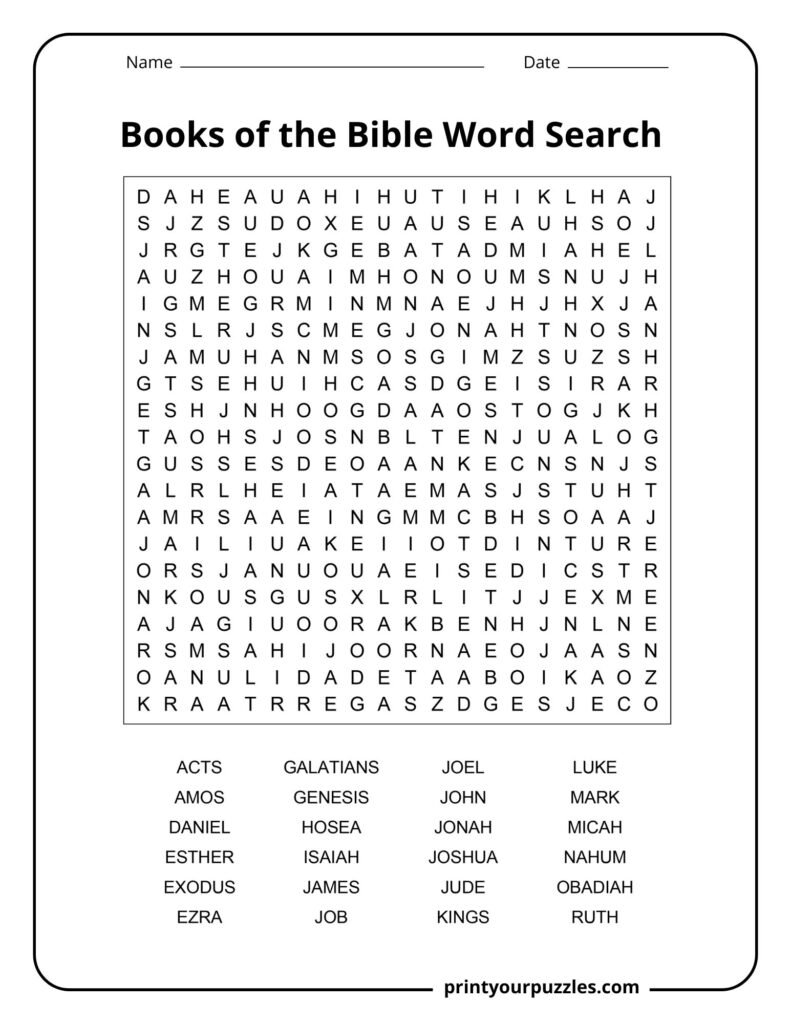
ACTS, AMOS, DANIEL, ESTHER, EXODUS, EZRA, GALATIANS, GENESIS, HOSEA, ISAIAH, JAMES, JOB, JOEL, JOHN, JONAH, JOSHUA, JUDE, KINGS, LUKE, MARK, MICAH, NAHUM, OBADIAH, RUTH
The Bible contains 66 books in total, divided into two main sections: the Old Testament with 39 books and the New Testament with 27 books, written by approximately 40 different authors.
The Bible’s books are grouped into categories including Law, History, Poetry, Major Prophets, Minor Prophets, Gospels, Epistles, and Apocalyptic literature, each serving a unique purpose in conveying God’s message.
The Bible was originally written in three ancient languages: Hebrew for most of the Old Testament, Aramaic for small portions of Daniel and Ezra, and Greek for the entire New Testament.
The Bible’s books were written over approximately 1,500 years, spanning from around 1400 BC with Moses’ earliest writings to approximately 95 AD with John’s book of Revelation.
The Old Testament covers God’s creation, covenant with Israel, laws, and prophetic promises, while the New Testament focuses on Jesus Christ’s life, teachings, salvation, and the early Christian church’s formation.
It contains 150 individual psalms, comprising songs, prayers, and poems written by various authors including King David, making it the Bible’s most extensive collection of worship literature.
Found in John 11:35, it simply reads “Jesus wept,” capturing a powerful moment of Christ’s deep compassion and humanity at the death of His beloved friend Lazarus.
Despite this remarkable absence, God’s providence and protection are evident throughout the entire narrative, working behind the scenes to save the Jewish people from complete destruction.
The complete Bible has been translated into over 700 languages, with portions available in more than 3,500 languages, reaching billions of people across every continent worldwide.
It contains only 21 verses in a single chapter, entirely dedicated to a prophetic message of divine judgment against the nation of Edom for betraying Israel during crisis.