Introduction to Moses Word Search
Moses is one of the most important leaders in the Bible. His story appears mainly in the books of Exodus, Leviticus, Numbers, and Deuteronomy. He is remembered for leading the Israelites out of slavery in Egypt, receiving God’s laws, and guiding the people during their long journey through the wilderness.
Moses was born at a dangerous time when Pharaoh had ordered that Hebrew baby boys be killed. To protect him, his mother placed him in a basket among the reeds of the Nile River. Pharaoh’s daughter discovered the child and raised him in the royal household. However, Moses remained connected to his Hebrew family and people.
As an adult, Moses fled Egypt after killing an Egyptian who was beating a Hebrew slave. He settled in Midian, married Zipporah, and worked as a shepherd. His life changed when he saw a bush burning without being consumed. From the bush, God called Moses to return to Egypt and demand that Pharaoh release the Israelites.
Moses felt uncertain about this mission, but God promised to help him. His brother Aaron became his spokesman. Pharaoh repeatedly refused to free the Israelites, and Egypt experienced ten plagues. The final plague led to the first Passover, when Israelite families marked their doors with lamb’s blood. Pharaoh then allowed the people to leave.
Soon afterward, Pharaoh’s army pursued them. According to Exodus, God divided the Red Sea so the Israelites could cross on dry ground. The waters returned after they passed, preventing the Egyptian forces from capturing them. This dramatic escape became a central event in Israel’s history.
At Mount Sinai, Moses received the Ten Commandments and other laws that guided the people’s worship, behavior, and community life. During forty years in the wilderness, he faced hunger, complaints, rebellion, and difficult decisions. God provided manna, quail, and water, while Moses continued leading the nation toward the Promised Land.
Moses did not enter Canaan, but he viewed it from Mount Nebo before his death. His life illustrates courage, faith, leadership, patience, and obedience, while also showing moments of doubt and frustration. Our printable Moses word search puzzle can help readers review important people, places, objects, and events connected with his story, including Egypt, Pharaoh, Aaron, the plagues, Passover, the Red Sea, Mount Sinai, and the Ten Commandments.
Related Word Searches:
Burning Bush | Red Sea Crossing | Ten Commandments | Old Testament
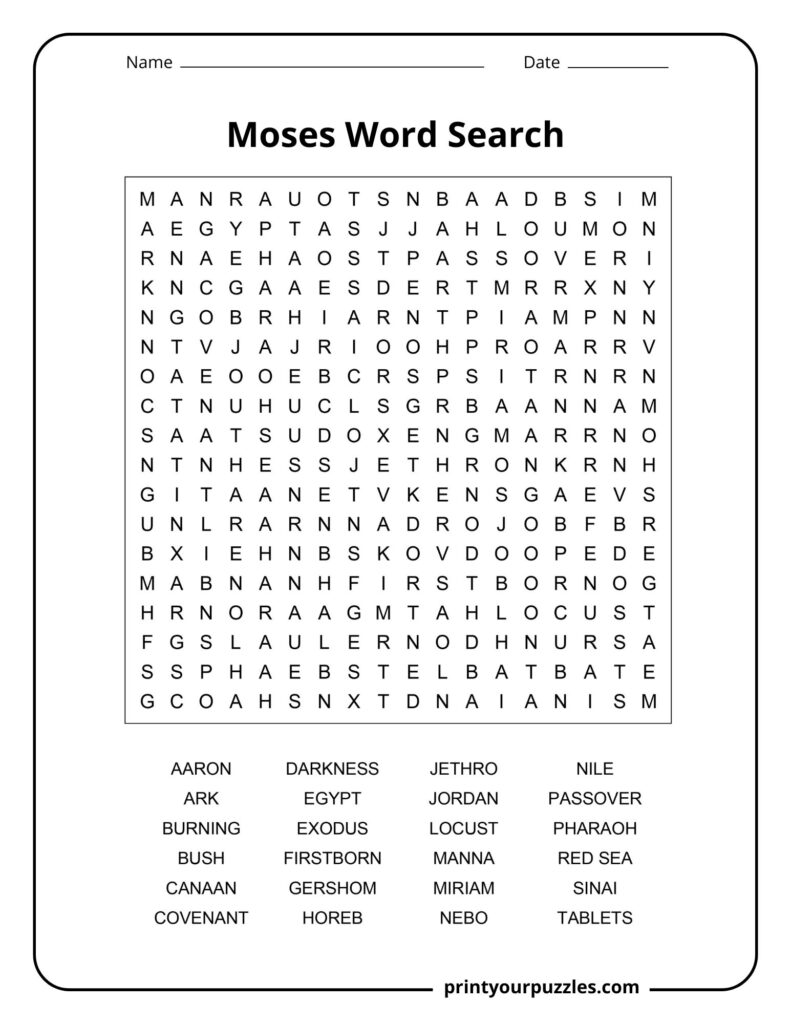
Medium Difficulty Word Search
Words to Find:
AARON, ARK, BURNING, BUSH, CANAAN, COVENANT DARKNESS, EGYPT, EXODUS, FIRSTBORN, GERSHOM, HOREB, JETHRO, JORDAN, LOCUST, MANNA, MIRIAM, NEBO, NILE, PASSOVER, PHARAOH, RED SEA, SINAI, TABLETS
All Words Defined
AARON – Elder brother of Moses and first High Priest of Israel. He served as Moses’ spokesperson before Pharaoh and assisted him throughout the Exodus journey from Egypt.
ARK – The Ark of the Covenant was a sacred wooden chest covered in gold, built to hold the stone tablets of the Ten Commandments given by God to Moses.
BURNING – Refers to the miraculous burning bush on Mount Horeb, where God first appeared to Moses in flames that consumed the bush without destroying it.
BUSH – The bush on Mount Horeb that burned with divine fire yet was not consumed. Through it, God called Moses to lead the Israelites out of Egyptian slavery.
CANAAN – The Promised Land God pledged to Abraham and his descendants. Moses led the Israelites toward Canaan after their liberation from Egypt, though he never entered it himself.
COVENANT – A sacred agreement between God and the Israelites, established through Moses at Mount Sinai. It defined their relationship with God and included the Ten Commandments as its foundation.
DARKNESS – One of the ten plagues God sent upon Egypt. A thick, supernatural darkness covered the entire land for three days, yet the Israelites living in Goshen had light.
EGYPT – Ancient African kingdom where the Israelites lived as slaves for generations. Moses was born there, raised in Pharaoh’s palace, and later returned to demand his people’s freedom.
EXODUS – The dramatic departure of the Israelites from Egypt under Moses’ leadership. It is one of the most significant events in biblical history, symbolizing liberation and God’s saving power.
FIRSTBORN – The tenth and most devastating plague upon Egypt. God struck down the firstborn of every Egyptian household, finally compelling Pharaoh to release the Israelites from bondage.
GERSHOM – Moses’ firstborn son, born during his years in Midian. His mother was Zipporah, daughter of Jethro. Moses named him Gershom, meaning “a stranger there” in Hebrew.
HOREB – Another name for Mount Sinai, considered the Mountain of God. Moses encountered the burning bush here and later received the Ten Commandments from God at this sacred location.
JETHRO – Moses’ father-in-law and a Midianite priest. He sheltered Moses after his flight from Egypt, gave him his daughter Zipporah in marriage, and later offered wise counsel on leadership.
JORDAN – The river marking the boundary of the Promised Land of Canaan. Moses saw it from Mount Nebo but died before crossing it. Joshua led the Israelites across after Moses.
LOCUST – The eighth plague God sent upon Egypt. Massive swarms of locusts devoured every remaining crop and plant, devastating the land after the previous plagues had already caused widespread destruction.
MANNA – Miraculous food provided by God to sustain the Israelites during their forty years of wandering in the desert. It appeared each morning on the ground like small white flakes.
MIRIAM – Moses’ older sister and a prophetess. She watched over the infant Moses in the Nile and later led the Israelite women in song and dance after crossing the Red Sea.
NEBO – The mountain in Moab where Moses climbed at the end of his life. God showed him the Promised Land from its summit, and Moses died there at one hundred and twenty years old.
NILE – Egypt’s great river where the infant Moses was placed in a basket by his mother to save him from Pharaoh’s decree ordering the death of all Hebrew male newborns.
PASSOVER – A sacred Jewish festival commemorating the night God spared Israelite firstborns. Families marked their doorposts with lamb’s blood so the angel of death would pass over their homes.
PHARAOH – The Egyptian king who refused to free the Israelites despite the ten devastating plagues. His hardened heart prolonged Israel’s suffering until the death of the firstborn finally broke his resistance.
RED SEA – The body of water God miraculously parted for Moses and the Israelites to cross on dry ground, then closed over Pharaoh’s pursuing army, sealing Israel’s dramatic escape from Egypt.
SINAI – The sacred desert mountain where Moses received the Ten Commandments directly from God. The Israelites camped at its base while God’s presence descended upon its peak in fire and cloud.
TABLETS – Two stone tablets on which God inscribed the Ten Commandments and gave to Moses on Mount Sinai. Moses shattered the first set in anger upon finding the Israelites worshipping a golden calf.
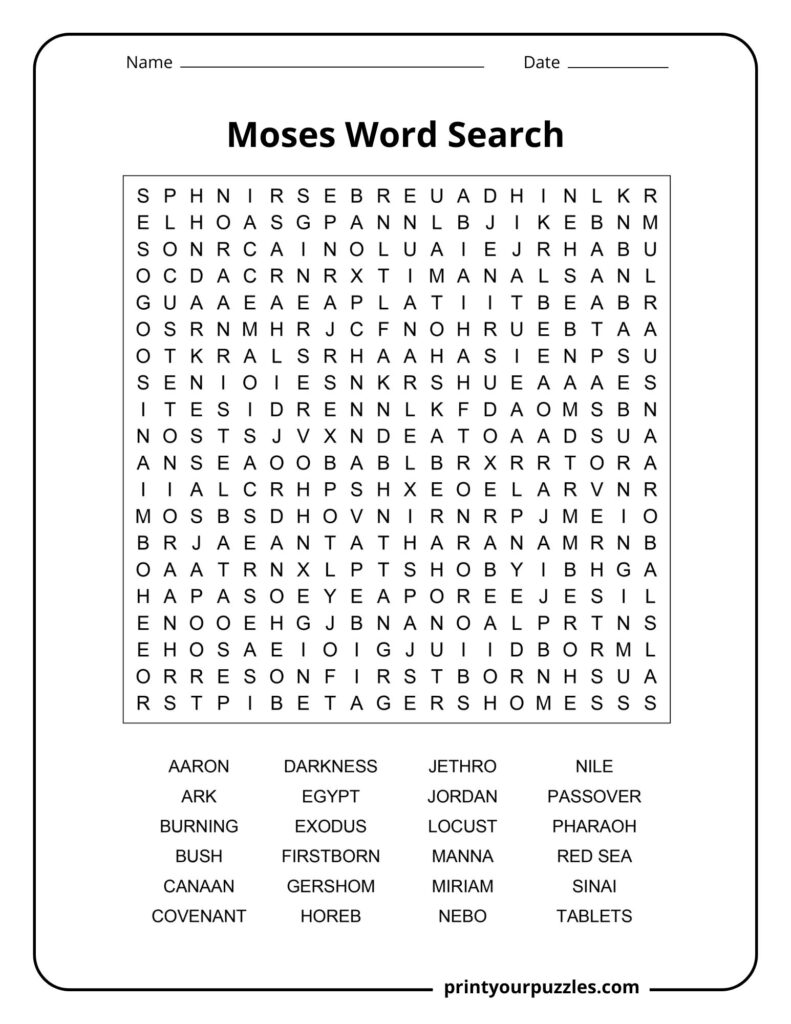
Hard Difficulty Word Search
Words to Find:
AARON, ARK, BURNING, BUSH, CANAAN, COVENANT DARKNESS, EGYPT, EXODUS, FIRSTBORN, GERSHOM, HOREB, JETHRO, JORDAN, LOCUST, MANNA, MIRIAM, NEBO, NILE, PASSOVER, PHARAOH, RED SEA, SINAI, TABLETS
7 Key FAQs About Moses
5 Curious "Did You Know?" Facts About Moses