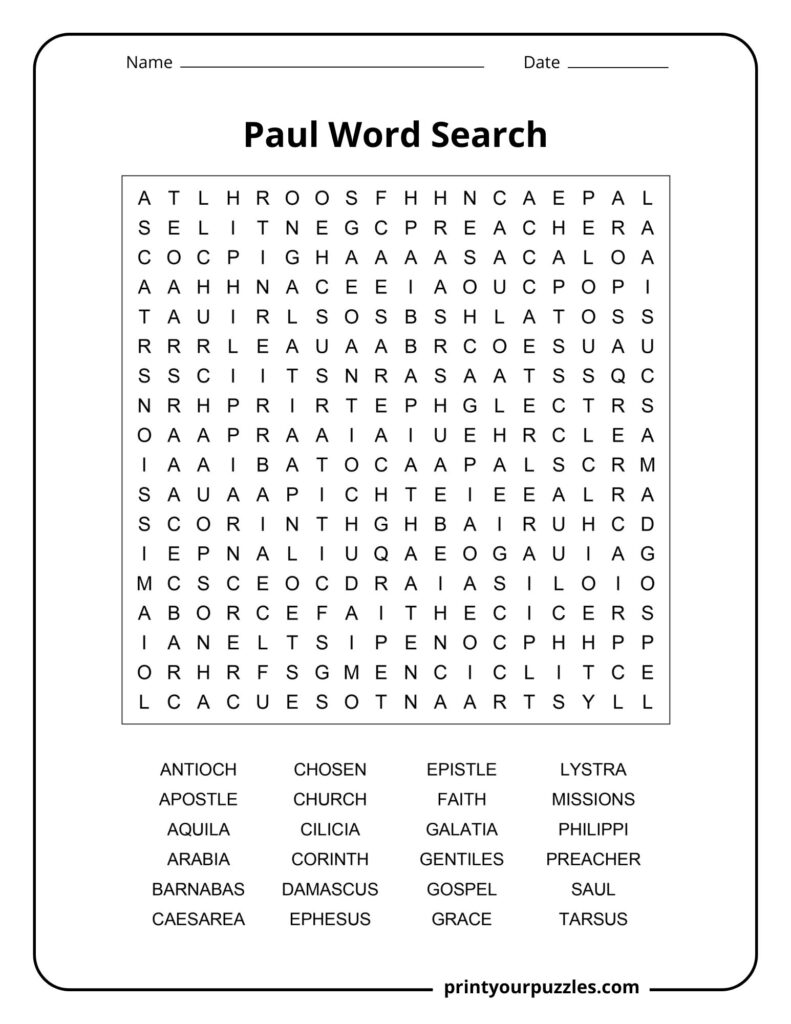
Introduction to Paul Word Search
Paul is one of the most important leaders in the New Testament and played a major role in the spread of Christianity. He is remembered as a missionary, teacher, letter writer, and courageous follower of Jesus Christ. Much of his story appears in the Book of Acts, while many New Testament letters are traditionally connected with his ministry.
Paul was originally known as Saul and came from Tarsus, an important city in the Roman world. He was Jewish, belonged to the group known as the Pharisees, and was also a Roman citizen. Saul strongly opposed the early Christian movement because he believed its teachings were dangerous. He approved of the death of Stephen, the first Christian martyr, and later helped arrest followers of Jesus.
His life changed dramatically while he was traveling to Damascus. According to Acts, a bright light suddenly appeared, and Saul heard the voice of Jesus asking why he was persecuting Him. Saul became blind and was led into the city. A Christian named Ananias later visited him, prayed for him, and helped restore his sight. Saul was baptized and began preaching that Jesus was the Son of God.
After his conversion, Paul traveled through many regions of the Roman Empire. He visited cities such as Antioch, Philippi, Corinth, Ephesus, and Athens, teaching both Jews and Gentiles. He helped establish Christian communities and trained other leaders to continue the work. His journeys were often difficult and included opposition, imprisonment, beatings, storms, and danger at sea.
Paul wrote letters to churches and individuals to encourage them, answer questions, correct problems, and explain Christian beliefs. Romans, Corinthians, Galatians, Philippians, and other letters discuss faith, grace, love, unity, spiritual gifts, resurrection, and Christian behavior. One of his best-known teachings describes love as patient, kind, and enduring.
Paul was eventually arrested and taken to Rome. The New Testament does not describe his death, but Christian tradition holds that he was executed there. His life demonstrates how a determined opponent of Christianity became one of its most influential messengers. A Paul word search provides an engaging activity for reviewing the people, places, journeys, letters, and ideas connected with his story, including Damascus, Ananias, Rome, missionary work, faith, courage, and the early Church.
Related Word Searches:
New Testament | Jesus Christ | Holy Spirit | Books of the Bible
Medium Difficulty Word Search
Words to Find
ANTIOCH, APOSTLE, AQUILA, ARABIA, BARNABAS, CAESAREA, CHOSEN, CHURCH, CILICIA, CORINTH, DAMASCUS, EPHESUS, EPISTLE, FAITH, GALATIA, GENTILES, GOSPEL, GRACE, LYSTRA, MISSIONS, PHILIPPI, PREACHER, SAUL, TARSUS
All Words Defined
ANTIOCH – Ancient city in Syria where followers of Jesus were first called Christians, and the base from which Paul launched his missionary journeys into the wider world.
APOSTLE – A person directly commissioned by Jesus Christ to spread the Gospel. Paul claimed this title despite not walking with Jesus, based on his Damascus road encounter.
AQUILA – A Jewish tentmaker and close companion of Paul, who together with his wife Priscilla hosted the apostle in Corinth and later mentored the eloquent preacher Apollos.
ARABIA – A region where Paul retreated shortly after his dramatic conversion, spending time in solitude and reflection before beginning his active ministry, as mentioned in Galatians.
BARNABAS – A trusted companion and fellow missionary who partnered with Paul on his first journey. Their later disagreement over John Mark led to a painful but productive separation.
CAESAREA – A Roman coastal city in Judea where Paul was imprisoned for two years before appealing to Caesar, eventually leading to his journey by sea toward Rome.
CHOSEN – Paul described himself as a chosen instrument of God, selected before birth to carry the name of Christ to Gentiles, kings, and the people of Israel.
CHURCH – The community of believers that Paul tirelessly planted, nurtured, and defended throughout his journeys. His letters were written to guide and correct specific local church congregations.
CILICIA – The Roman province in modern-day Turkey where Paul was born. Its capital, Tarsus, gave Paul Roman citizenship and exposure to Greek philosophy and culture from an early age.
CORINTH – A wealthy, cosmopolitan Greek city where Paul spent eighteen months establishing a church. He later wrote two significant letters addressing divisions, immorality, and theological confusion within the congregation.
DAMASCUS – The Syrian city where Paul was traveling to persecute Christians when a blinding light and the voice of Jesus transformed him from a persecutor into a devoted follower.
EPHESUS – A major city in Asia Minor where Paul ministered for nearly three years, resulting in widespread impact. A riot broke out among silversmiths who feared losing their idol trade.
EPISTLE – A formal letter written with theological depth and pastoral care. Paul authored at least thirteen epistles in the New Testament, addressing doctrine, ethics, church order, and personal encouragement.
FAITH – A central theme in Paul’s theology, emphasizing that salvation comes through trusting in Jesus Christ alone, not through observance of the Jewish law or human effort or merit.
GALATIA – A region in central Asia Minor where Paul planted churches during his first missionary journey. He later wrote a passionate letter defending salvation by faith against legalistic false teachers.
GENTILES – Non-Jewish peoples whom Paul was specifically called to evangelize. His ministry broke traditional boundaries, arguing that Gentiles could receive full salvation without first converting to Judaism through circumcision.
GOSPEL – The good news of Jesus Christ’s death and resurrection for the forgiveness of sins. Paul considered it his sacred duty to proclaim this message even under threat of death.
GRACE – Unmerited favor from God toward sinful humanity. Paul championed grace as the foundation of salvation, insisting that no human achievement or religious effort could earn a right standing before God.
LYSTRA – A city in Galatia where Paul healed a lame man, causing locals to mistake him for the god Hermes. He was later stoned there and left for dead by opponents.
MISSIONS – The organized effort to spread the Christian faith across regions and cultures. Paul’s three major missionary journeys established communities of believers from Jerusalem throughout the Mediterranean world toward Rome.
PHILIPPI – A Roman colony in Macedonia and the first European city where Paul planted a church. The congregation there was among his most beloved, inspiring his joyful letter to the Philippians.
PREACHER – A proclaimer of divine truth in public settings. Paul preached boldly in synagogues, marketplaces, courts, and homes, adapting his message skillfully to diverse Jewish, Greek, and Roman audiences.
SAUL – Paul’s Hebrew name, used before his conversion. As Saul, he was a zealous Pharisee who actively persecuted the early church, consenting to the stoning of Stephen the first martyr.
TARSUS – Paul’s birthplace, a prosperous city in Cilicia known for its university and intellectual culture. Growing up there gave Paul fluency in Greek language, Roman law, and broader Hellenistic thought.
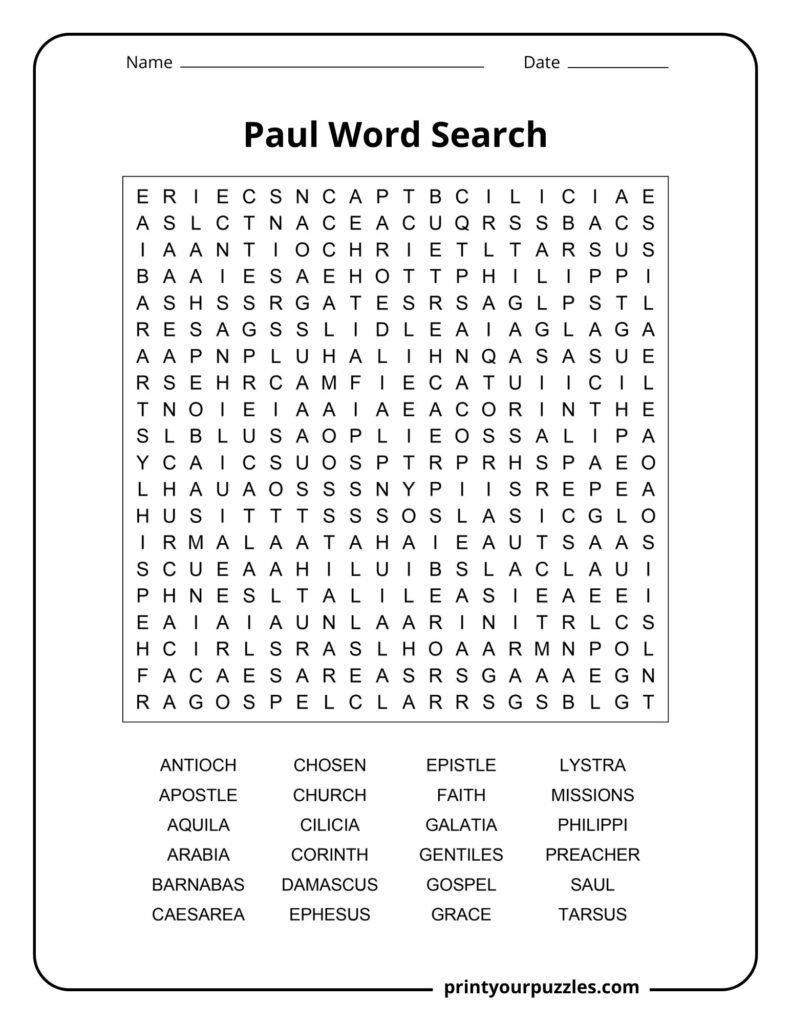
Hard Difficulty Word Search
Words to Find
ANTIOCH, APOSTLE, AQUILA, ARABIA, BARNABAS, CAESAREA, CHOSEN, CHURCH, CILICIA, CORINTH, DAMASCUS, EPHESUS, EPISTLE, FAITH, GALATIA, GENTILES, GOSPEL, GRACE, LYSTRA, MISSIONS, PHILIPPI, PREACHER, SAUL, TARSUS
6 Key FAQs About Paul the Apostle
5 Curious "Did You Know?" Facts About Paul the Apostle