
Topeka is a city where Kansas history, civil rights, prairie landscapes, and Midwestern culture come together. Located along the Kansas River, the state capital has long served as an important center for government, transportation, education, and community life, while its museums and historic sites reveal stories with national significance.
The city was founded in the 1850s during a turbulent period when Kansas was at the center of debates over slavery and statehood. Railroads later strengthened Topeka’s economy and connected it with cities across the Great Plains. Over time, the capital developed into an important regional center while maintaining strong ties to agriculture and the wider prairie landscape.
One of Topeka’s most significant attractions is the Brown v. Board of Education National Historical Park. The site preserves the former Monroe Elementary School and explains the landmark 1954 Supreme Court decision that declared racial segregation in public schools unconstitutional. Exhibits explore the families, teachers, lawyers, and communities involved in the struggle for educational equality.
For a broader look at the state, visitors can explore the Kansas Museum of History, where collections cover Indigenous cultures, pioneer settlement, railroads, agriculture, military history, and everyday life on the Plains. Another enjoyable stop is the Topeka Zoo, surrounded by Gage Park, where gardens, walking areas, and family attractions provide a more relaxed experience.
Art and performance have a visible place in the city as well. Local galleries, murals, theaters, music events, and community festivals add creative energy, while historic neighborhoods showcase architecture from different periods of Topeka’s development.
Food reflects the heartland character of Kansas. Barbecue, beef, burgers, fried chicken, homemade pies, corn-based dishes, and farm-fresh ingredients are common influences, alongside modern cafés and increasingly diverse international restaurants.
A Topeka word search can introduce readers to vocabulary connected with civil rights, railroads, prairie life, museums, art, and Kansas history. With nationally important historic sites, family attractions, and strong Midwestern traditions, Topeka offers much more depth than its quiet reputation might suggest.
Related Word Searches:
Kansas | Lincoln | Jefferson City | Oklahoma City | Denver
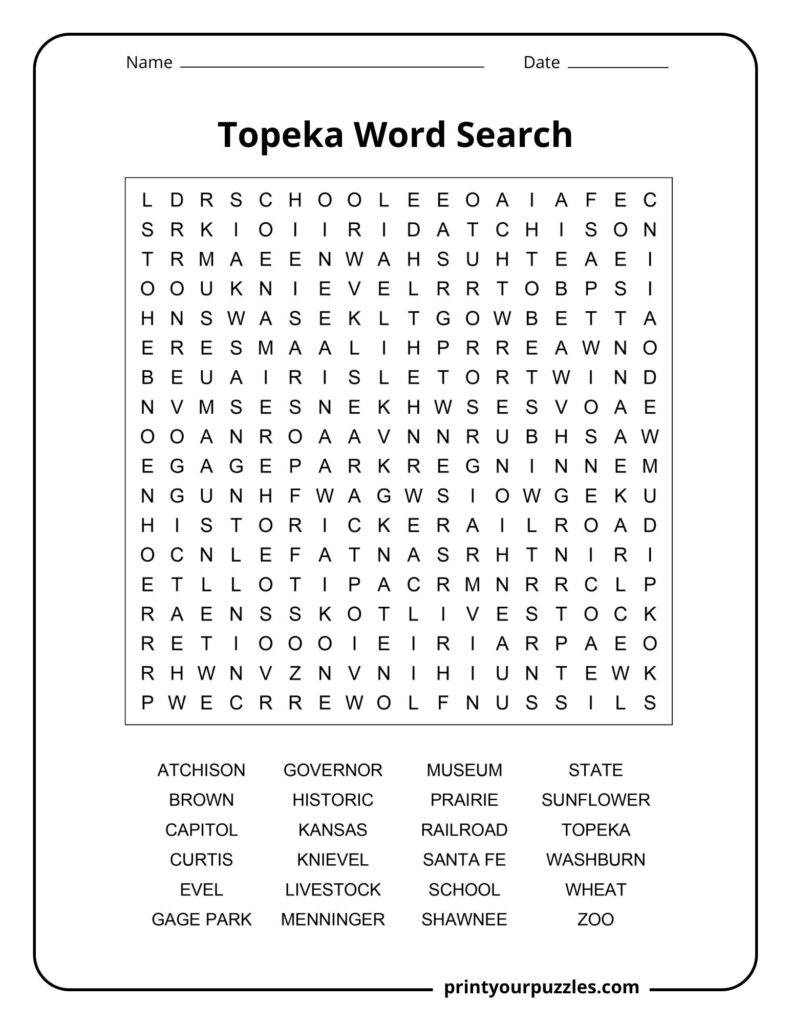
ATCHISON, BROWN, CAPITOL, CURTIS, EVEL, GAGE PARK, GOVERNOR, HISTORIC, KANSAS, KNIEVEL, LIVESTOCK, MENNINGER, MUSEUM, PRAIRIE, RAILROAD, SANTA FE, SCHOOL, SHAWNEE, STATE, SUNFLOWER, TOPEKA, WASHBURN, WHEAT, ZOO
ATCHISON – City in Kansas that was part of the historic Atchison, Topeka and Santa Fe Railway, one of America’s largest railroads that connected the Midwest to the Southwest and California.
BROWN – Refers to Brown v. Board of Education, the landmark 1954 Supreme Court case originating in Topeka that declared school segregation unconstitutional, transforming American civil rights history forever.
CAPITOL – The Kansas State Capitol building in Topeka, a stunning architectural landmark with a distinctive dome, serving as the center of state government operations and legislative activities since completion.
CURTIS – Charles Curtis was a Topeka native who became the first person with significant Native American ancestry to serve as U.S. Vice President under Herbert Hoover from 1929-1933.
EVEL – Evel Knievel, born Robert Craig Knievel in Butte, Montana but raised in Topeka, became America’s most famous motorcycle daredevil, performing death-defying stunts that captivated millions worldwide.
GAGE PARK – Gage Park is Topeka’s premier public park featuring the Topeka Zoo, beautiful gardens, mini-train rides, and recreational facilities spanning over 160 acres for community enjoyment and family activities.
GOVERNOR – Topeka serves as Kansas’s seat of executive power where the state governor resides and works, making important policy decisions and leading the state’s administrative functions and governmental operations.
HISTORIC – Topeka holds immense historical significance as the site of Brown v. Board of Education and as a vital railroad hub, preserving numerous landmarks that shaped American civil rights.
KANSAS – The state where Topeka serves as capital, known for wheat fields, prairies, agriculture, and its central location in the American heartland with rich pioneer and Native American heritage.
KNIEVEL – Robert “Evel” Knievel spent formative years in Topeka before becoming internationally famous for spectacular motorcycle jumps over buses, cars, and canyons, inspiring generations of extreme sports enthusiasts.
LIVESTOCK – Agriculture and livestock production form a crucial part of Topeka’s economy and Kansas heritage, with cattle ranching and meat processing being significant industries throughout the region’s history.
MENNINGER – The Menninger Clinic, founded by the Menninger family, was a world-renowned psychiatric treatment and research facility in Topeka that revolutionized mental health care and professional training internationally.
MUSEUM – Topeka houses several important museums including the Kansas Museum of History and Brown v. Board of Education National Historic Site, preserving and sharing vital state and national heritage stories.
PRAIRIE – The vast grassland ecosystem surrounding Topeka characterized by rolling hills, native grasses, and wildflowers, representing the natural landscape that pioneers encountered when settling the Kansas region.
RAILROAD – Topeka developed as a major railroad hub where the
Atchison, Topeka and Santa Fe Railway established operations, driving economic growth, population expansion, and connecting Kansas to national markets.
SANTA FE – Short for the Atchison, Topeka and Santa Fe Railway, this legendary railroad company headquartered in Topeka became one of America’s largest railroads, shaping Western expansion and commerce.
SCHOOL – Education is central to Topeka’s identity, most notably as the origin of Brown v. Board of Education, which ended legal school segregation and transformed American education forever.
SHAWNEE – Shawnee County surrounds Topeka, named after the Shawnee Native American tribe that historically inhabited the region, reflecting the area’s indigenous heritage and cultural roots before European settlement.
STATE – Topeka functions as Kansas’s state capital, housing government buildings, agencies, and the legislature where laws are created and state business is conducted, making it Kansas’s political center.
SUNFLOWER – Kansas’s official state flower, the wild sunflower blankets prairies around Topeka with golden blooms each summer, symbolizing the state’s agricultural heritage and natural beauty across endless plains.
TOPEKA – The capital city of Kansas since 1861, named from a Native American word meaning “a good place to dig potatoes,” serving as the state’s political, cultural, and historical center.
WASHBURN – Washburn University, founded in 1865, is Topeka’s prominent public university offering undergraduate and graduate education, including a respected law school, serving thousands of students throughout Kansas annually.
WHEAT – Kansas’s most iconic crop, wheat farming dominates the agricultural landscape around Topeka, earning Kansas the nickname “Wheat State” and making it America’s leading wheat-producing region historically.
ZOO – The Topeka Zoo, located in Gage Park, provides family entertainment and education through animal exhibits, conservation programs, and interactive experiences showcasing wildlife from around the world.
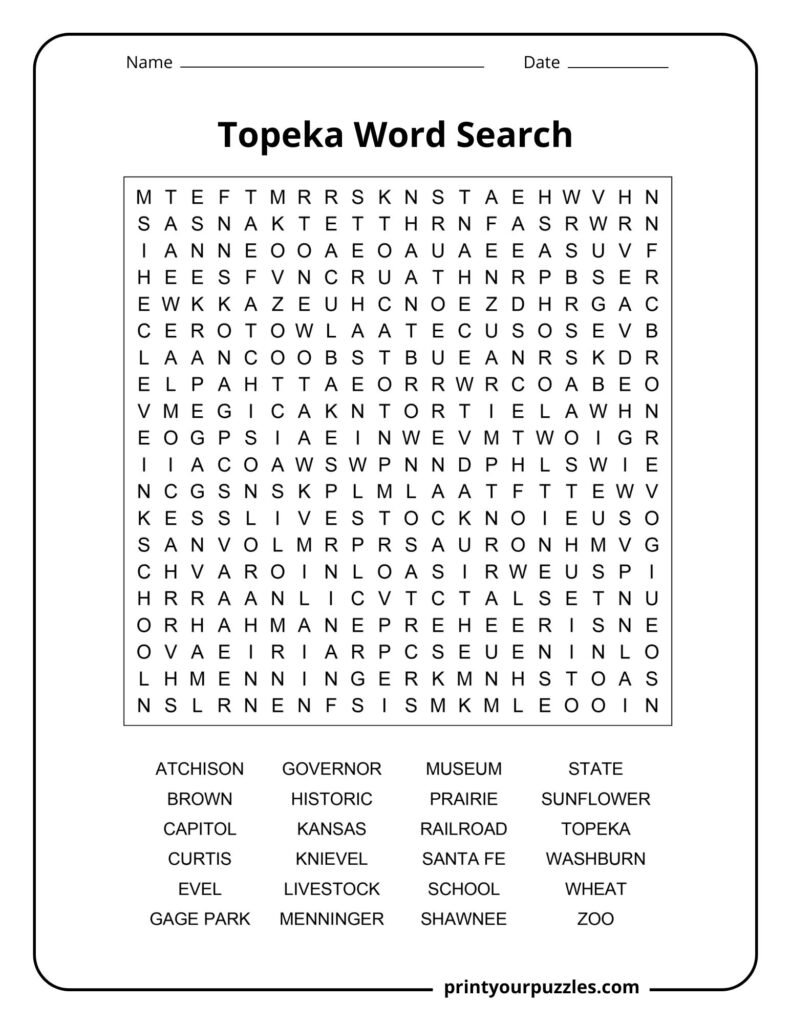
ATCHISON, BROWN, CAPITOL, CURTIS, EVEL, GAGE PARK, GOVERNOR, HISTORIC, KANSAS, KNIEVEL, LIVESTOCK, MENNINGER, MUSEUM, PRAIRIE, RAILROAD, SANTA FE, SCHOOL, SHAWNEE, STATE, SUNFLOWER, TOPEKA, WASHBURN, WHEAT, ZOO
Topeka is most famous as the origin of Brown v. Board of Education, the landmark 1954 Supreme Court case that ended legal school segregation in America and transformed civil rights history nationwide.
Topeka has approximately 125,000 residents in the city proper, with around 230,000 people in the greater metropolitan area, making it Kansas’s fourth-largest city and its governmental center.
Top attractions include the Kansas State Capitol with its magnificent dome, Brown v. Board of Education National Historic Site, Topeka Zoo, Gage Park, and the Kansas Museum of History.
Topeka became Kansas’s capital in 1861 when Kansas achieved statehood. The city’s central location, growing population, and strong political advocacy helped secure its selection over competing cities like Lawrence.
Topeka’s economy relies heavily on state government employment, healthcare services including major hospitals, education through Washburn University, distribution centers, and manufacturing facilities serving the regional agricultural industry.
For official city information, government updates, and public services, visit the City of Topeka website. If you are planning a trip, check out the official tourism portal, Visit Topeka.
The city nicknamed itself after the Pokémon character to celebrate the franchise’s U.S. launch, creating a worldwide media sensation and attracting thousands of fans to Kansas’s capital.
The city was established by Free-State advocates during the “Bleeding Kansas” era, determined to make Kansas a free state rather than allowing slavery, shaping its progressive historical legacy.
The legendary motorcycle stuntman spent part of his youth in Topeka, where his early risk-taking tendencies began developing before he became America’s most famous daredevil performer.
The Kansas State Capitol took 37 years to build initially, but its iconic copper dome remained incomplete for decades until a major restoration finally finished it after 120 years.
Founded in 1925, the Menninger Foundation revolutionized mental health care worldwide, training thousands of psychiatrists and psychologists while making Topeka an unexpected international psychiatric center.