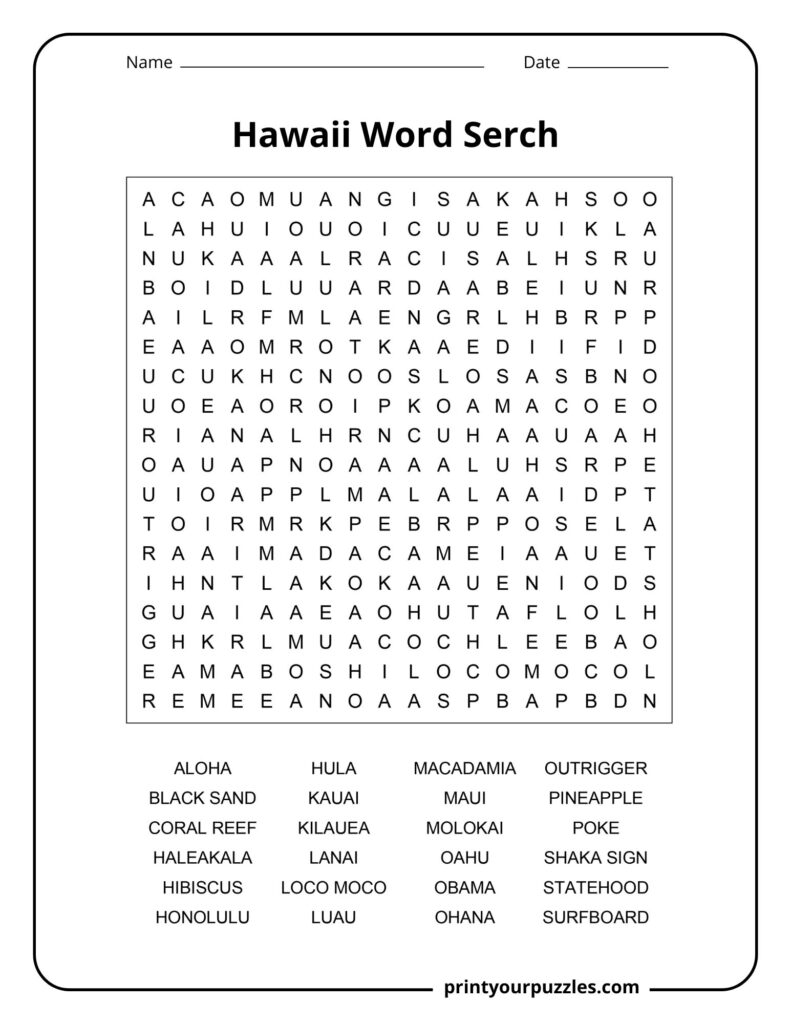
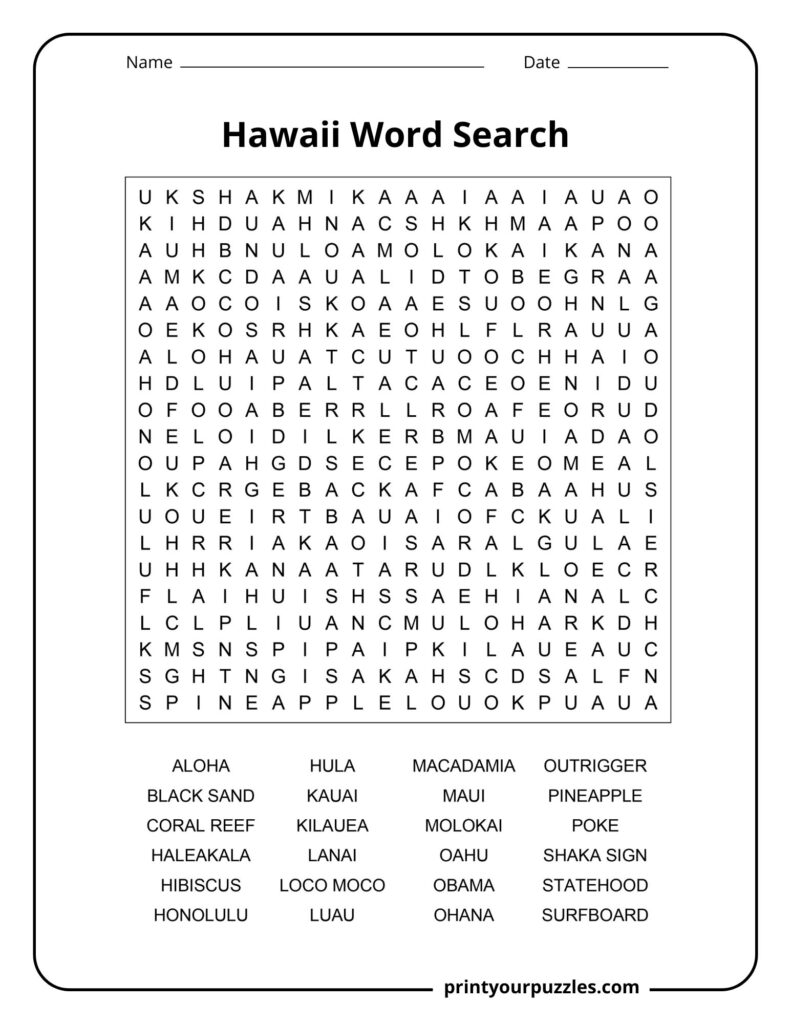
Far out in the Pacific Ocean, Hawaii rises from the sea as a chain of volcanic islands with a culture and landscape unlike any other state. It is the only U.S. state made entirely of islands, the only one located outside North America, and one of the most recognizable places in the world. Honolulu, on the island of Oʻahu, is both the capital and largest city. This Hawaii word search gives students and puzzle lovers a fun way to explore the people, places, and natural wonders that make the state so unique.
Hawaii’s geography begins with volcanoes. Over millions of years, volcanic activity created islands with black-sand beaches, green valleys, lava fields, waterfalls, coral reefs, and dramatic coastal cliffs. Mauna Loa and Kīlauea are among the most famous volcanoes in the state, while Haleakalā on Maui offers unforgettable views above the clouds. Because Hawaii is surrounded by ocean, marine life is also central to its identity. Sea turtles, humpback whales, monk seals, colorful reef fish, and dolphins all help make the islands a remarkable place to learn about nature.
Long before Hawaii became the 50th state in 1959, Native Hawaiian culture shaped life across the islands. Traditions connected to language, hula, music, navigation, storytelling, and respect for the land and ocean remain deeply important today. Hawaii’s history also includes Polynesian voyaging, royal kingdoms, plantation communities, immigration from Asia and other parts of the world, and the attack on Pearl Harbor in 1941, which changed the course of World War II.
Food is another wonderful way to understand Hawaii’s mix of cultures. Dishes such as poke, poi, kalua pork, laulau, shave ice, malasadas, and plate lunches reflect Native Hawaiian, Portuguese, Japanese, Filipino, Korean, Chinese, and American influences. These flavors help show how Hawaii became a meeting place of many traditions.
Hawaii is famous for beaches and vacations, but it is much more than a tropical postcard. It is a state of volcanoes, ocean ecosystems, living traditions, historic events, and extraordinary natural beauty. As you complete this free printable Hawaii word search, look for words that connect to its islands, wildlife, culture, foods, and history. Each hidden word offers another way to discover why Hawaii stands apart from every other state.
From one Pacific State to another, keep exploring with our Alaska word search, California word search, Oregon word search, and the full US States Word Searches collection.
ALOHA – Hawaiian word meaning hello, goodbye, and love, embodying the spirit of compassion, warmth, and mutual respect that defines Hawaiian culture and hospitality towards others and nature.
BLACK SAND – Volcanic beaches formed from lava fragments and basalt, creating distinctive dark shorelines. Found on Hawaii’s Big Island, these beaches showcase the islands’ volcanic origins and geological activity.
CORAL REEF – Underwater ecosystems formed by colonies of tiny marine animals. Hawaii’s reefs support diverse marine life, protect coastlines from erosion, and provide vital habitats for tropical fish species.
HALEAKALA – Massive dormant volcano on Maui meaning “House of the Sun.” Rising over 10,000 feet, it features a moonlike crater landscape and hosts rare native species in its national park.
HIBISCUS – Hawaii’s official state flower, this tropical plant produces large, colorful blooms in shades of red, yellow, pink, and white, symbolizing beauty and welcoming visitors to the islands.
HONOLULU – State capital and largest city located on Oahu island. Home to Waikiki Beach, Pearl Harbor, and major cultural institutions, serving as Hawaii’s economic and political center with diverse populations.
HULA – Traditional Hawaiian dance combining rhythmic movements, chants, and storytelling. This sacred art form preserves ancient legends, genealogies, and cultural knowledge through graceful gestures and precise choreography.
KAUAI – The “Garden Isle,” Hawaii’s fourth largest and oldest main island. Known for dramatic cliffs, lush rainforests, Waimea Canyon, and pristine beaches featured in numerous Hollywood films.
KILAUEA – One of the world’s most active volcanoes located on the Big Island. Its continuous eruptions shape the landscape, creating new land and attracting scientists and tourists to witness nature’s power.
LANAI – Small Hawaiian island once dominated by pineapple plantations. Now features luxury resorts, dramatic sea cliffs, and remote beaches, offering secluded experiences away from crowded tourist destinations across Hawaii.
LOCO MOCO – Hawaiian comfort food dish featuring white rice topped with hamburger patty, fried egg, and brown gravy. This hearty meal originated in Hilo and represents Hawaii’s multicultural fusion cuisine.
LUAU – Traditional Hawaiian feast featuring roasted pig, poi, and entertainment. These celebrations showcase native culture through hula dancing, music, and communal dining, welcoming guests with authentic island hospitality.
MACADAMIA – Buttery, rich nuts grown extensively in Hawaii since the 1880s. These premium nuts are used in cookies, candies, and local cuisine, representing an important agricultural export product.
MAUI – Hawaii’s second largest island, called the “Valley Isle.” Famous for Haleakala volcano, scenic Road to Hana, world-class beaches, whale watching, and charming historic towns like Lahaina.
MOLOKAI – Known as the “Friendly Isle,” this fifth largest Hawaiian island maintains traditional lifestyles and resists overdevelopment. Features dramatic sea cliffs, historic leper colony, and authentic rural Hawaiian character.
OAHU – Hawaii’s third largest island and most populated, housing state capital Honolulu. Combines urban sophistication with natural beauty, featuring famous Waikiki Beach, North Shore surfing, and Pearl Harbor.
OBAMA – Barack Obama, 44th President of the United States, born in Honolulu in 1961. First African American president, he maintains strong ties to Hawaii, returning frequently to his birthplace for family vacations.
OHANA – Hawaiian word meaning family, including blood relatives and chosen family. This concept emphasizes interconnectedness, loyalty, and mutual support, representing core values in Hawaiian culture and community bonds.
OUTRIGGER – Traditional Polynesian canoe with lateral support floats providing stability. These vessels enabled ancient Hawaiians to navigate Pacific waters and remain important for cultural practices and ocean recreation today.
PINEAPPLE – Tropical fruit that became Hawaii’s major agricultural export during the plantation era. Though production declined, pineapples remain iconic symbols associated with Hawaiian hospitality, tourism, and tropical paradise imagery.
POKE – Hawaiian raw fish salad typically using ahi tuna marinated with soy sauce, sesame oil, and seaweed. This traditional dish has gained worldwide popularity representing Hawaii’s fresh seafood culture.
SHAKA SIGN – Hand gesture with thumb and pinky extended, embodying Hawaii’s laid-back spirit. Used to convey friendship, gratitude, solidarity, or simply “hang loose,” this symbol represents island lifestyle worldwide.
STATEHOOD – Hawaii became the 50th US state on August 21, 1959, after years as a territory. This milestone transformed the islands politically, economically, and culturally, integrating them fully into America.
SURFBOARD – Essential equipment for riding ocean waves, deeply rooted in Hawaiian culture. Ancient Hawaiians pioneered surfing as spiritual practice; modern boards continue this tradition, attracting surfers globally to Hawaiian shores.