Introduction to the Honolulu Word Search
Honolulu is a capital where city life unfolds beside the Pacific Ocean. Framed by volcanic ridges, beaches, and tropical vegetation, Hawaii’s capital combines Native Hawaiian heritage, Asian and Pacific influences, modern neighborhoods, historic landmarks, art, and some of the most recognizable coastal scenery in the United States.
Long before Honolulu became a modern city, Native Hawaiians lived throughout Oahu and developed sophisticated communities connected to fishing, agriculture, navigation, and the land. During the nineteenth century, Honolulu grew into the political and commercial center of the Hawaiian Kingdom. Its protected harbor encouraged trade across the Pacific, while merchants, immigrants, missionaries, and sailors brought new influences that gradually shaped the city’s multicultural identity.
One of the most meaningful places to visit is Iolani Palace, the former royal residence of Hawaii’s monarchs and the only royal palace in the United States. Its rooms and collections offer insight into the Hawaiian Kingdom and the lives of King Kalakaua and Queen Liliuokalani. Visitors can also explore the Bishop Museum, which preserves extensive collections related to Hawaiian history, Polynesian cultures, natural science, and traditional artifacts.
Honolulu’s artistic life reflects its position between cultures. The Honolulu Museum of Art presents Asian, European, American, and Pacific works, while local galleries, murals, music, hula, and craft traditions add a distinctly Hawaiian character. Traditional and contemporary forms often appear side by side.
Food is just as diverse. Poke, kalua pork, plate lunches, shave ice, fresh tropical fruit, malasadas, and seafood are among the flavors associated with Honolulu. Japanese, Filipino, Chinese, Korean, Portuguese, and other influences have also become deeply woven into local cuisine.
Outdoor experiences are impossible to separate from the city. Visitors can walk along Waikiki Beach, swim or surf in warm Pacific waters, or hike to the summit of Diamond Head for panoramic views over Honolulu and the coast. These activities reveal how closely urban life remains connected to Hawaii’s natural landscape.
A printable Honolulu word search puzzle can introduce readers to vocabulary connected with Hawaiian royalty, Polynesian culture, beaches, art, food, and volcanic scenery. Few state capitals combine history, multicultural traditions, and spectacular outdoor experiences as naturally as Honolulu.
Related Word Searches:
Hawaii | Sacramento | Salem | Olympia | Carson City
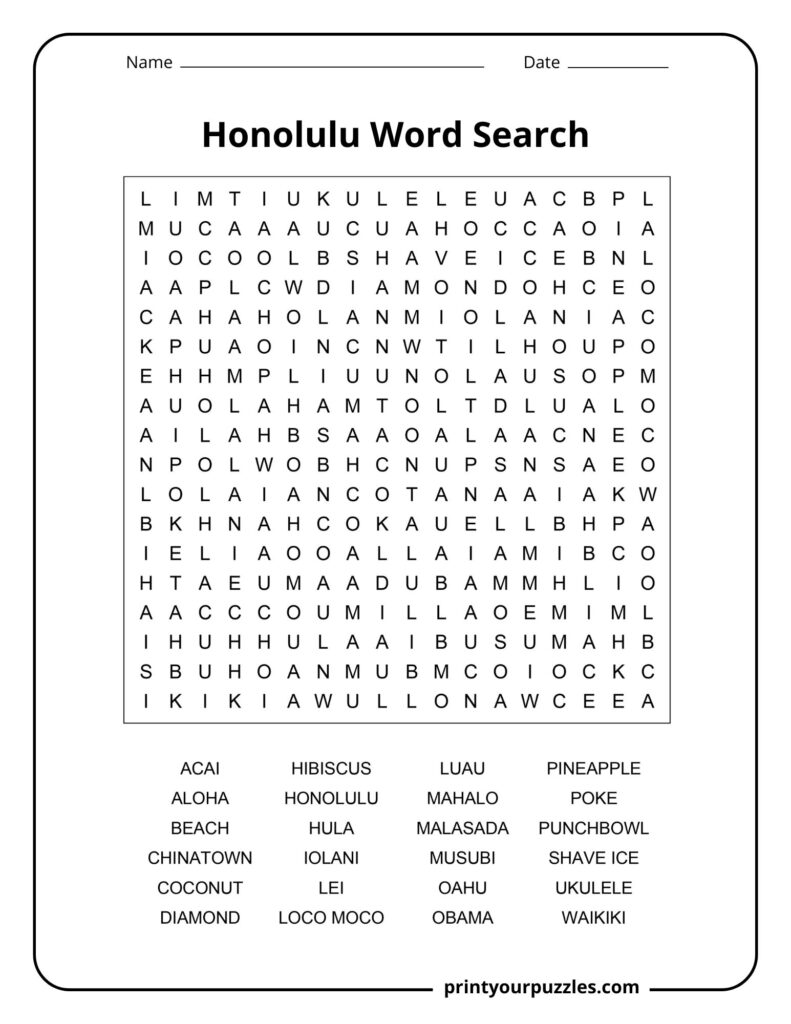
Medium Difficulty Word Search
Words to Find:
ACAI, ALOHA, BEACH, CHINATOWN, COCONUT, DIAMOND, HIBISCUS, HONOLULU, HULA, IOLANI, LEI, LOCO MOCO, LUAU, MAHALO, MALASADA, MUSUBI, OAHU, OBAMA, PINEAPPLE, POKE, PUNCHBOWL, SHAVE ICE, UKULELE, WAIKIKI
All Words Defined
ACAI – A superfood berry from the Amazon, popular in Honolulu’s health-conscious food scene, often served in smoothie bowls topped with fresh tropical fruit and granola.
ALOHA – Hawaiian word meaning hello, goodbye, and love. Represents the spirit of warmth, compassion, and hospitality that defines Hawaiian culture and Honolulu’s welcoming atmosphere toward visitors and locals.
BEACH – Honolulu features world-famous beaches with white sand, turquoise waters, and ideal surfing conditions. Beaches are central to the city’s tourism industry, recreation, and outdoor lifestyle.
CHINATOWN – Historic neighborhood in downtown Honolulu established in the 1860s. Features Asian markets, herbal shops, art galleries, restaurants, and lei stands, reflecting the city’s multicultural heritage and immigrant history.
COCONUT – Tropical palm tree fruit abundant in Hawaii. Used in Hawaiian cuisine, drinks, and crafts. Coconut palms line Honolulu’s beaches, symbolizing the island’s tropical paradise aesthetic.
DIAMOND – Refers to Diamond Head, an iconic volcanic crater and state monument overlooking Waikiki. A popular hiking destination offering panoramic views of Honolulu and the Pacific Ocean coastline.
HIBISCUS – Hawaii’s official state flower, this colorful tropical bloom is ubiquitous throughout Honolulu. Often worn behind the ear or used in leis, symbolizing beauty and island hospitality.
HONOLULU – Hawaii’s state capital and largest city, located on Oahu’s south shore. Home to nearly one million residents, blending Polynesian culture with modern urban development and tourism.
HULA – Traditional Hawaiian dance form telling stories through graceful hand movements and hip motions. Performed at cultural events and luaus throughout Honolulu, preserving ancient Hawaiian traditions.
IOLANI – Iolani Palace served as the royal residence for Hawaiian monarchy until 1893. Located in downtown Honolulu, it’s America’s only official royal palace and important historical landmark.
LEI – Traditional Hawaiian garland made from flowers, leaves, shells, or nuts. Given as symbols of affection, celebration, and aloha spirit at arrivals, departures, and special occasions.
LOCO MOCO – Iconic Hawaiian comfort food featuring white rice topped with hamburger patty, fried egg, and brown gravy. Originated in Hilo but beloved throughout Honolulu’s local restaurants.
LUAU – Traditional Hawaiian feast featuring kalua pig, poi, and entertainment including hula dancing and fire performances. Popular tourist experience showcasing Hawaiian culture and hospitality in Honolulu.
MAHALO – Hawaiian word meaning “thank you.” Commonly heard throughout Honolulu, reflecting the culture of gratitude and respect central to Hawaiian values and everyday interactions with others.
MALASADA – Portuguese fried dough pastry without a hole, coated in sugar. Brought by Portuguese immigrants, now a beloved local treat sold at bakeries throughout Honolulu, especially Leonard’s.
MUSUBI – Popular Hawaiian snack featuring grilled spam atop rice, wrapped in nori seaweed. Reflects Hawaii’s Asian influences and unique local cuisine, available at convenience stores throughout Honolulu.
OAHU – The Hawaiian island where Honolulu is located. Known as “The Gathering Place,” it’s Hawaii’s most populated island, combining urban development with stunning natural beauty.
OBAMA – Barack Obama, 44th U.S. President, was born in Honolulu in 1961. His childhood home and Punahou School roots connect him to the city’s multicultural identity.
PINEAPPLE – Though not native, pineapples became synonymous with Hawaii through plantation agriculture. The Dole Plantation near Honolulu celebrates this sweet fruit’s history and Hawaiian agricultural legacy.
POKE – Traditional Hawaiian dish of cubed raw fish seasoned with soy sauce, sesame oil, and sea salt. A staple of local cuisine found in markets throughout Honolulu.
PUNCHBOWL – National Memorial Cemetery of the Pacific, located in an extinct volcanic crater. Honors military personnel who served in the Pacific theater, overlooking downtown Honolulu with solemn beauty.
SHAVE ICE – Hawaiian frozen dessert featuring finely shaved ice topped with colorful fruit syrups. Often includes condensed milk and ice cream, popular at Honolulu beaches during hot weather.
UKULELE – Small four-stringed guitar-like instrument central to Hawaiian music. Portuguese immigrants introduced it to Hawaii; Honolulu remains a hub for ukulele culture and manufacturing.
WAIKIKI – Famous beach neighborhood in Honolulu, featuring hotels, restaurants, and shopping. Known worldwide for surfing, sunbathing, and Diamond Head views, Hawaii’s primary tourist destination.
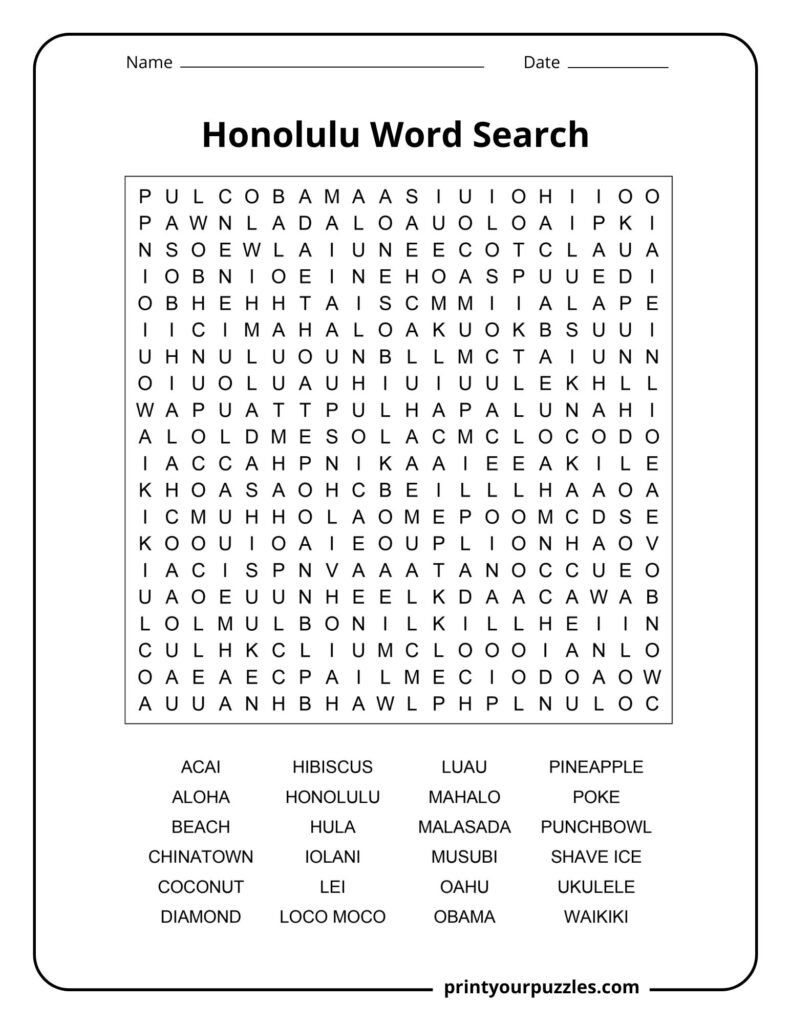
Hard Difficulty Word Search
Words to Find:
ACAI, ALOHA, BEACH, CHINATOWN, COCONUT, DIAMOND, HIBISCUS, HONOLULU, HULA, IOLANI, LEI, LOCO MOCO, LUAU, MAHALO, MALASADA, MUSUBI, OAHU, OBAMA, PINEAPPLE, POKE, PUNCHBOWL, SHAVE ICE, UKULELE, WAIKIKI
6 Key FAQs About Honolulu
5 Curious "Did You Know?" Facts About Honolulu