
Maryland is a small state with a surprisingly large variety of landscapes, traditions, and historical connections. Located in the Southeast, it sits along the Chesapeake Bay and touches the Appalachian region, the Atlantic coastal plain, and the busy corridor between Washington, D.C., and Baltimore. Annapolis is the capital, while Baltimore is the largest city. Known as The Old Line State, Maryland has long played an important role in American history, transportation, science, and culture.
The Chesapeake Bay is at the heart of Maryland’s identity. Its waters, rivers, wetlands, and shoreline communities have shaped the state for centuries, supporting fishing, boating, trade, wildlife, and local food traditions. Blue crabs are especially famous in Maryland, often steamed with seasoning and shared at family gatherings, restaurants, and summer crab feasts. Oysters, rockfish, and other seafood also connect the state’s cuisine to the bay.
A Maryland word search can help students and puzzle lovers explore a state filled with important places and symbols. Indigenous peoples lived in the region long before European settlement, and Maryland later became one of the original thirteen colonies. During the War of 1812, the defense of Fort McHenry in Baltimore inspired the poem that became “The Star-Spangled Banner,” the national anthem of the United States.
Maryland’s geography changes quickly from east to west. The Eastern Shore is known for farms, marshes, small towns, and coastal communities. Central Maryland includes Baltimore, Annapolis, and many historic sites. Farther west, the land rises into forests, mountains, lakes, and scenic areas near the Appalachian region. This variety makes Maryland feel much larger than it looks on the map.
Today, Maryland’s economy includes government, healthcare, biotechnology, education, cybersecurity, shipping, tourism, agriculture, and research. Its location near Washington, D.C., gives it a strong connection to national institutions, while Baltimore’s harbor continues to reflect the state’s maritime history. From Chesapeake Bay bridges to colonial streets, from crab houses to historic forts, Maryland offers a rich mix of nature and heritage. As you complete this free printable Maryland word search, look for words connected to its waters, history, cities, foods, wildlife, and coastal traditions.
Keep moving through the Southeast States with our Virginia word search, Delaware word search, Pennsylvania word search, and the full US States Word Searches collection.
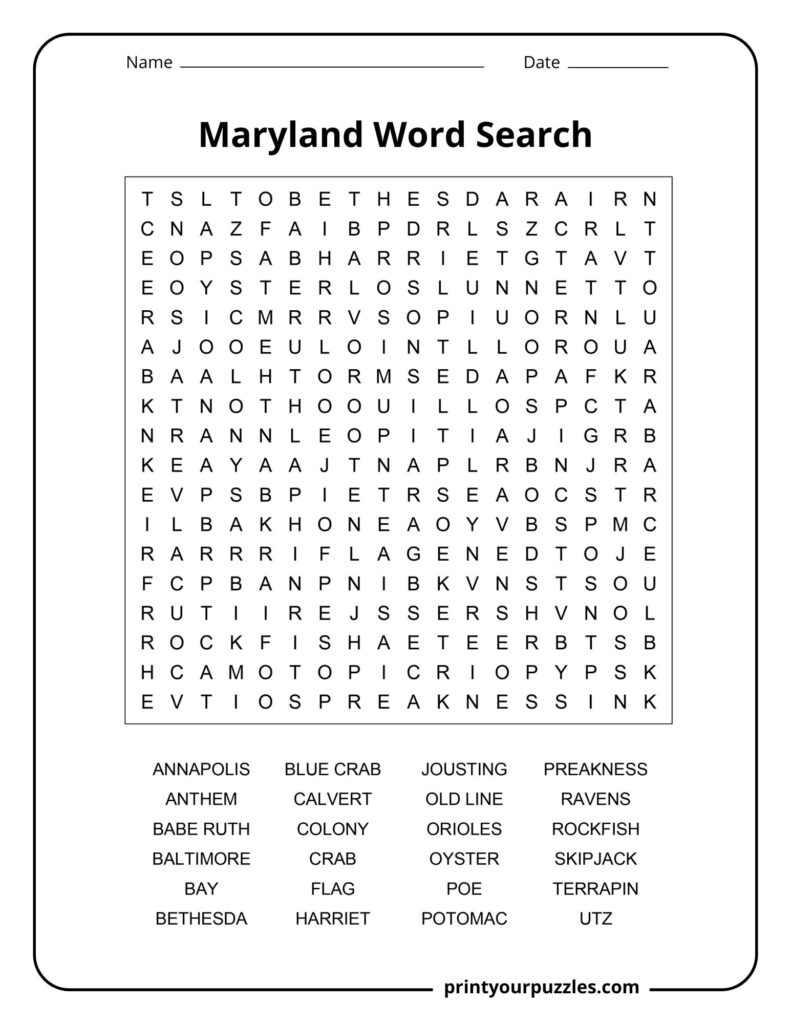
ANNAPOLIS, ANTHEM, BABE RUTH, BALTIMORE, BAY, BETHESDA, BLUE CRAB, CALVERT, COLONY, CRAB, FLAG, HARRIET, JOUSTING, OLD LINE, ORIOLES, OYSTER, POE, POTOMAC, PREAKNESS, RAVENS, ROCKFISH, SKIPJACK, TERRAPIN, UTZ
ANNAPOLIS – Maryland’s capital city since 1694, home to the U.S. Naval Academy, featuring historic colonial architecture and serving as a major sailing hub on the Chesapeake Bay.
ANTHEM – Refers to “The Star-Spangled Banner,” America’s national anthem written by Francis Scott Key in Baltimore during the War of 1812 after witnessing Fort McHenry’s bombardment.
BABE RUTH – George Herman Ruth Jr., legendary baseball player born in Baltimore in 1895, became one of the greatest athletes in American sports history with 714 home runs.
BALTIMORE – Maryland’s largest city and major seaport, known for its historic Inner Harbor, vibrant neighborhoods, Johns Hopkins institutions, and rich cultural heritage including diverse ethnic communities.
BAY – The Chesapeake Bay, America’s largest estuary, defines Maryland’s geography and economy, providing seafood, recreation, and serving as a vital ecological and commercial waterway.
BETHESDA – Affluent Montgomery County city near Washington D.C., home to the National Institutes of Health, Walter Reed Medical Center, and numerous biotechnology and research companies.
BLUE CRAB – Callinectes sapidus, Maryland’s official state crustacean, is the foundation of local cuisine and culture, harvested from the Chesapeake Bay and prepared steamed with Old Bay.
CALVERT – Lord Baltimore, Cecil Calvert, founded Maryland as a proprietary colony in 1634, establishing it as a haven for religious tolerance, particularly for Catholics.
COLONY – Maryland was one of the original thirteen British colonies, founded in 1634, known for its religious tolerance and tobacco-based economy before becoming a state.
CRAB – Blue crabs are Maryland’s culinary icon, harvested from the Chesapeake Bay and served steamed, in crab cakes, or as soft-shell crabs in restaurants throughout the state.
FLAG – Maryland’s distinctive flag features the Calvert and Crossland family coats of arms in bold black, gold, red, and white, officially adopted in 1904 and widely displayed.
HARRIET – Harriet Tubman, born enslaved in Dorchester County around 1822, escaped and became a legendary Underground Railroad conductor, helping hundreds reach freedom before the Civil War.
JOUSTING – Maryland’s official state sport since 1962, this medieval horseback competition involves riders spearing small rings with lances at full gallop, preserving a unique centuries-old tradition.
OLD LINE – Maryland’s nickname “Old Line State” honors the Maryland Line, regular troops who served courageously in the Continental Army during the Revolutionary War, praised by Washington.
ORIOLES – Baltimore’s Major League Baseball team since 1954, named after Maryland’s state bird, plays at Camden Yards and has won three World Series championships.
OYSTER – Chesapeake Bay oysters are a Maryland delicacy and ecological keystone species, harvested for centuries and served raw, fried, or in traditional stews throughout the region.
POE – Edgar Allan Poe, master of macabre literature, lived in Baltimore where he died mysteriously in 1849 and is buried at Westminster Hall, inspiring gothic tourism.
POTOMAC – The Potomac River forms Maryland’s southern and western border with Virginia and West Virginia, flowing through history as a major transportation route to Washington D.C.
PREAKNESS – The second jewel of horse racing’s Triple Crown, held annually at Baltimore’s Pimlico Race Course since 1873, featuring the traditional painting of weather vanes.
RAVENS – Baltimore’s NFL team since 1996, named through fan contest after Poe’s famous poem, has won two Super Bowl championships and plays at M&T Bank Stadium.
ROCKFISH – Striped bass, Maryland’s official state fish, is a prized game and food fish found in the Chesapeake Bay, supporting commercial and recreational fishing industries.
SKIPJACK – Traditional Chesapeake Bay sailing vessel and Maryland’s state boat, characterized by its V-shaped bottom and raked masts, historically used for oyster dredging throughout the bay.
TERRAPIN – The diamondback terrapin is Maryland’s state reptile and the University of Maryland’s mascot, a unique turtle species inhabiting Chesapeake Bay’s brackish marshes.
UTZ – Iconic Maryland snack food brand founded in Hanover in 1921, famous for its potato chips and crab-flavored snacks, now distributed nationally from its headquarters.
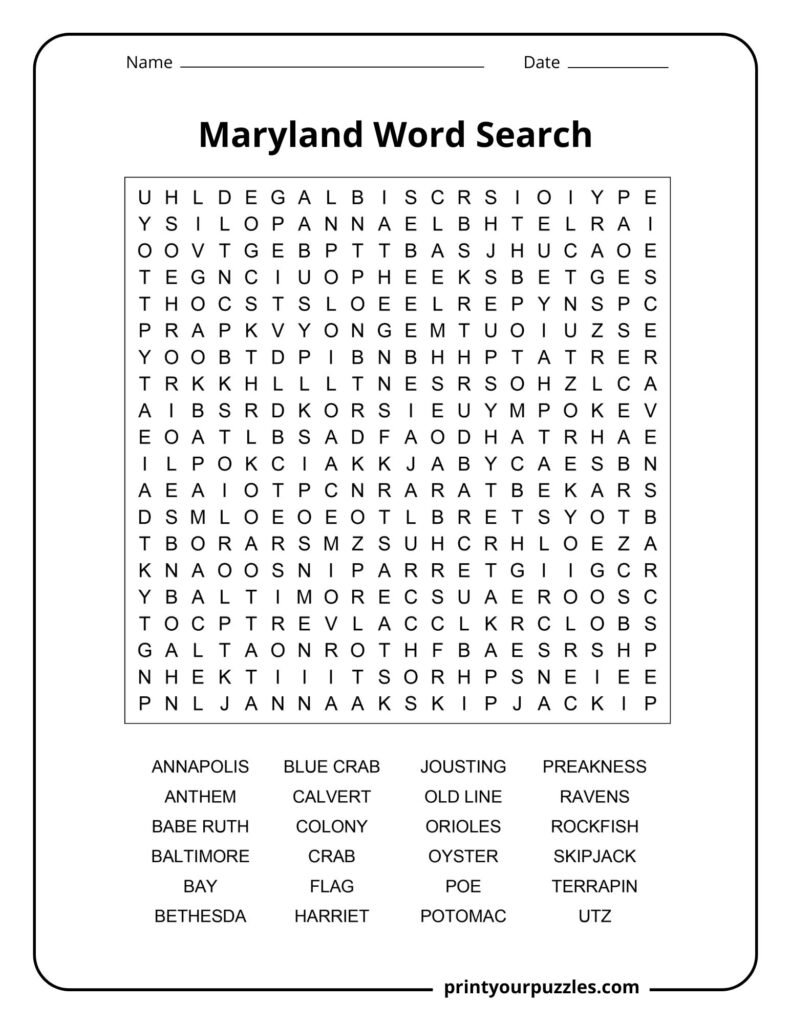
ANNAPOLIS, ANTHEM, BABE RUTH, BALTIMORE, BAY, BETHESDA, BLUE CRAB, CALVERT, COLONY, CRAB, FLAG, HARRIET, JOUSTING, OLD LINE, ORIOLES, OYSTER, POE, POTOMAC, PREAKNESS, RAVENS, ROCKFISH, SKIPJACK, TERRAPIN, UTZ
Maryland is famous for blue crabs and Chesapeake Bay seafood, its role in American history, the Star-Spangled Banner’s birthplace in Baltimore, and being home to the U.S. Naval Academy in Annapolis.
Annapolis is Maryland’s capital city, established in 1694. It houses the state government, the historic U.S. Naval Academy, and features beautifully preserved colonial architecture along the scenic Chesapeake Bay waterfront.
The nickname honors the Maryland Line, brave Continental Army troops who fought heroically during the Revolutionary War. General George Washington praised their courage, particularly at the Battle of Long Island in 1776.
Maryland is renowned for blue crab prepared with Old Bay seasoning, crab cakes, oysters, rockfish (striped bass), Smith Island cake (the state dessert), and Berger cookies—a Baltimore chocolate-topped shortbread treat.
Maryland was founded in 1634 by Cecil Calvert, Lord Baltimore, as a proprietary colony. It became a haven for religious tolerance, particularly for Catholics, and was one of America’s original thirteen colonies.
For official state records and government services, visit the Maryland State Portal. If you are planning a trip, check out Visit Maryland.
Since 1962, Maryland has recognized jousting—medieval horseback lance competition—as its official sport. Riders gallop at full speed attempting to spear small rings, continuing a tradition dating back centuries.
Despite abundant water from the Chesapeake Bay and numerous rivers, Maryland contains no natural lakes. Deep Creek Lake, the state’s largest lake, is actually a man-made reservoir created in 1925.
The mysterious Ouija board was patented in Baltimore in 1890 by Elijah Bond. The city even has an Ouija board gravestone marking the inventor’s contribution at Green Mount Cemetery.
Near Hancock, Maryland narrows to just 1.8 miles wide between Pennsylvania and West Virginia, making it the thinnest point of any U.S. state—you could walk across in thirty minutes.
The Baltimore College of Dental Surgery, established in 1840, was the world’s first dental school. It revolutionized dentistry as a formal profession, setting standards for dental education worldwide.