

Dive into the fascinating world of science with this engaging Physics word search! This educational puzzle features 24 carefully selected terms that cover fundamental concepts in physics, from atomic particles to energy principles. Whether you’re a student looking to reinforce classroom learning or simply someone who enjoys scientific challenges, this word search printable offers an entertaining way to explore physics vocabulary.
Each term included in this Physics word search printable has been chosen to represent key areas of physics study, including mechanics, electricity, waves, and matter. The puzzle contains words ranging from simple three-letter terms to more complex nine-letter concepts, providing a balanced challenge for learners at various levels. To enhance your learning experience, comprehensive definitions accompany each word, with clear explanations ranging from 20 to 30 words that clarify the meaning and significance of every term.
This combination of puzzle-solving fun and educational content makes it an ideal resource for classrooms, homeschooling, independent study, or anyone curious about the fundamental laws governing our physical universe. All words to search are thoroughly defined to maximize your learning opportunity.
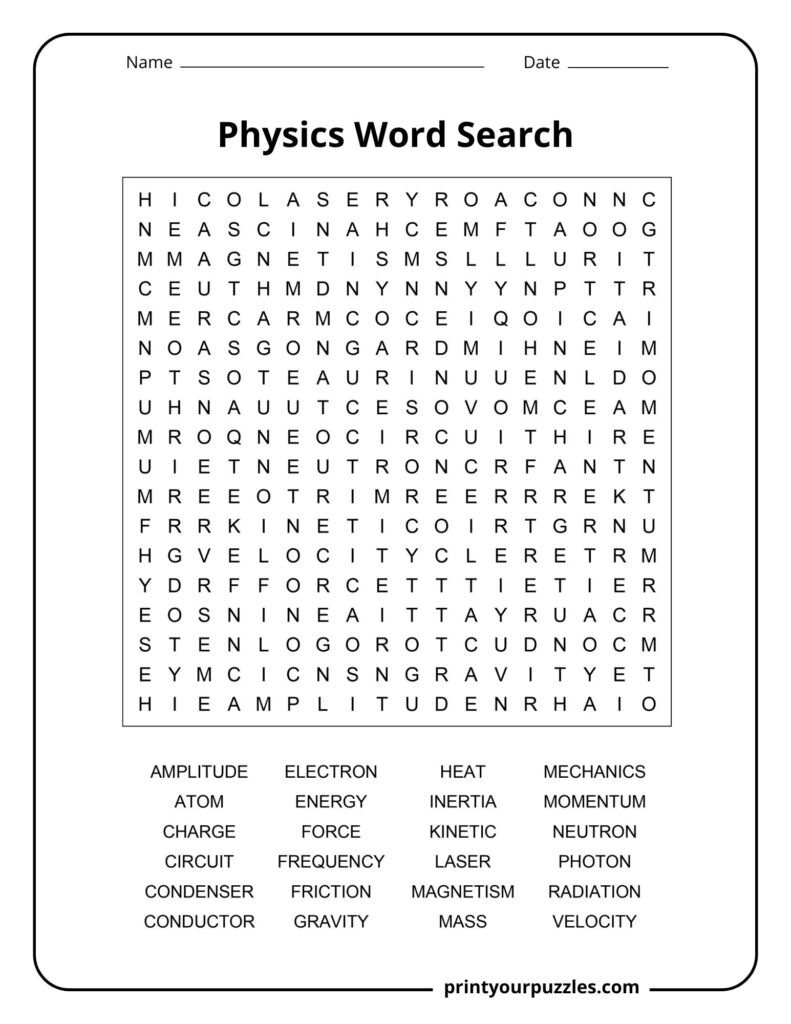
AMPLITUDE, ATOM, CHARGE, CIRCUIT, CONDENSER, CONDUCTOR, ELECTRON, ENERGY, FORCE, FREQUENCY, FRICTION, GRAVITY, HEAT, INERTIA, KINETIC, LASER, MAGNETISM, MASS, MECHANICS, MOMENTUM, NEUTRON, PHOTON, RADIATION, VELOCITY
AMPLITUDE – The maximum displacement or distance moved by a point on a vibrating body or wave measured from its equilibrium position, indicating the wave’s strength or intensity.
ATOM – The smallest unit of matter that retains the properties of an element, consisting of a nucleus containing protons and neutrons, surrounded by electrons in orbital shells.
CHARGE – A fundamental property of matter that causes it to experience electromagnetic force. It exists in two types: positive and negative, with like charges repelling and opposite charges attracting.
CIRCUIT – A closed loop pathway through which electric current flows, consisting of a power source, conductors, and typically various components like resistors, capacitors, or switches for controlling electricity.
CONDENSER – A device that stores electrical energy in an electric field, also known as a capacitor, consisting of two conductors separated by an insulating material called a dielectric.
CONDUCTOR – A material that allows electric current or heat to flow through it easily due to the free movement of electrons, such as metals like copper, silver, and aluminum.
ELECTRON – A subatomic particle with negative electric charge that orbits the nucleus of an atom, responsible for chemical bonding, electricity, and magnetism in matter and fundamental to atomic structure.
ENERGY – The capacity to do work or cause change in a system, existing in various forms including kinetic, potential, thermal, electrical, and chemical, and governed by conservation laws.
FORCE – A push or pull acting upon an object, causing it to accelerate, decelerate, or change direction. Measured in newtons, force equals mass times acceleration according to
Newton’s law.
FREQUENCY – The number of complete wave cycles or oscillations that occur per unit of time, typically measured in hertz. Higher frequency means more waves pass a point each second.
FRICTION – The resistance force that opposes motion when two
surfaces slide or attempt to slide against each other, converting kinetic energy into heat and slowing down moving objects.
GRAVITY – The attractive force between objects with mass, causing them to pull toward each other. Earth’s gravity keeps us grounded and governs planetary motion throughout the universe significantly.
HEAT – The transfer of thermal energy from a hotter object to a cooler one through conduction, convection, or radiation, causing temperature changes and molecular motion in materials.
INERTIA – An object’s tendency to resist changes in its state of motion, remaining at rest or continuing at constant velocity unless acted upon by an external force.
KINETIC – Relating to or produced by motion. Kinetic energy is the energy an object possesses due to its movement, calculated as one-half mass times velocity squared.
LASER – A device producing an intense, focused beam of coherent light through stimulated emission of radiation, used in technology, medicine, communications, and scientific research applications extensively.
MAGNETISM – The physical phenomenon where certain materials produce forces of attraction or repulsion on other materials, created by moving electric charges and exhibited by magnets and electromagnetic fields.
MASS – The measure of the amount of matter in an object, determining its resistance to acceleration and the strength of its gravitational attraction to other objects nearby.
MECHANICS – The branch of physics dealing with motion, forces, and energy in physical systems, divided into statics studying objects at rest and dynamics studying objects in motion.
MOMENTUM – The product of an object’s mass and velocity, representing the quantity of motion. Momentum is conserved in closed systems and determines collision outcomes between objects significantly.
NEUTRON – An electrically neutral subatomic particle found in atomic nuclei alongside protons, with slightly greater mass than protons, crucial for nuclear stability and involved in radioactive decay.
PHOTON – A quantum of electromagnetic radiation, essentially a particle of light with no mass, traveling at light speed and carrying energy proportional to its frequency or wavelength.
RADIATION – Energy transmitted through space or matter as waves or particles, including electromagnetic radiation like light and radio waves, or particle radiation from radioactive decay processes.
VELOCITY – The rate of change of an object’s position with respect to time, including both speed and direction of motion. It is a vector quantity measured in meters per second.
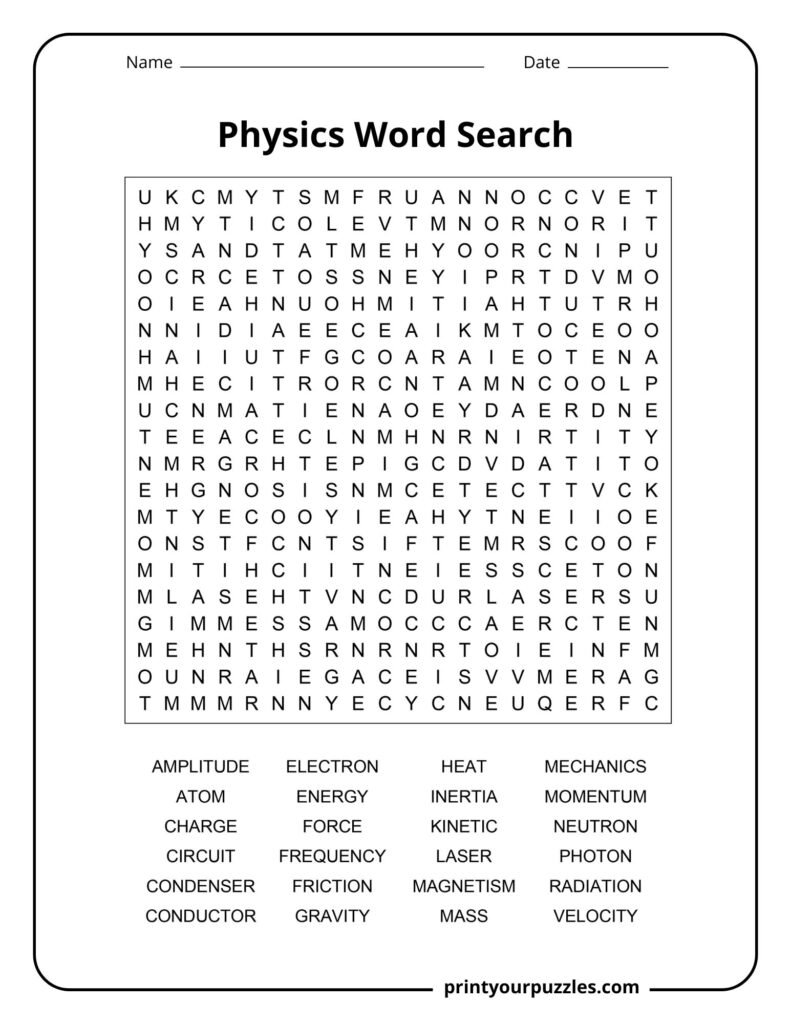
AMPLITUDE, ATOM, CHARGE, CIRCUIT, CONDENSER, CONDUCTOR, ELECTRON, ENERGY, FORCE, FREQUENCY, FRICTION, GRAVITY, HEAT, INERTIA, KINETIC, LASER, MAGNETISM, MASS, MECHANICS, MOMENTUM, NEUTRON, PHOTON, RADIATION, VELOCITY
Physics is the natural science that studies matter, energy, motion, and force, exploring fundamental laws governing the universe from subatomic particles to galaxies, providing foundations for technology and understanding.
Physics explains everyday phenomena like electricity, gravity, light, and sound. It enables modern technology including smartphones, medical equipment, transportation, and renewable energy, making it essential for innovation and progress.
The main branches include classical mechanics, thermodynamics, electromagnetism, optics, quantum mechanics, nuclear physics, and relativity. Each focuses on different aspects of matter, energy, and their interactions comprehensively.
Physics seeks fundamental laws governing all matter and energy using mathematics and experimentation. While chemistry studies matter’s composition and biology examines living things, physics provides underlying principles for all sciences.
Studying physics requires mathematical proficiency, analytical thinking, problem-solving abilities, and curiosity about natural phenomena. Critical observation, logical reasoning, and persistence when tackling complex concepts are also essential for success.
Traveling at approximately 300,000 kilometers per second, sunlight covers the 150 million kilometer distance in about 8 minutes and 20 seconds, meaning we see the Sun as it was minutes ago.
If an atom’s nucleus were the size of a basketball at center court, its electrons would orbit near the stadium’s outer walls, making matter mostly emptiness held together by forces.
Einstein’s theory of general relativity proves that clocks run slower near massive objects like Earth. GPS satellites must account for this time dilation to provide accurate location data constantly.
Absolute zero (-273.15°C) is theoretically impossible to achieve because reaching it would require infinite energy. The coldest scientists have gotten is billionths of a degree above it remarkably.
A lightning bolt reaches approximately 30,000°C, while the Sun’s surface is only about 5,500°C. This extreme heat causes the explosive expansion of air, creating thunder we hear.



Purus ut praesent facilisi dictumst sollicitudin cubilia ridiculus.