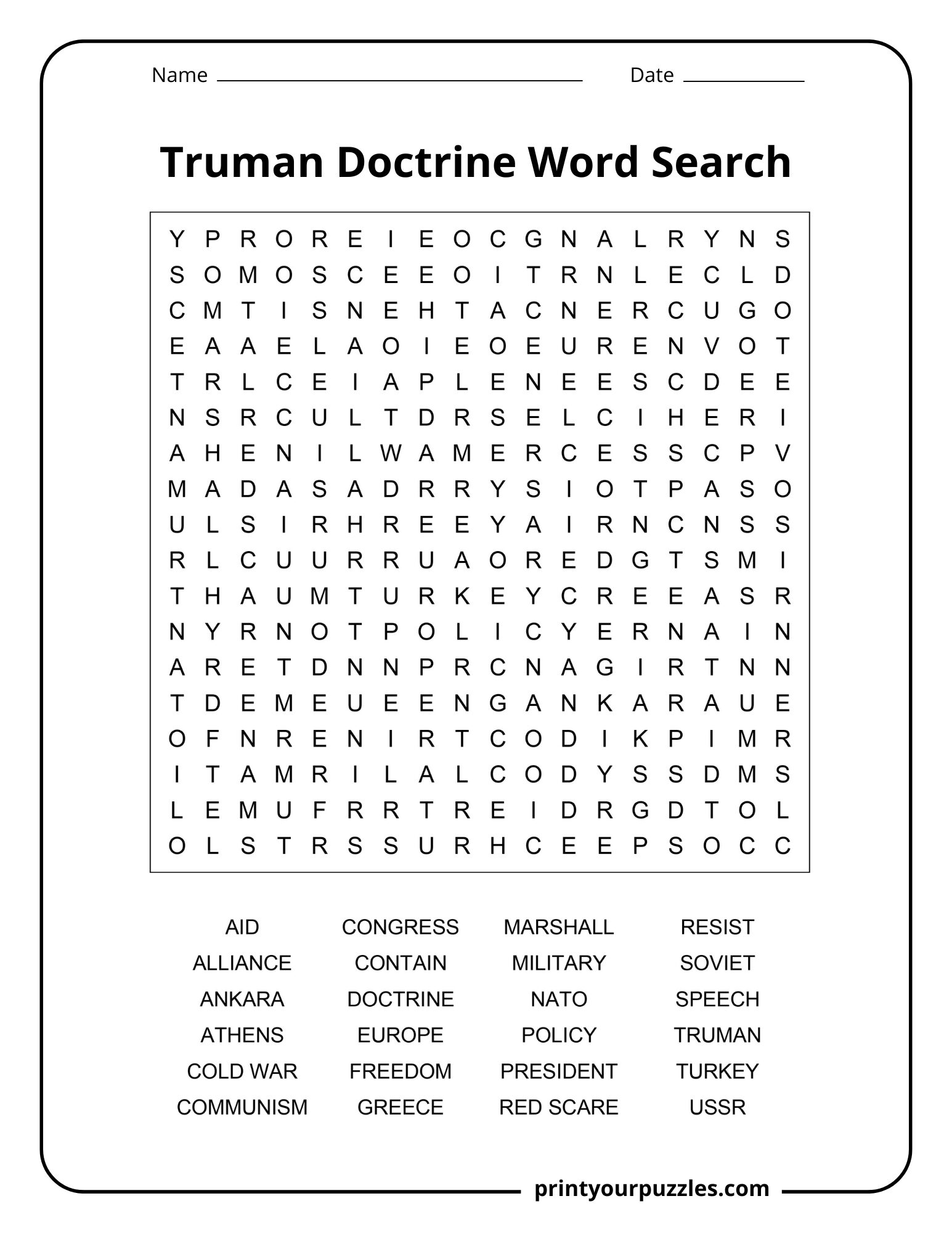

This Truman Doctrine word search explores one of the most transformative moments in American foreign policy history. On March 12, 1947, President Harry S. Truman delivered a groundbreaking 18-minute speech to Congress that would reshape international relations for decades to come. The doctrine established America’s commitment to supporting free nations resisting communist subjugation, marking a dramatic shift from traditional isolationism to active global interventionism during the emerging Cold War.
The policy emerged from urgent circumstances in Greece and Turkey. Great Britain, economically devastated after World War II, announced it could no longer provide financial and military support to these strategically vital nations. Greece faced a communist insurgency threatening to overthrow the government, while Turkey resisted Soviet pressure for territorial concessions. Truman requested $400 million in aid for both countries, arguing that totalitarian regimes threatened freedom worldwide and required American opposition.
The doctrine’s impact extended far beyond Greece and Turkey. It established containment as America’s fundamental Cold War strategy, leading to the Marshall Plan’s economic assistance, NATO’s formation, and military interventions across multiple continents. Interestingly, Truman never mentioned the Soviet Union by name in his speech, maintaining diplomatic flexibility while clearly targeting communist expansion.
This word search printable contains 24 carefully selected terms related to the Truman Doctrine, including key figures, locations, and concepts. To enhance the educational experience, this Truman Doctrine word search printable includes comprehensive definitions for all 24 words, a helpful FAQ section answering common questions, and a fascinating Did You Know? section revealing surprising facts about this pivotal policy. Together, these resources transform a simple puzzle into an engaging learning tool for students and history enthusiasts alike.
AID, ALLIANCE, ANKARA, ATHENS, COLD WAR, COMMUNISM, CONGRESS, CONTAIN, DOCTRINE, EUROPE, FREEDOM, GREECE, MARSHALL, MILITARY, NATO, POLICY, PRESIDENT, RED SCARE, RESIST, SOVIET, SPEECH, TRUMAN, TURKEY, USSR
AID – Financial and military assistance provided by the United States to countries threatened by communism, particularly Greece and Turkey, totaling over $400 million initially.
ALLIANCE – Strategic partnerships formed between the United States and free nations to collectively resist communist expansion, exemplified by NATO and bilateral agreements following Truman Doctrine principles.
ANKARA – Capital city of Turkey, one of two nations receiving American support under the Truman Doctrine to prevent Soviet expansion into the Mediterranean region.
ATHENS – Capital of Greece, which received crucial American aid to combat communist insurgents during the Greek Civil War under the Truman Doctrine’s framework.
COLD WAR – Prolonged geopolitical tension between the United States and Soviet Union following World War II, characterized by ideological conflict without direct military confrontation.
COMMUNISM – Political and economic ideology advocating collective ownership that the United States sought to contain and prevent from spreading to vulnerable democratic nations worldwide.
CONGRESS – United States legislative body that approved Truman’s request for $400 million in aid to Greece and Turkey, establishing America’s interventionist foreign policy.
CONTAIN – Core strategy of preventing Soviet communist expansion by supporting free nations resisting subjugation, becoming America’s fundamental Cold War foreign policy
approach.
DOCTRINE – Official policy statement declaring America’s commitment to support free peoples resisting attempted subjugation by armed minorities or external pressures from communist forces.
EUROPE – Continent devastated by World War II, vulnerable to Soviet influence, where the Truman Doctrine first applied American resources to prevent communist takeover.
FREEDOM – Democratic way of life that Truman pledged America would defend globally against totalitarian regimes attempting to impose their will on independent nations.
GREECE – Southeastern European nation experiencing civil war between government forces and communist rebels, becoming the first major recipient of Truman Doctrine assistance.
MARSHALL – Secretary of State George Marshall, who helped develop the European Recovery Plan complementing the Truman Doctrine’s political goals with economic reconstruction.
MILITARY – Armed forces assistance including equipment, training, and advisors provided to nations resisting communist aggression as part of containment strategy implementation worldwide.
NATO – North Atlantic Treaty Organization, military alliance formed in 1949 as an extension of Truman Doctrine principles, committing members to collective defense.
POLICY – Official governmental course of action establishing America’s role as global defender of democracy, marking departure from traditional isolationist approaches to international affairs.
PRESIDENT – Harry S. Truman, thirty-third President of the United States, who delivered the landmark speech to Congress establishing America’s containment policy framework.
RED SCARE – Widespread American fear of communist infiltration and Soviet expansion that intensified public support for Truman’s aggressive containment policy and interventionist stance.
RESIST – Active opposition to communist expansion that free nations would undertake with American support, preventing totalitarian subjugation through military and economic assistance.
SOVIET – Union of Soviet Socialist Republics, communist superpower whose expansionist policies prompted American development of containment doctrine and global resistance strategy.
SPEECH – Truman’s March 12, 1947 address to Congress requesting aid for Greece and Turkey, articulating America’s commitment to defending freedom against totalitarianism.
TRUMAN – Harry S. Truman, President who established the doctrine bearing his name, fundamentally reshaping American foreign policy toward active global engagement.
TURKEY – Strategic nation bordering the Soviet Union that received American military and economic aid to resist Soviet pressure for territorial concessions and influence.
USSR – Union of Soviet Socialist Republics, communist nation whose aggressive expansion into Eastern Europe and pressure on Greece and Turkey prompted Truman’s containment response.
AID, ALLIANCE, ANKARA, ATHENS, COLD WAR, COMMUNISM, CONGRESS, CONTAIN, DOCTRINE, EUROPE, FREEDOM, GREECE, MARSHALL, MILITARY, NATO, POLICY, PRESIDENT, RED SCARE, RESIST, SOVIET, SPEECH, TRUMAN, TURKEY, USSR
A 1947 American foreign policy declaring U.S. commitment to support free nations resisting communist subjugation, marking America’s shift from isolationism to global interventionism during Cold War.
To counter Soviet expansion into Greece and Turkey, prevent communist takeover of strategically important nations, and establish America’s role as defender of democracy against totalitarianism.
Greece and Turkey received initial assistance totaling $400 million. Greece faced communist insurgency during civil war, while Turkey resisted Soviet pressure for territorial concessions.
It established containment as America’s fundamental strategy, led to NATO’s formation, justified military interventions globally, and intensified ideological conflict between democracy and communism.
It transformed American foreign policy for decades, justified interventions in Korea, Vietnam, and elsewhere, increased military spending, and established U.S. global leadership throughout Cold War.
President Truman’s historic speech to Congress on March 12, 1947, lasted only 18 minutes yet fundamentally transformed American foreign policy for generations to come.
The doctrine began with $400 million for Greece and Turkey, but its principles eventually justified American intervention in dozens of countries across multiple continents.
Britain informed the U.S. it could no longer afford supporting Greece and Turkey financially, forcing America to assume responsibility for containing Soviet expansion in the region.
Truman deliberately avoided naming the USSR directly in his speech, instead referring to totalitarian regimes and armed minorities to maintain diplomatic flexibility and broader application.
When accounting for subsequent programs like the Marshall Plan, NATO, Korean War, and Vietnam War, containment policy expenditures totaled approximately $13 trillion in current dollars.