
Physical science is the branch of science that explores nonliving matter, energy, forces, and the laws that govern the physical world. It helps explain how objects move, why materials behave differently, how energy changes form, and what happens during chemical reactions. From the motion of planets to the structure of atoms, physical science provides the basic principles needed to understand many everyday events and natural processes.
Two major areas of physical science are physics and chemistry. Physics focuses on matter, motion, forces, and energy. It examines topics such as gravity, electricity, magnetism, light, sound, heat, and speed. For example, physics can explain why a ball falls toward the ground, how a bicycle moves, why magnets attract certain metals, and how sound travels through the air.
Chemistry studies the substances that make up matter and how those substances can change. Everything around us, including water, air, rocks, food, and household objects, is made from chemical elements and compounds. Chemists investigate atoms, molecules, mixtures, chemical bonds, and reactions. When iron rusts, wood burns, or ingredients combine during cooking, chemical changes are taking place.
Physical science also teaches students how matter can exist as a solid, liquid, gas, or plasma. Changes between these states occur when energy is gained or lost. Ice melts when it absorbs heat, while water freezes when heat is removed. Learning about these changes helps explain weather, manufacturing, cooking, and many other familiar activities.
Scientists use observation, measurement, experimentation, and mathematical calculations to investigate physical science. They ask questions, develop hypotheses, test ideas, collect data, and use evidence to form conclusions. These scientific methods help researchers create new materials, improve technology, develop cleaner energy sources, and understand the universe more accurately.
A physical science word search can introduce useful vocabulary such as atom, force, motion, matter, energy, gravity, element, and reaction. Recognizing these terms makes it easier for students to understand lessons in physics and chemistry. Physical science shows that the world operates according to patterns and principles that can be studied, tested, and used to solve practical problems.
Related Word Searches:
Physics | Chemistry | Matter | Energy | Electricity | Chemical Reaction
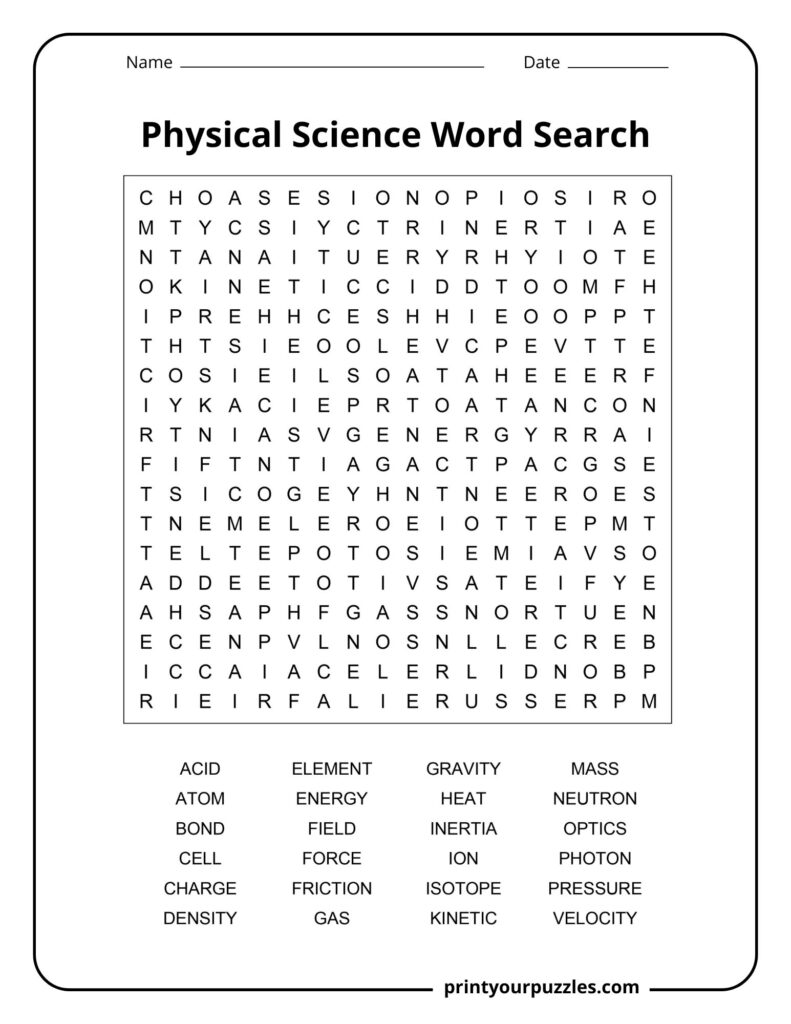
ACID, ATOM, BOND, CELL, CHARGE, DENSITY, ELEMENT, ENERGY, FIELD, FORCE, FRICTION, GAS, GRAVITY, HEAT, INERTIA, ION, ISOTOPE, KINETIC, MASS, NEUTRON, OPTICS, PHOTON, PRESSURE, VELOCITY
ACID – A chemical substance that donates hydrogen ions in solution, has a pH below 7, tastes sour, and can react with metals and bases to form salts and water.
ATOM – The smallest unit of a chemical element that retains its properties. It consists of a nucleus containing protons and neutrons, surrounded by orbiting electrons in energy levels.
BOND – A force of attraction that holds atoms together in molecules or crystals. Bonds can be ionic, covalent, or metallic, depending on how electrons are shared or transferred between atoms.
CELL – In physics, a device that converts chemical or solar energy into electrical energy. Batteries contain electrochemical cells that produce voltage through controlled chemical reactions between different materials.
CHARGE – A fundamental property of matter that causes it to experience electromagnetic force. Charge can be positive or negative. Like charges repel each other, while opposite charges attract one another.
DENSITY – A measure of how much mass is contained within a given volume of a substance. It is calculated by dividing mass by volume and is commonly expressed in grams per cubic centimeter.
ELEMENT – A pure substance made entirely of one type of atom, identified by its atomic number. Elements cannot be broken down into simpler substances by ordinary chemical reactions and are organized in the periodic table.
ENERGY – The capacity to do work or cause change in a system. Energy exists in many forms, including kinetic, potential, thermal, chemical, and nuclear, and can be transformed but never created or destroyed.
FIELD – A region of space where a force acts on objects without direct contact. Gravitational, electric, and magnetic fields surround masses, charges, and magnets, influencing other objects within their range.
FORCE – A push or pull that can change an object’s motion, shape, or direction. Measured in newtons, forces include gravity, friction, and electromagnetic force. Unbalanced forces cause acceleration according to Newton’s laws.
FRICTION – A resistive force that opposes the relative motion or tendency of motion between two surfaces in contact. Friction converts kinetic energy into thermal energy and depends on surface texture and normal force.
GAS – A state of matter in which particles move freely and rapidly, filling any container they occupy. Gases have no fixed shape or volume, are easily compressed, and exert pressure on container walls.
GRAVITY – A fundamental force of attraction between all objects with mass. Its strength depends on the masses involved and the distance between them. Gravity governs planetary orbits, tides, and falling objects on Earth.
HEAT – The transfer of thermal energy between objects or systems due to a temperature difference. Heat flows naturally from warmer to cooler bodies through conduction, convection, or radiation until equilibrium is reached.
INERTIA – The tendency of an object to resist changes in its state of motion. An object at rest stays at rest, and a moving object continues moving at constant velocity unless acted upon by an external force.
ION – An atom or molecule that has gained or lost one or more electrons, giving it a net electrical charge. Positive ions are called cations, and negative ions are called anions.
ISOTOPE – Atoms of the same element that have equal numbers of protons but different numbers of neutrons in their nuclei. Isotopes share chemical properties but differ in atomic mass and nuclear stability.
KINETIC – Relating to motion. Kinetic energy is the energy an object possesses due to its movement, calculated as one-half times its mass multiplied by the square of its velocity.
MASS – A measure of the amount of matter in an object, typically expressed in kilograms. Unlike weight, mass does not change with location or gravitational field strength. It determines an object’s resistance to acceleration.
NEUTRON – A subatomic particle found in the atomic nucleus with no electrical charge and a mass slightly greater than a proton. Neutrons help stabilize the nucleus and determine which isotope an element forms.
OPTICS – The branch of physics that studies the behavior and properties of light, including reflection, refraction, diffraction, and absorption. Optics is applied in designing lenses, mirrors, telescopes, microscopes, and fiber-optic communication systems.
PHOTON – A quantum of electromagnetic radiation carrying energy proportional to its frequency. Photons have no mass, travel at the speed of light, and exhibit both wave-like and particle-like behavior in different experiments.
PRESSURE – The amount of force applied per unit area of a surface. Measured in pascals, pressure explains how gases behave in containers, how fluids transmit forces, and how atmospheric conditions change with altitude.
VELOCITY – A vector quantity describing the rate of change of an object’s position, including both speed and direction. Unlike speed alone, velocity specifies which way an object moves, making it essential in motion analysis.
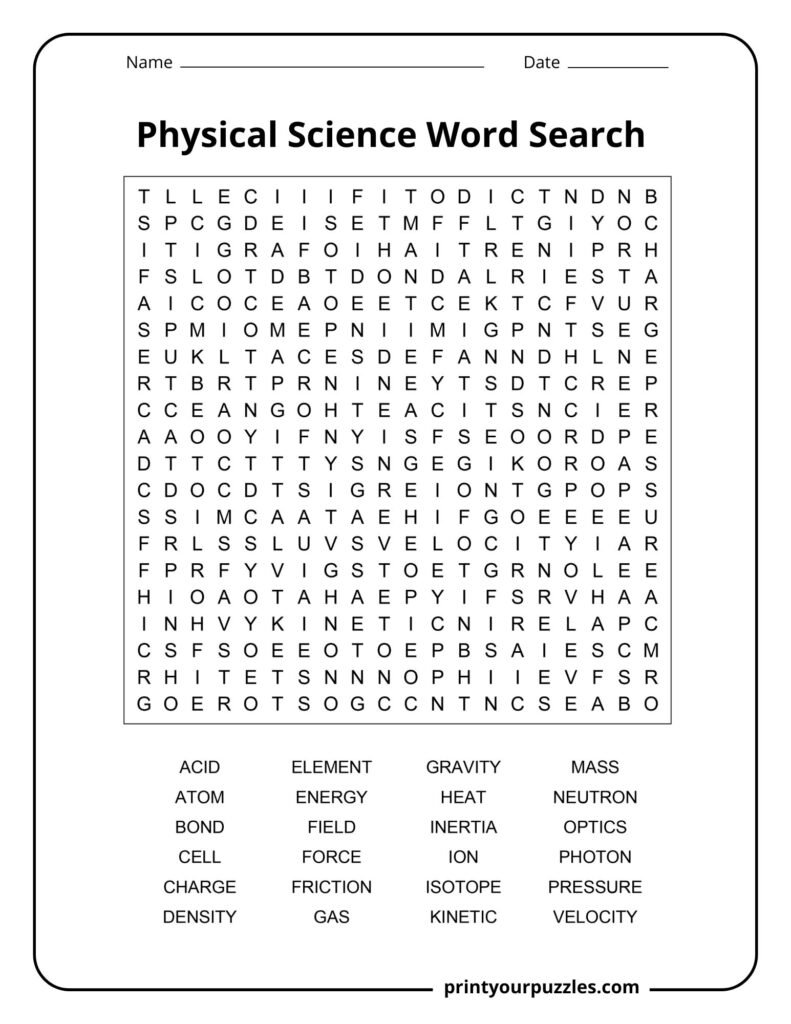
ACID, ATOM, BOND, CELL, CHARGE, DENSITY, ELEMENT, ENERGY, FIELD, FORCE, FRICTION, GAS, GRAVITY, HEAT, INERTIA, ION, ISOTOPE, KINETIC, MASS, NEUTRON, OPTICS, PHOTON, PRESSURE, VELOCITY
Physical Science is the study of non-living matter and energy. It includes disciplines like physics and chemistry, exploring how the natural world behaves through observation, experimentation, and mathematical analysis.
A physical change alters a substance’s form or appearance without changing its chemical composition, like melting ice. A chemical change creates entirely new substances with different properties, like burning wood into ash.
The periodic table organizes all known elements by atomic number and chemical properties. It helps scientists predict how elements behave, react with others, and form compounds, making it an essential reference tool.
First, objects remain at rest or in motion unless acted upon by a force. Second, force equals mass times acceleration. Third, every action produces an equal and opposite reaction governing all movement.
Einstein’s equation E=mc² shows that energy and matter are interchangeable. Matter can be converted into energy and vice versa. This principle underlies nuclear reactions, particle physics, and our understanding of the universe.
Neutron stars are incredibly dense remnants of massive stars. Their matter is so tightly compressed that a tiny amount contains an extraordinarily enormous mass, defying everyday human comprehension.
A lightning bolt can reach temperatures of approximately 30,000 kelvins, while the Sun’s surface sits around 5,500 kelvins. This intense heat causes the surrounding air to expand rapidly, producing thunder.
Sound waves require a medium like air, water, or solids to propagate. Since space is essentially a vacuum with no molecules to vibrate, it remains completely silent regardless of any nearby explosions or events.
At a specific temperature and pressure called the triple point, water exists as solid, liquid, and gas at the same time. This phenomenon occurs at 0.01 degrees Celsius and low pressure.
Both diamonds and graphite consist entirely of carbon atoms. The difference lies in their atomic arrangement. Carbon atoms in diamonds form rigid tetrahedral structures, while in graphite they form soft, layered sheets.