
John the Baptist is an important figure in the New Testament who prepared people for the ministry of Jesus Christ. He is remembered as a courageous preacher, a prophet, and the person who baptized Jesus in the Jordan River. His message focused on repentance, forgiveness, and the need to prepare spiritually for the coming Messiah.
The Gospel of Luke explains that John was the son of Zechariah, a priest, and Elizabeth, a relative of Mary. The couple had no children and were already elderly when the angel Gabriel announced that Elizabeth would give birth to a son. Gabriel said that the child would have a special mission and would help prepare people for the Lord.
John grew up and later lived in the wilderness. The Gospels describe him wearing clothing made from camel’s hair and eating locusts and wild honey. His unusual lifestyle reflected his simple way of living and his complete dedication to God’s work. Large crowds traveled from Jerusalem, Judea, and the surrounding regions to hear him preach.
John called people to turn away from wrongdoing and change the way they lived. Those who accepted his message were baptized in the Jordan River as a sign of repentance. He encouraged people to act honestly, share with those in need, and avoid greed or injustice. Although some wondered whether John himself might be the Messiah, he clearly explained that someone greater was coming after him.
Jesus later came to John to be baptized. At first, John felt unworthy and believed that Jesus should baptize him instead. However, he agreed after Jesus explained that it was right to do so. When Jesus came out of the water, the Holy Spirit descended like a dove, and a voice from heaven identified Him as God’s beloved Son.
John also spoke boldly against King Herod Antipas for marrying Herodias, his brother’s wife. Because of this criticism, John was imprisoned and later executed. His courage made him an enduring example of faithfulness and truth.
A John the Baptist word search can help readers review important names, places, symbols, and events connected with his life. While completing the puzzle, readers can learn more about the wilderness, repentance, baptism, the Jordan River, the dove, and John’s role in preparing the way for Jesus.
Related Word Searches:
Jesus Christ | Baptism | Holy Spirit | New Testament
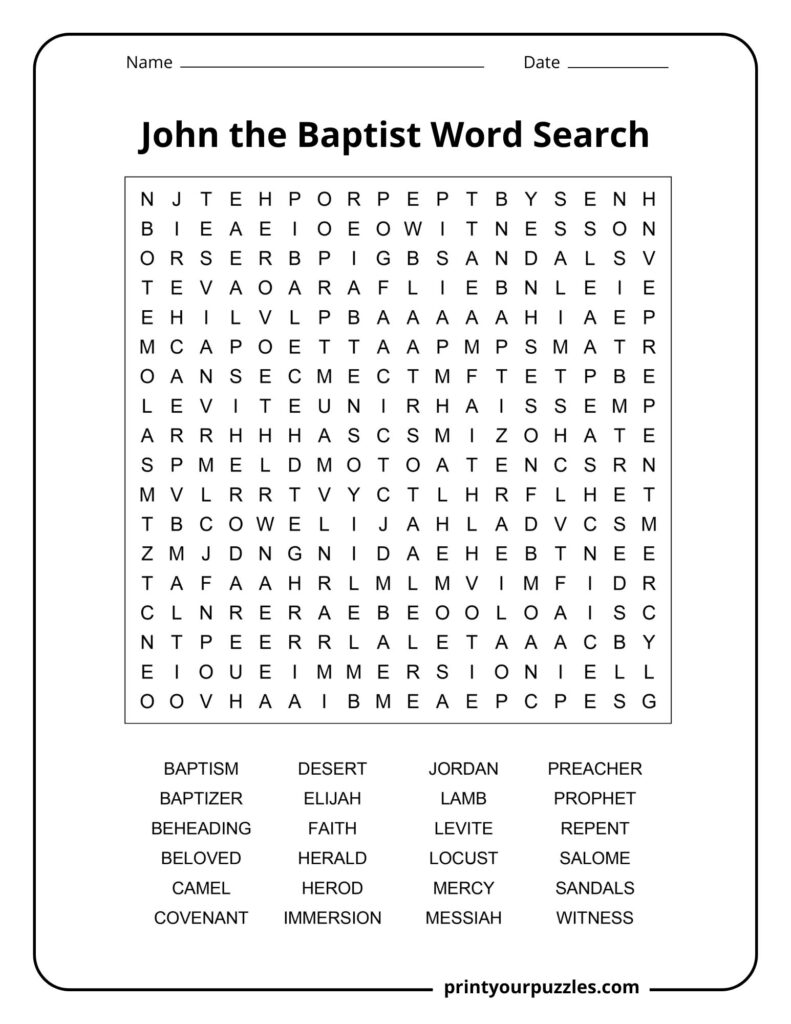
BAPTISM, BAPTIZER, BEHEADING, BELOVED, CAMEL, COVENANT, DESERT, ELIJAH, FAITH, HERALD, HEROD, IMMERSION, JORDAN, LAMB, LEVITE, LOCUST, MERCY, MESSIAH, PREACHER, PROPHET, REPENT, SALOME, SANDALS, WITNESS
BAPTISM – A sacred religious ritual involving water, symbolizing purification, spiritual rebirth, and commitment to God. John performed baptisms in the Jordan River, calling people to repent and turn away from their sins.
BAPTIZER – The title given to John, meaning one who baptizes. He was known throughout Judea as the Baptizer because he called people to receive baptism as a sign of repentance and preparation for the Messiah.
BEHEADING – The tragic death of John the Baptist, ordered by King Herod Antipas. After Salome’s dance pleased Herod, her mother Herodias demanded John’s head on a platter as revenge for his condemnation of their marriage.
BELOVED – John was deeply loved and respected by many followers who recognized him as a true prophet of God. Jesus himself declared that no one born of woman was greater than John the Baptist.
CAMEL – John the Baptist famously wore clothing made from camel hair, tied with a leather belt. This simple, rough garment reflected his austere desert lifestyle and echoed the appearance of the ancient prophet Elijah.
COVENANT – God’s solemn promise and agreement with His people. John’s ministry called Israel back to faithfulness to the covenant, urging repentance and moral renewal in anticipation of the new covenant brought by Jesus Christ.
DESERT – John lived and preached in the Judean desert wilderness. This remote, harsh environment shaped his austere lifestyle and ministry, fulfilling the prophecy of a voice crying out in the wilderness to prepare God’s people.
ELIJAH – The great Old Testament prophet whom John the Baptist resembled in spirit and mission. Jesus confirmed that John came in the spirit of Elijah, fulfilling the prophecy that Elijah would return before the Messiah arrived.
FAITH – A central theme in John’s preaching, calling people to trust in the coming Messiah. John urged genuine, active faith demonstrated through repentance, righteous living, and a sincere turning of the heart toward God.
HERALD – John served as the herald of Jesus Christ, announcing the coming of the Messiah to the people of Israel. Like a royal messenger preparing the way for a king, John declared that the Kingdom of God was near.
HEROD – King Herod Antipas was the ruler who imprisoned and ultimately executed John the Baptist. John had boldly and publicly rebuked Herod for unlawfully marrying Herodias, his own brother Philip’s wife, which led to his imprisonment and death.
IMMERSION – The act of being fully submerged in water during baptism. John practiced immersion in the Jordan River as a powerful outward symbol of inner spiritual cleansing, repentance, and total surrender and dedication to God.
JORDAN – The Jordan River was the primary location of John’s baptismal ministry. Crowds traveled from Jerusalem and across Judea to this historic river, where John baptized repentant believers, including Jesus Christ himself at the start of His ministry.
LAMB – John the Baptist proclaimed Jesus as the Lamb of God who takes away the sin of the world. This powerful title pointed to Jesus as the ultimate sacrificial offering, fulfilling the Old Testament imagery of the Passover lamb.
LEVITE – John the Baptist was of priestly Levitical descent through his father Zechariah, a temple priest. This heritage gave John spiritual authority and deep knowledge of Jewish law and tradition, which shaped his powerful prophetic ministry.
LOCUST – Part of John the Baptist’s unusual diet in the wilderness. Along with wild honey, locusts provided sustenance during his desert ministry. This simple, humble diet reflected his complete dedication and separation from worldly comforts and material pleasures.
MERCY – A key theme in John’s message, pointing to God’s compassion toward repentant sinners. John proclaimed that God’s mercy was available to all who genuinely turned from their sins and prepared their hearts for the coming Savior.
MESSIAH – The long-awaited Anointed One of God, whose coming John was sent to announce. John’s entire ministry was focused on preparing Israel to receive the Messiah, Jesus of Nazareth, whom John identified at the Jordan River.
PREACHER – John was a bold and fearless preacher who proclaimed God’s truth without compromise. He addressed crowds in the wilderness, calling sinners to repentance with urgency, passion, and complete disregard for personal safety or political consequences.
PROPHET – John the Baptist was the last and greatest prophet of the Old Testament era. Jesus declared him the greatest among those born of women, and John fulfilled the prophetic role of preparing Israel for the arrival of the Messiah.
REPENT – The central call of John’s ministry, urging people to turn away from sin and return to God. True repentance, according to John, required not just words but genuine transformation of behavior, attitude, and one’s entire way of living.
SALOME – The daughter of Herodias whose dance before King Herod pleased him greatly. Instructed by her mother, she requested the head of John the Baptist as her reward, directly leading to the prophet’s execution and beheading in prison.
SANDALS – John humbly declared himself unworthy to even untie or carry the sandals of Jesus. This statement powerfully expressed his deep humility and his understanding of the vast difference between his own role and the divine greatness of Christ.
WITNESS – John the Baptist served as a faithful witness to the light and truth of Jesus Christ. His entire life and ministry were devoted to testifying about the Messiah, pointing others toward Jesus rather than seeking glory for himself.
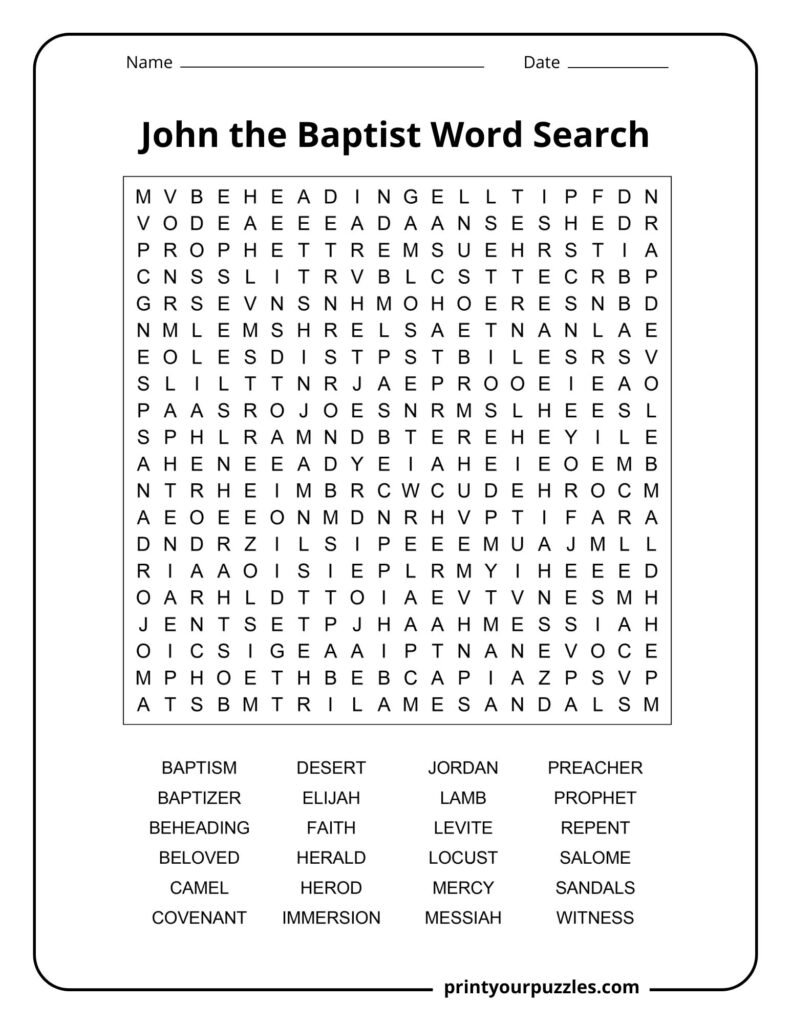
BAPTISM, BAPTIZER, BEHEADING, BELOVED, CAMEL, COVENANT, DESERT, ELIJAH, FAITH, HERALD, HEROD, IMMERSION, JORDAN, LAMB, LEVITE, LOCUST, MERCY, MESSIAH, PREACHER, PROPHET, REPENT, SALOME, SANDALS, WITNESS
John the Baptist was a Jewish prophet and preacher, son of Zechariah and Elizabeth, chosen by God to prepare Israel for the arrival of Jesus Christ the Messiah.
His mission was to call people to repentance, baptize believers in the Jordan River, and announce the coming of Jesus Christ as the long-awaited Messiah and Savior of the world.
John was beheaded in prison by order of King Herod Antipas, after Salome requested his head on a platter at the prompting of her vengeful mother, Herodias.
John and Jesus were relatives, with Elizabeth being Mary’s cousin. John baptized Jesus in the Jordan River and identified Him publicly as the Lamb of God who takes away sin.
John is considered the forerunner of Jesus Christ, fulfilling Old Testament prophecy. He prepared the hearts of the people for the Messiah, making him essential to the foundation of Christian faith.
The Baptism of Jesus: Matthew 3:13–17. John baptizes Jesus in the Jordan River, triggering a divine manifestation — the Father’s voice, the Spirit descending. This moment publicly launches Jesus’ ministry and fulfills John’s entire prophetic purpose as the one who prepares the way.
According to the Gospel of Luke, John leaped for joy inside his mother Elizabeth’s womb when Mary, pregnant with Jesus, came to visit her.
Scripture suggests John grew up in isolated desert regions, separated from society, preparing spiritually for his extraordinary prophetic mission of announcing the coming Messiah to Israel.
John gathered faithful followers who practiced fasting and prayer. Some later became disciples of Jesus, including Andrew and possibly John the Apostle, after John pointed them toward Christ.
John is venerated across multiple Christian denominations worldwide. His birth and beheading are celebrated as official feast days, recognizing his unique and irreplaceable role in salvation history.
In the Gospel of Matthew, Jesus stated that among all people born of women, no one greater than John the Baptist had ever appeared, giving him extraordinary prophetic distinction.