
Cain and Abel were the first two sons of Adam and Eve mentioned in the Bible. Their story appears in Genesis and describes the first conflict between brothers, the first recorded murder, and the serious consequences of jealousy and uncontrolled anger. Although the account is brief, it introduces important themes involving worship, responsibility, sin, justice, mercy, and personal choice.
Cain, the older brother, became a farmer who worked the soil, while Abel became a shepherd who cared for flocks. In time, both brothers brought offerings to God. Cain presented some of the produce from his crops, and Abel offered the firstborn animals from his flock and their finest portions.
God looked with favor upon Abel and his offering, but Cain and his offering were not regarded in the same way. Genesis does not provide every detail explaining the difference, although the passage emphasizes Abel’s careful choice of the best from his flock. Cain became extremely angry and discouraged when his offering was not accepted.
God warned Cain that sin was waiting to control him, but He also told him that he could overcome it. This warning showed that Cain still had the opportunity to change his attitude and make a better decision. Instead, Cain invited Abel into a field, attacked him, and killed him.
When God asked Cain where Abel was, Cain replied with the famous question, “Am I my brother’s keeper?” God already knew what had happened and declared that Abel’s blood cried out from the ground. As punishment, Cain would no longer be able to farm successfully and would become a restless wanderer.
Cain feared that someone might kill him, but God placed a protective mark upon him and warned others not to harm him. Cain later settled in the land of Nod, east of Eden, where he built a city and began a family line. This part of the story shows that judgment was accompanied by a measure of protection.
This printable Cain and Abel word search puzzle can help readers review the people, occupations, offerings, emotions, and consequences connected with this biblical account. While completing the puzzle, readers can reflect on jealousy, anger, responsibility, brotherhood, and the importance of controlling harmful thoughts before they lead to destructive actions.
Related Word Searches:
Adam and Eve | Genesis | Old Testament | Abraham
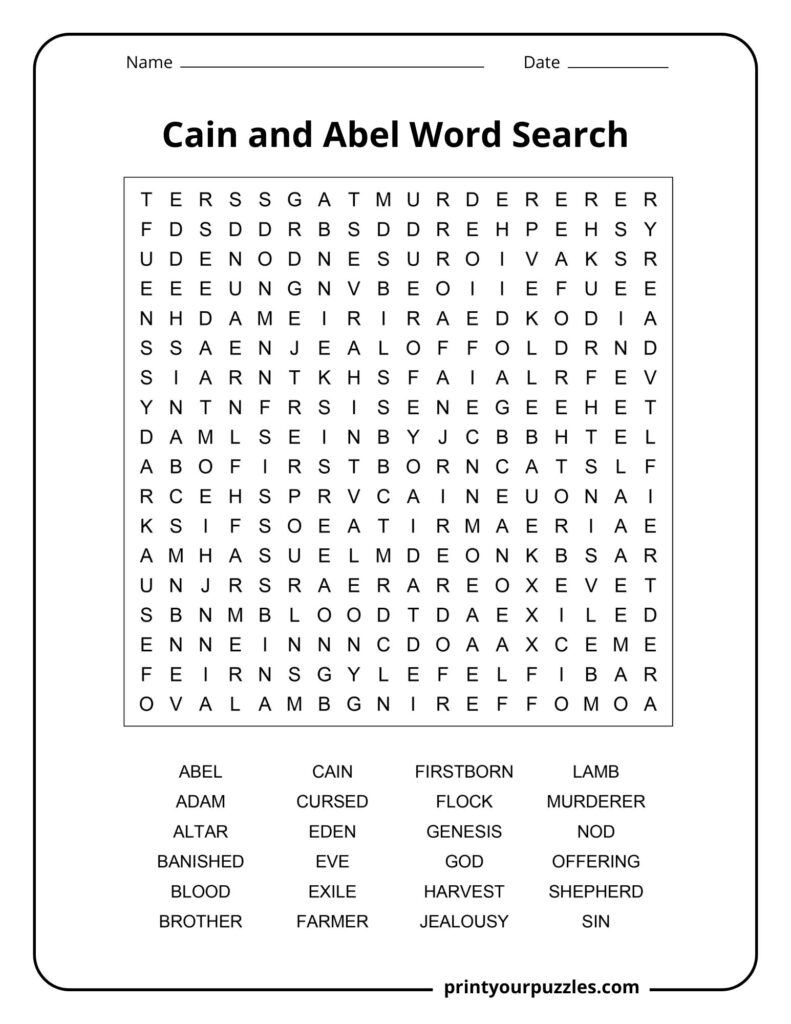
ABEL, ADAM, ALTAR, BANISHED, BLOOD, BROTHER, CAIN, CURSED, EDEN, EVE, EXILE, FARMER, FIRSTBORN, FLOCK, GENESIS, GOD, HARVEST, JEALOUSY, LAMB, MURDERER, NOD, OFFERING, SHEPHERD, SIN
ABEL – Second son of Adam and Eve, a shepherd whose animal offering was accepted by God, making him the first murder victim in the Bible.
ADAM – The first man created by God, father of both Cain and Abel, who witnessed the tragedy of his sons’ conflict and Abel’s death.
ALTAR – A sacred structure used for making offerings to God. Both Cain and Abel built altars to present their sacrifices, but only Abel’s was accepted.
BANISHED – The punishment God imposed on Cain after murdering Abel, forcing him to leave his homeland and wander as a fugitive across the earth.
BLOOD – Abel’s blood, spilled on the ground by Cain, is described as crying out to God, symbolizing injustice and demanding divine response and accountability.
BROTHER – The family bond between Cain and Abel, tragically broken by envy and murder, making their story the Bible’s first example of betrayal within a family.
CAIN – Firstborn son of Adam and Eve, a farmer who killed his brother Abel out of jealousy after God favored Abel’s offering over his own.
CURSED – God’s verdict upon Cain for murdering Abel. The ground would no longer yield crops for him, and he was condemned to wander without rest.
EDEN – The paradise garden where Adam and Eve lived before their fall. Cain and Abel were born outside Eden, in the world after their parents’ expulsion.
EVE – The first woman and mother of both Cain and Abel. She named Cain saying she had acquired a man with God’s help, full of hope.
EXILE – Cain’s forced departure from his homeland after killing Abel. He was sent to the land of Nod, east of Eden, to live as a wanderer.
FARMER – Cain’s occupation, tilling the soil and growing crops. His agricultural offering to God was rejected, a slight that fueled his deadly jealousy toward Abel.
FIRSTBORN – Cain was the firstborn son of Adam and Eve, the very first human child ever born. Despite this privileged status, his offering to God was rejected over Abel’s.
FLOCK – The sheep and livestock tended by Abel as a shepherd. He offered the firstborn of his flock to God, a sacrifice that was divinely accepted.
GENESIS – The first book of the Bible, where the story of Cain and Abel is told in chapter four, right after the account of Adam and Eve.
GOD – The divine figure who accepted Abel’s offering and rejected Cain’s, then confronted Cain after the murder by asking where his brother Abel had gone.
HARVEST – The fruits of Cain’s farming labor, which he brought as an offering to God. Unlike Abel’s gift, this harvest offering was not favored by God.
JEALOUSY – The destructive emotion Cain felt when God accepted Abel’s offering but not his own. This jealousy grew into anger and ultimately led to Abel’s murder.
LAMB – A young sheep, representative of the kind of animal Abel sacrificed to God. The lamb became a powerful biblical symbol of innocence, purity, and acceptable sacrifice.
MURDERER – The identity Cain acquired after killing Abel, making him the first murderer recorded in the Bible and a symbol of sin’s destructive consequences on humanity.
NOD – The land east of Eden where Cain was exiled after murdering Abel. Its name in Hebrew suggests wandering, reflecting Cain’s punishment of restless homelessness on earth.
OFFERING – A gift presented to God as an act of worship. Abel’s offering of livestock pleased God, while Cain’s offering of crops was mysteriously not accepted.
SHEPHERD – Abel’s role as a keeper of sheep, contrasting with Cain’s life as a farmer. His closeness to animals reflected a life of simplicity, care, and faithfulness.
SIN – God warned Cain that sin was crouching at his door before the murder. Cain ignored the warning, and his act became the Bible’s first recorded mortal sin.
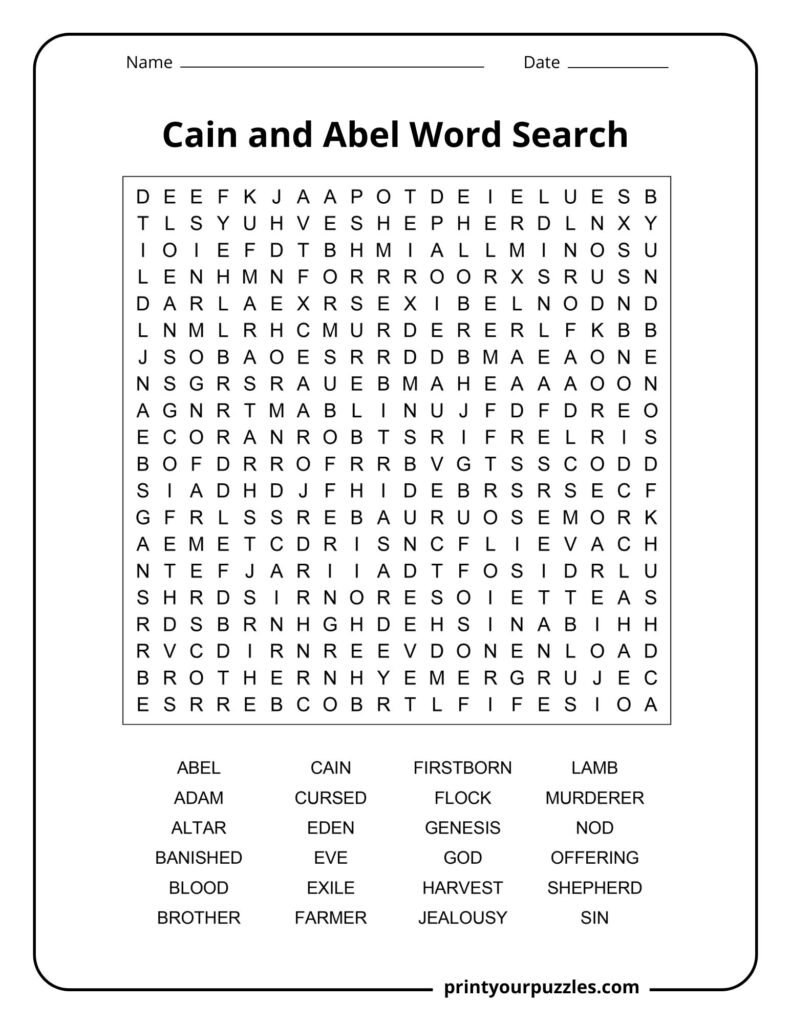
ABEL, ADAM, ALTAR, BANISHED, BLOOD, BROTHER, CAIN, CURSED, EDEN, EVE, EXILE, FARMER, FIRSTBORN, FLOCK, GENESIS, GOD, HARVEST, JEALOUSY, LAMB, MURDERER, NOD, OFFERING, SHEPHERD, SIN
Cain and Abel were the first two sons of Adam and Eve, the original human couple in the Bible, representing the first generation born outside the Garden of Eden.
The Bible does not fully explain the rejection. Many scholars suggest Cain’s attitude was insincere, while Abel offered his very best firstborn livestock with genuine faith and devotion.
Cain murdered Abel out of jealousy and wounded pride after God accepted Abel’s offering but not his own, despite being warned by God to master his rising anger.
God cursed Cain, making farmland barren for him and condemning him to wander the earth. However, God also placed a protective mark on Cain to prevent others killing him.
The story explores universal themes of jealousy, sin, divine justice, and brotherhood. It warns that unchecked anger and envy destroy relationships and carry severe, lasting consequences for everyone involved.
Read Genesis 4.
In Hebrew, “Cain” may mean “acquired” or “spear.” Eve declared she had acquired a man from God, though some scholars link the name to metalworking and craftmanship.
Despite being a central figure, Abel has no recorded dialogue whatsoever. He is entirely defined by his actions, his offering, and his tragic death at his brother’s hands.
Contrary to popular belief, God’s mark on Cain was not a punishment but a shield, warning others not to kill him and guaranteeing sevenfold vengeance against anyone who did.
After his exile, Cain founded a city in the land of Nod and named it Enoch, after his son, making him surprisingly the Bible’s first recorded urban builder and settler.
Similar fraternal rivalry tales appear in Sumerian, Egyptian, and Roman mythology, suggesting the theme of two brothers in deadly conflict reflects a deeply universal human experience across civilizations worldwide.