
Palm Sunday is a Christian celebration that remembers Jesus Christ’s arrival in Jerusalem shortly before His crucifixion and resurrection. It marks the beginning of Holy Week, the final and most important week of Lent. Christians observe Palm Sunday as a day of praise and welcome, but also as the start of the solemn events leading to Good Friday and Easter Sunday.
The story appears in all four Gospels: Matthew, Mark, Luke, and John. Jesus traveled toward Jerusalem with His disciples and entered the city riding on a young donkey. This fulfilled a prophecy from the Book of Zechariah describing a humble king arriving on a donkey rather than on a powerful warhorse. His entrance showed that His kingship was connected with peace, humility, and service.
Large crowds gathered along the road to welcome Jesus. Some people spread their cloaks on the ground, while others placed branches before Him. The Gospel of John specifically mentions palm branches, which were symbols of victory and celebration. The people praised Jesus and shouted “Hosanna,” a word that originally meant “save us” and later became an expression of joyful praise.
Many in the crowd believed that Jesus might be the promised Messiah who would free them from oppression. However, His mission was different from the political or military victory some expected. Jesus entered Jerusalem peacefully and continued teaching about faith, love, justice, forgiveness, and devotion to God.
Palm Sunday services vary among Christian denominations. Many churches distribute blessed palm leaves, which worshippers carry during processions or hold while listening to the Gospel account. In places where palms are difficult to obtain, branches from other local trees may be used. Some people later shape the leaves into crosses and keep them at home as reminders of the celebration.
The joyful mood of Palm Sunday is often followed by readings about Jesus’ suffering and death. This contrast reminds Christians that the same week included praise, betrayal, sacrifice, and resurrection. A printable Palm Sunday word search offers readers a simple way to revisit the main details of Jesus’ entry into Jerusalem. The puzzle brings together key elements such as the donkey, palm branches, cheering crowds, the cry of Hosanna, the beginning of Holy Week, and Jesus’ peaceful arrival as King.
Related Word Searches:
Easter | Good Friday | Spring | April
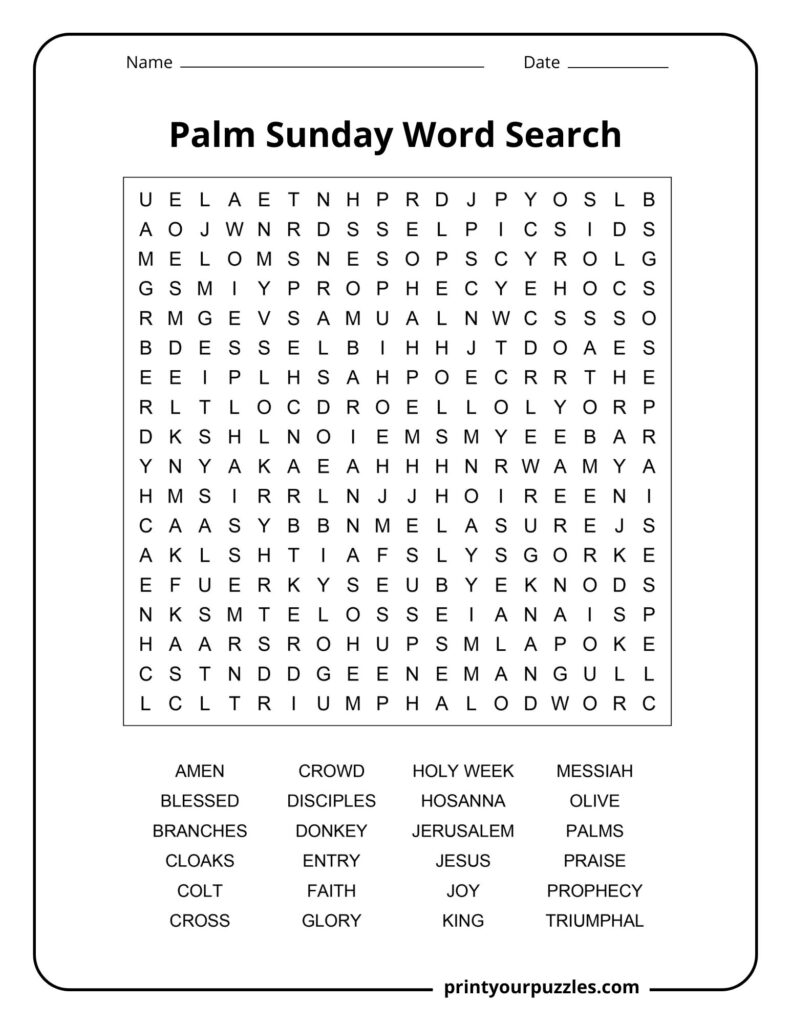
AMEN, BLESSED, BRANCHES, CLOAKS, COLT, CROSS, CROWD, DISCIPLES, DONKEY, ENTRY, FAITH, GLORY, HOLY WEEK, HOSANNA, JERUSALEM, JESUS, JOY, KING, MESSIAH, OLIVE, PALMS, PRAISE, PROPHECY, TRIUMPHAL
AMEN – A word spoken at the end of prayers and hymns meaning “so be it.” It expresses agreement, affirmation, and faith in God’s will and promises shared during worship.
BLESSED – Describes someone favored and honored by God. On Palm Sunday, the crowd declared Jesus blessed as He entered Jerusalem, fulfilling the ancient messianic prophecy of Zechariah.
BRANCHES – The palm fronds and leafy branches cut from trees and spread along the road by the crowd to honor Jesus during His triumphal entry into Jerusalem.
CLOAKS – Outer garments that people removed and laid on the road before Jesus as He rode into Jerusalem, a gesture of deep respect and royal recognition.
COLT – A young donkey that Jesus rode into Jerusalem, fulfilling the Old Testament prophecy that the Messiah would come humbly, not on a warhorse but on a donkey’s colt.
CROSS – The wooden instrument of crucifixion where Jesus would die days after Palm Sunday. It represents sacrifice, redemption, and the ultimate expression of God’s love for humanity.
CROWD – The large gathering of people in Jerusalem who welcomed Jesus with shouts of praise, waving palms and laying cloaks, celebrating Him as the long-awaited Messiah and King.
DISCIPLES – The devoted followers of Jesus who accompanied Him during His ministry. On Palm Sunday, they helped prepare the colt and witnessed the joyful procession into Jerusalem.
DONKEY – The humble animal Jesus chose to ride into Jerusalem, symbolizing peace and humility rather than military power, fulfilling the prophecy found in the book of Zechariah.
ENTRY – Refers to Jesus’s arrival into Jerusalem on Palm Sunday. This triumphal entry marked the beginning of Holy Week and the final events leading to His crucifixion and resurrection.
FAITH – Deep trust and belief in God and His promises. Palm Sunday calls believers to place their faith in Jesus as the Messiah, the Savior who brings salvation and eternal life.
GLORY – The divine majesty and splendor attributed to God. The crowd glorified Jesus on Palm Sunday, praising God for the miracles they had witnessed and proclaiming His heavenly kingship.
HOLY WEEK – The sacred seven-day period beginning on Palm Sunday and ending on Easter. It commemorates the final days of Jesus’s life, including His passion, death, and resurrection.
HOSANNA – A Hebrew exclamation meaning “save us” that became a shout of joyful praise. The crowds cried “Hosanna!” as Jesus entered Jerusalem, acknowledging Him as their deliverer and King.
JERUSALEM – The ancient holy city where Jesus made His triumphal entry on Palm Sunday. It was the religious and political center of Israel, and the place of His crucifixion and resurrection.
JESUS – The central figure of Palm Sunday and Christianity. He is the Son of God who entered Jerusalem as the promised Messiah, bringing salvation through His death and resurrection.
JOY – The deep happiness and celebration felt by the crowd welcoming Jesus into Jerusalem. Palm Sunday is a day of rejoicing that honors the coming of the promised Savior and King.
KING – A title the crowd gave Jesus on Palm Sunday, proclaiming Him the King of Israel. Unlike earthly kings, Jesus came in humility and peace, offering a spiritual kingdom to all.
MESSIAH – The anointed one promised by God in the Old Testament to save His people. Christians believe Jesus is the Messiah, and Palm Sunday celebrates His public revelation as such.
OLIVE – Refers to the Mount of Olives, the hillside near Jerusalem from which Jesus began His Palm Sunday procession. It was a significant location throughout His ministry and final days.
PALMS – The palm branches waved by the crowd to welcome Jesus into Jerusalem. They were symbols of victory and triumph in ancient times, and today represent the joy of Palm Sunday.
PRAISE – The act of expressing worship and admiration for God. On Palm Sunday, the people praised Jesus with songs and shouts, recognizing His divine authority and mission of salvation.
PROPHECY – A divine message or prediction revealed through Scripture. Palm Sunday fulfilled several Old Testament prophecies, including the Messiah riding a donkey and being welcomed in Jerusalem.
TRIUMPHAL – Describes the victorious and celebratory nature of Jesus’s entry into Jerusalem. Though He came humbly on a donkey, the crowd received Him with the honor due to a conquering king.
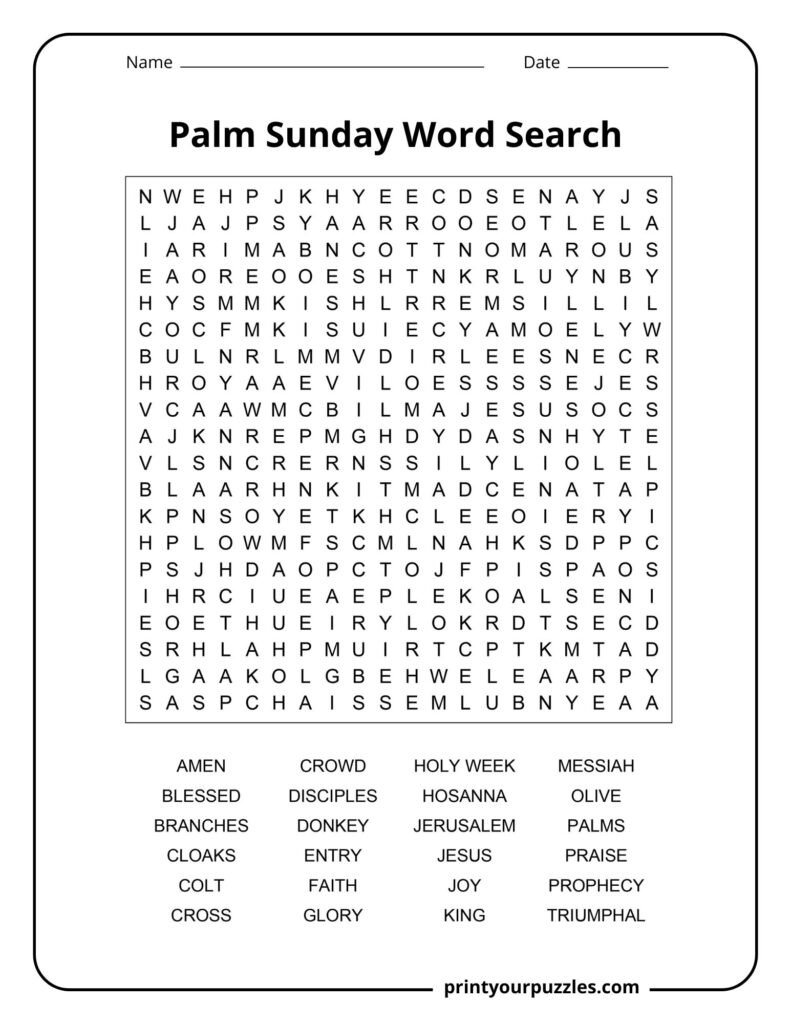
AMEN, BLESSED, BRANCHES, CLOAKS, COLT, CROSS, CROWD, DISCIPLES, DONKEY, ENTRY, FAITH, GLORY, HOLY WEEK, HOSANNA, JERUSALEM, JESUS, JOY, KING, MESSIAH, OLIVE, PALMS, PRAISE, PROPHECY, TRIUMPHAL
Palm Sunday is the Christian celebration commemorating Jesus Christ’s triumphal entry into Jerusalem, riding a donkey while crowds waved palm branches and shouted praises, marking the beginning of Holy Week.
In ancient times, palm branches symbolized victory, triumph, and peace. The crowd waved them to honor Jesus as the Messiah and King, celebrating His arrival into Jerusalem with great joy and reverence.
Jesus chose a donkey to fulfill the prophecy of Zechariah and to symbolize humility and peace. A horse represented war and military conquest, while a donkey represented a peaceful and humble king.
“Hosanna” is a Hebrew word meaning “save us now.” The crowd shouted it as a joyful plea and praise, recognizing Jesus as the promised Savior who would deliver Israel from oppression and sin.
Palm Sunday reminds Christians of Jesus’s willingness to fulfill God’s plan of salvation. It begins Holy Week, encouraging believers to reflect on His sacrifice, humility, and the true meaning of His kingship.
It marks the beginning of Holy Week, the most sacred period in the Christian calendar, leading to Good Friday and culminating in the joyful celebration of Easter Sunday.
In regions where palms don’t grow, Christians use olive branches, willow, boxwood, or even flowers. In Finland, birch twigs are used, and in England, yew branches are common.
According to the Gospels of Mark and Luke, Jesus specifically requested an unridden colt. In biblical tradition, an animal never used before was considered especially appropriate for sacred purposes.
Those burned palms are turned into ashes used on Ash Wednesday, the first day of Lent. This beautiful tradition connects two important moments in the Christian liturgical calendar.
Despite the joyful celebration, the Gospel of Luke recounts that Jesus cried foreseeing the city’s future destruction, showing His deep compassion and sorrow for the people He came to save.