
Baptism is an important Christian ceremony that marks a person’s entry into the Christian faith. It uses water as a symbol of cleansing, new life, forgiveness, and belonging to the community of believers. Although Christian denominations celebrate baptism in different ways, they generally connect it with faith in Jesus Christ and a commitment to follow His teachings.
The practice has strong biblical foundations. In the New Testament, John the Baptist called people to repent and baptized them in the Jordan River. Jesus also came to John and was baptized before beginning His public ministry. According to the Gospel accounts, the Holy Spirit descended upon Jesus, and a voice from heaven identified Him as God’s beloved Son.
After His resurrection, Jesus instructed His followers to make disciples and baptize them in the name of the Father, the Son, and the Holy Spirit. The Book of Acts describes many people being baptized after hearing the Christian message. These stories helped establish baptism as a central practice in the early Church.
Water may be used in several ways during baptism. Some churches fully immerse the person in water, while others pour or sprinkle water over the head. Immersion can represent dying to an old way of life and rising to a new life with Christ. Pouring or sprinkling also symbolizes spiritual cleansing and renewal.
Some Christian traditions baptize infants, believing that baptism welcomes children into the Church and expresses God’s grace. Parents and godparents may promise to guide the child in the Christian faith. Other traditions practice believer’s baptism, in which individuals are baptized after personally declaring their faith. Despite these differences, baptism remains a meaningful sign of Christian identity.
The ceremony often includes prayers, Bible readings, promises, a profession of faith, and the sign of the cross. In some churches, the baptized person also receives a white garment or a candle. The white garment represents a new life, while the candle symbolizes the light of Christ.
A baptism word search helps readers recognize key terms associated with this important Christian ceremony, including water, faith, repentance, grace, and the Holy Spirit. The activity also reinforces baptism’s biblical foundations, meaningful symbols, varied traditions, and role in welcoming believers into the Christian community.
We’ve dedicated a post to each of the Seven Sacraments: Anointing of the Sick, Baptism, Confirmation, Eucharist, Holy Orders, Marriage, and Reconciliation.
We have also curated seven books on the Seven Sacraments, each offering a unique perspective on this sacred theme. All seven books cover the complete set of sacraments, not just one individual sacrament. Every post in our Seven Sacraments series features a different book recommendation. Don’t miss them — a great read awaits you!
Related Word Searches:
John the Baptist | Jesus Christ | Confirmation | Holy Spirit
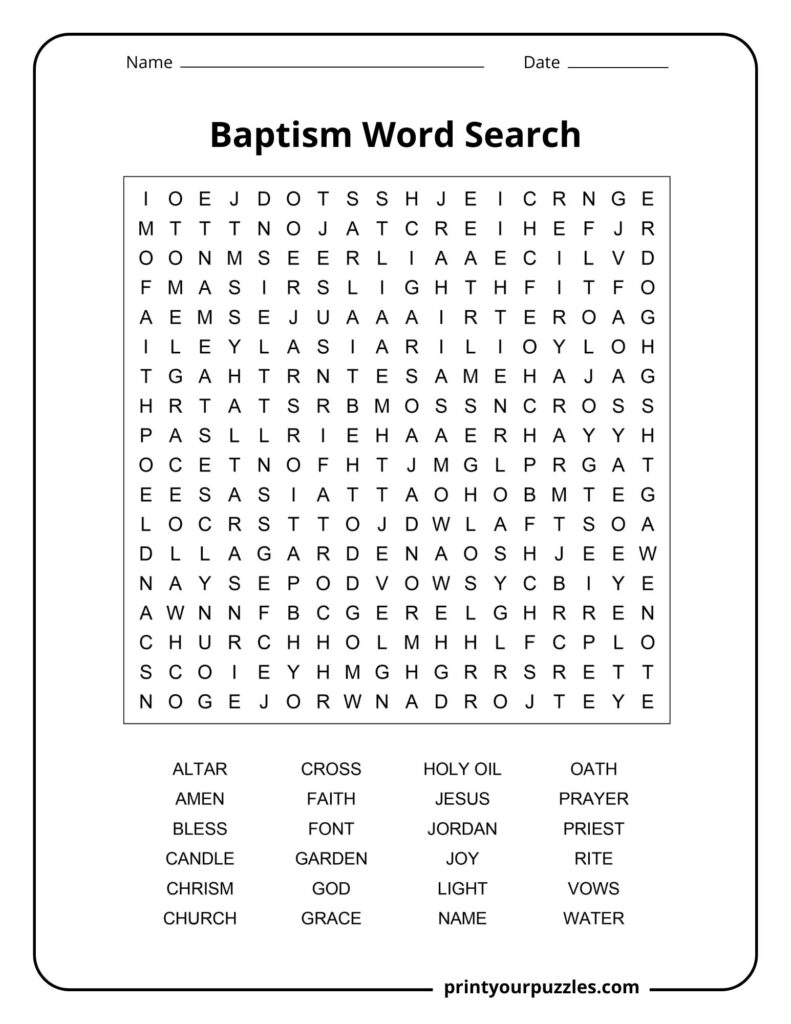
ALTAR, AMEN, BLESS, CANDLE, CHRISM, CHURCH, CROSS, FAITH, FONT, GARDEN, GOD, GRACE, HOLY OIL, JESUS, JORDAN, JOY, LIGHT, NAME, OATH, PRAYER, PRIEST, RITE, VOWS, WATER
ALTAR – A sacred table or platform in a church where religious ceremonies, including baptism, are performed. It represents the place of worship and spiritual offering to God.
AMEN – A word spoken at the end of prayers and blessings meaning “so be it.” During baptism, the community says amen to affirm their faith and agreement with the sacrament.
BLESS – To invoke divine favor and protection upon someone. In baptism, the priest blesses the child or adult, asking God to grant grace, guidance, and spiritual strength throughout life.
CANDLE – A baptismal candle is lit from the Paschal candle, symbolizing the light of Christ. It represents the faith passed on to the baptized person to walk in God’s light.
CHRISM – A sacred oil consecrated by a bishop, used during baptism to anoint the newly baptized. It signifies the gift of the Holy Spirit and the person’s incorporation into Christ’s mission.
CHURCH – The community of believers and the sacred building where baptism takes place. Through baptism, a person becomes a member of the Church, joining the universal family of Christian faith.
CROSS – A central Christian symbol representing the death and resurrection of Jesus. During baptism, the sign of the cross is traced on the forehead, marking the person as belonging to Christ.
FAITH – The belief and trust in God that baptism celebrates and strengthens. Parents and godparents profess their faith during the ceremony, committing to raise the baptized person in Christian teachings.
FONT – A basin or vessel in the church that holds the holy water used for baptism. It is the place where the sacrament is administered, symbolizing spiritual cleansing and new birth.
GARDEN – A symbolic reference to the Garden of Eden, representing innocence and new creation. Baptism restores the soul to a state of grace, echoing the original purity of God’s creation.
GOD – The supreme Creator and Father whom Christians worship. Baptism is performed in the name of God the Father, the Son, and the Holy Spirit, establishing a divine relationship with the baptized.
GRACE – The free and undeserved gift of God’s love and favor. Through baptism, sanctifying grace is received, cleansing original sin and enabling the soul to grow in holiness and virtue.
HOLY OIL – Sacred oil blessed by a bishop and used in baptismal anointing ceremonies. It symbolizes healing, strength, and the presence of the Holy Spirit, consecrating the baptized person for God’s service.
JESUS – The Son of God whose own baptism by John in the Jordan River established the model for Christian baptism. He commanded his disciples to baptize all nations in his name.
JORDAN – The river in the Holy Land where John the Baptist baptized Jesus Christ. It holds deep significance as the original place of baptism, symbolizing purification, renewal, and divine calling.
JOY – The deep happiness and celebration that accompanies the sacrament of baptism. The family, godparents, and church community rejoice together as a new member enters the Christian faith and life.
LIGHT – A powerful symbol in baptism representing Christ as the light of the world. The baptismal candle embodies this light, reminding the baptized to live as children of God’s radiance.
NAME – During baptism, the child’s Christian name is formally spoken, giving the person their identity within the faith community. The name often honors a saint who serves as spiritual patron.
OATH – A solemn promise made during the baptismal ceremony. Parents and godparents take an oath to renounce sin and profess their faith, pledging to guide the baptized in Christian life.
PRAYER – Words spoken to God during the baptism ceremony asking for blessings, protection, and spiritual guidance. The community unites in prayer to support the newly baptized on their faith journey.
PRIEST – The ordained minister who performs the sacrament of baptism. The priest pours water over the person’s head and speaks the baptismal formula, officially welcoming them into the Christian Church.
RITE – The formal ceremony and set of prayers and actions that compose the sacrament of baptism. The baptismal rite follows a sacred tradition passed down through centuries of Christian practice.
VOWS – The solemn promises made during baptism by parents and godparents on behalf of the child. They vow to reject sin, profess faith in God, and nurture the child’s spiritual growth.
WATER – The essential element of baptism, poured over the head or used for immersion. Water symbolizes purification, the washing away of sin, and the gift of new spiritual life in Christ.
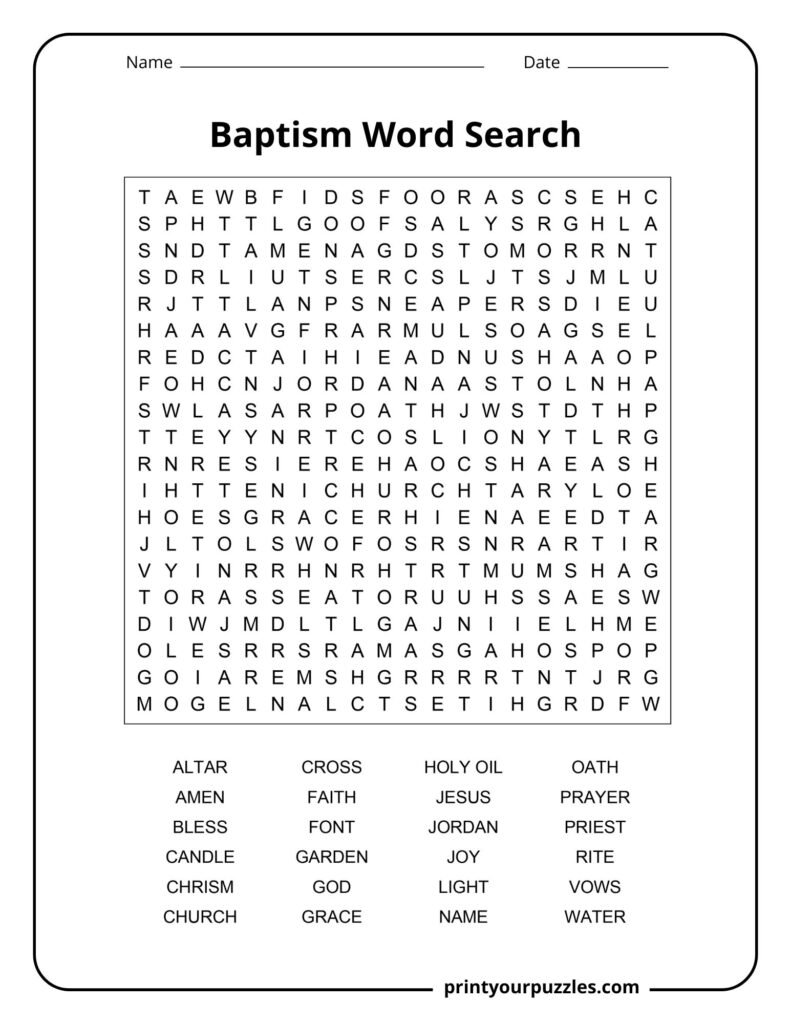
ALTAR, AMEN, BLESS, CANDLE, CHRISM, CHURCH, CROSS, FAITH, FONT, GARDEN, GOD, GRACE, HOLY OIL, JESUS, JORDAN, JOY, LIGHT, NAME, OATH, PRAYER, PRIEST, RITE, VOWS, WATER
Baptism is a Christian sacrament of initiation using water, performed in the name of the Father, Son, and Holy Spirit. It cleanses original sin and welcomes the person into the Church.
Any person who has not been previously baptized can receive this sacrament, including infants, children, and adults. For infants, parents and godparents profess faith on their behalf during the ceremony.
Water symbolizes purification, renewal, and new life. Pouring water or immersion represents the washing away of sin and spiritual rebirth. Jesus himself was baptized with water in the Jordan River.
Godparents are chosen by the family to serve as spiritual guides for the baptized person. They profess faith during the ceremony and commit to supporting the child’s Christian education and growth.
Essential items include holy water, a baptismal candle, sacred chrism oil, and a white garment. These elements symbolize purification, the light of Christ, the Holy Spirit, and new life in faith.
Doors to the Sacred by Joseph Martos. A sweeping historical and cultural account of the sacraments’ evolution, this book helps readers understand how sacramental rituals developed over centuries, making present participation more meaningful and theologically informed for a broad audience.
This ancient Greek term means “to immerse” or “to dip in water.” It reflects the original practice of fully submerging a person in water during the early Christian ceremonies.
It was discovered in the ancient city of Dura-Europos in modern-day Syria. This archaeological finding proves that formal baptism ceremonies were already established in the earliest Christian communities.
This tradition exists in various countries where the child’s name is revealed publicly for the first time during baptism, making the sacrament also a celebration of the child’s unique identity.
This tradition dates back to the early Church when newly baptized adults wore white robes for an entire week after their baptism, symbolizing their new life free from sin.
For example, the Baptistery of Florence in Italy is a stunning octagonal building dedicated entirely to baptism. Its magnificent golden mosaics attract millions of visitors every year worldwide.